
Tag Archives: Angels

Eliyahu’s Immortality, Passover, and Shabbat HaGadol

This week’s Torah reading is Tzav, detailing many of the priestly laws that applied to the Kohanim. It begins with God telling Moses to instruct Aaron (the first Kohen) and his children in the proper sacrificial rites, starting with the olah, a type of offering that is wholly consumed by the flames (as opposed to being roasted and eaten). Rashi comments that the term “tzav” – command – has the connotation of commanding not just Aaron, but all of his future descendants, and all generations of kohanim.
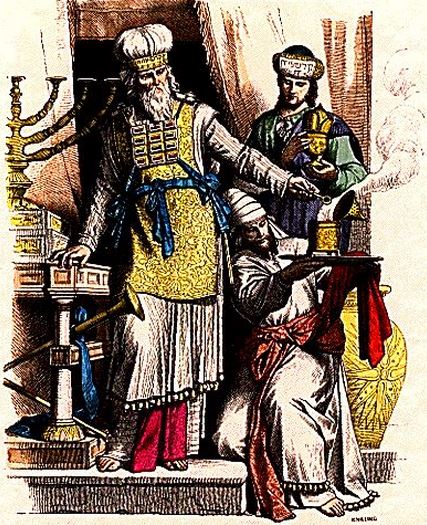
Kohen Gadol (High Priest) and Levites. (Braun & Schneider)

Kohen Gadol (High Priest) and Levites. (Braun & Schneider)

One of those descendants is Pinchas, the grandson of Aaron (through his son Elazar). For his heroic efforts, as described in Numbers 25, God blessed him with an eternal priesthood. Pinchas is mentioned as the Kohen Gadol (High Priest) in the book of Joshua (who was the first of the Biblical Judges). According to the Sages, he remained in this role until the times of Yiftach, one of the last Judges. This would mean he served as the High Priest for several hundred years! The Sages suggest that when God promised him an “eternal priesthood”, He literally meant it.

Due to the scandal that concluded the story of Yiftach (Judges 11-12), the commentaries state that Pinchas resigned as the High Priest. He then disappears from the narrative, only to reappear again a couple of centuries down the road. This time, he comes back as Eliyahu HaNavi, Elijah the prophet, as the Sages state: Pinchas ze Eliyahu, “Pinchas is Eliyahu”. The Arizal (Sha’ar HaGilgulim, 33, 2b) explains that Eliyahu was the reincarnation of Pinchas, while many others say it was literally one and the same person, since God’s blessing connoted everlasting life.

Eliyahu himself never passed away, further proving the point that Pinchas was meant to live forever. The Tanakh describes how Eliyahu was taken up to Heaven alive in a whirlwind of flames (II Kings 2:11). It is said that Eliyahu transformed into an angel, and thus lives on. This is why he appears (spiritually speaking) at certain times in the Jewish calendar and life cycle, including during a brit, and for the fifth cup during the Passover seder. Ultimately, it is prophesized that he will return in physical form once more at the End of Days to herald the coming of Mashiach, as it says: “Behold, I will send you Eliyahu the prophet before the coming of the Day of Hashem, the great and awesome” (Malachi 3:23).

The commentary of Abudraham (or Abu Dirham, Rabbi David ben Yosef of 14th century Spain) explains that this is why the Sabbath before Passover is called Shabbat HaGadol, “the Great Sabbath”. The verse in Malachi ends by saying “the great and awesome”, hagadol v’hanora. After all, this passage from Malachi is the Haftarah portion that we read at the synagogue on Shabbat HaGadol!

The basic purpose of Shabbat HaGadol is to get us into the “Pesach spirit” and prepare us for Passover. On this Sabbath, It is customary to review the Haggadah and the pertinent laws of the holiday. Similarly, the Haftarah portion is also designed to get us into the Passover mindset. The Haftarah ends by juxtaposing the first redemption under Moses with the coming redemption ushered in by Eliyahu:

“Remember the Law of Moses, My servant, whom I commanded at Horev [Mt. Sinai] for all Israel, statutes and ordinances. Behold, I will send you Eliyahu the prophet before the coming of the Day of Hashem…” (Malachi 3:23-24)

The Sages tell us that after the final redemption we will no longer need to recall the first redemption, which will pale in comparison. This is based on the verse in Jeremiah 23:7 which prophesizes that in the End of Days, people will no longer describe God as the One who took the children of Israel out of Egypt, but as the One who saved Israel from oppression all over the world, and restored them to their Promised Land.

This is one reason why during the Pesach seder, while commemorating the first redemption, we end by pouring a fifth cup for Eliyahu, who will come to usher in the final redemption. Is it then that Jews will no longer be misunderstood and oppressed, our exile will end, and we will all return to live in the Holy Land in peace, as we say at the conclusion of the seder: “Next year in Jerusalem”.
The Guardian Angels and Hybrid Beasts Known as Cherubs

Terumah relays God’s instructions to the Israelites for constructing the Mishkan, the Holy Tabernacle. The most important part of this elaborate structure was undoubtedly the Aron HaKodesh, the Ark of the Covenant. Throughout the centuries, this gold-plated Ark has often been depicted in art, history, and even film (most notably with Indiana Jones in Raiders of the Lost Ark). However, what the Ark actually looked like is hard to discern. The Ark disappeared two and a half thousand years ago when the First Temple was destroyed. Since then, many different versions and interpretations for its appearance have been proposed, both by Jewish Sages and secular scholars.

The issue is not so much with the Ark itself, since the Torah is pretty clear on its description: a box two and a half cubits long, one and a half cubits wide, and one and a half cubits high, made of wood and plated with gold from the inside and out. (A cubit is roughly two feet long.) What’s not so clear is the Ark’s cover, with its two golden Cherubs.

What is a “Cherub” (kruv, in Hebrew)? The only descriptor the Torah gives is that the Cherubs had wings. Rashi, drawing from the Talmud, comments on Exodus 25:18 that they had the face of a child. The Torah describes the two as being set on the cover ish el echav, literally “a man facing his brother”. This suggests a human form to the Cherubs, along with their child-like face and wings. Indeed, this is how the Cherubs are generally depicted. The reality may be quite different, though. A look at the historical and Biblical evidence may shed some more light as to the true identity of the Cherubs.

The Evidence

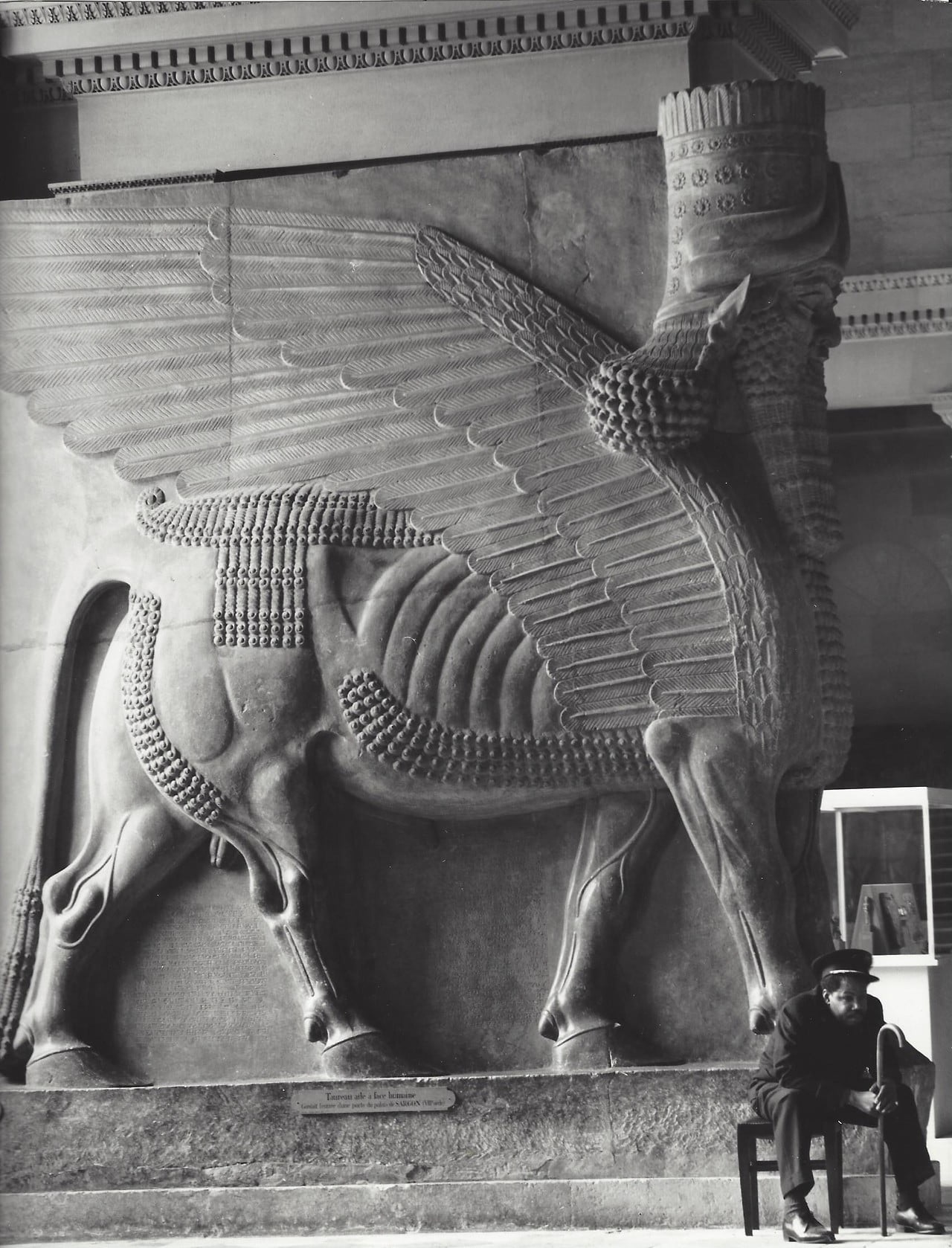
A similar word for the Hebrew term kruv is found across the languages of the Ancient Near East: kuribu in Akkadian, karabu or kirubu in Babylonian and Assyrian. These refer to very large statues placed at entrances to important venues which served as guardians. They had the body of a bull or lion, with wings, and a human head. At times, they were worshipped as guardian deities.

This parallels the Torah’s original description of Cherubs. The very first time Cherubs appear is in Genesis 3:24. Following Adam and Eve’s banishment from the Garden of Eden, God placed Cherubs to guard the entrance to Eden so that man could not return. Like the Mesopotamian kuribu, the Cherubs are guarding an entrance.

All of this is reminiscent of a famous passage in the Tanakh: Ezekiel’s Vision of the Chariot.This could be why the Cherubs were placed atop the Ark, again as guardians of the holy vessel. When the Tanakh describes how King Solomon built the Temple in Jerusalem (I Kings, chapter 6), it states that Solomon had two massive ten-cubit high Cherubs placed at the entrance to the Holy of Holies (the room in which the Ark of the Covenant was kept). The following chapter describes them as kruvim arayot, “Cherub-Lions” (7:36). Not only do we once again see the Cherubs as guarding an entrance, but we now have some evidence that the Cherubs had a lion-like appearance, just as the Mesopotamian kuribu (or lamassu) often had.

Kuribu were also known as lamassu. This is a photo by Kees Scherer, taken in the Louvre Museum in 1968, of a massive lamassu statue from King Sargon II’s palace, dated back to the 8th century BCE. It is from nearly the same time period as King Solomon’s giant Cherubs, which would have been about the same size.

Ezekiel’s Chariot

In the first chapter of the Book of Ezekiel, we are given a detailed description of the Merkavah, the Divine Chariot:

And I looked, and, behold, a stormy wind came out of the north, a great cloud, with a fire flashing up, a brightness was all around it; and from within the appearance of electrum, out of the midst of the fire. And from within it came the likeness of four living creatures. And this was their appearance: they had the likeness of a man. And every one had four faces, and every one of them had four wings. And their feet were straight feet; and the sole of their feet was like the sole of a calf’s foot… As for the likeness of their faces, they had the face of a man; and all four had the face of a lion on the right side; and all four had the face of an ox on the left side; all four had also the face of an eagle.”
(Ezekiel 1:4-10)

Ezekiel describes his angelic vision, with winged figures that have attributes of a lion, an ox, an eagle, and the appearance of a man. The figures are part of the Divine Chariot, again serving as sentries or guardians.

This description allows us to potentially synthesize the Torah’s description of Cherubs with the historical and Biblical evidence: human-like winged creatures with aspects of a lion and a bull or ox. Although Cherubs are not explicitly mentioned in Ezekiel’s account, the Merkavah shares the same root letters (k-r-v or r-k-v) as Cherubs, kruvim.

We can draw further proof from the Psalms 18:11, which states that God “rode upon a Cherub, and flew, and swooped down upon the wings of the wind,” as well as from II Samuel 22:11, which says God “rode upon a Cherub, and flew, and was seen upon the wings of the wind.” Clearly, the Cherubs are associated with the Divine Chariot upon which God rides, as described by Ezekiel.

So, are the Cherubs innocent child-like, winged angels—as commonly depicted in artwork—or are they powerful Heavenly guardians with the hybrid qualities of various majestic beasts?


The above is an excerpt from Garments of Light, Volume Two. Get the book here

The Soul of Abraham

In this week’s parasha we get a true glimpse into the character and soul of Abraham. The Kabbalists teach that Abraham stems from the sefirah of chessed – kindness. (The sefirot, or sefirah in the singular, are the ten central energies present in Creation, with which God formed the entire Universe. They are said to imbue all things, and directly parallel the Ten Commandments, the Ten Plagues of Egypt, and essentially all other “tens” in the Torah. All things emanate from the sefirot, including the spiritual anatomy of each individual.)

The parasha begins by telling us that Abraham was sitting at the entrance of his tent on a very hot day, and God appeared to him. As always, the question that must be asked is: why the details? The Torah could have simply said that God appeared to Abraham. Why does it mention that the day was very hot and that Abraham was sitting at the opening of his tent?

The commentaries explain that this was the third day since Abraham was circumcised (which is how the last parasha concluded), and the third day is the most painful. God wished to make it a little easier on Abraham, so He made it a very hot day, forcing people to stay home. As we know, Abraham constantly entertained guests, setting up his tent at a busy intersection to meet as many people as possible. On this day, the guests were not showing up. This is why Abraham was sitting at the entrance of his tent, hoping for a visitor. The Sages explain that for Abraham the pain of not having guests was even greater than the pain of the circumcision!

Suddenly, Abraham spots a trio of travelers in the distance. Despite his recent circumcision, he immediately jumps up and runs after them, begging them to take a rest at his home. Little does he know that these are angels sent by God, bringing him the news of the coming birth of Isaac. Abraham immediately springs into action, giving his visitors a place to relax, and water to wash their feet, then hurrying to make food. He asks his wife Sarah to bake various breads and cakes, while he goes off to prepare a calf. For just three visitors, Abraham took an entire calf, which would have a couple of hundred pounds of meat. Meanwhile, he asked Sarah to use three se’im of flour. A se’ah is a Biblical unit of volume that equals nearly seven and a half litres. This means that Sarah took about twenty two litres of flour – almost a hundred cups!

It is beyond evident that Abraham embodied generosity and kindness. We continue to see these traits throughout the parasha. The very next scene shows Abraham “bargaining” with God in an attempt to prevent the destruction of Sodom. Though Abraham knew very well how evil Sodom was, he hoped that there was a better way than simply eliminating them; perhaps they can be brought to repentance? Once again we see why Abraham merited to be the very first Jew and patriarch: his passion to make the world a better place. Not to destroy, but to build. Not to combat the darkness, but to bring in more light.