Tag Archives: Ba’al HaTurim

Can a Husband and Wife Speak Lashon HaRa To Each Other?

This week’s parasha, Metzora, is primarily concerned with the laws of various skin diseases. Jewish tradition holds that the main reason for a person to contract these skin afflictions is for the sin of evil speech. The term metzora, loosely translated as “leper”, is said to be a contraction of motzi ra or motzi shem ra, “one who brings out evil” or gives someone a “bad name”. The Sages described lashon hara, a general category referring to all kinds of negative speech (even if true), as the gravest of sins.

The Ba’al HaTurim (Rabbi Yakov ben Asher, 1269-1343) comments on the parasha (on Leviticus 13:59) that the word “Torah” is used in conjunction with words like tzaraat or metzora five times, alluding to the fact that one who speaks lashon hara is likened to one who has transgressed all five books of the Torah! The Talmud (Arakhin 15b) famously states that one who speaks lashon hara “kills” three people: the subject of the evil speech, the speaker, and the listener. The same page states that lashon hara is equal to the three cardinal sins: murder, idolatry, and adultery. Other opinions (all supported by Scriptural verses) include: one who speaks lashon hara is considered a heretic, deserves death by stoning, and God personally declares that He and the speaker of lashon hara cannot dwell in the same space.

Having said that, the Talmud’s definition of lashon hara is quite narrow. It doesn’t include general tale-bearing, but specifically refers to slandering another person. It also states that lashon hara is only applicable when two people are speaking in private, secretly. If one slanders before three or more people, then it is evident that he doesn’t care that the subject will know he said it. It is like saying it publicly, or to the person’s face directly, which does not constitute lashon hara. (It is still a horrible thing to do, of course.) This is why God says (Psalms 101:5) that “Whoever slanders his fellow in secret, him I will destroy.” It is specifically when done in secret that it is such a terrible, cowardly sin.

Since Talmudic times, the definition of lashon hara has broadened considerably. It has come to include rechilut, “gossiping”, saying negative things about another person that are true, saying them publicly, and even to suggest or imply something disparaging about another, without naming a person specifically. When it comes to gossiping, one can find an allusion to its severity from the Torah itself, which states “You shall not go as a talebearer among your people, neither shall you stand idly by the blood of your fellow” (Leviticus 19:16). In a single verse, the Torah juxtaposes gossiping with failing to prevent bloodshed. One can learn from this that one who listens to gossip (specifically where another person is spoken of unfavourably) without trying to stop it is like one standing idly while the “blood” of another is being shed.

One question frequently asked about this is whether lashon hara applies between a husband and wife. We saw that the Talmud states lashon hara is especially horrible when spoken in secret between two people. Does this include a married couple as well? On the one hand, we want to distance ourselves from negative speech as much as possible, at all times. On the other hand, we expect a married couple to be allowed to speak freely between one another as they wish. After all, they are two halves of one soul and considered a singular unit.
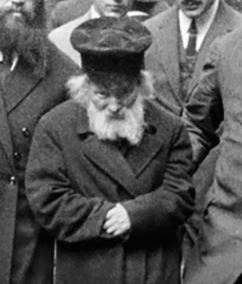
A still of the Chafetz Chaim from a rare, recently released video of the great rabbi. Click the image to see the video.

The Chafetz Chaim (Rabbi Israel Meir Kagan, 1839-1933), generally considered the greatest authority on lashon hara, forbids such speech even between husband and wife. However, many other great authorities before and after him (including Rav Shlomo Zalman Auerbach, 1910-1995, and the Chazon Ish, Rabbi Avraham Isaiah Karelitz, 1878-1953) ruled on the contrary, and permitted a husband and wife to speak about whatever is on their mind, particularly if something bothers them. Technically, even the Chafetz Chaim is lenient in a case where a spouse is in distress and needs to get something off their shoulders.

Still, all agree that we should limit negative words as much as possible, and certainly keep gossip to a minimum. Of course, when negative words have a constructive purpose, it is not considered lashon hara at all, whether between spouses or fellows. This is the case if a person undoubtedly knows, for example, that a particular contractor or salesman is dishonest, and tells a friend in order to protect them from harm.

Repairing Evil Speech, Repairing the World

In the days of the Temple, the kohanim would bring about atonement for the nation through sacrifices and various offerings and rituals. The most important time for atonement was Yom Kippur, and the greatest atonement ritual of the day was when the Kohen Gadol, the high priest, would enter the Holy of Holies (just once a year) and fill it with incense smoke. What was the ultimate purpose of this? The Talmud (Arakhin 16a) states that it served to atone for lashon hara! This was especially necessary because, elsewhere, the Talmud (Bava Batra 165a) states: “Many transgress the law of stealing, few transgress the prohibition of adultery, and all transgress lashon hara.” Everyone is guilty of negative speech, at least to some degree. How do we repair this sin, especially when we don’t have a Temple today?

The Talmud (Arakhin 15b) states that if one is a Torah scholar, they should learn more Torah, and if one is not a Torah scholar, they should strive to be more humble. Like all the other statements, support is brought from verses in Tanakh. King Solomon said “A healing tongue is a tree of life” (Proverbs 15:4). The Sages see the use of the word tongue (lashon) as alluding to lashon hara, and therefore if one wants to heal their lashon hara, they should cleave to the Tree of Life. What is the Tree of Life? King Solomon himself said in another place (Proverbs 3:18) that the Torah is a Tree of Life! Therefore, to rectify the sin of lashon hara one should study Torah.

Upon closer examination, we see that Torah study is actually the perfect remedy for lashon hara. When a person speaks lashon hara they are using their tongue in a negative way and infusing bad energy into the world. When a person learns Torah (which is traditionally done vocally), they are using their tongue in a positive way and infusing good energy into the world. The balance is thereby restored, measure for measure. On top of this, the purpose of Torah study is ultimately to make a person better. The Torah is the best tool to counter the yetzer hara, the evil inclination, as God Himself declared: “I have created the evil inclination, and I have created the Torah as its remedy” (Sifre Devarim, 45). Thus, a person who learns Torah simultaneously neutralizes the evil speech they have spoken and refines their inner qualities so that they will not participate in evil speech in the future.

On that note, there are two kinds of people when it comes to lashon hara: those that like to speak it, and those that love listening to it. The latter often quell their conscience by telling themselves that they never speak lashon hara, God forbid, but only passively, faultlessly, hear it. As we’ve seen above, the listener is almost as culpable as the speaker. Thankfully, there is a remedy for this, too. While many don’t necessarily learn Torah directly from a sefer or on their own, today we have unlimited potential to learn Torah by listening to lectures. These are shared widely on social media, and through digital devices, on apps, and over the radio. Every person today is a click away from Torah learning.

This takes us back to the Talmud, which stated that a Torah scholar can repair lashon hara by learning, while one who is not a Torah scholar should become more humble. The big question here is how can a person just “become more humble”? Humility is one of the most difficult traits to attain! We might even say that the Talmud should have required the Torah scholar—who is constantly learning, growing, and working on themselves—to “become more humble”, not the other way around! How can we make sense of the Talmud?

To prove the point about the non-Torah scholar, the Talmud uses that same verse from Proverbs: “A healing tongue is a tree of life, while perverseness through it will break the spirit.” The plain reading of the verse is that a person who uses their tongue for positive, healing purposes is likened to a Tree of Life, while one who uses their tongue for perverseness is destroying their soul. The Sages take the latter half of the verse to mean, on a simple level, that one who uses their tongue for perverseness should “break their spirit”, ie. become more humble, in order to rectify the sin. There is also a deeper way to read that same verse.

To solve the puzzle, one needs to re-examine what “it” (bah, in Hebrew) refers to. The simple meaning is that “it” refers to the tongue, and one who speaks perverseness through it (the tongue) will break their spirit. However, the verse can just as easily be read so that “it” refers to the Tree of Life. If so, the verse is read this way: “A healing tongue is a tree of life while perverseness, through it [the Tree of Life] will break the spirit.” What is it that will “break” one’s spirit and cause them to become humble? The Tree of Life itself!

Therefore, it is specifically the learning of Torah, the Tree of Life, that brings one to more humility. With this in mind, if we go back to the Talmudic statement of our Sages, what they are saying is: The Torah scholar should rectify their sin by learning more Torah, as they have yet to attain the proper level of holiness, while a non-Torah scholar should learn by listening to more Torah, for this will have the same effect of bringing a person to humility, and rectifying lashon hara.

At the end, this rectification is what will bring Mashiach. In Kabbalistic texts, the generation before Mashiach is in the sefirah of Yesod, which is concerned primarily with sexuality. It is not a coincidence that this is one of the major global issues today. The time following Mashiach’s coming is that of the final sefirah, Malkhut, “Kingdom”. One of the most famous passages from the Tikkunei Zohar is “Patach Eliyahu”, customarily recited before the prayers. There we are told that “Malkhut is the mouth, the Oral Torah.” While Yesod is the sexual organ, Malkhut is the mouth; it is Torah sh’be’al Peh, the Oral Torah, literally “Torah on the mouth”. The key path to realizing Mashiach, Malkhut, is by rectifying the mouth, which is done through the study of Torah.*

As we prepare for Pesach, we should remember the Midrash (Vayikra Rabbah, ch. 32) which states that the Israelites were redeemed from Egypt in the merit of four things: for not changing their names, not forgetting their language, not engaging in sexual sins, and not speaking lashon hara. The same is true if we wish to bring about the Final Redemption. Not engaging in sexual immorality is a direct reference to Yesod, while the other three all deal with the holy tongue, with proper speech and Malkut: using holy names, speaking the Holy Language, and making sure to speak only positive words.

‘Going Up To The Third Temple’ by Ofer Yom Tov


*More specifically, the first rectification is that of the “lower mouth”, Yesod, a tikkun that will be fulfilled by Mashiach ben Yosef. This is followed by the tikkun of the upper mouth, Malkhut, fulfilled by Mashiach ben David (of whom the Prophet says he will slay evil with his mouth, Isaiah 11:4) bringing about God’s perfect Kingdom on Earth.
The Guardian Angels of Israel

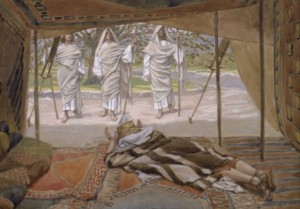
‘Abraham and the Three Angels’ by James Tissot

This week’s parasha, Vayera, begins with Abraham being visited by a trio of angels. Jewish tradition holds that these angels were Michael, Gabriel, and Raphael. The Ba’al HaTurim (Rabbi Yakov ben Asher, c. 1269-1343)—famous for his numerological commentary—points out that the words “And behold three…” (והנה שלשה), referring to the three angels, has the same gematria (701) as “these are Michael, Gabriel, and Raphael” (אלו מיכאל גבריאל ורפאל).

Rashi (Rabbi Shlomo ben Itzchak, 1040-1105) comments that each angel came for a specific mission: Michael to bless Abraham and Sarah with news of their impending child; Gabriel to destroy Sodom (which happens right after in the Torah); and Raphael to heal Abraham from his circumcision (which happened just before). The root of Gabriel is gevurah, “strength” or “restraint”, which is why Gabriel often appears in difficult situations, or acts of destruction. The root of Raphael is refuah, “healing”, so he appears whenever a recovery is required. Michael is the guardian angel of Israel, as we are told explicitly in Daniel 12:1.

These three angels regularly appear together. They were originally depicted as the highest of the angels in the Heavens. Later mystical literature would place others above them (namely Metatron). Still, the trio of Michael, Gabriel, and Raphael remain the most well-known. What else do we know about them?

Michael: Priest and Saviour

In one mystical passage, the Talmud (Chagigah 12b) outlines the Seven Heavens. The first is called Vilon (“curtain”) and simply refers to the atmosphere stretching over the Earth like a curtain. This is the place of clouds and weather, serving no particular spiritual purpose. Then comes the Rakia, the vast realm beyond Earth’s atmosphere that includes the Sun, moon, and all the stars and planets, ie. outer space. The third Heaven is called Shechakim, which we learn from other sources is the interface between this physical universe and the spiritual realms beyond. The Sages sometimes metaphorically describe it as being composed of millstones, or slabs of pure marble. The Talmud says this is the source of the manna that the Israelites ate in the Wilderness.

The fifth, sixth, and seventh Heavens are called Ma’on, Machon, and Aravot, but it is the fourth Heaven that is of particular interest for the present discussion. Here one will find the illustrious Yerushalaim shel Ma’alah, the Heavenly Jerusalem, a spiritual version of the Jerusalem below. Mirroring the one on Earth, there is a Temple up there, too, and it is Michael who serves as its High Priest.

Michael also serves as “Prince of Israel” and our Heavenly Guardian. In this role, he stands opposite Samael, the Heavenly “Accuser” who seeks to harm Israel. Hence, Michael stands at the gates of Heaven, admitting the righteous and guiding their souls. Similarly, he was Israel’s guide during their forty years in the Wilderness, being identified with the “angel that will go before you” (Exodus 23:20, 32:34), as God has promised (see Midrash haNe’elam, Beresheet 2).

Naturally, Michael is a great saviour for the Jews. It was he who saved Abraham from the fiery furnace (Beresheet Rabbah 44:16), and protected Sarah when she was abducted by Avimelech (Pirkei d’Rabbi Eliezer 26). In one intriguing Midrash (Yalkut Shimoni, Beresheet 134), we learn that Michael saved the baby that was born from Dinah’s rape by Shechem. Michael took the baby to Egypt, into the care of a wealthy childless couple. That wealthy man was Potiphar, and the adopted baby was Osnat, future wife of Joseph!

Gabriel and the Founding of Rome

When it comes to Joseph, it was Gabriel that helped him throughout his journey. According to the Talmud (Sotah 36b), Gabriel taught Joseph overnight (or perhaps “uploaded” into his brain) knowledge of the seventy languages, which allowed him to become viceroy of Egypt. Gabriel also taught Joseph all of the esoteric mystical wisdom of the Torah (while Raphael taught the same wisdom to Isaac; see Ravad on Sefer Yetzirah).

The Talmud credits Gabriel with setting the foundations of Ancient Rome (Shabbat 56b). This happened on the very same day that King Solomon married an Egyptian princess. Although Solomon’s intensions were certainly good, his many marriages spiralled out of control, and ultimately led to his downfall. In poetic fashion, King Solomon first builds Jerusalem’s Temple, and simultaneously sows the seeds of its destruction, for Rome would go on to destroy Jerusalem’s Temple for good, ushering in an endless exile which we are still in.

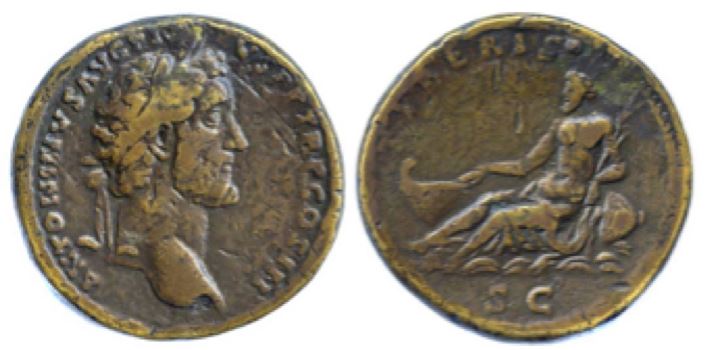
Interestingly, archaeologists have found coins bearing images depicting this version of Rome’s founding. The coins show a divine being of some sort planting reeds in the Tiber River to set the foundations of the “eternal city”, just as the Talmud describes. These coins were minted in the time of Emperor Antoninus Pius, which is most fitting because the Talmud tells us that a Roman emperor named Antoninus was good friends with Rabbi Yehudah haNasi, and the two engaged in many philosophical discussions.

Coins minted by Emperor Antoninus depicting the founding of Rome.


The above essay is an excerpt from Garments of Light, Volume Three.
To continue reading, get the book here! 

The Jewish View on Cards and Gambling

In this week’s parasha, Matot-Massei, we read how the Israelites were supposed to divide up the Holy Land between the Twelve Tribes:

And you shall inherit the land by lot according to your families; to the more [numerous] you shall give the more inheritance, and to the fewer you shall give the lesser inheritance; wherever the lot falls to any man, that shall be his…

We learn that the land of Israel was apportioned based on family size, with larger families logically receiving a larger share. Now, to determine which chunk of land a family would receive, the Israelites cast lots. The Talmud (Bava Batra 122a) describes how this was done: two urns were prepared, one containing the names of the Twelve Tribes, and the other containing the names of the various allotments of land. Elazar the High Priest would pick one name from each urn, thus designating a piece of land for a particular tribe.

Casting lots was very common in Biblical times, and is mentioned frequently in the Tanakh. For example, the Torah commands casting lots to determine which goat is sent to Azazel on Yom Kippur (Leviticus 16:8). In the Book of Jonah (1:7), the sailors on Jonah’s ship cast lots to determine who was guilty of causing the storm. In the time of King David, the kohanim were thus divided into 24 groups (I Chronicles 24). Haman cast lots to determine the best day to attack the Jews, and this is why the holiday is called “Purim”, since purim was the Persian word for “lots” (Esther 3:7).

Casting lots suggests a large degree of chance or randomness in the process. Yet, people of faith are naturally quite averse to the concept of random chance, for isn’t everything determined by God? Not surprisingly, the word “lot” (goral) also takes on the meaning of “fate” in the Tanakh. For instance, Isaiah (17:14) prophesies: “At evening there will be terror, and before morning they are not. This is the portion of them that spoil us, and the goral of them that rob us.” The ultimate fate of those that harm the Jewish people will be utter destruction. The Sages, too, were uncomfortable with the idea of dividing the Holy Land by seemingly random lots. They therefore stated (ibid.) that the lots were really just a show for the people to see what God intended. In reality:

Elazar was wearing the Urim and Tumim, while Joshua and all Israel stood before him… Animated by the Holy Spirit, he gave directions, exclaiming: “Zevulun” is coming up and the boundary lines of Acco are coming up with it. [Thereupon], he shook well the urn of the tribes and Zevulun came up in his hand. [Likewise] he shook well the urn of the boundaries and the boundary lines of Acco came up in his hand…

Elazar would prophetically see which tribe needed which land, and when he then shook the urns those exact pairs that he foresaw would emerge! So, the process was not random at all, but simply a materialization of the Divine Will. Still, the Sages insist that in the messianic era the Holy Land will not be apportioned through this method of casting lots, but rather “The Holy One, blessed be He, Himself, will divide it among them; for it is said [Ezekiel 48:29], ‘And these are their portions, says the Lord God.’”

If the Sages were not fond of casting random lots by chance, how would they feel about playing games of chance and gambling?

Gambling in the Talmud

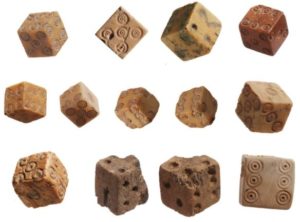
In 1999 and 2000, the Muslim Waqf (Temple Mount authority) dug up 9000 tons of Temple Mount soil and unceremoniously dumped it in the Kidron Valley, creating one of the largest archaeological catastrophes in history. Thankfully, archaeologists did not give up on this precious soil, and began the “Temple Mount Sifting Project”. Among the many incredible finds are these Second Temple-era playing dice.

In a list of people that are ineligible to serve as witnesses or as judges, the Mishnah includes a mesachek b’kubia, a person who plays with dice, and mafrichei yonim, “pigeon flyers”. According to the Talmud, the latter most likely refers to people who bet on pigeon races, which were apparently common in those days. We know from historical sources that gambling with various dice games was very popular in Greek and Roman times. The Talmud (Sanhedrin 24b) goes on to discuss what the problem with such people is.

Rami bar Hama teaches that the issue with gambling is that it is essentially built on a lie: each player agrees to pay a certain sum of money if they lose, yet they hope (and fully intend) not to lose at all! That means the initial agreement made by the players is not even valid. The losing gambler is entirely dejected, and gives up their money reluctantly, often with a nagging feeling of being robbed or cheated out of their money.

Rav Sheshet disagrees. After all, there may be some people who are not so sad to part with their money, or are simply addicted to the game itself. Whatever the case, Rav Sheshet holds that gambling is inappropriate because it is a terribly unproductive waste of time, and the gambler contributes nothing to “the welfare of the world”. This is why, Rav Sheshet says, the Mishnah above concludes by saying that only a full-time gambler is prohibited, but one who has an actual job and just plays for fun on the side is permitted.

Nonetheless, Rav Yehudah holds that regardless of whether the gambler has an occupation or not, or whether he is a full-time player or not, a gambler is disqualified from being a kosher witness or judge. Rav Yehudah bases his statement on a related teaching of Rabbi Tarfon, and on this Rashi comments that a gambler is likened to a thief. The Midrash is even more vocal, saying that gamblers “calculate with their left hand, and press with their right, and rob and wrong one another” (Midrash Tehillim on Psalm 26:10).

The Talmud (Sanhedrin 25b) goes on to state that the prohibitions above don’t only refer to a literal dice-player, but any kind of gambler, including one who plays with pebbles (or checkers), and even with nuts. The Sages state that such a person is only readmitted when they do a complete repentance, and refuse to play the game even just for fun without any money!

Halachically-speaking, the Shulchan Arukh (Choshen Mishpat 370:2-3) first states that any kind of gambling is like theft and is forbidden, but then suggests that while it may not exactly be theft it is certainly a waste of time and not something anyone should engage in.

A Ban on Gambling

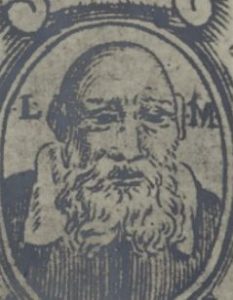
While the Talmud does not explicitly forbid gambling, later rabbis recognized its addictive nature and sought to ban the practice entirely. In 1628, for example, the rabbis of Venice issued a decree (to last six years) excommunicating any Jew who gambled. Part of the motivation for this decree was the case of Leon da Modena (Rabbi Yehudah Aryeh of Modena, 1571-1648).

Rabbi Leon Yehudah Aryeh da Modena

Born in Venice to a family of Sephardic exiles, da Modena went on to become a respected rabbi and the hazzan of Venice’s main synagogue for forty years. A noted scholar, he wrote about a dozen important treatises. In Magen v’Herev, he systematically tore down the major tenets of Christianity, while in Ari Nohem he sought to discredit Kabbalah and prove that the Zohar has no ancient or divine origin. (The latter is probably why he isn’t as well-known in Jewish circles today as he should be.)

In 1637, he published Historia de’riti hebraici, an overview of Judaism for the European world, meant to dispel myths about Judaism and quell anti-Semitism. Historians credit this with being the first Jewish text written for the non-Jewish world in over a millennium, since the time of Josephus. The book was incredibly popular, and played a key role in England’s readmitting Jews to the country in the 1650s (after having being expelled in 1290).

More pertinent to the present discussion, Rabbi da Modena wrote Sur miRa (“Desist from Evil”), outlining the problems with gambling. He would know, since he was horribly addicted to gambling himself. He wrote of this problem in his own autobiography, Chayei Yehudah. And because such a high-profile sage was a gambler, his rabbinic colleagues in Venice issued that decree to ban any form of gambling.

Rabbi da Modena’s game of choice was cards. At that point in time, playing cards had become wildly popular in Europe. First invented in China in the 9th century, playing cards slowly made their way across Asia, and reached Europe around 1365. They have remained popular ever since, both for gambling and non-gambling games. While it is clear from an halachic standpoint that card games involving money (like Poker or Blackjack) should not be played, is it permissible to play non-gambling card games (like Crazy Eights or Go Fish)?

At first glance, it may not seem like there should be a problem with this. Yet, some rabbis have recently spoken out against all playing cards. Usually, this prohibition is connected not to gambling or wasting time, but rather to cards’ apparent origins in idolatry or the dark arts. Although it is true that some types of cards are used in divination and fortune-telling, it is important to examine the matter in depth and determine whether cards really are associated with forbidden practices.

The History of Playing Cards

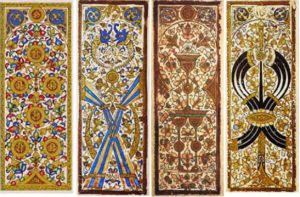
Mamluk Cards

The exact origins of cards are unclear. We do know that they come from China, where paper and printing were invented. Card games are attested to in Chinese texts as early as 868 CE. In the 12th and 13th centuries, the Muslims brought cards across Asia. They were particularly popular in Egypt during the Mamluk Sultanate (1250-1517). The Mamluks created the first modern-style deck of 52 cards with 4 suits. The suits were sticks, coins, swords, and cups. In the 15th century, Italians started to make cards of their own, with the suits being leaves, hearts, bells, and acorns. The French had three-leaf clovers for leaves, square tiles (or diamonds) for bells, and pikes for acorns. Although these suit symbols remained, the English names reflect the earlier suits of sticks (“clubs”) and swords (“spades”).

The Muslim Mamluks did not draw any faces on their court cards (since depicting faces in art is forbidden in Islam). The Europeans did not have this issue, and adapted the Muslim court cards of malik (king), malik na’ib (deputy king), and thani na’ib (second deputy) to king, queen, and prince or knight (“jack”). In 16th century France, the four kings were depicted as particular historical figures: the King of Spades was King David, the King of Clubs was Alexander the Great, the King of Hearts was Charlemagne, and the King of Diamonds was Julius (or Augustus) Caesar.
We see that playing cards have no origins in idolatry. The style of cards we know today were developed by staunchly monotheistic Muslims. They were further developed by mostly non-religious European renaissance printers, against the wishes of the Church which sought to ban cards on a number of occasions. Neither are playing cards known for being used in fortune-telling. However, a related type of card is used in divination today.

Tarot Cards and Kabbalah

In 15th century Italy, a different type of playing card developed. These were called trionfi, later tarocchi, and finally “tarot cards”. They, too, have four suits, but with 56 cards. These were, and still are, used for a number of different games, just like regular playing cards are. Outside of Europe, tarot cards are not well-known, and are generally associated with fortune-tellers.

In reality, the earliest mention of tarot cards being used in divination is only from 1750, and it was essentially unheard of until the late 19th century. Besides, most diviners actually use a different deck of 78 cards. Of course, such divination is entirely forbidden according to the Torah. So, it seems like some well-meaning rabbis have confused these tarot cards with regular playing cards. Ironically, many occultists actually claim that tarot cards come from Kabbalah!

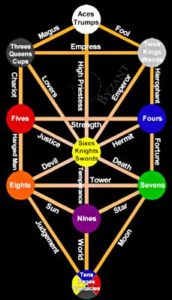
The Tarot “Tree of Life” (Credit: Byzant.com)

These occultists tie the 22 additional divination cards to the 22 letters of the Hebrew alphabet and the 22 paths on the mystical “Tree of Life”. The ten numeral cards (naturally) correspond to the Ten Sefirot, while the four suits correspond to the four olamot, or universes. Finally, the four court cards and the ace represent the five partzufim (with the king and queen appropriately being Aba and Ima). While these parallels are neat, there is absolutely no known historical or textual basis to support these claims. Tarot cards have nothing to do with traditional Kabbalah or Jewish mysticism. (There is a concept in Kabbalah of a negative set of Ten Sefirot belonging to the Sitra Achra, so perhaps there is some connection between these tarot cards and certain evil spiritual forces.)

Having said all that, to forbid playing with cards (or even standard tarot cards) just because some people recently started using them in divination is like forbidding drinking coffee because some people recently started divining with coffee (a practice called “tassology” or “tasseography”). While playing cards copiously is certainly a waste of time, there is nothing wrong with the occasional—no gambling—game.

Ba’al HaTurim

It is fitting to end with the words of the Ba’al HaTurim (Rabbi Yakov ben Asher, c. 1269-1343) who writes in his commentary on the Torah (Tur HaAroch on Deuteronomy 1:1) that Moses himself cautioned Israel about gambling in his final speech before passing away:

Before Moses got ready to relate all these various commandments, he used the present opportunity, a few weeks before his death, to admonish the people, and to remind them of past sins, and how they had caused Hashem a lot of grief during these years. He reminded them how God had treated them by invoking His attribute of mercy and loving kindness time and again. He warned them not to become corrupt again by gambling… They should not rely on the fact that because they were human they were bound to err and sin from time to time and that God, knowing this, would overlook their trespasses.


The above is adapted from Garments of Light, Volume Two. Get the book here!