
In this week’s parasha, Lech Lecha, we read of God’s covenant with Abraham, which was sealed with a circumcision. For centuries, the most important honour given at a traditional brit milah is the role of sandak, or sandek, the person who holds the child during the circumcision. While everyone knows what a sandak is, few actually know what a sandak is! Where did this role come from? What does it mean? And what is the deeper spiritual significance behind it?
Tag Archives: Greek
What is Tekhelet?
At the beginning of this week’s parasha, Tetzave, the Torah describes the special garments worn by the Kohanim. Making these garments requires the use of three unique dyed fabrics: tekhelet, argaman, v’tola’at shani, “blue, purple, and crimson wool”. Last year, we discussed tola’at shani and the practice of wearing a red string on the wrist. This year we will explore the other two ingredients: tekhelet and argaman. What are they and where do they come from?
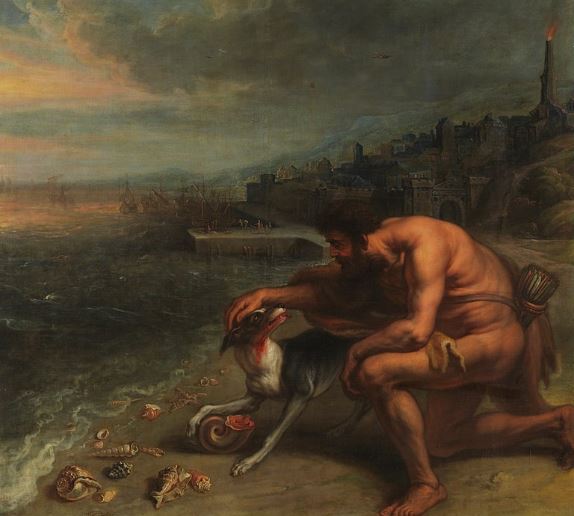
In Greek mythology, the hero Hercules discovered Tyrian purple when his dog chewed on sea snails, as depicted here in Peter Paul Rubens’ “Hercules’ Dog Discovers Purple Dye”
Argaman is more commonly known as “Tyrian purple” or “royal purple”, a famous and prized dye in ancient times. Historical records and archaeological findings show that as early as 3500 years ago, trade in Tyrian purple was widespread across the Mediterranean and the Middle East. It was the Phoenicians who were experts in its production, and carried it around the region. (In fact, the root of the term Phoenician means “purple” in Greek. Similarly, some scholars have found evidence that Canaan means “dye merchant”.) Tyrian purple was worth at least as much as silver, and in some points in history, more than gold.
By the Roman Era, it was so expensive and prized that it was essentially only worn by royalty, hence “royal purple”. An average Roman, or even a Roman senator, would wear a toga pura, plain white, while magistrates and priests wore a toga praetexta, with a purple stripe or hem. Only the emperor would wear a toga picta, one that was entirely dyed purple, with gold embroidery. (Such a toga might also be worn by high ranking generals during their victory processions, as well as by the consuls.)
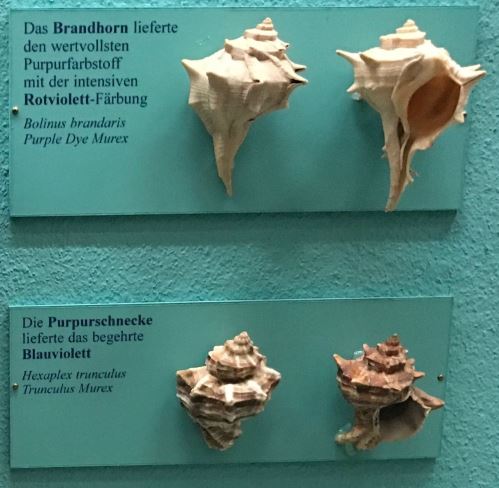
Shells of the Murex snails that produce purple and blue dye. (Credit: U.Name.Me)
How did the Phoenicians produce argaman? It was extracted from the glands of shellfish on the Phoenician shores of the Eastern Mediterranean. These Murex snails make the dye as a defense mechanism, spraying it on potential predators (just as squids and octopuses, their mollusc relatives, famously do). Research shows that the snails also use the dye for their own predatory behaviour when catching prey, and also as an antimicrobial to protect their eggs. To extract the dye, the snails are either “milked”, which takes a very long time, or more commonly, pierced through their shells to have the glands removed. It would take over 10,000 snails to produce just a few grams of dye!
Tekhelet was made the same way. Though not nearly as popular in ancient times, it was known as “royal blue”. The Phoenicians made it the same way, extracted from a snail. Some say it was derived from a different species of snail, while others point out that the same Tyrian purple, when exposed to large amounts of UV radiation (sunlight), becomes blue.
The Talmud (Menachot 44a) states that the dye was made from chilazon, a snail “whose body resembles the sea, and its form resembles a fish, and it comes up once in seventy years, and with its blood one dyes tekhelet, and therefore its blood is expensive.” It’s not quite the blood of the snail that makes the dye, of course, nor do the snails emerge only once in seventy years. This bit probably entered the Talmud because by that point in history, tekhelet production among Jews had long ended, and knowledge of its exact extraction forgotten. It was probably difficult, if not entirely impossible, for Jews to get their hands on it.
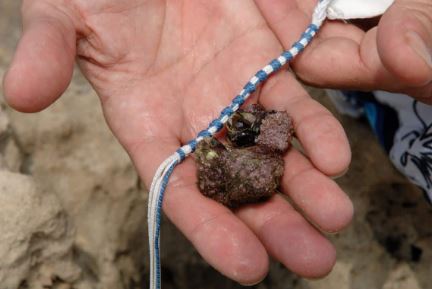
Tzitzit with tekhelet (Credit: Tekhelet.com)
Dr. Baruch Sterman, in a paper for B’Or HaTorah (vol. 11, pg. 185), points out that by the 4th century CE it was actually a crime for a commoner to wear tekhelet across the Roman world. It is highly likely that it was then, for this reason, that most Jews stopped using tekhelet in their tzitzit. Dr. Sterman brings proof from the Talmud (Sanhedrin 12a), where we read how two rabbis were arrested by the Romans for possessing tekhelet. Wealthy Jews living in the Persian Empire continued to pay exorbitant rates to import and use it, until sometime in the middle of the 7th century. It was then, likely due to the rise of Islam and the rapid Arab conquest of the region, that use of tekhelet among all Jews essentially ceased. This is why until today the majority of Jews do not use tekhelet in their tzitzit (as the Torah commands). However, in recent decades, the Murex snails have been rediscovered, and tekhelet is once again available.
Having said all that, Karaite Jews—a small group that rejects the Talmud—believe that tekhelet (and argaman) could not have been derived from snails. And they actually have a couple of seemingly valid points.
The Problem of Karaite Tekhelet
The Karaites believe that tekhelet cannot come from a snail because the Torah would not command something so important to come from a non-kosher animal. They also argue that royal blue tekhelet from snails would have been far too expensive for the average Israelite. Finally, they point out that God commanded this to the Israelites in the Wilderness—so where would they find sea snails in the middle of the desert? Instead, Karaite scholars proposed that tekhelet came from an indigo plant, such as the Indian Indigofera tinctoria (incidentally, this is the indigo once used to dye jeans blue).
Another, more likely, possibility is the woad plant, Isatis tinctoria, which contains the same indigo dye. This plant actually grows in Israel, and was once known as “Asp of Jerusalem”. Interestingly, the Mishnah (Megillah 4:7) states how Kohanim are forbidden from blessing the congregation if their hands are stained with “istis”, ie. the Isatis tinctoria dye. The Bartenura (Rabbi Ovadiah of Bartenura, c. 1445-1515) confirms that istis is a dye “whose colour resembles tekhelet”. This makes it clear that Kohanim in the ancient Holy Temple did use woad as a blue dye, though for what purpose is unclear.
Karaite Jews today continue to make tekhelet from indigo or woad to dye their tzitzit. Since Karaites hold strictly to the Written Torah, they maintain that tzitzit must be blue (and cannot be entirely white like most current “Rabbinic” tzitzit). They hold that any blue dye is fine, since the Torah does not explicitly say that other blue dyes are forbidden. The Talmud, meanwhile, states that a person who uses plant-derived blue dyes instead of authentic tekhelet is sinning, and God declares that He will “exact retribution” from such a person (Bava Metzia 61b, see also Tosefta on Menachot 9:6). And here the Karaites should take heed, for when it comes to tekhelet they are absolutely mistaken.
The big problem for the Karaites is basically everyone else. Aristotle (384-322 BCE) wrote in his History of Animals about the production of blue and purple dyes from snails, as did the Roman philosopher and historian Pliny the Elder (23-79 CE) in his Natural History. These were the choicest and best dyes for clothes and fabrics. While tekhelet and argaman were expensive for the distant Greeks and Romans to procure, they would not have been expensive for the ancient Israelites. After all, these dyes were only expensive to purchase; there is no indication that they were expensive to produce. And the Israelites, like the Phoenicians and Canaanites, were the producers. They made the dyes cheaply, and exported them far and wide, for a healthy profit.
It was only in later centuries, when Israel was no longer an independent entity and was subject to a series of foreign empires, that Jews lost control of the means of tekhelet production. Tekhelet became rarer, and more expensive, and eventually forbidden. This development only occurred in the late Second Temple era, and possibly later. Still, when chemists in the 1990s analyzed blue fabrics uncovered at the Masada archaeological site, they discovered that the fabrics were indeed dyed with Murex snail tekhelet. Even in the late Second Temple era, tekhelet was available and used widely. Besides, the average Israelite in those days would have needed only a minute amount to dye a handful of strings to fulfil the mitzvah of tzitzit.
Another bit of evidence for the fact that snail dye was the real tekhelet comes from the Tanakh itself. While we’ve already seen how historical and archaeological records make it clear that the ancient Phoenicians were experts in snail dyes (not any plant-based blue dyes), we mustn’t forget that these same Phoenicians were heavily involved in the production of Israelite holy items, too! We read in the haftarah for last week’s parasha (I Kings 5:26-6:13) how King Solomon made an agreement with the Phoenician King Hiram, and the latter’s workers played an instrumental role in the construction of the Holy Temple. Granted, this was not the Mishkan of the Wilderness, but the later Temple was based on the earlier Mishkan, and the items were fashioned to the same specifications.
Where was Hiram’s capital city? The Tanakh always refers to him as melekh tzor, “King of Tyre”. This is the selfsame Tyre as the Tyre of Tyrian purple and Tyrian royal blue. We read how “Hiram, king of Tyre, sent his servants to Solomon…” (I Kings 5:15) It is hard to believe that it’s only a coincidence that the Tyrians renowned around the ancient world for their snail dyes are the same ones that the Tanakh tells us worked in Jerusalem! The evidence is therefore quite strong that tekhelet and argaman are the same as the snail-derived Tyrian dyes.
Tekhelet in the Wilderness
The nail on the coffin comes from an even more ancient historical text. Long before Pliny, Aristotle, and even Hiram, the ancient Egyptian Papyrus Anastasi I—dated back to the Nineteenth Dynasty (c. 1292-1189 BCE)—mentions how a royal blue dye is made from sea creatures and smells like putrid fish. This is particularly important because the Nineteenth Dynasty was the time of Pharaoh Ramses II, who is the one most associated with the Exodus. Ramses II built a new capital city which, of course, he named after himself, and which archaeologists have uncovered and refer to as Pi-Ramesses. This is the same city that the Torah mentions the Israelite slaves built (Exodus 1:11). Putting the pieces together, we now have an answer to the question posed by the Karaites: how did the Israelites find tekhelet and argaman in the Wilderness?
The Torah tells us that when the Israelites left Egypt, God commanded them to ask the Egyptians to give them precious materials: “And the children of Israel did according to the word of Moses, and they asked of the Egyptians jewels of silver, and jewels of gold, and raiment.” (Exodus 12:35) The Israelites got tekhelet and argaman from the same place they got their gold and silver (also used in constructing the Mishkan): from the Egyptians. The Papyrus of Anastasi proves that the ancient Egyptians, too, produced blue and purple dyes from Mediterranean snails. They made “raiment”, garments and fabrics dyed with these colours. The Torah informs us that the Israelites took these fabrics with them. And this is how they had them available for the Mishkan in the Wilderness!
Despite all that’s been said, the Orthodox world today has been very slow in readapting the use of tekhelet. Some rabbis maintain that these Murex snails are not the right ones. The Radziner Rebbe (Rabbi Gershon Henoch Leiner, 1839–1891) didn’t know about the snails at all and instead consulted chemists to produce a blue dye from the common cuttlefish, Sepia officinalis. The problem is that the cuttlefish only produces black ink, and turning it blue was a long chemical process that required adding iron filings. When later analyzed by experts, it was found that the Radziner Rebbe’s dye was basically synthetic, and the blue was simply a result of the added iron. (For more, see Dr. Sterman’s article in B’Or haTorah, cited above.) Meanwhile, Rabbi Isaac Herzog (1888-1959, Israel’s first Ashkenazi Chief Rabbi) was an early proponent of snail-derived dyes.
In recent decades, more and more researchers have explored the subject, and today everything points to tekhelet being the blue dye of the Murex trunculus snail. The scientists at Masada confirmed it chemically, and although some state that there is no chemical difference between woad, indigo, and Murex blue, there are small differences in their molecular structure. One with a chemistry background will agree that the addition of even a single atom can dramatically change the nature of a substance. Still, many rabbis are reluctant to adopt tekhelet, and have decided it is best to wait until Mashiach comes just to be sure.

Comparing the chemistry of blue dyes: though looking similar to the untrained eye, the chemical structure of plant-based Indigotin (top left) is different from synthetic indigo (bottom left) and the indigo of Murex snails (bottom right).
And as for the Karaite argument that the Torah wouldn’t command something derived from a non-kosher animal, this argument falls apart when considering the third ingredient that always goes along with tekhelet and argaman: tola’at shani. The word is literally translated as a “crimson worm” or, more accurately, “red insect”. Tola’at definitely refers to a bug of some sort, as we read in Exodus 16:20 how leftover manna was infested with tola’im.
Tola’at shani is undoubtedly referring to the common carmine dye used around the world, and known commercially in food as E120. This dye is derived from a variety of scale insects, most commonly the cochineal family of bugs. Professor Zohar Amar of Bar Ilan University spent many years researching tola’at shani and concluded that it is unquestionably a red insect, which nests in the common Israeli oak tree. In fact, the Temple Institute has already begun harvesting these insects to produce an authentic avnet, the priestly belt that requires the red dye, in preparation for Mashiach’s coming and the return of priestly service in the forthcoming Third Temple.
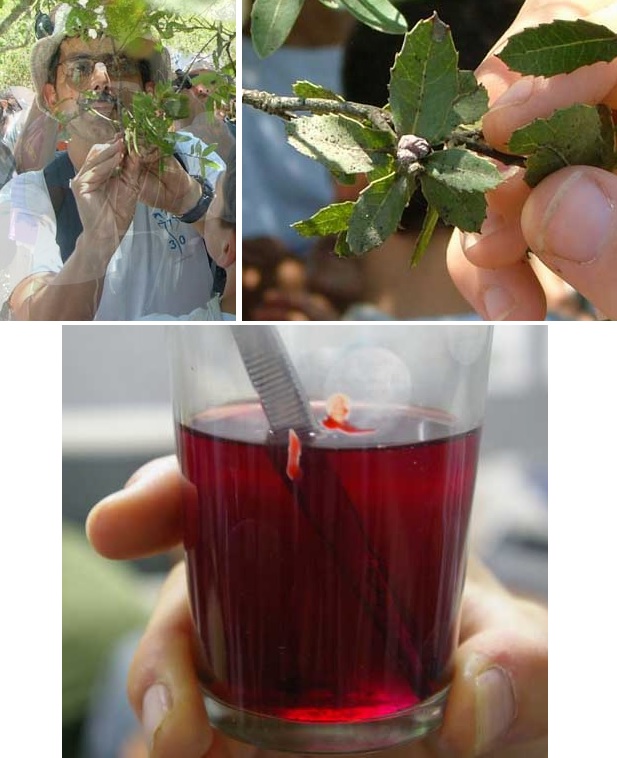
Clockwise from top left: Professor Amar leads the Temple Institute’s Tola’at Shani harvest; the “crimson worm” on a branch of an Israeli oak tree; Professor Amar holds a cup of crimson water produced by crushing a single worm.
The above essay is adapted from Garments of Light, Volume Three.
Get the book here!
Who is Metatron?
In this week’s parasha, Mishpatim, we read about a large set of laws that Moses received on Mt. Sinai following the Ten Commandments. While there, God tells Moses (Exodus 23:20-21):
Behold, I am sending an angel before you to guard you on the way and to bring you to the place that I have prepared. Beware of him and obey him; do not defy him, for he will not forgive your transgression, for My Name is within him.
God sends an angel to guide the Israelites through the Wilderness to the Promised Land. This is a very special angel, for God says that He has placed His Name within the angel. The Torah does not identify the name of this angel, but the Talmud does (Sanhedrin 38b):
A certain heretic said to Rav Idit: “It is written: ‘And to Moses He said: Come up to God.’ [Exodus 24:1] The heretic raised a question: It should have stated: ‘Come up to Me.’” Rav Idit said to him: “This is Metatron, whose name is like that of his Master [God], as it is written: ‘…for My Name is within him.’”
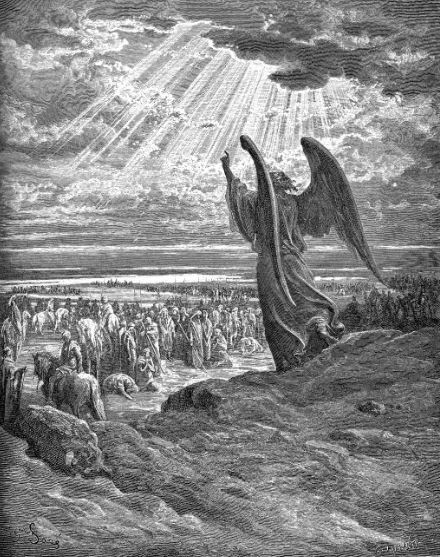
‘Angel Appearing to Joshua’ by Gustave Doré. According to the Book of Zerubavel, this was Metatron, the same angel that led the Israelites through the Wilderness.
A heretic challenges Rav Idit by saying that God should have spoken to Moses in the first person, saying “come up to Me”, not “come up to God”. Rav Idit replied that the speaker was the angel Metatron, who was sent by God to be His representative, and has God’s Name within him, as the Torah clearly states.
How do we find God’s Name within the name “Metatron”? The Kabbalists pointed out that the gematria of Metatron (מטטרון) is 314, equal to the Name of God Shaddai (שדי). However, this is only on the surface level. In reality, God’s absolute Name is the Tetragrammaton, and we do not find these four letters (Yud, Hei, Vav, Hei) in Metatron.
Of course, we must remember that the names of angels were generally adapted from non-Jewish sources, as the Talmud affirms (Yerushalmi, Rosh Hashanah 6a). How could this be? The true names of the angels had to be concealed so that people would be unable to summon them. Metatron, therefore, is not the angel’s real name. This is pretty evident in itself because anyone who first hears the term “Metatron” would never guess it is a Hebrew word. It sounds foreign, perhaps Aramaic, or more likely Greek. Indeed, some scholars have suggested that “Metatron” comes from the Greek meta and thronos, meaning “near” or “after the throne”, ie. that Metatron is the angel that sits nearest to the Throne of God, or the one that has authority right after the Throne of God. This brings us to the second place in the Talmud where Metatron is mentioned, in one of the most perplexing and intriguing Talmudic passages.
Sitting in Heaven
The Talmud relates the famous story of the “Four Who Entered Pardes” (Chagigah 14b-15a):
The Sages taught: Four entered “the orchard” [pardes], and they are: Ben Azzai, and Ben Zoma, Acher, and Rabbi Akiva… Ben Azzai glimpsed and died, and with regard to him the verse states: “Precious in the eyes of the Lord is the death of His pious ones” [Psalms 116:15]. Ben Zoma glimpsed and was harmed, and with regard to him the verse states: “Have you found honey? Eat as much as is sufficient for you, lest you become full from it and vomit it” [Proverbs 25:16]. Acher cut the saplings. Rabbi Akiva came out safely.
…“Acher cut the saplings” [meaning, he became a heretic]. With regard to him, the verse states: “Do not let your mouth bring your flesh into guilt” [Ecclesiastes 5:5]. What was it [that led him to heresy?] He saw the angel Metatron, who was granted permission to sit and write the merits of Israel [some versions add: for one hour a day]. He said: “It is taught that in the world above there is no sitting, no competition, no turning one’s back to Him, no lethargy. Heaven forbid—there are two authorities!”
They removed Metatron from his place in Heaven and smote him with sixty lashes of fire, so that others would not make the mistake that Acher did…
In this esoteric narrative, four great mystics of the highest order are able to ascend to the Heavens. Ben Azzai died immediately, Ben Zoma lost his mind, and Elisha ben Avuya became a heretic, for which he was referred to as Acher, “the other”. Only Rabbi Akiva exited in peace. (For a deeper analysis of this enigmatic passage, see Secrets of the Last Waters.)
The Talmud relates what it was that turned Elisha ben Avuya into a heretic. He saw Metatron sitting in the Heavens, when it was taught to him that none but God sits in Heaven. He concluded that perhaps there is more than one god, and this led him to abandon the Torah. (We must remember that this was nearly two millennia ago, in a time when most of the world was still polytheistic.) Back in Heaven, Metatron was severely punished for not standing up when the Sages entered, causing Acher’s apostasy.
This narrative seems to support the Greek origins of the name Metatron. He was the angel that was permitted to sit in Heaven—like none other but God Himself—as if on a lesser throne, a throne next to God’s, meta-tron. So, what was his real name?
Becoming an Angel
The renowned scholar of Kabbalah, Gershom Scholem, researched the origins of the angel and presented his findings in an essay, “Metatron”. He found that in the most ancient texts which mention the figure (such as the Apocalypse of Abraham) he is called Yeho-El (יהואל). This is precisely what we’d expect, for angel names generally have the suffix El, and Metatron is the one who carries God’s Name, the Tetragrammaton. His real name, then, is simply the Name of God with the angelic El appended to it. In some texts, he is even referred to as the “Lesser God” (יהוה קטן). Not surprisingly, these texts didn’t make it (for the most part) to the official corpus of Rabbinic literature. They did find their way into Gnostic and Mandean texts. (On that note, it should be mentioned that Christians revere Metatron, too, as do Muslims, who refer to him as Mitatrush.)
Scholem also presents alternative possibilities to the name Metatron. It may be rooted in matara, “keeper of the watch”, or metator, “a guide” (after all, Exodus says God designated him to guide the Israelites in the Wilderness). In some ancient texts, Metatron is an angel that preceded Creation and assisted God in bringing about the physical universe. Again, this is a dangerous idea that may lead to a belief in dualism or heresy, and is a problem for a monotheistic Judaism. Instead, Jewish texts generally present the origins of Metatron in a different way.

Cover for the popular 2011 video game ‘El Shaddai – Ascension of the Metatron’, released for PlayStation 3 and Xbox 360. Gamers play as Enoch in defending the world, and are supported by angels like Michael, Gabriel, Uriel, and Raphael. The game developers clearly did their research!
The Zohar draws from the apocryphal Book of Enoch in teaching that “Enoch is Metatron” (see, for example, Zohar III, 189a). Recall that Enoch was a descendant of Adam (seven generations down) of whom the Torah states “And all the days of Enoch were three hundred sixty and five years. And Enoch walked with God, and he was not; for God took him.” (Genesis 5:23-24) Thus, Enoch never died, but was taken up to Heaven by God, where he was transformed into the angel Metatron. He is the angel that “walks with God”. The one that God sent to Earth to lead the Israelites. This is a fitting role for Metatron, for he was once a man of the Earth, too.
In Jewish tradition, there are two men who became angels, and two angels who descended into this world and became like men. The latter are Shemhazai and Azazel, while the former are Enoch and Elijah. Perhaps we can say that Enoch and Elijah filled the missing spaces of Shemhazai and Azazel. Enoch became the angel referred to as Metatron, while Elijah became the angel referred to as Sandalfon. Interestingly, if Metatron’s real name is Yeho-El, then we find that the names of the two angel-men share the same letters: יהואל and אליהו. In fact, the names are just reversed, and mean the same thing!
It should be mentioned that there were those in the past who rejected the notion that Enoch became an angel. For example, Onkelos translates Genesis 5:24 to say that Enoch was “no more” because God killed Enoch! This would fit with the alternate view that Metatron has nothing to do with Enoch and was already an angel before Creation. In more recent centuries, some Kabbalists even believed there must be two Metatrons, each with a slight variation of the name (מטטרון and מיטטרון). It is also possible that the two became one: an angel called Metatron existed before Creation, and when Enoch went up to God his soul was fused with that angel.
The notion of a fusion of different souls is supported by the teachings of the Arizal (Rabbi Isaac Luria, 1534-1572). In one place, he describes how Enoch took the highest and purest soul of Adam, called zihara ila’ah, and fused together with it in becoming Metatron (Sha’ar HaPesukim on Beresheet). Elsewhere, the Arizal writes that any person who refines themselves to the highest degree, and fulfils all of their rectifications, is called a malakh, “angel” (Sha’ar HaGilgulim, ch. 39). The Arizal says this was the case with Elijah, for example, among others.
Scribing and Teaching
What is the angelic role of Metatron? We saw above from the Talmud that Metatron is the Heavenly Scribe, writing down the merits of Israel. Gershom Scholem argues that he is one and the same as the Sar HaOlam, the “prince of the world” mentioned in Rabbinic literature, appointed to watch over our Earth. The Talmud (Yevamot 16b) says that he is the subject of the verse: “I have been young, and now am old; yet I have not seen the righteous forsaken, nor his seed begging bread.” (Psalms 37:25) This makes sense, for Metatron began his life as the earthly Enoch; born a baby, grew to adulthood, and was then transformed into an angel with everlasting life.
The Arizal agrees, teaching that Metatron is the “prince of the seventy nations”, the angel above all the lesser angels appointed to watch over each of the seventy root nations on Earth (Sha’ar HaGilgulim, ch. 31). In the same place, the Arizal confirms that Metatron is Enoch, who never died. He also reveals that he was the angel that came to Joseph and taught him all seventy languages in one night so that Joseph could present himself before Pharaoh.
In his commentary on Sefer Yetzirah, the Ravad (Rabbi Avraham ben David, c. 1125-1198) says that Metatron was the angel that taught Moses. The Talmud (Avodah Zarah 3b) states that Metatron teaches Torah to little schoolchildren. Not much else is known of him.
In the past, various critics of Judaism have used the notion of Metatron to suggest that Jews have strayed from monotheism. This is a false claim. From its first pages, the Torah speaks of angels that serve as God’s emissaries and assistants. Metatron is just another angel, albeit one imbued with more powers than others.
This brings us back to the first Talmudic passage cited above (Sanhedrin 38b), which continues with the heretic questioning Rav Idit: “If so, we should worship [Metatron] as we worship God!” Rav Idit replied: “It is written: ‘Do not defy [tammer] him,’ meaning ‘Do not replace Me [temireni] with him.’” In a classic play on words, Rav Idit explains that when God said not to rebel against His appointed angel, He also meant not to start worshipping him in place of God.
We mustn’t forget that there is only one God whom we pray to and turn to. The Jewish people have no intercessors or intermediaries. We are Israel (ישראל), or yashar-El (ישר-אל), “direct to God”. And Rav Idit concludes in the Talmudic passage that the ancient Israelites ultimately rejected Metatron as their guide, and requested that God Himself lead them, as it is written (Exodus 33:15): “If Your Presence go not with me, raise us not up from here.”
The above essay is adapted from Garments of Light, Volume Three.
Get the book here!