Tag Archives: Berakhot (Tractate)

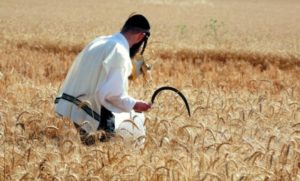
Why Physical Labour is a Spiritual Necessity

In this week’s Torah portion, Ekev, Moses tells the Israelites that if they follow God’s commandments, He will “give the rain of your land in its season, the former rain and the latter rain, and you shall gather in your corn, and your wine, and your oil.” The Talmud (Berakhot 35b) asks:

“And you shall gather in your corn.” What is to be learned from these words? Since it says, “This book of the law shall not depart out of your mouth,” I might think that this injunction is to be taken literally. Therefore it says, “And you shall gather in your corn”, which implies that you are to combine the study of them with a worldly occupation.

Although elsewhere the Torah states that one should always be meditating upon the Torah, here we are told that we should be working the fields. The Sages learn from this the importance of combining Torah study with some form of employment. This sentiment is expressed throughout rabbinic literature. Pirkei Avot (2:2) famously states:

Rabban Gamliel, the son of Rabbi Yehudah HaNasi, would say: Beautiful is the study of Torah with the way of the world, for the toil of them both causes sin to be forgotten. And all Torah study that is not accompanied by work will eventually be negated and lead to sin.

Rabban Gamliel goes so far as to say one who only learns Torah and does not combine it with labour will have their Torah learning nullified, and will be lead to sin. The Rambam (Hilkhot Talmud Torah 3:10) takes an even more hard-line approach:

Anyone who takes upon himself to study Torah without doing work, and derive his livelihood from charity, desecrates [God’s] Name, dishonours the Torah, extinguishes the light of faith, brings evil upon himself, and forfeits his life in the World to Come, for it is forbidden to derive benefit from the words of Torah in this world.

Our Sages declared: “Whoever benefits from the words of Torah forfeits his life in the world” … Also, they commanded and declared: “Love work and despise rabbinic positions,” and “All Torah study that is not accompanied by work will eventually be negated and lead to sin.” Ultimately, such a person will steal from others.

Rabbi Moshe ben Maimon, the Rambam (1135-1204)

In another place (Hilkhot Matnot Ani’yim 10:18), the Rambam further elaborates:

Even a dignified Sage who becomes poor should work in a profession, even a degrading profession, rather than seek public assistance. It is better to skin the hides of dead animals than to tell the people, “I am a Sage” or “I am a priest, support me.”

… Our greatest Sages were wood-choppers, porters of beams, water-drawers for gardens, blacksmiths, and charcoal-makers. They did not ask anything from the public and refused to accept anything that was given to them.

The Sages that the Rambam is referring to include the great Hillel, who famously worked as a wood-chopper, though just enough to support his family and pay the entrance fee to the Torah study hall (Yoma 35b), and Rabbi Yehoshua ben Chananiah who was a blacksmith and charcoal-maker (Berakhot 28a). Meanwhile, Rav Papa and Rav Chisda were beer brewers, and Rav Chanina and Rav Oshaia were cobblers (Pesachim 113a-b). The Rambam was himself a physician.

Of course, today we need rabbis who devote themselves full-time to the needs of the community, and to serve as teachers, judges, counsellors, and so on. Such leaders certainly deserve a good salary for their work. However, those adults that simply learn Torah most of the day, subsisting off of the community while giving little in return, are engaging in a tremendous transgression.

Humans are meant to be productive. From the very beginning, God made man His partner in creation, to complete what He started – asher bara Elohim la’asot. God explicitly instructed Adam to work the Garden and tend to it (Genesis 2:15). Physical work is part of man’s spiritual rectification. Amazingly, the Talmud (Nedarim 49b) records how Rabbi Yehuda would carry a huge pitcher of water over his shoulder on his way to the beit midrash, and Rabbi Shimon would similarly carry a heavy basket, both saying “great is labour, for it honours its worker”. Women are not exempt from this, and the Talmud famously states that a husband who forbids his wife from doing any work should better divorce her, since “idleness leads to promiscuity” and “idiocy” (Ketubot 59b).

The Rambam once again summarizes it best (Hilkhot Talmud Torah 3:11):

It is a great thing for a person to derive his livelihood from his own efforts. This attribute was possessed by the pious of the early generations. In this manner, one will merit all honour and benefit in this world and in the World to Come, as it is said: “If you eat the toil of your hands, you will be happy and it will be good for you.” [Psalms 128:2] You will be happy in this world, and it will be good for you in the World to Come, which is entirely good.


The above is an excerpt from Garments of Light, Volume Two. Get the book here

A Mystical Look at Pregnancy and Abortion

Parashat Tazria begins by stating that a woman who gives birth to a son is spiritually impure for seven days, and requires another 33 days of purification afterwards. If she gives birth to a female, the impurity lasts fourteen days, followed by 66 days of purification. The Zohar (III, 43b) comments on this section by first reminding us that each soul has male and female halves, and when the soul enters this world, it splits and enters two different bodies, male and female. If the two soulmates merit it, they will find each other and reunite. We are then told that the female part of the soul is larger and more powerful, which is why a woman who gives birth to a female needs double the purification time.

The Zohar explains why the Torah prescribes these specific time periods: 7 and 33 days for boys; 14 and 66 days for girls. It states that at birth, the soul first enters the body and is in complete disarray. For the first seven days, the unsettled soul “roams the body to find its place”. On the eighth day, the soul is finally getting comfortable in its new home. This is one reason why circumcision is done on the eighth day, once the soul is no longer distressed. The soul then needs an additional 33 days to acclimatize to its new environment until it has completely settled into the body. For the greater female souls, the time periods are doubled.

Note how these time periods are referring to the soul of the newborn, yet it is the mother that is described as being “impure”. This is because the mother carried the child, and its soul was housed within her temporarily. (Perhaps this extra soul is responsible for the well-known “pregnancy glow”.) Once the baby is born, its soul leaves the mother’s shelter and is now independent in the baby’s body. (And that pregnancy glow is gone!) The sudden loss of spiritual energy is difficult on the mother as well, and she requires forty (or eighty) days to get back to herself.

A major question arises here: if the soul only enters the newborn at birth, why is abortion forbidden? Religious groups of various faiths have argued for centuries on when exactly the soul enters the body, and many have taken the stance that a fetus already carries a soul, making abortion indistinguishable from murder. What do Jewish texts say?

Abortion and Gestation in the Talmud

In one passage, the Talmud includes abortion under the category of murder. However, it also famously states that if the mother’s life is at risk—at any point in the pregnancy—the fetus must be removed, “limb by limb” if necessary. In such cases, the fetus is seen as a rodef, a “pursuer”, referring to the Torah law that if one is “pursuing” another to kill them, it is permitted to kill the pursuer first. The Talmud concludes that a fetus can be aborted at any point until its head has emerged. Once the head has emerged, the newborn is considered completely alive, and in cases of life-risk, it is no longer clear who the “pursuer” is. The Sages suggest that the soul fully enters the newborn only at birth, and it is only then that the newborn is a complete person.

Three-month old fetus (Courtesy: BabyCentre)

Elsewhere in the Talmud (Niddah 8b), we are told that the fetus already resembles a person at the three-month mark. We now know that it is precisely around this point that the developing baby has the features of a human (and is no longer called an “embryo”, but a “fetus”). The Talmud adds (Berakhot 60a) that until this three-month mark, a person should pray every day that there shouldn’t be a miscarriage. After three months, a person should pray that the fetus will not be stillborn, and after six months, a person should pray that the mother has an easy delivery. We are told that one should pray for the baby’s desired gender only before the 40-day mark. This, too, shows incredible wisdom on the part of our Sages. Today we know scientifically that the sex organs begin their development around day 42. The ancient rabbis knew that after day 40, gender development is already in progress, and there is no point praying for something different.

In a related passage, we are told that until day 40, the fetus is insignificant and more lifeless than living (Yevamot 69b). Today we know that the neural tube which will make the brain forms around day 40, and this is when the first neurons start signalling. Scientifically speaking, there could be no talk of any kind of consciousness or brain activity before day 40.

Because of this, most rabbinic authorities are far more lenient when it comes to abortions before the 40th day of pregnancy. Rabbi Chaim Ozer Grodzinski (1863-1940), who was widely recognized as the greatest posek of his generation, even suggested that abortions before the 40th day are not Biblically prohibited (Achiezer, III, 65:14). Nevertheless, even before the 40th day there is a potential to produce a living human being, and life is valued above all else, which is why abortions are still forbidden except for cases of absolute necessity.

By the 20-week mark (midway through pregnancy), fetuses are seen rolling around, sucking their thumbs, and responding to the prodding of the ultrasound. There is no doubt that the fetus is alive and aware at this point, and any abortion other than a life risk is hardly distinguishable from murder.

Soul Infusion

The fact that the fetus is aware by the 20-week mark (if not sooner) suggests that it does indeed have some level of soul. Yet, earlier we saw sources seemingly propose that the soul does not enter until birth. How do we reconcile these apparent contradictions?

To answer this question it is important to keep in mind that the soul is not one uniform entity. Rather, the soul is composed of multiple layers, each made up of countless sparks. The lowest level of soul is called nefesh, the basic life essence. Above that is the ruach, “spirit”, an animating force that, among other things, gives a person their drives and inclinations. Then comes the neshamah, a higher level of consciousness and the part that gives one their unique traits and qualities. Further still is the chayah, the aura that emanates from the body, followed by the loftiest level, the yechidah, which may be described as a spiritual umbilical cord between each soul and its Creator.

The Arizal taught that ever-higher levels of soul are accessed gradually over the course of one’s life. At birth, a person has only a complete nefesh. As they grow, they are infused with ruach, which becomes fully accessible at bar or bat mitzvah age. At this point one starts to tap into their neshamah, which is wholly available only at age 20. (For this reason, the Torah considers an adult one who is over 20 years of age. Only those over 20 were counted in the census and allowed to join the military. Our Sages state that although one may be judged for their crimes before age 20 here on Earth, only those sins accrued after age 20 are judged in Heaven. Meanwhile, the Midrash notes that Adam and Eve were created as 20 year olds.) The Arizal taught that most people never end up accessing their entire neshamah, and only the most refined individuals ever unlock their chayah and yechidah.


Based on this model, we see that right from conception the developing embryo is steadily infused with nefesh, the basic life force. By day 40, there is enough nefesh for the embryo to be considered alive. In fact, it is said that this is why the gematria of אם, “mother”, is 41, since a woman becomes a mother on the 41st day of pregnancy.

Once its entire nefesh has been infused, the baby is ready to be born. At birth, it begins to receive its next soul level, the ruach. A careful look at the Zohar passage with which we started reveals that this is precisely what the Zohar meant, as it explicitly mentions the ruach entering at birth, requiring forty days to fully settle in. Therefore, a developing fetus does indeed have a soul, which is why abortion is so highly discouraged—reserved only for true medical cases—and why it has been compared to murder.

Solving a Scientific Mystery

The above also answers a mystery that has been perplexing biologists for decades: what is it that drives an embryo to grow? Why do the cells multiply, and how do they know to differentiate? Each cell is exactly the same, with the exact same set of DNA, yet one clump of cells knows to form the eyes while another knows to form the liver, and so on. Scientists have still not been able to figure out how the embryo “knows” what to do. (For that matter, we can’t figure out how any cell really “knows” what to do.)

The Kabbalists have an answer: it is the steady infusion of soul that drives a mass of undifferentiated cells to do what it needs to. It is the soul that gives the instructions for how the DNA is to be transcribed and translated in each cell, and how the cells are to interact with one another. As the soul grows, so too does the body. It is therefore not surprising that around the age when most people’s bodies stop growing, their souls tend to stop “growing” as well.

This should remind us that our education does not end with formal schooling, nor does maturing stop with the end of puberty. The process of growth and refinement, both physical and spiritual, must continue throughout life. This is the key to true self-fulfillment and happiness.


The article above is an excerpt from Garments of Light. Click here to get the book.

Tisha B’Av: Why Are We Still Mourning?

This week’s Torah portion is Devarim, which begins the fifth and final book of the Torah. This book (Deuteronomy), is written from the perspective of Moses, and summarizes much of what the Torah discussed earlier. At the same time, it also introduces many new mitzvot, and reveals deeper insights into the Torah’s previous narratives. For example, while the book of Numbers told us that Moses was forbidden to enter the Holy Land because he disobeyed God in striking the rock, here we are told that Moses was forbidden to enter the Land because of the incident of the Spies! (1:22-38) How do we reconcile these differences? The answer can actually be found in next week’s parasha, Va’etchanan.

Va’etchanan (literally “and I beseeched”) describes how Moses begged God to allow him to enter the Holy Land. The Talmud (Berachot 32b) states that Moses prayed so much that God actually relented and forgave him for striking the rock. However, it would have been wrong for Moses to enter the Holy Land at that time, considering that the rest of the men were condemned to perish in the Wilderness because of the sin of the spies. After all, Moses was their leader. Could a shepherd abandon his flock? Would a captain abandon his sinking ship? So, Moses didn’t enter the land not because of the rock, but because of the spies.

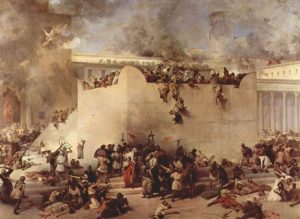
'Destruction of the Temple of Jerusalem' by Francesco Hayez (1867)

‘Destruction of the Temple of Jerusalem’ by Francesco Hayez (1867)

This is all the more pertinent now with Tisha B’Av right around the corner. Tisha B’Av commemorates the destruction of both Holy Temples in Jerusalem, along with a handful of other tragedies said to have happened on, or around, that date – the ninth of the month of Av. According to tradition, the origins of Tisha B’Av lie in the incident of the spies. It was on that day that the spies returned from the land of Israel, and reported negatively about the people’s chances of conquering the land. The faithless nation feared and cried needlessly on that day so, it is said, God subsequently gave the nation many good reasons to truly fear and cry on that day throughout history.

The Problem with the 9th of Av

There are many problems with this classic narrative. First of all, why would God punish generations far in the future for the sins of that one generation long ago? Deuteronomy 24:16 itself states clearly that “Parents shall not be put to death because of their children, nor children because of their parents. Each person shall be put to death for their own crime.” While the Torah does also mention a number of times that God “carries over the iniquity of the fathers onto the children to the third and fourth generations”, the phrase concludes by saying this is only true to those that “hate Him”. In any case, it is only to the third and fourth generations, not millennia into the future! Even so, the Talmud (Makkot 24a) says the prophet Ezekiel came and repealed this divine decree anyway:

Said Rabbi Yose bar Chanina, “Moses pronounced four decrees upon Israel, which four prophets came and cancelled.”
…Moses said, “carries over the iniquity of the fathers onto the children…” (Exodus 34:7) Ezekiel came and cancelled it: “The one who sins will die.” (Ezekiel 18:14)

'The Spies With The Grapes Of The Promised Land' by Nicolas Poussin (1664)

‘The Spies With The Grapes Of The Promised Land’ by Nicolas Poussin (1664)

Second of all, did the spies really return on the 9th of Av? The Talmud (Ta’anit 29a) calculates that the spies went forth on the 29th of Sivan and returned forty days later on the 9th of Av. However, the Torah tells us that the spies went to Israel at the start of the grape harvest (Numbers 13:20) and the same tractate of Talmud (Ta’anit 30b) states that the grape harvest season lasted from the 15th of Av until Yom Kippur! How could the spies have returned on the 9th of Av when the grape harvest only began on the 15th? (A simple Google search reveals that the ideal time for grape harvest is September-October, which is right between the 15th of Av and Yom Kippur.)

On the same note, when exactly were the Temples destroyed? The Tanakh tells us that “in the fifth month, on the seventh day of the month, which was the nineteenth year of King Nebuchadnezzar, king of Babylon, came Nebuzaradan, the captain of the guard, a servant of the king of Babylon, to Jerusalem. And he burned the house of Hashem, and the king’s house…” (II Kings 25:8-9) This verse suggests the First Temple was destroyed on the 7th of Av.

Another verse in the Tanakh tells us that “in the fifth month, in the tenth day of the month, which was the nineteenth year of King Nebuchadnezzar, king of Babylon, came Nebuzaradan, the captain of the guard, who stood before the king of Babylon, to Jerusalem; and he burned the house of Hashem, and the king’s house…” (Jeremiah 52:12-13) The verse is nearly identical, except that this one says Nebuzaradan came on the 10th and destroyed the Temple.

We have the 7th of Av and the 10th of Av, but no 9th! The Talmud (Ta’anit 29a) notes this contradiction and tries to reconcile it this way: “On the seventh the heathens entered the Temple and ate therein and desecrated it throughout the seventh and eighth, and towards dusk of the ninth they set fire to it and it continued to burn the whole of that day [the tenth].” Rabbi Yochanan goes on to say that if it were up to him, the mourning day would be the 10th of Av, not the 9th, since this is when the Temple was mostly destroyed.

And what about the Second Temple? Josephus lived through its destruction, and later wrote about it in detail. He says that it was destroyed on the 10th of Av, and writes that the Jews mourn its destruction on the same day that they mourn the destruction of the First Temple. However, he seems to admit that he is uncertain about the exact dates that the Temples fell.

What does the Talmud say? It, too, is uncertain, but concludes that since “good things tend to happen on good days, and bad things on bad days,” it is assumed that the Second Temple was destroyed on the same day as the First Temple!

Postponing, Abolishing, or Redefining?

This year, Tisha B’Av falls on Shabbat, so the fast is postponed, appropriately, to the 10th. While Rabbi Yochanan felt that the 10th is the correct day to fast anyway, Rabbi Yehudah HaNasi – the great redactor of the Mishnah – wanted to have the fast of Tisha B’Av abolished completely! Some say this was only when Tisha B’Av falls on Shabbat and needs to be postponed, while others say he wanted it gone entirely (Megillah 5b).

This idea has been echoed in modern times. The primary reason for mourning on Tisha B’Av is because of Jerusalem’s destruction and the Jewish people’s exile. Today, the Jewish people have returned to the Holy Land and have rebuilt Jerusalem. While there’s no Temple just yet, we are free to travel to, and settle in, the Holy City whenever we wish. Why are we still mourning?

Perhaps Rabbi Yehudah felt the same way. In his day, Jews had also returned to Jerusalem and enjoyed relatively good terms with the Romans. Rabbi Yehudah himself was friends with the Caesar known in the Talmud as ‘Antoninus’ (possibly the Emperor Marcus Aurelius, or maybe a local Roman governor).

Meanwhile, far worse tragedies have befallen the Jewish people since then: crusades, inquisitions, pogroms, the Holocaust, and the list goes on. Why focus on the temples and Jerusalem when there are more recent, greater tragedies? Indeed, former Israeli Prime Minister Menachem Begin intended to combine all the days of commemoration, and move Holocaust Remembrance Day and Israel’s Memorial Day to Tisha B’Av.

Perhaps this is what Tisha B’Av should be: one day to remember all of the suffering that has troubled the Jewish people, and all the suffering that continues to plague the world. A day to remind us that Mashiach has not come yet, the Temple is not yet rebuilt, and the world is not yet whole. A day to ask ourselves: what exactly are we doing to hasten the arrival of that magnificent, forthcoming time? What are we doing that will finally put an end to all the mourning? Tisha B’Av should be a day not about drowning in the sad tears of the past, but about actively working towards the happy tears of the future.

And this is precisely what Rabbi Akiva told his colleagues when they saw the ruins of the Temple. While Rabban Gamliel, Rabbi Elazar ben Azariah, and Rabbi Yehoshua ben Chananiah immediately fell into a bout of weeping, Rabbi Akiva was laughing. Surprised, they asked him to explain himself. He told them that while they were dwelling on the destruction of the first and second temples, he was dwelling on the vision of the coming Third Temple. The rabbis responded – and with this the tractate ends – “Akiva, you have consoled us! Akiva, you have consoled us!”