

Tag Archives: Sanhedrin (Tractate)

Secrets of Rosh Hashanah

This first of this week’s two Torah portions, Nitzavim, is always read right before Rosh Hashanah, and appropriately begins: “You are all standing today before Hashem, your God…” The verse has traditionally been seen as an allusion to Rosh Hashanah, when each person stands before God and is judged. The Torah says today, implying one day, yet everyone celebrates Rosh Hashanah over two days. This is true even in Israel, where yom tovs are typically observed for only one day.

The reason for this is because in ancient times there was no set calendar, so a new month was declared based on the testimony of two witnesses. Once the new month was declared in Jerusalem, messengers were sent out to inform the rest of the communities in the Holy Land, and beyond. Communities that were far from Israel would not receive the message until two or three weeks later, so they would often have to observe the holidays based on their own (doubtful) opinion of when the holiday should be. They therefore kept each yom tov for two days.

Rosh Hashanah, however, is the only holiday that takes place on the very first day of the month, so as soon as the new month of Tishrei was declared, it was immediately Rosh Hashanah, and messengers could not be sent out! Thus, even communities across Israel would observe the holiday for two days, based on their own observations.

Although today we have a set calendar, and there is no longer a declaration of a new month based on witnesses, two days are still observed since established traditions become permanent laws. Of course, this is only the simplest of explanations, for there are certainly deeper reasons in observing two days, especially when it comes to Rosh Hashanah.

Judgement in Eden

Rosh Hashanah commemorates the day that God fashioned Adam and Eve. On that same day, the first couple consumed the Forbidden Fruit, were judged, and banished from the Garden of Eden. Originally, they had been made immortal. Now, they had brought death into the world, and God decreed that their earthly life would have an end. Adam and Eve were, not surprisingly, the first people to be inscribed in the Book of Death. Each year since, on the anniversary of man’s creation and judgement, every single human being (Jewish or not) is judged in the Heavenly Court, and inscribed in the Book of Life, or the Book of Death.

This is the idea behind the symbolic consumption of apples in honey. In Jewish tradition, the Garden of Eden is likened to an apple orchard, with the scent of the air in Eden being like that of apples. (Having said that, it is not a Jewish tradition that the Forbidden Fruit itself was an apple!) The apple reminds us of the Garden—of Adam and Eve and their judgement—and we dip it in honey so that our judgement should be sweet.

But what happens when Rosh Hashanah falls on Shabbat? It is well-known that there is no judgement on Shabbat. The Heavenly Court rests, and even the souls in Gehinnom are said to have a day off. This is illustrated by a famous exchange in the Talmud (Sanhedrin 65b) between Rabbi Akiva and the Roman governor of Judea at the time, Turnus Rufus:

Turnus Rufus asked Rabbi Akiva: “How does [Shabbat] differ from any other day?”
He replied: “How does one official differ from another?”
“Because my lord [the Roman Emperor], wishes it so.”
Rabbi Akiva said: “the Sabbath, too, is distinguished because the Lord wishes it so.”
He asked: “How do you know that this day is the Sabbath?”
[Rabbi Akiva] answered: “The River Sambation proves it; the ba’al ov proves it; your father’s grave proves it, as no smoke ascends from it on Shabbat.”
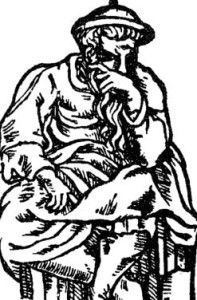
An illustration of Rabbi Akiva from the Mantua Haggadah of 1568

Rufus asks Rabbi Akiva how the Jews are certain that the Sabbath that they keep is actually the correct seventh day since Creation. Rabbi Akiva brings three proofs:

The first is a legendary river called the Sambation (or Sabbation), which was known in those days, and which raged the entire week, but flowed calmly only on Shabbat. The second proof is that people who summon the dead from the afterlife (practicing a form of witchcraft called ov) are unable to channel the dead on Shabbat. (I know of a person who was once involved in such dark arts and became a religious Jew after realizing that he was never able to summon spirits on the Sabbath or on Jewish holidays!) Lastly, Rabbi Akiva notes how Turnus Rufus’ own father’s grave would emit smoke every day of the week, except on Shabbat. This is because the soul of Rufus’ wicked father was in Gehinnom, but all souls in that purgatory get a reprieve on Shabbat. (Historical sources suggest that Rufus’ father was Terentius Rufus, one of the generals involved in the destruction of the Second Temple.)

Based on this, we can understand why Rosh Hashanah must be observed over two days. When the holiday falls on Shabbat, no judgement can take place, so the judgement is pushed off to the next day. This is also related to the fact that when Rosh Hashanah falls on Shabbat, the shofar is not blown. This is not at all because blowing a shofar is forbidden on Shabbat, which is, in fact, permitted.

The simple explanation given for this is that we’re worried the person blowing the shofar might carry it to the synagogue (in a place without an eruv), and carrying is forbidden on Shabbat. The deeper reason is this: Blowing the shofar is supposed to “confound Satan”. Satan is not the trident-carrying, horned demon of the underworld (as popularly believed in Christianity). Rather, Satan literally means the “one who opposes” or the “prosecutor”. It is Satan’s job to serve as the prosecution in the Heavenly Court. The shofar’s blow confuses Satan, and prevents him from working too much against us. On Shabbat, the Heavenly Court rests, and Satan is having a day off, so there is no need to confound him!

The First Shabbat

One might argue that Rosh Hashanah should only be two days long when it falls on Shabbat; in other years, one day would suffice. Other than the fact that this would be confusing—as the holiday would span different lengths in different years—there are other explanations for the two days, including that each day involves different types of judgement (for example, one day for sins bein adam l’Makom, between man and God; and one day for bein adam l’havero, between man and his fellow). Nonetheless, our Sages still describe Rosh Hashanah as really being one day—one unique, extra-long, 48-hour day which our Sages called yoma arichta, literally the “long day”. Perhaps this is another reason for the custom of not sleeping on the “first night” of Rosh Hashanah. (The other reason: how could anyone possibly sleep through their own trial?)

Finally, the story of Rabbi Akiva and Turnus Rufus gives us one more reason to commemorate Rosh Hashanah over two days. Rufus questioned Rabbi Akiva on how he can be so sure that the Sabbath which he keeps is indeed the correct seventh day going back to Creation. If Rosh Hashanah is the day Adam and Eve were created, then it corresponds to the sixth day of Creation. That means the very next day was the seventh day of Creation, and that the second day of Rosh Hashanah always commemorates the very first Sabbath. When we celebrate on the second day of Rosh Hashanah, we mark Adam and Eve’s first Shabbat, and recognize that each seventh day has been observed ever since, and will continue to be observed for another, 5778th upcoming year.

Shana Tova u’Metuka!
Is the Lubavitcher Rebbe Mashiach?

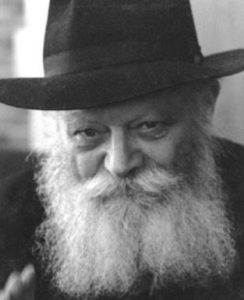
The Lubavitcher Rebbe (Photo Credit: Shlomo Vishinsky and Zev Markowitz/ chaiartgallery.com)

Today is the third of Tammuz, the yahrzeit of Rabbi Menachem Mendel Schneerson, better known as the Lubavitcher Rebbe. There is no doubt that the Rebbe was among the greatest sages of the last century (if not of all time). From the moment he took up the leadership of Chabad, the Rebbe began to make waves in the Jewish world, and quickly transformed Lubavitch into an international powerhouse. Today, Chabad finds itself in 81 countries, operating 3500 institutions.

The Rebbe himself inspired countless souls, both Jewish and non-Jewish. One of the latter was Congresswoman Shirley Chisholm (the first black woman in Congress). When Chisholm was first elected to the House of Representatives, she met fierce opposition and outright racism. Shortly after, she received a call from the Rebbe, who quelled her concerns and offered her advice on how to make the most of her situation. Chisholm went on to create programs that benefited millions of poor people, including the expansion of food stamps across the US. At her retirement breakfast, she said: “If poor babies have milk and poor children have food, it’s because this rabbi in Crown Heights had vision.”

With such vision, along with tremendous wisdom, righteousness, and charisma, it isn’t very surprising that a messianic movement would develop around the Rebbe. Despite the fact that he passed away in 1994, many within the Chabad movement continue to believe that he is Mashiach. Is there substance to this belief?

Mashiach Resurrected

One of the major arguments used by the so-called Mashichistim is a verse in the Talmud (Sanhedrin 98b) that states Mashiach can come from “among the living” or from “among the dead”. The Talmud states that if Mashiach is of the living, it would certainly be Rabbi Yehuda haNasi (who was also called, simply, Rebbi), the great compiler of the Mishnah; if of the dead, it would be the Biblical Daniel. Within Chabad, this passage is used to support the fact that despite the Rebbe’s passing, he may still return to be the messiah.

However, other texts state that Mashiach cannot be from the dead. For example, Midrash Rabbah (on Genesis 49:18) writes how Jacob saw a vision of Samson—who had the potential to be Mashiach—but when Jacob saw Samson’s death, he was saddened that Samson wouldn’t be the messiah and said, “I await Your salvation, Hashem!”

Some believe the Rebbe is not really dead (besides, if Mashiach is from “among the dead”, the Talmud already told us it would be Daniel!) but he is only “concealed”. Multiple Jewish sources state that Mashiach will come, then disappear for a certain amount of time, and then return again. For example, Midrash Rabbah (on Numbers 11:3), writes:

Just like the first redeemer, Moses, revealed himself to the Jews and then concealed himself… similarly, the final redeemer will reveal himself, then conceal himself… and then return and reveal himself again.

Thus, the Rebbe is said to only be “hidden”, and will imminently return. Of course, this isn’t very different from the Christian belief in Jesus’ eventual “second coming” (although it should be noted that Christians believe Jesus actually died, and was not simply “hidden”). Christians have been waiting eagerly for two millennia—much like some in Chabad have been waiting eagerly for over two decades.

In reality, when ancient Jewish sources speak of Mashiach’s concealment and return, they do not mean that Mashiach will disappear for millennia, or even decades. The Midrash cited above itself says that Moses was hidden from the Israelites for three months, and Mashiach would be hidden for only 45 days (though there are other opinions). And so, the potential for the Rebbe being Mashiach appears to have long expired.

The Rebbe on Being Mashiach

One of the things that the Rebbe was adamant about was studying and following the teachings of the Rambam. The Rambam makes it clear who Mashiach is: a Jewish leader who, among other things, successfully reunites the entire nation in Israel (ending the exile), defeats the nation’s enemies, and rebuilds the Temple in Jerusalem. Only one who has successfully accomplished these tasks can be titled “Mashiach”. The Rambam writes that if a person was on his way to fulfilling these, but died in the process, he is clearly not the messiah. The Rambam brings Shimon bar Kochva as an example. Although Bar Kochva was able to push the Romans out of Israel, reclaim the Temple Mount and start rebuilding the Temple, and was even proclaimed the messiah by Rabbi Akiva, he died and his messianic potential died with him.

Although the Rebbe did hint to himself possibly being the messiah in some of his talks (and his followers use those encoded statements as proof), he also said in one of his talks that one is only confirmed to be Mashiach when the Third Temple is built. Obviously, since the Rebbe did not build the Third Temple in his lifetime, he cannot be the messiah. If it turns out that the Rebbe does return somehow in the future, and accomplishes all the messianic tasks, then and only then can he be titled “Mashiach”. To do so now is premature and naïve, if not altogether wrong.

In fact, the Rebbe publicly made clear that he is not Mashiach. In his monumental biography of the Rebbe, Joseph Telushkin devotes a chapter to this question, and writes:

In 1965, Rabbi Avraham Parizh, an elder Chasid who had been with the movement from the time of the Fifth Rebbe, printed letters stating: “With great joy, we can inform you that King Messiah, for whom we have waited so many years, is already among us. He is the holy Lubavitcher Rebbe, Rabbi Menachem Mendel Schneerson, the King Messiah. His address is 770 Eastern Parkway, Brooklyn, New York. He does not need us to choose him since God has chosen him.” Rabbi Parizh printed up many of these letters and started handing them out in Israel. According to one account, Parizh also distributed these letters by dropping them out of a helicopter.

When the Rebbe learned of the letter, he instructed his secretariat to immediately dispatch a telegram to Parizh, dated June 24, 1965: “We were shocked by the letter [you wrote and handed out] and ask that you immediately cease distributing it. Gather and send to the secretariat all copies of the letter, every last one, and please confirm immediately that you have fulfilled this instruction.” Chasidim tell how Parizh spent several weeks scrounging around the streets of Tel Aviv looking for every such sheet he could find…

In 1991, Rabbi Aharon Dov Halprin, the editor of Chabad’s Israeli magazine, Kfar Chabad, wanted to print an article explaining why the Rebbe was worthy of being considered the presumed Messiah. When the Rebbe learned of this he responded sharply, “If you, God forbid, [plan to write] anything even remotely similar, it is preferable that you shut down the periodical completely.”

In an urgent audience to which the Rebbe summoned Chabad activist Rabbi Tuvia Peles, the Rebbe rebuked those who were making Messianic claims about him, saying, “They are taking a knife to my heart” and “they are tearing off parts of me.”

… Some months later, and shortly before the Rebbe’s stroke, the Alaska-based shliach, Rabbi Yosef Greenberg (author of Y’mei Bereishit), brought a letter to be given to the Rebbe in which he referred to him as “King Messiah”. Later that same day, Rabbi Groner told Greenberg that the Rebbe had looked at the letter, thrown it down in frustration, and then wrote on it, “Tell him that when the Moshiach comes, I will give him the letter.”

An even more definitive statement of the Rebbe on this same issue occurred at around the same time. An Israeli journalist, Sarah Davidowitz of the Kol Ha’ir newspaper, approached the Rebbe and said, “We appreciate you very much, we want to see you in Israel; you said soon you will be in Israel, so when will you come?” The Rebbe responded: “That depends on the Moshiach, not on me.” The journalist persisted, “You are the Moshiach!,” to which the Rebbe responded: “I am not”.

In light of this, to call the Rebbe “Mashiach” is highly inappropriate, and against his own wishes. More dangerously, it risks turning Chabad into a religion of its own. After all, Christianity developed in the very same way; in its first decades, it was nearly indistinguishable from Judaism, and was followed almost entirely by Jews. It took a couple of centuries before the divide between Judaism and Christianity was complete, and by that point, Jesus had become a God-like figure.

The same may very well happen with the Rebbe and Chabad in coming decades. Already, there are elements within Chabad who have taken to equating the Rebbe with some kind of god on Earth. Many in Chabad still write letters to the Rebbe, adorn their homes with countless images and elaborate paintings of him, and read out the Rebbe’s letters at important public events (while everyone is asked to rise in honour of the Rebbe’s “presence”, of course). It isn’t uncommon to see children saluting the Rebbe’s empty chair at 770, while worshippers ecstatically chant “long live our master, teacher, and rabbi, the king Mashiach” (see video here). If Chabad’s leaders do not rein in such activity soon, there is little doubt Lubavitch will morph into a religion of its own. And for the Rebbe—who worked so tirelessly to unite all Jews—that would be a most devastating legacy.


For a more detailed analysis of the Rebbe’s messianism, please see here. 

A Mystical Look at Pregnancy and Abortion

Parashat Tazria begins by stating that a woman who gives birth to a son is spiritually impure for seven days, and requires another 33 days of purification afterwards. If she gives birth to a female, the impurity lasts fourteen days, followed by 66 days of purification. The Zohar (III, 43b) comments on this section by first reminding us that each soul has male and female halves, and when the soul enters this world, it splits and enters two different bodies, male and female. If the two soulmates merit it, they will find each other and reunite. We are then told that the female part of the soul is larger and more powerful, which is why a woman who gives birth to a female needs double the purification time.

The Zohar explains why the Torah prescribes these specific time periods: 7 and 33 days for boys; 14 and 66 days for girls. It states that at birth, the soul first enters the body and is in complete disarray. For the first seven days, the unsettled soul “roams the body to find its place”. On the eighth day, the soul is finally getting comfortable in its new home. This is one reason why circumcision is done on the eighth day, once the soul is no longer distressed. The soul then needs an additional 33 days to acclimatize to its new environment until it has completely settled into the body. For the greater female souls, the time periods are doubled.

Note how these time periods are referring to the soul of the newborn, yet it is the mother that is described as being “impure”. This is because the mother carried the child, and its soul was housed within her temporarily. (Perhaps this extra soul is responsible for the well-known “pregnancy glow”.) Once the baby is born, its soul leaves the mother’s shelter and is now independent in the baby’s body. (And that pregnancy glow is gone!) The sudden loss of spiritual energy is difficult on the mother as well, and she requires forty (or eighty) days to get back to herself.

A major question arises here: if the soul only enters the newborn at birth, why is abortion forbidden? Religious groups of various faiths have argued for centuries on when exactly the soul enters the body, and many have taken the stance that a fetus already carries a soul, making abortion indistinguishable from murder. What do Jewish texts say?

Abortion and Gestation in the Talmud

In one passage, the Talmud includes abortion under the category of murder. However, it also famously states that if the mother’s life is at risk—at any point in the pregnancy—the fetus must be removed, “limb by limb” if necessary. In such cases, the fetus is seen as a rodef, a “pursuer”, referring to the Torah law that if one is “pursuing” another to kill them, it is permitted to kill the pursuer first. The Talmud concludes that a fetus can be aborted at any point until its head has emerged. Once the head has emerged, the newborn is considered completely alive, and in cases of life-risk, it is no longer clear who the “pursuer” is. The Sages suggest that the soul fully enters the newborn only at birth, and it is only then that the newborn is a complete person.

Three-month old fetus (Courtesy: BabyCentre)

Elsewhere in the Talmud (Niddah 8b), we are told that the fetus already resembles a person at the three-month mark. We now know that it is precisely around this point that the developing baby has the features of a human (and is no longer called an “embryo”, but a “fetus”). The Talmud adds (Berakhot 60a) that until this three-month mark, a person should pray every day that there shouldn’t be a miscarriage. After three months, a person should pray that the fetus will not be stillborn, and after six months, a person should pray that the mother has an easy delivery. We are told that one should pray for the baby’s desired gender only before the 40-day mark. This, too, shows incredible wisdom on the part of our Sages. Today we know scientifically that the sex organs begin their development around day 42. The ancient rabbis knew that after day 40, gender development is already in progress, and there is no point praying for something different.

In a related passage, we are told that until day 40, the fetus is insignificant and more lifeless than living (Yevamot 69b). Today we know that the neural tube which will make the brain forms around day 40, and this is when the first neurons start signalling. Scientifically speaking, there could be no talk of any kind of consciousness or brain activity before day 40.

Because of this, most rabbinic authorities are far more lenient when it comes to abortions before the 40th day of pregnancy. Rabbi Chaim Ozer Grodzinski (1863-1940), who was widely recognized as the greatest posek of his generation, even suggested that abortions before the 40th day are not Biblically prohibited (Achiezer, III, 65:14). Nevertheless, even before the 40th day there is a potential to produce a living human being, and life is valued above all else, which is why abortions are still forbidden except for cases of absolute necessity.

By the 20-week mark (midway through pregnancy), fetuses are seen rolling around, sucking their thumbs, and responding to the prodding of the ultrasound. There is no doubt that the fetus is alive and aware at this point, and any abortion other than a life risk is hardly distinguishable from murder.

Soul Infusion

The fact that the fetus is aware by the 20-week mark (if not sooner) suggests that it does indeed have some level of soul. Yet, earlier we saw sources seemingly propose that the soul does not enter until birth. How do we reconcile these apparent contradictions?

To answer this question it is important to keep in mind that the soul is not one uniform entity. Rather, the soul is composed of multiple layers, each made up of countless sparks. The lowest level of soul is called nefesh, the basic life essence. Above that is the ruach, “spirit”, an animating force that, among other things, gives a person their drives and inclinations. Then comes the neshamah, a higher level of consciousness and the part that gives one their unique traits and qualities. Further still is the chayah, the aura that emanates from the body, followed by the loftiest level, the yechidah, which may be described as a spiritual umbilical cord between each soul and its Creator.

The Arizal taught that ever-higher levels of soul are accessed gradually over the course of one’s life. At birth, a person has only a complete nefesh. As they grow, they are infused with ruach, which becomes fully accessible at bar or bat mitzvah age. At this point one starts to tap into their neshamah, which is wholly available only at age 20. (For this reason, the Torah considers an adult one who is over 20 years of age. Only those over 20 were counted in the census and allowed to join the military. Our Sages state that although one may be judged for their crimes before age 20 here on Earth, only those sins accrued after age 20 are judged in Heaven. Meanwhile, the Midrash notes that Adam and Eve were created as 20 year olds.) The Arizal taught that most people never end up accessing their entire neshamah, and only the most refined individuals ever unlock their chayah and yechidah.

Based on this model, we see that right from conception the developing embryo is steadily infused with nefesh, the basic life force. By day 40, there is enough nefesh for the embryo to be considered alive. In fact, it is said that this is why the gematria of אם, “mother”, is 41, since a woman becomes a mother on the 41st day of pregnancy.

Once its entire nefesh has been infused, the baby is ready to be born. At birth, it begins to receive its next soul level, the ruach. A careful look at the Zohar passage with which we started reveals that this is precisely what the Zohar meant, as it explicitly mentions the ruach entering at birth, requiring forty days to fully settle in. Therefore, a developing fetus does indeed have a soul, which is why abortion is so highly discouraged—reserved only for true medical cases—and why it has been compared to murder.

Solving a Scientific Mystery

The above also answers a mystery that has been perplexing biologists for decades: what is it that drives an embryo to grow? Why do the cells multiply, and how do they know to differentiate? Each cell is exactly the same, with the exact same set of DNA, yet one clump of cells knows to form the eyes while another knows to form the liver, and so on. Scientists have still not been able to figure out how the embryo “knows” what to do. (For that matter, we can’t figure out how any cell really “knows” what to do.)

The Kabbalists have an answer: it is the steady infusion of soul that drives a mass of undifferentiated cells to do what it needs to. It is the soul that gives the instructions for how the DNA is to be transcribed and translated in each cell, and how the cells are to interact with one another. As the soul grows, so too does the body. It is therefore not surprising that around the age when most people’s bodies stop growing, their souls tend to stop “growing” as well.

This should remind us that our education does not end with formal schooling, nor does maturing stop with the end of puberty. The process of growth and refinement, both physical and spiritual, must continue throughout life. This is the key to true self-fulfillment and happiness.


The article above is an excerpt from Garments of Light. Click here to get the book.