
Tag Archives: Midrash Talpiot

Torah of Fire: Adele & Metatron

This weekend we conclude the annual Torah reading cycle with the final parasha, v’Zot haBerakhah. It begins by saying: “This is the blessing with which Moses, the man of God, bade the Israelites farewell before he died. He said: YHWH came from Sinai, and shone upon them from Seir—appearing from Mount Paran, and approaching from Ribeboth-Kodesh; lightning flashing at them from His right.” (Deuteronomy 33:1-2) The three concluding words, esh dat lamo (אש דת למו), are cryptic and mysterious, giving rise to various interpretations and translations.

The first word, esh, is seemingly clear, meaning “fire”. However, in an actual Torah scroll, it is fused with the next word and written as eshdat lamo (אשדת למו). This combined term is more difficult, and can mean “slope“ or “waterfall” or “cascade“, so some translations of the verse say “a fiery stream for His people”. Meanwhile, the word dat later came to mean “law” or “religion” (see Em laMikra on the verse). So, some interpretations translate the phrase as “He gave a fiery law to His people”. Others say God gave the Torah “out of the fire”, or that He gave a “flaming Torah”. Rashi comments here that it refers to the famous mystical teaching that God gave the Torah as “black fire on white fire”.

The Tikkunei Zohar (57b) expands on this fiery Torah theme and first suggests that it’s a Torah of fire because if we don’t fulfil the Torah, God’s fiery wrath comes down upon us, chas v’shalom. This is what led to the destruction of the First and Second Temples, and the exile of the Shekhinah. Later (in 127b), the Tikkunei Zohar has a much deeper discussion. The meaning of that fiery Torah on God’s right side is actually a reference to the “angel of the Torah”, who is always described as God’s “right-hand man”, so to speak. This is, of course, Metatron. Continue reading →
Eliezer & the Immortals

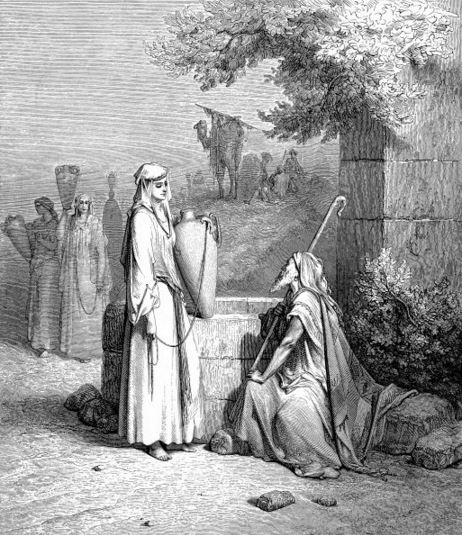
‘Eliezer and Rebekah’ by Gustav Doré

In this week’s parasha, Lech Lecha, we are introduced to Abraham’s loyal servant, Eliezer (Genesis 15:2). Eliezer was a righteous man and wanted nothing more than to be a full-fledged part of Israel. He hoped to marry into Abraham’s family, too, but because he was a Canaanite, and the Canaanites were deemed cursed, it was not possible. Nonetheless, the Arizal (Sha’ar haPesukim on Chayei Sarah) explains that in his future life, Eliezer reincarnated in none other than Caleb, the righteous spy and leader from the Tribe of Judah. In fact, the Arizal explains that this is why Caleb went to visit the Cave of the Patriarchs in Hebron at the start of his spy mission (Sotah 34b). He specifically wanted to pray at the grave of his former master, Abraham, and hoped that just as Abraham had helped him in his past life, he would assist him again in the difficult journey he was on.

Interestingly, the minor Talmudic tractate Derekh Eretz Zuta actually states that Eliezer was one of nine immortal people who never died. These special people merited to enter the Garden of Eden alive and well. As a quick aside, Derekh Eretz Zuta is a fascinating tractate that reads like Pirkei Avot, with maxims from the Sages on ethics, morals, and life advice. It begins with the following statement:

The ways of a scholar are that he is meek, humble, alert, fulfilled, modest, and beloved by all. He is humble to the members of his household, sin-fearing, and judges people according to their deeds. He says “I have no desire for all the things of this world because this world is not for me.” He sits and studies, dusting his cloak at the feet of the scholars. In him no one sees any evil. He questions according to the subject-matter and answers to the point.

The last three verses in the first chapter tell us about some of the greatest figures in Jewish history. First the tractate points out (with citations to prove it) that God forged a covenant with seven people in Tanakh: Abraham, Isaac, Jacob, Moses, Aaron, Pinchas, and David. One might notice that these are nearly the same as the Seven Shepherds made popular by the Sukkot ushpizin, with the exception being Pinchas in place of Joseph. The truth is that Pinchas and Joseph are spiritually linked, with Pinchas containing a spark of Joseph. Kol HaTor (Ch. 2) even states that Pinchas was the potential “Mashiach ben Yosef” of his generation. There is mathematical proof to this, too, with “Pinchas” (פינחס) being 208, exactly like “Ben Yosef” (בן יוסף).

We are then told that seven people were so righteous and holy that their bodies never decomposed: Abraham, Isaac, Jacob, Moses, Aaron, Miriam, and Amram. Some also add David to this list. Finally, the chapter ends with nine people who merited to enter the heavenly Garden of Eden alive: Enoch, Eliyahu, Mashiach, Eliezer, King Hiram, Eved-Melekh the Cushite, Yaavetz “the son of Rabbi Yehuda HaNasi”, Batya the daughter of Pharaoh, and Serach bat Asher. Some add a tenth person to the list: Rabbi Yehoshua ben Levi. What was so great about these individuals?  Continue reading →

Metatron & the Book of Enoch

What really happened to Enoch when God “took him”? Who is the mysterious angel Metatron? And why did Rabbi Elisha ben Avuya become a heretic after seeing him in Heaven? Find out in the class below, where we also compare the three Books of Enoch, discuss Azazel and the Watchers, and uncover the true identity of the Biblical “Son of Man”. Also: who was the teacher of Moses and how did Joseph know 70 languages?

For lots more on the Four Who Entered Pardes and a different interpretation of Elisha’s vision of Metatron, see here.

See also ‘Who is Metatron?’

For part one of the series on the Apocrypha, see here.

For the class on the Watchers and the Book of Jubilees, see here.