
Tag Archives: Mishneh Torah

Ten Rectifications for Judaism

As we prepare to usher in another new year, we pray fervently that it will be the one in which we finally see the completion of the Geulah, the great redemption of our people, followed by the transformation of the entire world into a more wholesome, peaceful, and divine place. As we listen to the shofar on Rosh Hashanah, we hope it will be the great shofar that will herald the coming of Mashiach (Isaiah 27:13). We hope that it will be the final Judgement Day, and that we will all be inscribed in the Book of Life for good. But as we yearn for these things, it is vital to ask: what are we doing practically to bring about that reality? There are so many issues and threats confronting us both externally and internally. And we know that, at the end of day, all of these things come not from various political opponents, or antisemites, or military powers, or terrorists, or propagandists—but straight from Hashem.

God tells us over and over again in the Torah that if we follow his mitzvot properly then we will be safe, blessed, and prosperous. It’s only when we don’t that all the suffering and travails come upon us. So, as a nation, we are obviously doing something wrong here. Yes, as we all know, we are lacking unity. There is a lot of disagreement and infighting, and many within the house of Israel remain secular and disconnected. But we rarely ask why this is the case, and what we can actually do to fix it. It’s like we’ve helplessly accepted the status quo, as if there’s nothing we can do about it. When our Sages list all the things wrong with the world before Mashiach comes (Sotah 49b), they conclude by saying “there is no one to rely on except our Father in Heaven”. Some of our rabbis understood this concluding statement as being part of the list of things wrong with the world, ie. that people have given up and say there is nothing we can do but wait for Hashem!

The truth is that God is waiting for us. This was precisely the case at the Splitting of the Sea, when Moses prayed fervently to Hashem and Hashem replied: ma titzak alai?! “Why are you calling out to Me?!” (Exodus 14:15) It was Nachshon who understood what had to be done, and when everyone else stood back passively; crying, stressing, waiting; he decided to dive into the water. Only then did the Sea split. Today we are, yet again, at another splitting of the sea moment, right at the finish line of Geulah, and we all need to be Nachshon right now. So, what can we do? How do we actually solve the lack of unity? How do we address the widespread secularism and materialism? How do we bring people back to Hashem, back to Torah and mitzvot, to a “Geulah mindset”? How do we shift away from passively waiting to actively doing? In short, how do we bring Mashiach? Continue reading
Mysteries & Secrets of Tefillin

At the end of this week’s parasha, Ekev, we read one of four passages in the Torah that speak of the great mitzvah of tefillin. In the list of 613, tefillin is actually two separate mitzvot—one for the head, and one for the arm. Some even say that tefillin counts as eight mitzvot, since we should multiply by four for the four times the Torah speaks of it! (Menachot 44a) Today, the mitzvah of tefillin is one of the best-known practices in all of Judaism, thanks in large part to the Lubavitcher Rebbe’s tefillin campaign starting in 1967, in the days leading up to the miraculous Six-Day War. We find many Jews who are otherwise secular or unaffiliated still laying tefillin every day. Following October 7, demand for tefillin was so high that there were reportedly shortages. Yet, tefillin binding hasn’t always been so widespread and well-known.

The Talmud (Berakhot 47a) suggests that one thing distinguishing Torah scholars (talmidei chakhamim) from the general public (am ha’aretz) is that the latter do not don tefillin. Even in responsa literature from the times of the Geonim (roughly 500-1000 CE), we find Jews asking if tefillin should be worn by all Jewish men, or if it was specifically reserved for great rabbis and Torah scholars. More puzzling still, we find that no other prophet besides Moses speaks of them, and there is no explicit mention of tefillin anywhere in the rest of Tanakh. Nor is there any historical or archaeological evidence of tefillin prior to about two millennia ago. Tefillin may just be the most mysterious Torah mitzvah we have. Where did it really come from, and what secrets does it contain? Continue reading

Understanding Hair Covering for Women in Jewish Law

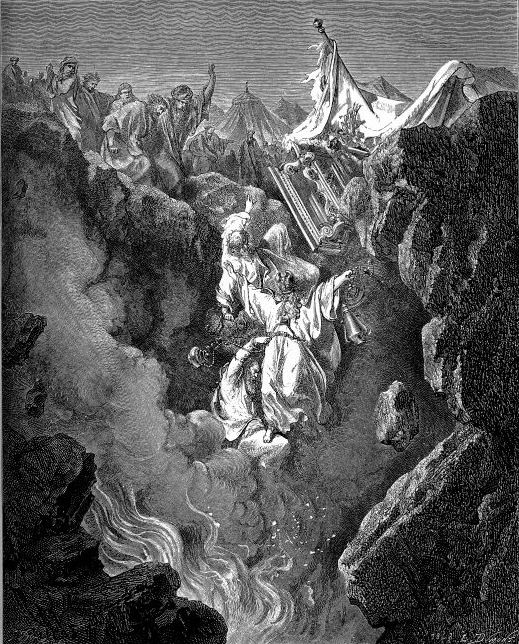
“Death of Korah, Dathan, and Abiram” by Gustave Doré

This week’s parasha, Korach, has a hidden theme: hair. In fact, the name of the villain himself, Korach (קרח), is spelled exactly the same way as kere’ach, “bald”. As we shall see below, Korach’s rebellion began when he saw himself bald-headed following his initiation ritual as a Levite. Hair comes up again in the famous story of one of Korach’s co-conspirators, a man named On ben Pelet. On is strangely mentioned right at the beginning of the parasha (Numbers 16:1), and never again. The Talmud (Sanhedrin 109b-110a) explains that he was saved thanks to his wife: She told her husband that he had nothing to gain from joining the rebellion; now he was subservient to Moses, and if the rebellion would be successful he would just become subservient to Korach!

On understood, but worried that he had already agreed to join the group. So, his clever wife got him drunk and sleepy, and On passed out in bed. Meanwhile, she went out to the entrance of their tent and “exposed her hair”. When Korach’s collaborators approached, the Talmud says they turned away due to the immodest sight of the woman. By the time On recovered from his drunken stupor, the whole episode was over, and he was spared. This story implies that Jewish women cover their hair, and for a woman to expose her hair publicly is immodest. Yet, nowhere in the Torah is there an explicit command for a Jew to cover their hair at all times (male or female). Hair-covering is not listed among the 613 mitzvot! If it isn’t a Torah mitzvah, where did it come from? Continue reading