Tag Archives: Reincarnation

How Many Soulmates Do You Have?

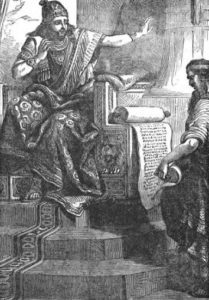
An 1873 illustration of King Josiah (Yoshiyahu) listening to a reading of the Torah

In this week’s parasha, Shoftim, the Torah relates the laws pertaining to Jewish kings. According to the Torah, the king of the Jews is not, and should not be, like the king of other nations. His primarily role is not to be a dictator or a conqueror. Rather, he must act like a divine messenger of God, and his duty is to ensure the observance of Torah law throughout the Holy Land. This is why we read across the Tanakh how the best Jewish kings—like Hezekiah and Josiah—were the ones that expunged idolatry from Israel and restored proper spirituality.

It is also why we see on several occasions in the Book of Shoftim (not to be confused with this week’s parasha of the same name) that the time before kings was lawless: “…there was no king in Israel; every man did that which was right in his own eyes.” (Judges 21:25) The Jewish king, therefore, is like God’s representative on Earth. In this regard, he is likened to an angel, which is why the term for a king, melekh (מלך), is nearly identical and shares the same root with the word for an angel, malakh (מלאך).

Not surprisingly, the Jewish king is held to a very high standard. The Torah (Deuteronomy 17:16-20) tells us that he:

may not acquire many horses for himself… And he shall not take many wives for himself, and his heart must not turn away, and he shall not acquire much silver and gold for himself. And it will be, when he sits upon his royal throne, that he shall write for himself two copies of this Torah on a scroll, before the priests. And it shall be with him, and he shall read it all the days of his life, so that he may learn to fear Hashem, his God, to keep all the words of this Torah and these statutes, to perform them, so that his heart will not be haughty over his brothers, and so that he will not turn away from the commandment, either to the right or to the left, in order that he may prolong [his] days in his kingdom, he and his sons, among Israel.

The Talmud discusses the finer points of these rules. One of the questions the Sages ask is: How many wives is too many? (Sanhedrin 21a) The Mishnah states the maximum is eighteen wives. Rav Yehuda then opines that a king can take more wives, as long as they will not “turn his heart astray”. Rabbi Shimon insists that even a single wife might turn her husband’s heart astray, and thus, the king must not take more than eighteen “even if they be women like Abigail”. Abigail, of course, was one of the righteous wives of King David, who is listed among the seven female prophetesses of Judaism.

In fact, the Talmud derives the maximum of eighteen wives from the case of King David:

Whence do we deduce the number eighteen? From the verse, “And unto David were sons born in Hebron; and his firstborn was Amnon of Ahinoam the Jezraelite; the second, Khilav of Abigail, the [former] wife of Naval the Carmelite; the third, Avshalom the son of Maacah; and the fourth, Adoniyah the son of Hagit; and the fifth, Shefatiah the son of Avital; and the sixth, Ithream of Eglah, David’s wife. These were born to David in Hebron.” (II Samuel 3:2-5) And of them the Prophet [Nathan] said: “And if that were too little, then would I add unto thee the like of these, and the like of these” (II Samuel 12:8), each “these” implying six, which, with the original six, makes eighteen in all.

Scripture tells us that David had six wives while he reigned from Hebron during his first seven years: Ahinoam, Abigail, Maacah, Hagit, Avital, and Eglah. When his court prophet Nathan recounted how he had once blessed him, he said he would multiply the king’s wealth (and wives) kahena v’kahena, more and more “like these”. This implies that David would have, or potentially could have, eighteen wives.

The Talmud continues to cite the opinion of Ravina, who believed that each kahena refers not to six, but twelve. He holds that David had six wives, the blessing was to double that to twelve, and “if that were too little”—as Nathan said—then he would multiple them kahena v’kahena. Thus, Ravina reasons that the maximum is twenty-four wives, not eighteen. The Talmud admits that there is an alternate Mishnaic teaching that 24 is the maximum, and yet another teaching that the maximum is 48. The latter comes from the fact that there is a letter vav in the term, meaning 24 and another 24! Nonetheless, the accepted tradition is a maximum of 18 wives, and no more.

The Talmud interestingly points out a potential flaw: wasn’t David also married to Michal, the daughter of King Saul, while in Hebron? The Sages conclude that Michal is the same person as Eglah. They then raise the following issue: how could Michal be Eglah if the Tanakh states Michal was childless while Eglah gave David a son? In a classic Talmudic interpretation, the Sages take the verse “Michal the daughter of Saul had no child until the day of her death” (II Samuel 6:23) to mean that she did not have children until her death, and died in childbirth. So, she finally had a child on the day of her death.

The Kabbalah of Soulmates

The Arizal (Rabbi Itzchak Luria, 1534-1572) gives a deeper, mystical answer to why the maximum number of wives for a king is eighteen. The implications of his teachings are not just relevant to kings, but to every Jew. While we generally think of a person as having a single soulmate, the Arizal explains that a person actually has eighteen soulmates (see, for example, Sha’ar HaMitzvot on this week’s parasha). Why would a person need eighteen soulmates?

The Talmud (Sotah 2a) famously states that “forty days before conception a Bat Kol [Heavenly Voice] proclaims: the daughter of so-and-so is destined for so-and-so…” The same passage states that pairing a person with their soulmate is “as difficult as the Splitting of the Sea”. The Midrash adds to this that ever since the Splitting of the Sea, God is busy making matches between people (Pesikta d’Rav Kahana 2:4). The Sages conclude that a person’s first match is pre-destined, while a second or subsequent match (if the first marriage fell through) becomes as difficult as splitting a sea.

The central issue that all of this rests on is free will. While a person does have a perfect, pre-destined match, free will can very easily get in the way and ruin things. For example, person A is destined to be with person B, but A makes some really poor decisions in life and ends up in a bad place (or dead). Does that mean B is now condemned to spend the rest of their life without their rightful soulmate? Must they now hopelessly struggle in search of the “right one” or be miserable in a series of failed relationships for the rest of their life, through no fault of their own? Surely, the Most Merciful God would not allow this to happen. And so, He spends all of His time “making matches”, finding alternate soulmates.

For this reason, a person has up to 18 different soulmates designated for them. If, due to free will, the match of A and B doesn’t work, there is always A and C. And if C, too, decides to move to the other side of the world, there’s a D behind them. Granted, the Arizal puts the soulmates in hierarchical fashion: D is not as good as C, nor is C as good as B—but they are all matching souls for A nonetheless. Of course, each of B, C, and D have 18 of their own soulmates, so one can see how complicated this matchmaking game becomes—“as difficult as the Splitting of the Sea”. The Arizal notes that 18 is a maximum, and not necessarily will there be 18 soulmates for a person alive all at once. Elsewhere, the Arizal explains that a person who does not find one of their soulmates will reincarnate to try again in a future life, as might one who needs to unite with a better soulmate, higher up on the chain of 18.

This brings us back to the first question: why is a king allowed up to, but no more than, 18 wives? A king, like every person, has up to 18 soulmates. He may choose to seek out and find all 18 of them, to unite with all of his soulmates. However, he must not take even a single wife more, for a nineteenth wife would certainly not be a soulmate. A king should not be taking a wife or concubine solely for pleasure. He may have more than one (and this may even be a political necessity), but only on the condition that she is one of his soulmates anyway.

The Kabbalah of David and Batsheva

The above discussion helps to explain the Talmudic dictum that one who believes David sinned with Batsheva is mistaken (Shabbat 56a). Recall that Batsheva was the wife of Uriah the Hittite, one of David’s generals. When Uriah was away in battle, David spotted Batsheva bathing and ended up sleeping with her. She would become pregnant, and to hide the sin, David ultimately placed Uriah in a situation where he would die in battle.

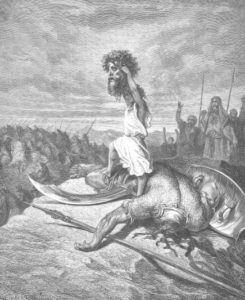
‘David and Goliath’ by Gustave Doré

From a mystical perspective, Batsheva was one of David’s 18 soulmates. In fact, she was his #1, and the two had been matched by God all the way back in the “six days of Creation” (Sanhedrin 107a). The Midrash relates that it was David’s own hubris that prevented him from marrying her. When David had defeated Goliath, he wanted (or needed) to decapitate the giant with his own sword. At the time, Uriah the Hittite happened to be the attendant of Goliath. David promised Uriah the best woman in Israel if Uriah would only provide him with Goliath’s sword. Uriah did so. He later became a righteous convert, and one of David’s greatest warriors. (This is why he is called a Hittite, for he was not originally Jewish.)

At the same time that David made the promise to Uriah, God made a decree in Heaven: Because of David’s haughty and immodest offer to distribute the daughters of Israel, God will mete out his punishment by giving away his very own soulmate to Uriah! What David did with Batsheva was certainly a sin, and the Talmud (ibid.) recounts how severely he was punished, including six months of intense leprosy in addition to the punishments already enumerated in Scripture. Yet, Batsheva was his rightful soulmate, and would go on to produce his rightful heir, King Solomon. The Talmud concludes that David simply rushed to be with her. Uriah was destined to die soon enough anyway, and then David could marry Batsheva with no issues.

The Kabbalists see David and Batsheva rushing to be with each other as a replay of Adam and Eve rushing to consume the Forbidden Fruit. Had Adam and Eve waited until Shabbat, they would have been permitted to eat from the Tree of Knowledge. David and Batsheva, too, needed only to wait a little longer. The connection between the two couples is deeper than that, for David and Batsheva were none other than the reincarnations of Adam and Eve. They had the opportunity to complete a great tikkun, a rectification for that primordial sin. (In some ways, so does every young couple that must wait until marriage to be intimate in holiness.) Alas, they failed, and the same souls will return one last time in Mashiach and his wife to finally fulfil the task.

(For more on the Adam-David-Mashiach connection, see here.)


The above essay is adapted from Garments of Light, Volume Three.
Get the book here! 

Did Moses Have a Black Wife?

Towards the end of this week’s Torah portion, Beha’alotcha, we read that “Miriam and Aaron spoke against Moses because of the Cushite woman whom he had married, for he had married a Cushite woman.” (Numbers 12:1) This verse brings up many big questions, and the Sages grapple with its meaning. Who is this Cushite woman? When did Moses marry her? Why did Miriam and Aaron speak “against” Moses because of her? Why the superfluous phrasing of mentioning twice that he married the Cushite woman? What does “Cushite” even mean?

Traditionally, there are two main ways of looking at this passage: either Moses actually took on a second wife in addition to his wife Tzipporah, or the term “Cushite” simply refers to Tzipporah herself. The second interpretation is problematic, since we know Tzipporah was a Midianite, not a Cushite. The term “Cushite” generally refers to the people of Cush, or Ethiopia, and more broadly refers to all black people or Africans. Scripture does connect the Cushites with the Midianites in one verse (Habakkuk 3:7), which some use as proof that the Midianites were sometimes referred to as Cushites, or had particularly dark skin.

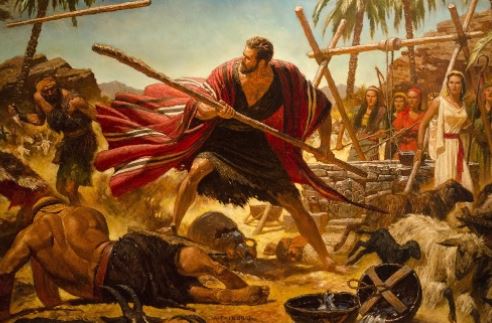
‘The Fight at Jethro’s Well’ – where Moses first meets Tzipporah – scene from ‘The Ten Commandments’ (1953) painted by Arnold Friberg.

Rashi (Rabbi Shlomo Itzchaki, 1040-1105) prefers the second interpretation. He says that Tzipporah was called a “Cushite” because she was very beautiful. He cites Midrash Tanchuma in stating that just as everyone can immediately identify a black person (Cushite), everyone immediately recognized the incomparable beauty of Tzipporah. The same Midrash offers another possibility: apparently if a person had a very beautiful child in those days, they would call them “Cushite” to ward off the evil eye. This suggests that a Cushite was not considered beautiful at all, yet Rashi provides a numerical proof that Cushite does indeed mean “beautiful”, since the gematria of Cushite (כושית) is 736, equal to “beautiful in appearance” (יפת מראה), the term frequently used in the Torah to describe beauty.

If the Cushite is Tzipporah, then why did Miriam and Aaron suddenly have a problem with her? Rashi cites one classic answer: because Moses had become so holy—recall how after coming down Sinai, his skin glowed with such a blinding light that he had to wear a mask over his face—he had essentially removed himself from this material world. This means he was no longer intimate with his wife Tzipporah. Miriam had learned of this, and thought Moses was in error for doing so.

Unlike certain other religions, Judaism does not preach celibacy, and does not require complete abstinence to remain holy and pure. Conversely, Judaism holds that sexual intimacy is an important aspect of spiritual growth. The famous Iggeret HaKodesh (the “Holy Letter”, often attributed to the Ramban, Rabbi Moshe ben Nachman, 1194-1270, but more likely written by Rabbi Joseph Gikatilla, 1248-1305) writes that it is specifically during sexual union (if done correctly and in holiness) that a man and woman can bring down and experience the Shekhinah, God’s divine presence.

As such, Miriam and Aaron came to their little brother and admonished him for separating from his wife. This is why the Torah goes on to state that “They said, ‘Has God spoken only to Moses? Hasn’t He spoken to us too?’” (Numbers 12:2) Miriam and Aaron argued that they, too, were prophets, and they clearly had no need to separate from their own spouses! Moses was so humble and modest that he did not respond at all: “…Moses was exceedingly humble, more so than any person on the face of the earth.” (Numbers 12:3)

God immediately interjected and summoned Miriam and Aaron to the Ohel Mo’ed, the “Tent of Meeting”, where He regularly conversed with Moses. God told them:

If there be prophets among you, I will make Myself known to him in a vision; I will speak to him in a dream. Not so My servant Moses; he is faithful throughout My house. With him I speak mouth to mouth; in [plain] sight and not in riddles, and he beholds the image of the Lord…

God makes it clear to Miriam and Aaron that although they are also prophets, they are nowhere near the level of Moses. In all of history, Moses alone was able to speak to God “face to face”, while in a conscious, awake state. All other prophets only communed with God through dreams or visions, while asleep or entranced.

By juxtaposing the fact that Moses was the humblest man of all time, and also the greatest prophet of all time, the Torah may be teaching us that the key to real spiritual greatness is humility. Moses had completely subdued his ego, and so he merited to be filled with Godliness. Fittingly, the Talmud (Sotah 5a) states that where there is an ego, there cannot be a Godly presence, because a person with a big ego essentially sees themselves as a god—and there cannot be two gods! “Every man in whom there is haughtiness of spirit, the Holy One, blessed be He, declares: ‘I and he cannot both dwell in the world.’”

Moses Had a Black Wife

The explanation above is certainly a wonderful one, yet it is hard to ignore the plain meaning of the text: that Moses actually married a Cushite woman. The repetitive phrasing of the verse seems like it really wants us to believe he had taken another wife. And many of the Sages agree. However, Moses hadn’t married her at this point in time, but many years earlier. The Midrash describes in great detail what Moses was up to between the time that he fled Egypt and arrived in Midian. After all, he had fled as a young man, and returned to Egypt in his 80th year. What did he do during all those intervening decades?

The Midrash (Yalkut Shimoni, Shemot 168) says that Moses initially fled to Cush. At the time, the Cushites had lost their capital in a war and were unsuccessful in recapturing it. Their king, named Koknus (קוקנוס, elsewhere called Kikanos or Kikianus), fought a nine-year war that he was unable to win, and then died. The Cushites sought a strong ruler to help them finally end the conflict. They chose Moses, presumably because he had fought alongside the Cushites and had a reputation as a great warrior. Moses did not disappoint, and devised a plan to win the war and recapture the Cushite capital. (His enemy was none other than Bilaam!) The grateful Cushites gave Moses the royal widow of Koknus for a wife, and placed him upon the throne.

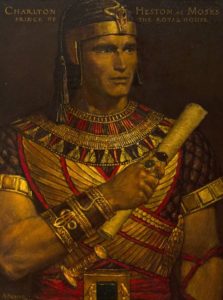
Charlton Heston as Egyptian General Moses, also by Arnold Friberg

This Midrash is very ancient, and was already attested to by the Jewish-Roman historian Josephus (37-100 CE). Josephus writes (Antiquities, II, 10:239 et seq.) a slightly different version of the story, with Moses leading an Egyptian army against the Cushites. The Cushite princess, named Tharbis, watches the battle and falls in love with the valiant Moses. She goes on to help him win the battle, and he fulfils his promise in return to marry her. In some versions, Moses eventually produces a special ring that causes one to forget certain events, and puts it upon Tharbis so that she can forget him. He then returns to Egypt.

So, Moses married a Cushite queen. Yet, he remembered “what Abraham had cautioned his servant Eliezer” about intermarriage, and abstained from touching her. (If you are wondering how Moses later married Tzipporah, who was not an Israelite, remember that the Midianites are also descendants of Abraham through his wife Keturah, see Genesis 25:2. Thus, Moses still married within the extended family of Abrahamites.) Although Moses married the Cushite queen, he never consummated the marriage. The Midrash says he reigned over a prosperous Cush for forty years until his Cushite wife couldn’t take the celibacy anymore and complained to the wise men of Cush. Moses abdicated his throne and finally left Ethiopia. He was 67 years old at the time.

All of this was kept secret until it came out publicly in this week’s parasha. This is a terrific version of the story, but it doesn’t answer why Miriam and Aaron complained to Moses. For this we must look to the mysticism of the Arizal.

Soulmates of Moses

The Arizal cites the above Midrash in a number of places (see Sefer Likutei Torah and Sha’ar HaPesukim on this week’s parasha, as well as Sha’ar HaMitzvot on parashat Shoftim). He explains that both Tzipporah and the Cushite were Moses’ soulmates. This is because Moses was a reincarnation of Abel, who had two wives according to one tradition. This was the reason for the dispute between Cain and Abel, resulting in the latter’s death. Cain was born with a twin sister, and Abel was born with two twin sisters (otherwise, with whom would they reproduce?) Cain reasoned that he should have two wives since he was the older brother, and the elder always deserves a double portion. Abel reasoned that he should have the second wife since, after all, she was his twin! Cain ultimately killed Abel over that second wife.

Therefore, the Arizal explains that Cain reincarnated in Jethro, and Abel in Moses. This is why Jethro gave his daughter Tzipporah to Moses, thus rectifying his past sin by “returning” the wife that he had stolen.* Moses’ other spiritual twin was the Cushite woman. The Arizal suggests that Miriam and Aaron were aware of this, and were frustrated that Moses did not consummate his marriage to the Cushite, for she was his true soulmate! Apparently, after the Exodus Moses summoned the Cushite woman and she happily joined the Israelites and converted to Judaism. The Arizal explains that this was a necessary tikkun, a spiritual rectification for her lofty soul. However, he could not consummate the marriage because her soul originated from a place of intense dinim gemurim, strict judgement and severity. It appears that when Miriam heard about his abstention from his wife, she complained to Moses, failing to grasp that a soul as pure as Moses’ had different requirements.

Whatever the case may be, the root of the matter is Moses’ separation from his wife (or wives). Having said all that, there is a third possibility. This comes from a simple reading of the Torah text, and the lesson that we learn from it is particularly relevant today.

Black or White

When we read the first two verses of Numbers 12 in isolation, we might be led to believe that Miriam and Aaron had a problem with Moses marrying a black woman. Was there a hint of racism in their complaint, or did they just genuinely wonder whether an Israelite was allowed to marry a black person? Either way, we see how perfectly the punishment fits the crime: “… Behold, Miriam was afflicted with tzara’aat, [as white] as snow.” (Numbers 12:10)

If the issue was about Moses separating from his wife, it isn’t clear why Miriam would be punished with tzara’at (loosely translated as “leprosy”). Rashi, for one, does not seem to offer a clear explanation why this in particular was her punishment. Of course, we know that God doesn’t really “punish”, and simply metes out justice, middah k’neged middah, “measure for measure”. It is therefore totally fitting that in complaining about Moses taking a black woman as a wife, Miriam’s own skin is turned white “like snow”. Perhaps God wanted to remind her that she is not so white herself.

We can learn from this that there really is no place for racism in Judaism. In fact, God explicitly compares the Israelites to the Cushites (Amos 9:7), and maintains that He is not the God of the Jews alone, but the God of all peoples: “‘Are you not as the children of the Cushites unto Me, O children of Israel?’ Said Hashem. ‘Have I not brought up Israel out of the land of Egypt, [just as I brought] the Philistines from Caphtor, and Aram from Kir?’” Among a list of nine holy people that merited to enter Heaven alive, without ever dying, the Sages include a Cushite man named Eved-Melekh (Derekh Eretz Zuta 1:43, see Jeremiah 39:16).

At the end of the day, there is no reason to hold prejudice against anyone, or discriminate against any individual at all, as the Midrash (Yalkut Shimoni, Shoftim 42) clearly states:

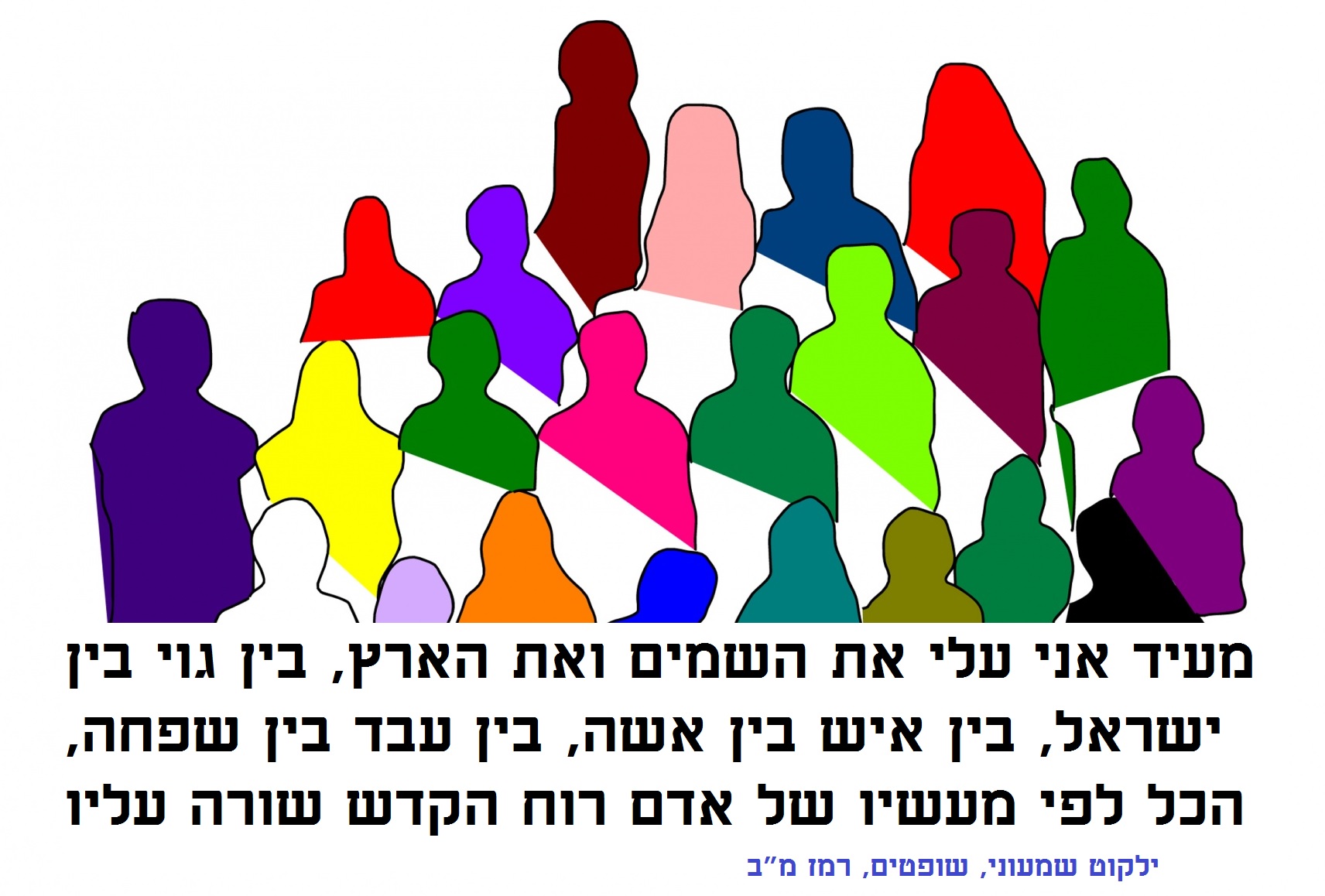
I bring Heaven and Earth to witness that the Divine Spirit may rest upon a non-Jew as well as a Jew, upon a woman as well as a man, upon a maidservant as well as a manservant. All depends on the deeds of the particular individual.

*The Arizal actually writes how Cain reincarnated in three people: Korach, Jethro, and the Egyptian taskmaster that Moses killed before fleeing Egypt. The rectification for the improper dispute between Cain and Abel was rectified in the dispute between Korach and Moses, with Moses’ victory. The rectification for the stolen wife was fulfilled by Jethro. And the rectification for Cain murdering Abel was that Moses, in return, killed the Egyptian taskmaster. Thus, all the rectifications were complete. We can see a hint in the name Cain (קין) to his three future incarnations: the ק for Korach (קרח), the י for Jethro (יתרו), and the ן for the Egyptian, whose name we don’t know but perhaps it started with a nun!


The above essay is adapted from Garments of Light, Volume Three.
Get the book here! 

Is Your Brain a Quantum Computer? (A Scientific Explanation for the Soul and Afterlife)

This week’s parasha, Chayei Sarah, begins with the passing of the matriarch Sarah. The Torah states that “the lives of Sarah were one hundred years, and twenty years, and seven years…” Traditionally, two big questions were asked of this verse: the first is why the Torah describes her life as one hundred, twenty, and seven years instead of simply saying that she was 127 years old when she died. The second is why the Torah says these were the lives of Sarah, instead of life in the singular, especially in light of the fact that the parasha actually describes her death, not life!

The classic answer to the first question is that Sarah was as beautiful at 100 as she was at 20, and she was as pure at 20 as she was at 7 years old. The answer to the second question, as we’ve explored in the past (see ‘A Mystical Journey through the Lives of Sarah’ in Garments of Light), is that Sarah – or at least a part of her soul – was immediately reincarnated in Rebecca, and thus Sarah’s life and life’s work continued with her future daughter-in-law. In general, the word for “life” in Hebrew is in plural, chaim, which alludes to the fact that there are really two lives: the transient life in this current physical world, and the everlasting life of the soul.

Today, many question (or outright reject) the possibility of an afterlife. Such people argue that there is no evidence or scientifically plausible explanation for such things. When the body dies, the person dies with it, and that’s it. In reality, there is a great deal of evidence to support the notion of a soul and an afterlife, and even one solid scientific explanation that is slowly gaining popularity and acceptance.

The Quantum Brain

Although there have been millions of cases of “near death experiences” and medically-induced “clinical deaths”—many of which end with the victim or patient describing other worlds and relating accurate information that would have been impossible for them to know—these are all relegated to “anecdotal evidence” and generally not taken seriously in the scientific community. We can put all of that aside (together with countless people’s personal stories of prophetic dreams and premonitions, “out-of-body” experiences, miraculous occurrences, and other inexplicable phenomena), and focus strictly on accepted science.

In recent decades, neurologists studying the human brain have sought to uncover what it is that generates consciousness and actually makes the brain work. Why and how is it that this network of cells produces a “mind”? Biology and chemistry have given us the general mechanisms of electrical signals and neurotransmitters, but have not been able to answer the real fundamental questions. To solve the mystery actually requires the most complex of sciences: quantum physics.

In 1989, world-renowned physicist Sir Roger Penrose published The Emperor’s New Mind in which he argued that classical physics simply cannot explain consciousness, nor can the brain be compared in any way to a typical computer, or be explained with familiar algorithms. Penrose suggested that the only plausible explanation for consciousness can come from quantum physics.

To go into the major principles of quantum physics is far beyond our scope. Indeed, one of the great quantum physicists, Richard Feynman, once noted: “I think I can safely say that nobody understands quantum mechanics.” Suffice it to say that quantum physics has completely revolutionized science and our entire understanding of reality. It has turned the universe into a funky place where just about anything is possible, and where things at the sub-atomic level behave in totally bizarre ways. Niels Bohr, one of the early quantum physicists (and a Nobel Prize winner) offered that “If quantum mechanics hasn’t profoundly shocked you, you haven’t understood it yet.” Meanwhile, the man who is often called “the father of quantum physics”, Max Planck, stated:

As a man who has devoted his whole life to the most clear headed science, to the study of matter, I can tell you as a result of my research about atoms this much: There is no matter as such. All matter originates and exists only by virtue of a force which brings the particle of an atom to vibration and holds this most minute solar system of the atom together. We must assume behind this force the existence of a conscious and intelligent mind. This mind is the matrix of all matter.

From his lifetime of studies, Planck concluded that reality as we know it doesn’t exist, and all of matter is held together by some kind of universal mind or consciousness. Building on these ideas, and the complex math and science behind them, Penrose proposed that the brain is a “quantum computer” of sorts, and may be intricately linked to the very fabric of the universe.

Quantum Biology and the Soul

Penrose’s hypothesis inspired a psychology professor in Arizona named Stuart Hameroff. As a practicing anesthesiologist, Hameroff knew that anesthesia works by shutting down small proteins inside neurons called microtubules, and this shuts off a person’s consciousness. Penrose and Hameroff teamed up to continue researching the possibility of the brain as quantum computer. Incredibly, their conclusions suggest that the brain can actually store its quantum information in the universe itself, so that even if the brain was to die, its information would not die with it. That information can be held indefinitely in the universe, and can return to a revived brain, or even into another brain. This would explain near death experiences and clinical deaths, and provides a scientific explanation for reincarnation and a life after death. The death of the body does not at all mean the death of the person, or that person’s memories and thoughts.

While there are those who are quick to criticize the theory and reject it, no one has been able to actually refute it. In fact, since the theory was first proposed, more and more evidence has accumulated to support it. In 2014, quantum biologist Anirban Bandyopadhyay (based in Japan’s National Institute for Materials Science and a visiting professor at MIT) successfully demonstrated the quantum activity of microtubules.

It appears that science has finally discovered the soul. There are now valid, empirical evidence-based theories to explain the existence of an eternal mind or spirit, a universal consciousness, the possibility of an afterlife and reincarnation. The scientific community needs to stop aggressively denying anything that seems “spiritual”, and instead delve deeper into this exciting and promising new field. This sentiment was already expressed long ago by Nikola Tesla, considered by many to be the greatest scientist of all time: “The day science begins to study non-physical phenomena, it will make more progress in one decade than in all the previous centuries of its existence.” It was the genius Tesla who first noted that his brain “is only a receiver,” and stated that “In the Universe there is a core from which we obtain knowledge, strength, inspiration. I have not penetrated into the secrets of this core, but I know it exists.”


The above is an excerpt from Garments of Light, Volume Two. Get the book here