
Tag Archives: Septuagint

Mysteries & Secrets of Tefillin

At the end of this week’s parasha, Ekev, we read one of four passages in the Torah that speak of the great mitzvah of tefillin. In the list of 613, tefillin is actually two separate mitzvot—one for the head, and one for the arm. Some even say that tefillin counts as eight mitzvot, since we should multiply by four for the four times the Torah speaks of it! (Menachot 44a) Today, the mitzvah of tefillin is one of the best-known practices in all of Judaism, thanks in large part to the Lubavitcher Rebbe’s tefillin campaign starting in 1967, in the days leading up to the miraculous Six-Day War. We find many Jews who are otherwise secular or unaffiliated still laying tefillin every day. Following October 7, demand for tefillin was so high that there were reportedly shortages. Yet, tefillin binding hasn’t always been so widespread and well-known.

The Talmud (Berakhot 47a) suggests that one thing distinguishing Torah scholars (talmidei chakhamim) from the general public (am ha’aretz) is that the latter do not don tefillin. Even in responsa literature from the times of the Geonim (roughly 500-1000 CE), we find Jews asking if tefillin should be worn by all Jewish men, or if it was specifically reserved for great rabbis and Torah scholars. More puzzling still, we find that no other prophet besides Moses speaks of them, and there is no explicit mention of tefillin anywhere in the rest of Tanakh. Nor is there any historical or archaeological evidence of tefillin prior to about two millennia ago. Tefillin may just be the most mysterious Torah mitzvah we have. Where did it really come from, and what secrets does it contain? Continue reading
Understanding Names of God #4: Shaddai, Elyon, Ehyeh

What is the true meaning of the name El Shaddai? What did the Ark of the Covenant actually look like? Who is El Elyon? Adam Kadmon? What are the 41- and 72- and 216-Letter Names of God? And what are the secrets hidden in the name Ehyeh Asher Ehyeh (“I Will be What I Will Be”)? Find out in this eye-opening concluding installment of the series. Also: What is the esoteric meaning of Jacob’s sheep? Is the Torah text we have today identical to the Dead Sea Scrolls and other ancient manuscripts? And which name of God is most-associated with the forthcoming Final Redemption?

Can a Virgin Get Pregnant?

Kohanim and Kohen Gadol

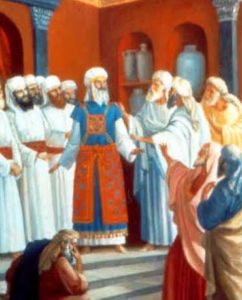
At the beginning of this week’s parasha, Emor, we learn of the various requirements and obligations placed upon the priestly class of kohanim. For the high priest in particular, he must marry only a virgin (Leviticus 21:13). The Talmud asks a perplexing question on this law: is a kohen gadol allowed to marry a virgin who is pregnant? (Chagigah 14b-15a) At first glance, the question seems silly and irrelevant, for how could a virgin ever be pregnant? However, when placed in context, the question has major theological significance.

The question of the pregnant virgin appears in the Talmud (Chagigah 14b-15a) immediately after the story of the four Sages who ascended to the Heavenly realms, Pardes. It was posed specifically to Shimon ben Zoma, one of those four mystics, upon his return. To understand it, we must remember that the Pardes event took place some time in the first third of the second century CE. This was an era when Christianity was already spreading rapidly and, as discussed in depth before, one of Ben Zoma’s contemporaries that went to Pardes with him, Elisha ben Avuya, subsequently became a Christian! Of the four that went up, Shimon ben Azzai never came back, Elisha ben Avuya became a Christian, while Rabbi Akiva became fiercely anti-Christian (as explored in the Apocrypha series of classes). So, the question of the pregnant virgin fittingly went to the neutral Ben Zoma—what did he think about the possibility of an “immaculate” conception? Continue reading