
This week we begin reading the fifth and final book of the Torah, Devarim, relayed by Moses over the final 37 days of his life. During this time, Moses “undertook to explain this Torah” (Deuteronomy 1:5) that he left for his people. Rashi comments here by citing the Midrash that Moses translated the Torah into all seventy ancient languages. Why did he do this? Continue reading
Category Archives: Midrash
Greatest Women in Tanakh
In this week’s parasha, Pinchas, we read about the righteous daughters of Tzelofchad. Recall that the five daughters (Machlah, Noa, Haglah, Milkah, and Tirzah) had no male siblings, and their father had passed away, so they inquired about their inheritance. Are daughters allowed to inherit? It might sound like a straight-forward “yes”, but it was much more complicated in ancient Israel. Continue reading
Manna: Nutritional Information
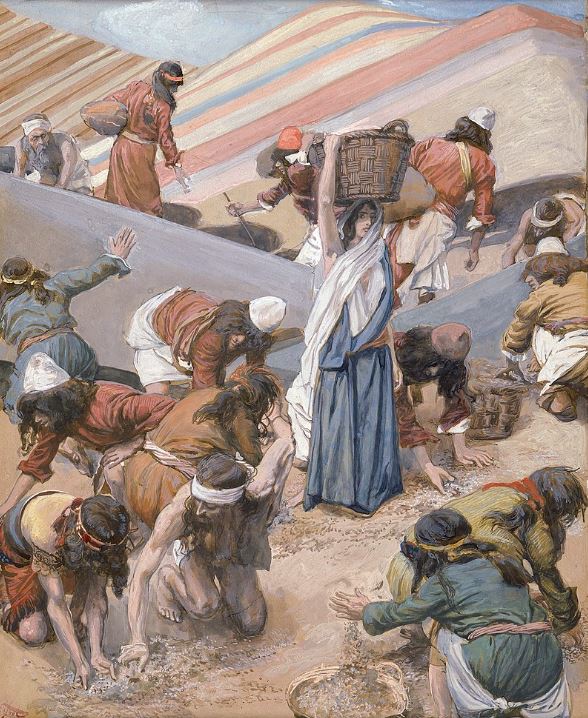
‘The Gathering of the Manna’ by James Tissot
In this week’s parasha, Beha’alotcha, we read how the Israelites had become fed up (literally) with eating manna. The Torah reminds us how the people would collect their share of manna every day (Numbers 11:8): “The people walked about and gathered it. Then they ground it in a mill or crushed it in a mortar, cooked it in a pot and made it into cakes. It had a taste like the taste of oil cake.” Although it had its own innate taste, our Sages teach that in reality the manna would transform into whatever the person felt like eating! Still, the Israelites complained (Numbers 11:6):
We remember the fish that we ate in Egypt for free; the cucumbers, the watermelons, the leeks, the onions, and the garlic. But now, our souls are dried out, for there is nothing at all except the manna before our eyes.