Category Archives: Midrash

The Kabbalah of Moses’ Divine Staff

In this week’s parasha, Va’era, we read about the first seven plagues to strike Egypt. These were brought about through the Staff of Moses, as were the later Splitting of the Sea, the victory over Amalek (Exodus 17) and the water brought forth from a rock. What was so special about this particular staff, and what was the source of its power?

Pirkei Avot (5:6) famously states that the Staff was one of ten special things to be created in the twilight between the Sixth Day and the first Shabbat. The Midrash (Pirkei d’Rabbi Eliezer, ch. 40) elaborates:

Rabbi Levi said: That staff which was created in the twilight was delivered to the first man out of the Garden of Eden. Adam delivered it to Enoch, and Enoch delivered it to Noah, and Noah to Shem. Shem passed it on to Abraham, Abraham to Isaac, and Isaac to Jacob, and Jacob brought it down to Egypt and passed it on to his son Joseph, and when Joseph died and they pillaged his household goods, it was placed in the palace of Pharaoh.

And Jethro was one of the magicians of Egypt, and he saw the staff and the letters which were upon it, and he desired it in his heart, and he took it and brought it, and planted it in the midst of the garden of his house. No one was able to approach it any more.

When Moses came to his house, he went into Jethro’s garden, and saw the staff and read the letters which were upon it, and he put forth his hand and took it. Jethro watched Moses, and said: “This one in the future will redeem Israel from Egypt.” Therefore, he gave him Tzipporah his daughter to be his wife…

God gave the staff to Adam, who gave it to Enoch (Hanokh)—who later transformed into the angel Metatron—and Enoch passed it on further until it got to Joseph in Egypt. The Pharaoh confiscated it after Joseph’s death. The passage then alludes to another Midrashic teaching that Jethro (Yitro), Moses’ future father-in-law, was once an advisor to Pharaoh, along with Job and Bila’am (see Sanhedrin 106a). The wicked Bila’am was the one who advised Pharaoh to drown the Israelite male-born in the Nile. While Job remained silent (for which he was so severely punished later), Jethro protested the cruel decree, and was forced to resign and flee because of it. As he fled, he grabbed the divine staff with him. Arriving in Midian, his new home, Jethro stuck the staff in the earth, at which point it seemingly gave forth deep roots and was immovable.

A related Midrash states that all the suitors that sought the hand of his wise and beautiful Tzipporah were asked to take the staff out of the earth, and should they succeed, could marry Jethro’s daughter. None were worthy. (Not surprisingly, some believe that this Midrash may have been the source for the Arthurian legend of the sword Excalibur.) Ultimately, Moses arrived and effortlessly pulled the staff out of the ground.

The passage above states that Moses was mesmerized by the letters engraved upon the staff, as was Jethro before him. What were these letters?

The 72 Names

Targum Yonatan (on Exodus 4:20) explains:

And Moses took the rod which he had brought away from the chamber of his father-in-law, made from the sapphire Throne of Glory; its weight forty se’ah; and upon it was engraved and set forth the Great and Glorious Name by which the signs should be wrought before Hashem by his hand…

God’s Ineffable Name was engraved upon the sapphire staff, which was itself carved out of God’s Heavenly Throne. The staff weighed a whopping 40 se’ah, equivalent to the minimum volume of a kosher mikveh, which is roughly 575 litres (or 575 kilograms) of water. (This might explain why none could dislodge the staff, except he who had God’s favour.)

A parallel Midrash (Shemot Rabbah, 8:3) also confirms that the staff was of pure sapphire, weighing forty se’ah, but says it was engraved with the letters that stand for the Ten Plagues, as we recite at the Passover seder: datzach, adash, b’achav (דצ״ך עד״ש באח״ב).

A final possibility is that the “Great and Glorious Name by which the signs should be wrought” refers to the mystical 216-letter Name of God (or 72-word Name of God). This Name is actually 72 linked names, each composed of three letters. The names are derived from the three verses Exodus 14:19-21:

And the angel of God, who went before the camp of Israel, removed and went behind them; and the pillar of cloud removed from before them, and stood behind them; and it came between the camp of Egypt and the camp of Israel; and there was the cloud and the darkness here, yet it gave light by night there; and the one came not near the other all the night. And Moses stretched out his hand over the sea; and Hashem caused the sea to go back by a strong east wind all the night, and made the sea into dry land, and the waters were divided.
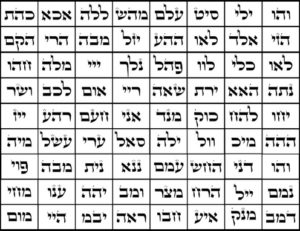
The 72 Three-Letter Names of God

Each of these verses has exactly 72 letters. Hidden within them is this esoteric Name of God, the most powerful, through which came about the miracle of the Splitting of the Sea as the verses themselves describe. The Name (or 72 Names) is derived by combining the first letter of the first verse, then the last letter of the second verse, and then the first letter of the third verse. The same is done for the next letter, and so on, for all 72 Names.

Since the Splitting of the Sea and the plagues were brought about through these Names, the Midrash above may be referring not to the Ineffable Name, but to these 72 Names as being engraved upon the Staff. In fact, it may be both.

Staff from Atzilut

The 72 Names are alluded to by another mystical 72-Name of God. The Arizal taught that God’s Ineffable Name can be expanded in four ways. This refers to a practice called milui,* where the letters of each word are themselves spelled out to express the inner value and meaning of the word. God’s Ineffable Name can be expanded in these ways, with the corresponding values:

יוד הא ואו הא = 45

יוד הה וו הה = 52

יוד הי ואו הי = 63

יוד הי ויו הי = 72

The Name with the 72 value is the highest, not just numerically, but according to the sefirot, partzufim, and universes laid out in Kabbalah. The 52-Name corresponds to Malkhut and the world of Asiyah; the 45-Name to Zeir Anpin (the six “masculine” sefirot) and the world of Yetzirah; and the 63-Name to Binah and the world of Beriah. The 72-Name—which is, of course, tied to the above 72 Names of God—corresponds to the highest universe, Atzilut, the level of God’s Throne, where there is nothing but His Emanation and Pure Light. Here we come full circle, for the Midrash states that the Staff of Moses was itself carved out of God’s Throne. This otherworldly staff came down to this world from the highest Heavenly realm!

Where is the Staff Today?

What happened to Moses’ staff after his passing? Another Midrash (Yalkut Shimoni, Psalms 869) answers:

…the staff with which Jacob crossed the Jordan is identical with that which Judah gave to his daughter-in-law, Tamar. It is likewise the holy staff with which Moses worked, and with which Aaron performed wonders before Pharaoh, and with which, finally, David slew the giant Goliath. David left it to his descendants, and the Davidic kings used it as a sceptre until the destruction of the Temple, when it miraculously disappeared. When the Messiah comes it will be given to him for a sceptre as a sign of his authority over the heathens.

This incredible passage contains a great deal of novel insight. Firstly, Jacob used this divine staff to split the Jordan and allow his large family to safely cross back to Israel, just as the Israelites would later cross the Jordan in miraculous fashion under the leadership of Joshua. It seems Joshua himself, as Moses’ rightful successor, held on to the staff, and passed it down through the Judges and Prophets until it came to the hand of David. Unlike the traditional account of David slaying Goliath with the giant’s own sword (after the slingshot), the Midrash here says he slew Goliath with the staff!

The staff remained in the Davidic dynasty until the kingdom’s end with the destruction of the First Temple. At this point a lot of things mysteriously disappeared, most famously the Ark of the Covenant. It is believed that the Ark was hidden in a special chamber built for it by Solomon, who envisioned the day that the Temple would be destroyed. It is likely that the staff is there, too, alongside the Ark.

Mashiach will restore both of these, and will once again wield the sceptre of the Davidic dynasty. As the staff is forged from God’s own Heavenly Throne, it is fitting that Mashiach—God’s appointed representative, who sits on His corresponding earthly throne—should hold a piece of it. And this symbol, the Midrash concludes, will be what makes even the heathens accept Mashiach’s—and God’s—authority. Jacob prophesied this on his deathbed (Genesis 49:10), in his blessing to Judah:

The sceptre shall not depart from Judah, nor the ruler’s staff from between his feet, until the coming of Shiloh; and unto him shall the obedience of all the peoples be.

Shiloh is one of the titles for Mashiach (see Sanhedrin 98b), and his wielding of the staff will bring about the obedience of all the world’s people to God’s law. We can now also solve a classic problem with the above verse:

The verse states that the sceptre will not depart from Judah until the coming of Mashiach, as if it will depart from Judah when Mashiach comes. This makes no sense, since Mashiach is a descendent of Judah! It should have simply said that the sceptre shall never depart from Judah, from whom the messiah will come. Rather, Jacob is hinting that the Staff will one day be hidden in the land of Judah, deep below “between his feet”, and won’t budge from there for millennia until Mashiach comes and finally restores it.

May we merit to see it soon.

*Interestingly, using the same milui method, one can expand the word staff (מטה) like this: מאם טאת הה, which is 501, equivalent to דצ״ך עד״ש באח״ב, the acronym for the Ten Plagues which the Staff brought about!


The above is an excerpt from Garments of Light, Volume Two. Get the book here

The Year 5778: Apex of the Messianic Era

The stars of this week’s parasha, Vayeshev, are Joseph and Judah. We are told how the sons of Jacob were envious (and suspicious) of Joseph, and ended up throwing him in a pit while deliberating what to do with him. Shimon wished to kill him, Judah to sell him, and Reuben to save him. Meanwhile, Midianite merchants found the helpless Joseph and abducted him, later selling him to Ishmaelites who brought Joseph down to Egypt. There, Joseph enters into servitude in the home of a well-to-do Egyptian family.

The Torah diverges from this narrative to describe what happens to Judah. Judah marries and has three sons. The elder Er marries Tamar and dies because of his sinful ways, as does the second son Onan after fulfilling the law of levirate marriage and marrying his former sister-in-law. After Judah fearfully avoids another levirate marriage for Shelah, his last son, Tamar seduces Judah and becomes pregnant. She gives birth to twins, Peretz and Zerach.

Peretz would go on to be a forefather of King David, and thus a forefather of Mashiach. As is known, there are actually two messianic figures (or two aspects to Mashiach): Mashiach ben David, and Mashiach ben Yosef—one from the line of Judah and one from the line of Joseph. In fact, it is in this week’s parasha where the spiritual origins of the two messiahs begin.

Samson and the Messiahs

Mashiach ben Yosef is the first messiah. He is the warrior that battles evil in the “End of Days”. Unfortunately, he is destined to die in these battles. The Talmud (Sukkah 52a) states how the entire nation will mourn his tragic death. However, it will not be too long before Mashiach ben David arises. As the direct descendant of the royal line, he re-establishes the rightful throne and restores the holy Kingdom of Israel. The Third Temple is built thereafter, and according to some Mashiach ben David reigns for forty years, as did his progenitor King David (Sanhedrin 99a, Midrash Tehillim 15).

We have already discussed why Mashiach ben Yosef must die in the past (see ‘Secrets of the Akedah’ in Garments of Light). How he will die is not exactly clear. What will bring him to his death? It appears that Mashiach ben Yosef will be sold out by his own people. This is what happened to one of the earliest prototypes of Mashiach ben Yosef: the Biblical judge Shimshon (Samson).

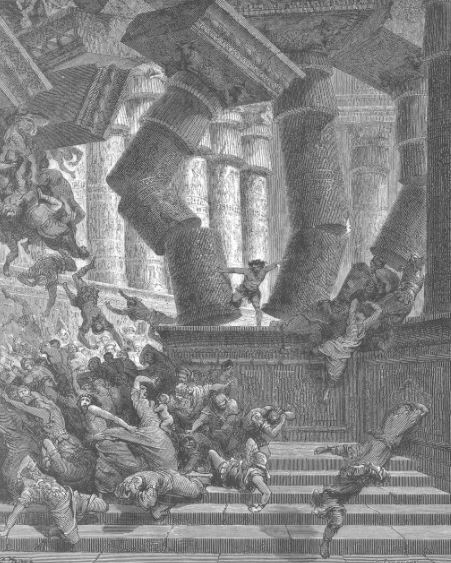
As is well known, when Jacob blessed his children, he concluded the blessing to Dan with the words “I hope for Your salvation, Hashem” (Genesis 49:18) which Rashi says refers to Samson, a descendent of Dan. Samson was the potential messiah of his generation. He was a warrior fighting the oppressive Philistines. Yet, the people of Judah did not appreciate the “trouble” he was causing, and apprehended him (Judges 15:11-12):

“Death of Samson”, by Gustav Doré

Then three thousand men of Judah went down to the cleft of the rock of Eitam, and said to Samson: “Do you not know that the Philistines are rulers over us? What then is this that you have done to us?” And he said to them: “As they did to me, so have I done to them.” And they said to him: “We have come to bind you, that we may deliver you into the hand of the Philistines.”

Samson turned himself in voluntarily, but with God’s help smote the Philistine oppressors and freed himself. He would be betrayed again by Delilah, but would manage to defeat the Philistines for good, though at the cost of his own life. Like Mashiach ben Yosef, Samson sacrifices himself.

The text above specifically states that three thousand men of Judah came for Samson. What is the significance of this numeric detail?

The Evil 3000

At the Exodus, the Torah states there was a “mixed multitude” (erev rav) of three thousand men among the Israelites. They, too, accepted the Torah at Mt. Sinai, only to instigate the Golden Calf incident forty days later. It is said that the same will happen at the End of Days, with an “erev rav” among the Jews who will instigate all sorts of problems for the nation from within (see, for example, Zohar I, 25 or Sha’ar HaGilgulim, ch. 39). Like Samson’s three thousand men of Judah, Mashiach ben Yosef is sold out by three thousand “Jewish” individuals.

And the fact that they are men of Judah is all the more significant. It was Judah in this week’s parasha who proposed selling Joseph. And to whom did he want to sell him?

And Judah said to his brothers: “What is the gain if we slay our brother and cover up his blood? Come, let us sell him to the Ishmaelites, but our hand shall not be upon him, for he is our brother, our flesh.” (Genesis 37:26-27)

Judah wanted to sell his brother to the Ishmaelites. In speaking of the battles of Mashiach ben Yosef and the End of Days, it is often the Ishmaelites (or the Ishmaelites banded together with Esau) that are implicated (see, for example, Pirkei d’Rabbi Eliezer, ch. 30). Today, of course, the modern “Philistines” are Ishmaelites, and among their biggest supporters are the descendants of Esau.

In The Era of Mashiach

This discussion is particularly timely in light of what’s currently happening in the Middle East. It seems the region is preparing for a massive war, one that would inevitably engulf the entire Ishmaelite sphere, if not the whole world. We’ve written before that we are undoubtedly in the “footsteps of the Messiah” and here is another intriguing point:

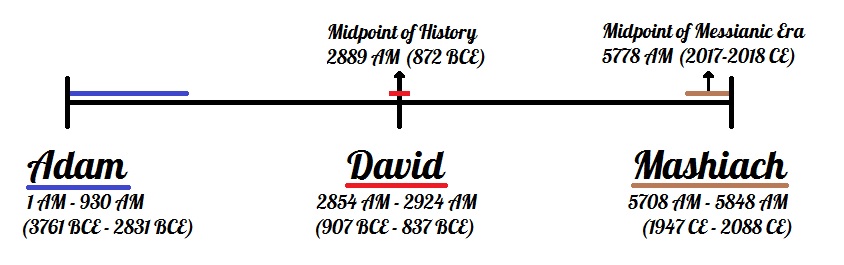
God originally intended for Adam to live 1000 years. Yet, we see in Genesis that Adam lived only 930 years. This is because, as is well known, Adam foresaw that David would be stillborn, and donated 70 years of his life to him. Indeed, David went on to live exactly 70 years. The Arizal saw in the name Adam (אדם) an acronym for three figures: Adam, David, Mashiach. These are the first, middle, and last major figures of human history. Based on this, Rabbi Yitzchak Ginsburgh teaches that David is supposed to be the literal midpoint of history. If that’s the case, then we only need to see when David lived to calculate the era of Mashiach.

The traditional lifetime for David is 2854-2924 AM (Anno Mundi, Hebrew calendar years, corresponding to about 907-837 BCE). To find the time period for the End of Days we must simply multiply David’s years by two. This gives 5708-5848, or 1947/1948-2087/2088 CE. That’s quite amazing, considering that Israel officially became a state in 5708 (the UN vote to create Israel took place in November 1947, and Israel declared independence in May 1948—both dates fall within the Jewish year 5708). And what would be the midpoint, or perhaps the apex, of the “End of Days” period? None other than 5778, the year which we are currently in.

Stay tuned.


The above essay is adapted from Garments of Light, Volume Three.
Get the book here! 


The Amazing Story of Og, the Giant King of Bashan

Devarim, or Deuteronomy in English, is the fifth and final book of the Torah. Deuteronomy comes from the Greek deuteronomion, meaning “second law”, which itself comes from the alternate Hebrew name of the book, Mishneh Torah, meaning “repetition of the law”. The name stems from the fact that Deuteronomy is essentially a summary of the four previous books of the Torah. The key difference is that it is given in the point of view of Moses, and records his final sermon to the people before his death.

One of the enigmatic figures mentioned in this week’s parasha is Og, the king of the land of Bashan. This character is explicitly mentioned a total of 10 times in the Torah, of which 8 are in this portion alone. He is first mentioned in the introductory verses of the parasha (1:4), which state how Moses began his discourse after smiting Sihon, the king of the Amorites, and Og, the king of Bashan.

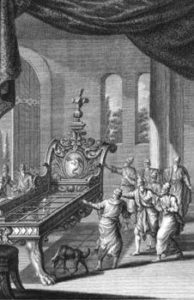
Og’s Bed, by Johann Balthasar Probst (1770)

We are later told how Og had come out to confront the children of Israel, and the Israelites defeated his army in battle. Og is said to be the last survivor of the Rephaim (3:11), which were apparently a nation of giants. His bed is described as being made of iron, and being nine cubits long, or roughly 18 feet!

Rashi provides a little more information. He tells us that Og was the last survivor of the Rephaim in the time of Abraham. It was then that the king Amraphel, together with his allies, dominated the Fertile Crescent region, and decimated many nations that inhabited it. One of these groups of victims were the Rephaim, and Og was the sole survivor among them. He was the “refugee” mentioned in Genesis 14:13 that came to Abraham to inform him of what had happened.

So, who was Og? Where did he come from? Why did he initially help Abraham, but then come out to battle Moses centuries later? And was he really a giant?

Half Man, Half Angel

The Talmud (Niddah 61a) tells us that Og was the grandson of Shemhazai. As we have written previously, Shemhazai was one of the two rebellious angels that had descended to Earth. These two angels argued before God that He should not have created man, who was so faulty and pathetic. God told the angels that had they been on Earth, and given the same challenges that man faced, they would be even worse.

The angels wanted to be tested anyway, and were thus brought down into Earthly bodies. Of course, just as God had said, they quickly fell into sin. This is what is meant by Genesis 6:2, which describes divine beings mating with human women. Their offspring, initially called Nephilim, were large and powerful, and were seen as “giants” by common people. However, during the Great Flood of Noah, all of these semi-angelic beings perished. Except for one.

The Sole Survivor

Midrashic texts famously record that Og was the only survivor of the Great Flood, aside from Noah and his family. When the torrential rains began, Og jumped onto the Ark and held on tightly (Zevachim 113b). He swore to Noah that he would be his family’s eternal servant if Noah would allow him into the Ark (Yalkut Shimoni, Noach 55). The Talmud (ibid.) states that the rain waters of the Flood were actually boiling hot. Yet, the rain that fell upon Og while he held unto the Ark was miraculously cool, allowing him to survive. Perhaps Noah saw that Og had some sort of merit (after all, his grandfather was the one angel that repented). Noah therefore had mercy on Og, and made a special niche for Og in the Ark. This is how the giant survived the Flood.

A variant account suggests that Og survived by fleeing to Israel, since the Holy Land was the only place on Earth which was not flooded.

Abraham’s Servant

As promised, Og became the servant of Noah and his descendants. The Zohar (III, 184a) says that he served Abraham as well, and as part of his household, was also circumcised. As Rashi says (on Genesis 14:13), Og informed Abraham that his nephew Lot was kidnapped, and that the armies of Amraphel and his allies were terrorizing the region. Rashi quotes the Midrash in telling us that Og hoped Abraham would go into battle and perish, so that Og would be able to marry the beautiful Sarah. For informing Abraham, Og was blessed with wealth and longevity, but for his impure intentions, he was destined to die at the hands of Abraham’s descendents (Beresheet Rabbah 42:12).

Whatever the case, the giant soon fell into immorality. The Zohar continues that although he had initially taken the Covenant upon himself (by way of the circumcision), he had later broken that very same Covenant by his licentious behaviour. He used his physical abilities to become king over 60 large, fortified cities (Deuteronomy 3:4). When the nation of Israel passed by his territory, he gathered his armies to attack them.

It is said that Moses feared Og for a number of reasons: Og had lived for centuries, and was also circumcised, so Moses figured the giant had a great deal of merit. God told Moses not to worry, and gave Moses the strength to slay Og himself. As the famous story goes, Moses used a large ten-cubit (roughly 20 foot) weapon to jump ten cubits high in the air—and was only able to strike Og’s ankle! Still, it caused Og to trip over and be impaled by a mountain peak. (On that note, there is a little-known Midrash which states Og survived the Flood simply because he was so large, and the floodwaters only reached up to his ankles! See Midrash Petirat Moshe, 1:128)

It is important to remember once more the old adage that one who believes that the Midrash is false is a heretic, yet one who believes that the Midrash is literally true is a fool. It is highly unlikely that Og was actually so immense (especially considering that this would make him bigger than the dimensions of Noah’s Ark). The Torah tells us his bed was nine cubits long, which the most conservative opinions estimate to be closer to 13 feet, a far more reasonable number.

There are many more colourful stories about Og, including one where a Talmudic sage found his thigh bone and ran through it (Niddah 24b). Another suggests that Og is actually Eliezer, Abraham’s trusty servant (Yalkut Shimoni, Chayei Sarah 109). This is an intriguing possibility, and might help explain how Abraham and Eliezer alone were able to defeat the conglomeration of four massive armies (See Genesis 14, with Rashi).

Archaeologists have even found mention of Og in ancient Phoenician and Ugaritic texts. One clay tablet from the 13th century BCE (Ugarit KTU 1.108) is believed to be referring to him as Rapiu, or the last of the Rephaim—as the Torah states. It suggests that Og’s grandeur got the better of him, and he began to consider himself a god among puny men:

May Rapiu, King of Eternity, drink [w]ine, yea, may he drink, the powerful and noble [god], the god enthroned in Ashtarat, the god who rules in Edrei, whom men hymn and honour with music on the lyre and the flute, on drum and cymbals, with castanets of ivory, among the goodly companions of Kothar…

Perhaps this hubris was Og’s fatal flaw, and brought about his ultimate downfall.

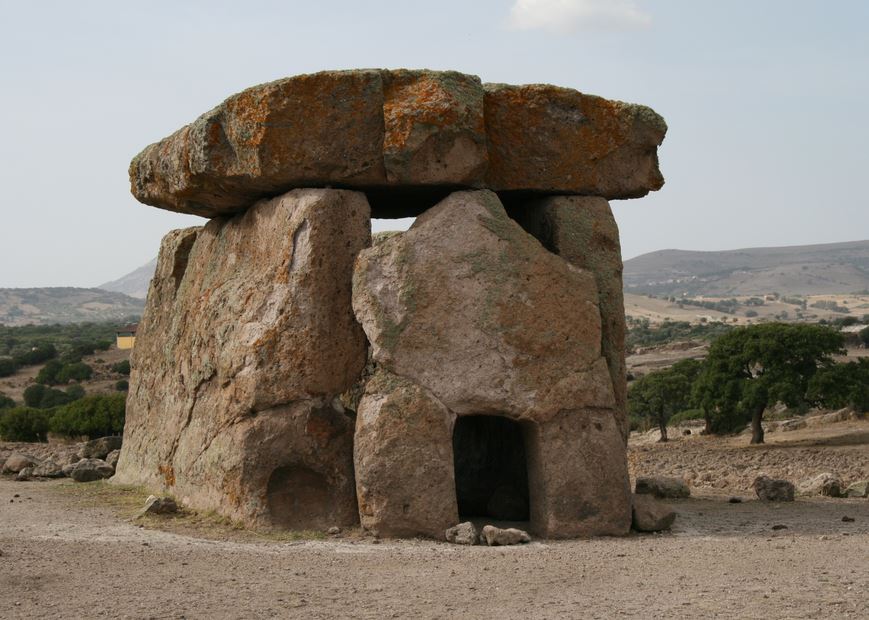
Dolmen (courtesy of www.museodeidolmen.it)

Dolmen (courtesy of www.museodeidolmen.it)

Interestingly, there are also a number of dolmen found in the modern-day area that would have been Bashan. These dolmen are massive stone structures that were erected millennia ago, with some rocks weighing many tons and perplexing scholars as to how they were put together. It is thought that dolmen served as burial tombs, and perhaps have a connection to the tradition of giants living in the Bashan area.


This is an excerpt from Garments of Light: 70 Illuminating Essays on the Weekly Torah Portion and Holidays. Click here to get the book.