Category Archives: Mysteries & Origins

An Honest Look at Death and the Afterlife

This week we once again read a double Torah portion, combining the parashot of Behar and Bechukotai to complete the book of Leviticus. The main themes of these parashas are the Sabbatical and Jubilee years, as well as God’s rewards and punishments for those who follow His ways and those who do not.

One interesting thing that the reader will note is that there is no mention of any kind of afterlife. All of the rewards and punishments that are listed are described in wholly physical terms: ample rains and abundant harvests, military victories and secure borders, good food and the feeling of God’s presence – and the opposite of these if the people are sinful. Why is it that the Torah does not mention any kind of reward and punishment in the afterlife? After all, we are accustomed to hearing that this world is nothing but a transient “hallway”, so to speak, while the next world is the real deal, where people receive what they deserve.

More puzzling is the fact that the Torah essentially never mentions the afterlife in explicit fashion. Everything appears to happen in this physical world. Yet, there is certainly a discussion of souls, and many spiritual entities. So, what is the real Torah conception of the afterlife?

The Garden of Eden
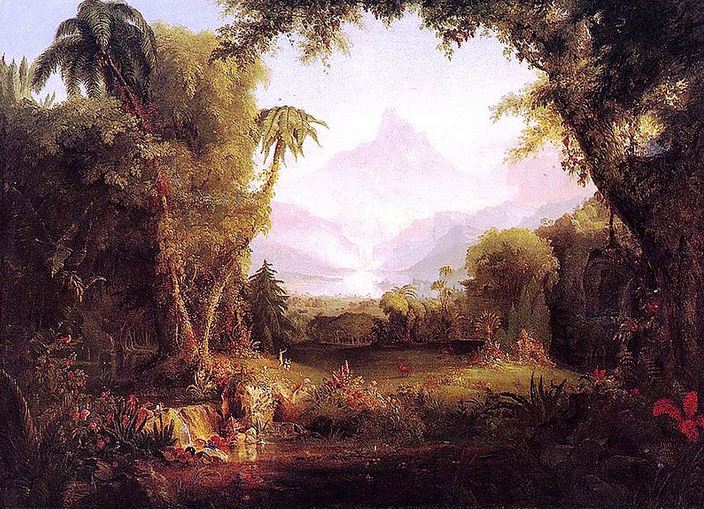
'Garden of Eden', by Thomas Cole

‘Garden of Eden’, by Thomas Cole

Typically, it is common to think that those who have passed away are now in the “Garden of Eden”, and this is indeed how Hebrew-speakers often refer to the dead, wishing them menucha (rest) in Gan Eden. But where exactly is this “Gan Eden”?

The Torah is quite clear on the fact that God created the Garden of Eden right here on Earth. The Genesis account describes God’s creation of the world, and all of its inhabitants, and concludes with the planting of a garden in Eden, where the first man and woman are placed. After their sin of consuming the fruit, Adam and Eve are banished from the Garden, and continue their lives elsewhere on Earth. There is no mention anywhere in the Torah of a spiritual Garden of Eden located somewhere in the Heavens!

Conversely, it is common for people to refer to an afterlife of damnation in a place called Gehinnom, typically translated as “hell”. Again, there is no explicit mention of a “hell” in Scripture. Gehinnom itself simply means “the Valley of Hinnom” (or the Valley of the Son of Hinnom, Gei Ben Hinnom) which is discussed in the Tanakh as a place right outside the Old City walls of Jerusalem. This is described as a place of sinners and idolaters, outcasts that were expelled from the Holy City. Once again, we see that the place usually thought of as hell is simply a physical place here on Earth.

As Above, So Below

By the times of the Talmudic period, the Jewish Sages had developed a unique cosmic worldview. They saw this material world as only a reflection of the spiritual world. What happened down here reflected, in some way, much greater cosmic events that were happening in the Heavens. Thus, just as there was a Jerusalem down here on Earth, there was a Jerusalem shel ma’alah, a “Jerusalem Above” (see, for example, Ta’anit 5a).

Similarly, just as there was a Garden of Eden – a place of utmost peace and pleasure – here on Earth, there must be a similar one above in the Heavens. And just as there was a Gehinnom – a deep valley of evil – here on Earth, there must be such a place in the Heavens, too.

It appears that the idea of righteous souls moving on to a Heavenly Gan Eden, or wicked souls to a Heavenly Gehinnom, came from this view on the nature of God’s universe.

The Big Afterlife Problem

However, this brings about a very large problem: both the Garden of Eden and Gehinnom are described in physical terms. But, after the body dies and decays, only the soul lives on, and how can the soul experience physical pleasures or pains? Additionally, the soul is described as pure and eternal. Why is it the soul that must suffer for the sins accrued by the body? And why should the soul suffer infinitely for a body that had only such a short, finite existence?

This problem was presented to Rabbi Yehuda haNasi by the Roman Emperor Antoninus nearly two millennia ago (Sanhedrin 91a-b).

Antoninus said to Rabbi: “The body and the soul can both free themselves from judgment. Thus, the body can plead: ‘The soul has sinned, since from the day it left me I lie like a dumb stone in the grave.’ While the soul can say: ‘The body has sinned, since from the day I departed from it I fly freely in the air like a bird.’”

He replied: “I will tell you a parable. To what may this be compared? To a human king who owned a beautiful orchard which contained splendid figs. Now, he appointed two watchmen, one lame and the other blind. [One day] the lame man said to the blind, ‘I see beautiful figs in the orchard. Come and take me upon your shoulders, that we may procure and eat them.’ So the lame strode the blind, procured and ate them. Some time after, the owner of the orchard came and inquired of them, ‘Where are those beautiful figs?’ The lame man replied, ‘Do I have feet to walk with?’ The blind man replied, ‘Do I have eyes to see with?’ What did he do? He placed the lame upon the blind and judged them together. So will the Holy One, blessed be He, bring the soul, place it in the body, and judge them together…”

Rabbi Yehuda replied with a wonderful parable, and concluded that God brings the body and soul together again, and only then judges the person, and bestows upon them their due rewards or punishments.

So, if the body and soul go back together again after death, then there is no “Garden of Eden” or “Gehinnom” in the sense that we might commonly think.

Gate of Reincarnations

The only way that the body and soul can go back together again is if, following death, the soul returns into bodily form. This is the definition of reincarnation. Roughly 500 years ago, the great kabbalist Rabbi Isaac Luria, better known as the Arizal, revealed many secrets of reincarnation, and these teachings were recorded by his primary disciple, Rabbi Chaim Vital, in a text called Sha’ar HaGilgulim (Gate of Reincarnations).

This text describes reincarnations in great detail, and affirms that those who have lived sinful lives are reincarnated into new lives that are very challenging, and in this way have to make reparations for the mistakes of their past. The righteous, too, are reincarnated, since no one goes through life without making some mistakes, and even the most minute of these errors must be repaired. However, such people will enjoy much better lives, and be given the opportunity to fix those minor details from their past.

Of course, proper repentance can nullify any trials that a person must bear due to a mishap from a past life. Thus, free will ultimately trumps everything else. And what happens to those who have completely fulfilled their missions? In that case, there is indeed a “Garden of Eden” of sorts.

(For more on reincarnation, click here to read ‘Everything You Wanted to Know About Reincarnation in Judaism’.)

Resurrection of the Dead

One form of afterlife that Scriptures do mention explicitly is the Resurrection of the Dead. It is taught that sometime after the coming of Mashiach, all of the righteous souls will miraculously come back to life. They will then enjoy the world as it was always meant to be: a Garden of Eden.

Ultimately, this is the role of Mashiach: to return the world to that perfect, primordial state. It is interesting to note how the figure responsible for driving mankind out of the Garden was the Serpent, Nachash (נחש) in Hebrew, a word which has a numerical value of 358; and the figure responsible for returning mankind to the Garden is Mashiach (משיח), a word which also has a gematria of 358 – measure for measure. Thus, the final step for each soul, once its mission is complete, is to be resurrected in the restored Garden of Eden, right here in a new Earth, following the arrival of Mashiach.

We can now understand why Bechukotai does not speak of any spiritual rewards or punishments in an afterlife. All of the rewards and punishments are right here in this world, where body and soul unite as one, as Rabbi Yehuda told Antoninus. We can now also see why no “Heaven” or “Hell” is ever explicitly mentioned in Scripture, and why we never even mention them in our prayers. The Amidah prayer recited thrice daily makes no reference to souls in some Heavenly realm, but does have a blessing for techiyat ha’metim, the Resurrection of the Dead in a future, perfected world.

May we merit to see it speedily and in our days.


The article above is adapted from Garments of Light – 70 Illuminating Essays on the Weekly Torah Portion and Holidays. Click here to get the book!
The Hidden History of Lag B’Omer

This week’s Torah reading is Emor, which begins with a continuation of various priestly and Temple-related laws. The parasha then lists all of the Biblical holidays, starting with the weekly Sabbath, then Passover, Shavuot, Rosh HaShanah, Yom Kippur, Sukkot, and Shemini Atzeret. The holidays of Chanukah and Purim are Rabbinically-instituted, having occurred long after the events of the Torah were complete (although it is important to note that the Torah does allude to those future events, too).

It is here in this week’s parasha that we are also commanded to count the 50 days between Passover and Shavuot, the period known as Sefirat HaOmer (the meaning of which we have explored in the past; see ‘The Spiritual Significance of Sefirat HaOmer‘). There are a number of important dates that fall during the Sefirat HaOmer period. Perhaps the most well-known of these is Lag B’Omer, which literally means “the 33rd day of the Omer” (Lag, ל”ג is the Hebrew designation for the number 33). This festive holiday is marked with lighting bonfires, playing with bows and arrows, and taking a break from the usual mourning customs of the Omer period.Bonfire

The basic story of Lag B’Omer is that during the first 32 days of the Omer period nearly two thousand years ago, a plague decimated Rabbi Akiva’s 24,000 students. All of his students died, hence the mourning customs still observed today to commemorate that tragic event. The plague ended on the 33rd day of the Omer, which is why the mourning rituals are now lifted.

The big question is: why were Rabbi Akiva’s students punished with a plague? What had they done to deserve this? The Talmud (Yevamot 62b) says that apparently these 24,000 students failed to love and respect one another. However, this immediately begs a whole bunch of other questions.

First of all, it was Rabbi Akiva who taught that the greatest principle of Torah is to love your fellow (TY Nedarim 9:4). Could it really be that Rabbi Akiva’s own students failed to uphold their master’s central teaching? And if it really was the case that these students didn’t love or respect each other, then they really weren’t very righteous people, so why are we so fervently mourning their deaths? Throughout history, there have been much greater numbers of much greater people who have perished, yet we do not mourn for such a lengthy period of time for any of them!

What’s Really Going On?

The Talmud (TY Ta’anit 24b) tells us that Rabbi Akiva was a central supporter of Shimon Bar Kochva during the Bar Kochva Revolt (132-136 CE), also known as the Third Roman-Jewish War. Bar Kochva was initially very successful against the Romans, and it seemed like the Jews would be able to throw off the yoke of the Roman authorities, and rebuild the Temple (after it was destroyed by the Romans around 70 CE). Not surprisingly, Rabbi Akiva went so far as to declare Bar Kochva as the Messiah! After all, the major role of Mashiach is to secure Israel’s borders, end the exile, and rebuild the Temple – which Bar Kochva seemed to be doing. Rabbi Pinchas Stolper has written that Bar Kochva’s army may have reconquered Jerusalem on Lag B’Omer itself (hence the holiday), and began the reconstruction of the Temple on that day. In fact, the Third Temple was nearing completion when Rabbi Akiva announced the messiahship of Bar Kochva.

Unfortunately, Bar Kochva’s power got to his head, and it seems that he became a violent dictator, even killing his own uncle, Rabbi Eleazar haModa’i. Soon, his armies fell to the Romans, who brutally quashed the rebellion. The Romans went on a killing spree, massacring countless people in Judea. One of their victims was Rabbi Akiva himself, who was tortured to death with iron combs (Berachot 61b).

It isn’t hard to imagine that Rabbi Akiva’s students were killed in a similar fashion, during this tragic time period. The “plague” that took their lives was the Romans, and the war ended on Lag B’Omer. Indeed, one explanation for why we light bonfires on Lag B’Omer is to commemorate the Bar Kochva war, when the Jewish guerilla warriors would light signal fires to each other. It may also explain why there is a custom to this day to play with bows and arrows – implements of war.

So why would Jewish texts say that Rabbi Akiva’s students died in a plague? It wasn’t uncommon in those days for the secular authorities to censor various texts. Perhaps the Romans, in a propaganda effort, forbid the Jews from publicly speaking about the real reasons for the deaths of the 24,000. Others suggest that it was the Sassanians, under whose domain the Talmud was completed, that censored the text to discourage Jews from rebelling against Sassanian authority (as they had rebelled against Rome so many times and so devastatingly). The Rabbis therefore had to encode the real history of Lag B’Omer through indirect means, like bonfires and bows and arrows. Maybe this is why they said that Rabbi Akiva’s students died out of failure to respect one another. They knew that such a statement would immediately set off alarm bells, for this is probably the last thing Rabbi Akiva’s students would fail in.

Many scholars of the past, both religious and secular, have explored this possibility in depth, including Rav Sherira Gaon, Nachman Krochmal, Eliezer Levi, and Rabbi Isaac Nissenbaum, as well as Rabbi David Bar-Hayim and others in modern times.

Rashbi and Kabbalah

Ultimately, the story ends with a small number of Rabbi Akiva’s students – some say five, others a little more – surviving “the plague”, and going on to re-establish Judaism, saving it from extinction. One of those students was Rabbi Shimon bar Yochai (also known as Rashbi). The Talmud (Shabbat 33b) is explicit in telling us that he hid from the Romans in a cave for 13 years, together with his son, surviving off of a carob tree. This is yet another piece of evidence suggesting Rabbi Akiva’s students were killed by the Romans, and not in a plague.

It was Rabbi Shimon who was first to publicly reveal the mystical teachings of Kabbalah. It is said that he did this to his own students on the day of his death – which was the 18th of the month of Iyar, and the 33rd day of the Omer. The central book of Kabbalah, The Zohar, which was first published in the 13th century, originated with Rabbi Shimon bar Yochai and those teachings that he revealed. According to tradition, those Kabbalistic teachings were so holy and powerful that when Rabbi Shimon expounded on them on that day of his death, the very house in which he and his students were in appeared to be engulfed in flames. This is another reason for lighting bonfires on Lag B’Omer.

Rabbi Shimon told his students not to mourn his death, for it was a happy occasion: the deepest of spiritual and mystical secrets were now revealed, and would help to preserve the Jewish religion and nation for centuries to come.


The article above is adapted from Garments of Light – 70 Illuminating Essays on the Weekly Torah Portion and Holidays. Click here to get the book!

The Legend of Azazel: Scapegoat, or Fallen Angel?

The parashot of Acharei Mot and Kedoshim are typically read together. The major part of Acharei deals with various sacrificial services, most notably those concerning Yom Kippur, the Day of Atonement. Kedoshim begins by telling us that it is every person’s mission in life to become holy, just as God Himself is holy. This parasha is concerned with ethics, morality, and the path to righteousness, and includes the famous dictum to “Love your fellow as yourself” (Leviticus 19:18).

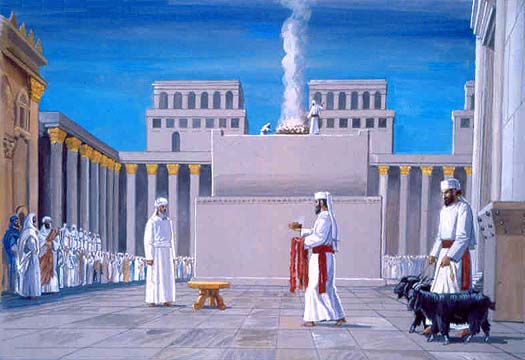
Perhaps the most peculiar item in this week’s portion is the mention of Azazel. As part of the atonement procedure on Yom Kippur, God commands Aaron to select (through a random lottery) two goats: one to be sacrificed, and another to be sent “to Azazel, in the wilderness” (Lev. 16:10). Aaron would place his hands on the goat to Azazel, and confess all of the people’s sins, as if transferring them to the animal (v. 21). The goat was then sent off into the wilderness.

The Rambam (Moreh Nevuchim, Part III, Ch. 46) writes that this act is completely symbolic. It does not mean that the High Priest literally transferred the people’s sins onto the goat, but that witnessing this act was meant to inspire a sense of repentance in the people, “as if to say, we have freed ourselves of our previous deeds, have cast them behind our backs, and removed them from us as far as possible.”

Temple Priests Bringing the Two Goats on Yom Kippur

Temple Priests Bringing the Two Goats on Yom Kippur

But what exactly is “Azazel”? What does the word mean? And why was the goat that symbolized sin sent towards it? The Talmud (Yoma 67b) maintains that the word Azazel can be broken down to mean “hardest of mountains”. This may be why some believe that the goat was sent off the edge of a mountainous cliff down to its death. The Talmud then presents the opinion of the school of Rabbi Ishmael: Azazel is a contraction of two names: Aza (or Uza) and Aza’el, and the goat atones for their sins. Other than this short allusion, this page of Talmud says nothing more.

Who were Aza and Aza’el?

The Fallen Angels

The origins of Aza and Aza’el are described in the Midrash (Yalkut Shimoni, Beresheet 44). When speaking of midrashic literature, it is important to remember the old adage that goes something like: one who believes that midrash is not true is a heretic, but one who believes that midrash is literally true is a fool. After all, the midrash corresponds to the third level of Torah study, referring to the metaphorical and allegorical level. (The other levels are peshat, the literal meaning; remez, the sub-textual meaning; and sod, esoteric/metaphysical secrets.)

Aza’el and Aza (also known as Shemhazai) were angels who saw the terrible sins of the people in the pre-Flood generation and scoffed at the pathetic humans. God told them that if they had been on Earth and given free will, they would succumb to their evil inclination far worse than people do. The angels wanted to prove God wrong, and asked Him to send them down to Earth into a physical body. God complied, and just as He had said, the angels quickly fell into all forms of evil.

Firstly, they could not hold back from the beautiful women, and this is what Genesis 6:2 means when it refers to divine beings mating with humans. The Midrash continues to say that it was these angels that taught women the art of makeup and provocative dress in order to entice men into further sin. These angels helped to bring the sword to the world, increasing bloodshed and warfare, as well as the consumption of animal meat, which was at this point forbidden, as God had only permitted Adam and Eve to consume fruits and vegetables.

Ultimately, the Midrash tells us that Shemhazai recognized his evil ways, and began a long process of repentance. No longer on Earth, but still not welcome back in the Heavenly realms, Shemhazai was suspended between the two worlds. Aza’el, on the other hand, refused to repent, and continued his evil ways. Thus, the Midrash concludes that the High Priest, in an act of repentance, would symbolically send the people’s sins towards Azazel, the one who taught mankind a new level of sinfulness, and refused to repent.

More details can be found in the Apocrypha. The Apocrypha refers to various ancient books which were not officially included in the Tanakh. Their origins are unclear, as is their authenticity. Nonetheless, they appear to have been well-known among the Jewish Sages, and are referenced in Talmud, Midrash, and Kabbalistic writings. One of the most famous of the apocryphal books is the Book of Enoch, which describes the journeys of Enoch (Hanoch, in Hebrew), who is briefly mentioned in Genesis 5:22. In the Book of Enoch, it is recorded that God sent the angel Raphael to apprehend Aza’el and stop his evil ways. Aza’el was chained to the “hardest of mountains” in the wilderness, as the Talmud quoted above explained. His painful imprisonment was a punishment, and the goats sent his way were a form of atonement for his sins. It is written there that at the End of Days, his time will come to an end, and Aza’el will finally be gone for good.


The above article is an excerpt from Garments of Light: 70 Illuminating Essays on the Weekly Torah Portion and Holidays. Click here to get the book!