Mashiach and the Mysterious 13th Zodiac Sign

When Jacob blesses his children before his passing, he begins by telling his sons that he wishes to reveal to them what will happen b’acharit hayamim, “in the End of Days”. Yet, the text we read does not appear to say anything about the End of Days! The Talmud (Pesachim 56a) states that the Shekhinah withdrew from Jacob at that moment so he was unable to reveal those secrets. If that’s the case, how was he able to properly bless his children?

The Talmud states that when the Shekhinah left him, Jacob worried one of his children was unworthy to hear those secrets. His sons then recited the Shema in unison and said, “just as there is only One in your heart, so is there in our heart only One.” Jacob was comforted to know they are all indeed righteous, and it seems the Shekhinah returned to him at this point, allowing him to bless his children in holiness. Nonetheless, Jacob reasoned that to reveal the secret of the End in explicit fashion would be unwise, so he encoded these mysteries within the blessings he recited. In fact, Jacob not only encrypted what will happen in the End, but summarized the breadth of Jewish history (see ‘How Jacob Prophesied All of Jewish History’ in Volume One of Garments of Light).

One place where Jacob appears to make an explicit reference to the End is in blessing Dan, when he says, “I hope for Your salvation, Hashem” (Genesis 49:18). Jacob says Dan will be the one to judge his people—alluding to the great Judgement Day—and wage the final battles like a “snake upon the road… who bites the horse’s heel so that its rider falls backwards”. Jacob is speaking of Mashiach. Although Mashiach is a descendent of David and from the tribe of Judah, the Midrash states that this is only through his father, while through his mother’s lineage Mashiach hails from the tribe of Dan.

Why does Jacob compare Mashiach to a snake?

Snakes of Divination

In cultures around the world, there is a peculiar connection between snakes and prophecy. In ancient Greece, for example, the Oracle went into a prophetic trance when supposedly breathing in the fumes (or spirit) of the dead python upon which the Temple in Delphi was built. According to myth, this great python (a word which has a Hebrew equivalent in the Tanakh, פתן) was slain by Apollo. The Temple was built upon its carcass. For this reason, the Greek prophetess was known as Pythia.

Similarly, the Romans had their sacred hill on the Vatican (later adopted as the centre of Christianity). The second-century Latin author Aulus Gellius explained that the root of the word Vatican is vates, Latin for “prophet”. Others explain that vatican refers more specifically to a “divining serpent”. Meanwhile, on the other side of the world the Aztecs had Quetzalcoatl and the Mayans had Kukulkan, the “feathered serpent” god of wisdom and learning. And such mystical dragons appear just about everywhere else, from Scandinavia to China.

Incredibly, the Torah makes the same connection, where Joseph is described as a diviner who uses a special goblet to nachesh inachesh (Genesis 44:5). This term for divination is identical to nachash, “snake”. In Modern Hebrew, too, the term for guessing or predicting is lenachesh. Why is the snake associated with otherworldly wisdom and prophecy?

Primordial Serpent

Back in the Garden of Eden, it was the Nachash, “Serpent”, who encouraged Eve to consume of the Forbidden Fruit. This was the fruit of the Tree of Knowledge. The Serpent is the one who unlocked the minds of Adam and Eve to higher wisdom so that they could “be like God”. Jewish tradition maintains that Adam and Eve were eventually supposed to eat of the Tree of Knowledge (for otherwise why would God put it there to begin with?) but they simply rushed to do so when they were not yet ready. They transgressed God’s command, and knew not what to do with all of this tremendous information, resulting in the shameful descent of man into sin. The one who instigated it all was the Nachash.

It appears that ever since then, the snake has been a symbol of forbidden wisdom. Such divination and mysticism can be quite dangerous, and most are unable to either grasp or properly use this knowledge. The Talmud cautions as much in its famous story of the four sages who entered “Pardes” (Chagigah 14b). Pardes is an acronym for the depths of Jewish wisdom, from the simple (pshat) and sub-textual (remez) to the metaphorical (drash) and esoteric (sod). The result of entering the mystical dimensions was that Ben Azzai died, Ben Zoma detached from this world, and Elisha ben Avuya became a heretic. Only Rabbi Akiva was able to “enter in peace and depart in peace.” It is important to remember that Rabbi Akiva was the teacher of Rabbi Shimon bar Yochai, the originator of the Zohar. (Still, the Zohar, like most mystical texts, does not speak explicitly of esoteric matters, but cloaks them in layers of garments and complex language which only the most astute can unravel.)

Long before, Joseph was a master of this wisdom, surprising even the Pharaoh and his best mystics, who proclaimed: “Can there be such a man in whom the spirit of God rests?” (Genesis 41:38). Joseph, of course, is a prototype of Mashiach. The sages state that Mashiach is a great prophet and sage in his own right, but can he really surpass the unparalleled prophecy of Moses or the wisdom of Solomon? The Alter Rebbe (Rabbi Schneur Zalman of Liadi, 1745-1812) solved the issue thus:

After the resurrection all will rise… the Patriarchs and Matriarchs, Moses and Aaron, all the righteous ones and the prophets, tens of thousands beyond number. Is it possible that Mashiach will teach them the same Torah that is revealed to us today? …Will all who knew the whole Torah be required to learn new laws from Mashiach? We must therefore say that Mashiach will instruct them in the “good of discernment and knowledge of the secrets of the esoteric teachings of Torah” that the “eyes will not have seen”—Moses and the Patriarchs not having been privileged to that knowledge, for only to Mashiach will it be revealed as it is written of him [Isaiah 52:13] “and he shall be very high.” (Likkutei Torah, Tzav)

Mashiach is the greatest of mystics, the holder of “forbidden” knowledge which will soon no longer be forbidden. The time will come when, as God originally intended, man will eat from the Tree of Knowledge and be “like God”. That first requires a return of mankind to the Garden of Eden, which is the very task of Mashiach. Beautifully, the gematria of Mashiach (משיח)—the one who brings us back into Eden—is 358, the same as Nachash (נחש)—the one who forced us out to begin with. And so, as Jacob foresaw, the snake symbolizes Mashiach himself.

While Mashiach is likened to a serpent, he must also defeat the Primordial Serpent which embodies all evil. Indeed, the Sages speak of two serpents (based on Isaiah 27:1): the “straight” serpent (nachash bariach) and the “twisted” serpent (nachash ‘akalaton). Mashiach is the straight serpent that devours the twisted one. This was all alluded to in Moses’ staff-turned-serpent consuming the Pharaoh’s staff-turned-serpent. In fact, another serpent staff, the nachash nechoshet, is later used by Moses to heal the nation. This healing staff found its way into Greek myth as well, where it was wielded by the healer god Asclepius, and eventually into the modern internationally-recognized medical symbol.

And that brings us back to the End of Days.

The 13th Zodiac

In recent years, there have been whispers of a necessity to change the current 12-sign horoscope to include a 13th zodiac sign. This was featured in the media on a number of occasions, with flashy headlines suggesting that some people’s astrological sign may now have changed. It is based on the fact that there is a “precession of the equinoxes”: Earth’s axis changes very slowly over time, meaning that the constellations which are visible in the night sky change, too.

The astrological signs are based on the 12 major constellations (out of 88 constellations total) that align with the sun and “rule” for about a month’s time every year (each making up 30º of the total 360º). The argument is that due to the precession of the equinoxes, a 13th sign has crept in which we can no longer ignore. The majority of astrologers have rejected this argument, mainly because astrology isn’t really based on the stars but fixed to the vernal equinox. While some in the East (namely Hindus) use “sidereal astrology”, which is based on shifting star positions, the system used in the West (“tropical astrology”) has 12 signs roughly corresponding to the 12 months.

The same is true in traditional Jewish thought, where each sign corresponds to a month on the Hebrew calendar, as well as to one of the twelve tribes of Israel. Having said that, including a 13th month for the Jewish system is not a problem at all. In fact, it is actually a solution, since the Jewish calendar has a 13th month in a leap year. The extra month has an astrological sign, too! Similarly, although we always speak of twelve tribes of Israel, there are really thirteen since, as we read in this week’s parasha, Jacob made Joseph count as two separate tribes: Ephraim and Menashe.

Whatever the case, whether the horoscope requires modification or not is irrelevant to Judaism, which denies any astrological effect on Israel (see ‘Should Jews Believe in Astrology’ in Volume One of Garments of Light). Besides, unlike astrologers, astronomers both ancient and modern have always been aware of this thirteenth constellation. To the ancient Babylonians it was the snake-like Nirah, while to the ancient Greeks it was known as Ophiuchus, the “serpent-bearer”. This constellation is in the shape of a man firmly grasping a twisted snake (the interlinked constellation Serpens). This is, of course, the very symbol of Mashiach, that serpentine saviour who defeats the primordial snake and all of its evil. After being an astrological footnote for a very long time, Ophiuchus has entered the spotlight, as if the cosmos itself is reminding us of Mashiach’s impending arrival.
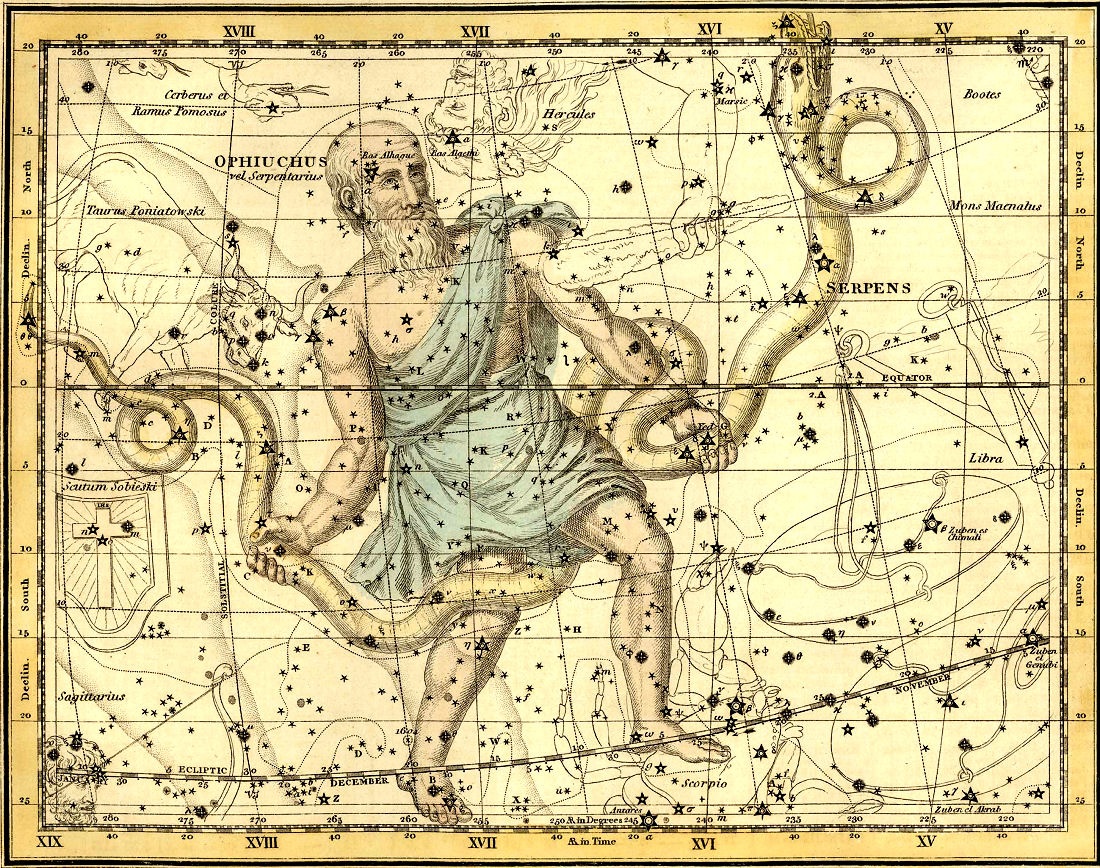
The constellation Ophiuchus (or Serpentarius) grasping the constellation Serpens, from Alexander Jamieson’s Celestial Atlas of 1822. It is interesting to note that Mashiach must be a direct descendant of King David, whose own father Yishai (Jesse) was also called Nachash! (See Talmud, Shabbat 55b.)


The above is an excerpt from Garments of Light, Volume Two. Get the book here

When Jews and Greeks Were Brothers: The Untold Story of Chanukah

As we celebrate the festive holiday of Chanukah, it is important to remember that not all of the Greeks were wicked and immoral. The enemies of the Chanukah narrative were the Seleucids, or Syrian-Greeks, not the mainland Greeks of Europe. In fact, the Book of Maccabees (I, 12:6-18) records an alliance between Jonathan Maccabee—the kohen gadol and righteous leader of Israel after the deaths of Matityahu and Judah Maccabee—and the famous Spartans of mainland Greece:

Jonathan, the high priest, and the council of the nation and the priests and the rest of the Jewish people send greetings to their brothers, the Spartans. In former times, a letter was sent to the high priest Onias, from Areus who was then king among you, to say that you are our kinsman… And Onias showed honour to the man who was sent to him, and accepted the letter, which contained a declaration of alliance and friendliness.

So, although we are in no need of these, since we find our encouragement in the sacred books that are in our keeping, we have undertaken to send to renew relations of brotherhood and friendliness with you, so that we may not become entirely estranged from you…

Jonathan points out that Israel does not need the help of the Spartans to defeat the Seleucids, as God’s help is all they need. Nonetheless, Israel and Sparta were always good friends, and Israel wants to keep it that way. In his letter, Jonathan mentions an earlier letter sent by King Areus of Sparta to Onias the kohen gadol (Onias is the Hellenized name for Choniyahu or Chonio, the son of Yadua the high priest, mentioned in Nehemiah 12:11). This letter is recorded in the Book of Maccabees (I, 12:20-23), as well as in the writings of Josephus, opening with the words:

Areus, king of the Spartans, sends greetings to Onias the high priest. It is found in writing that the Spartans and Jews are kinsman, and that they are both of the stock of Abraham…

Incredibly, the Spartan king suggests that the Spartans are descendants of Abraham, too! Where does this bizarre belief come from?

Greek Sons of Abraham

Sometime in the 2nd century BCE lived a Greek historian and sage named Cleodemus, sometimes referred to as Cleodemus the Prophet. He also went by the name Malchus which, because of its Semitic origins, makes some scholars believe he could have been Jewish. Cleodemus wrote an entire history of the Jewish people in Greek. While this text appears to have been lost, it is cited by others, including Josephus (Antiquities, i. 15).

Cleodemus commented on Abraham’s marriage to Keturah (typically identified with Hagar), and their children. This is recorded in Genesis 25, which begins:

And Abraham took another wife, and her name was Keturah. And she bore him Zimran, and Yokshan, and Medan, and Midian, and Ishbak, and Shuach. And Yokshan begot Sheva and Dedan. And the sons of Dedan were Ashurim, and Letushim, and Leumim. And the sons of Midian were Ephah, and Epher, and Chanokh, and Avidah, and Elda’ah. All these were the children of Keturah. And Abraham gave all that he had to Isaac, while to the sons of the concubines that Abraham had, Abraham gave gifts, and he sent them away from Isaac, while he was still alive, to the east country.

Abraham had six children with Keturah, from which came at least seven grandchildren, and three great-grandchildren which the Torah names explicitly. The Torah then makes it clear that Abraham gave everything that he had to Isaac—including the Covenant with God and the land of Israel—while the others received gifts and were sent away from the Holy Land.

Cleodemus suggests that Epher (or another child named Yaphran), the great-grandson of Abraham, migrated to Africa—which is where the term “Africa” comes from! (This is particularly interesting because Epher was the son of Midian, and Tziporah the wife of Moses was a Midianite, and is described as a Cushite, or African/Ethiopian.) Cleodemus states that Epher, Yaphran, and Ashurim assisted the Greek hero Hercules in one of his battles. Following this, Hercules married one of their daughters—a great granddaughter of Abraham—and had a son with her. This son was Diodorus, one of the legendary founders of Sparta!

It appears that the Spartan king Areus was aware of this possible historical connection, and accepted it as fact. This connection may explain why the Spartans were so similar to ancient Israelites. (Others have suggested that because the Israelite tribe of Shimon—known for being fierce warriors—did not receive a set portion in the Holy Land, many of them moved elsewhere and ended up in Sparta, or ended up in Sparta after being expelled from Israel by the Assyrians alongside the other lost tribes.) In his book Sparta, renowned historian Hugo Jones writes that the Spartans held in the highest regard a certain ancient law-giver, much like Moses the law-giver of Israel. The Spartans celebrated new moons (Rosh Chodesh), and unlike their Greek counterparts, even a seventh day of rest! Of course, the Spartans themselves were very different from other Greeks, particularly those in Athens, whom Sparta often battled. The Spartan form of government was different, too, not an Athenian-style democracy but a monarchy that governed alongside a “council of elders”, much like Israel’s king and Sanhedrin.

Perhaps most similarly, the Spartans were known for their “stoic” way of life. The later Greek school of stoicism was modeled on the ancient way of the Spartans. This meant living simply and modestly, being happy with what one has, and most importantly, putting mind above body, and logic above emotion. This almost sounds like something out of Pirkei Avot, and is a teaching echoed across Jewish texts both ancient and modern. In fact, when Josephus tried to explain who the rabbis were to his Roman audience, he said that they were Jewish stoic philosophers!

Gideon and Leonidas

Undoubtedly, the most famous story of the Spartans is the Battle of Thermopylae. Around 480 BCE, the Persian emperor Xerxes invaded Greece with a massive force. Xerxes first sent messengers to the Greek city-states to offer peaceful surrender. According to the historian Herodotus, Sparta’s King Leonidas told the messenger:

A slave’s life is all you understand, you know nothing of freedom. For if you did, you would have encouraged us to fight on, not only with our spear, but with everything we have.

Spoken like a true Maccabee. The messenger then told Leonidas and his men to bow down, to which Leonidas, like his historical contemporary Mordechai, said: “We bow down before no man.” Later, when the Persian boasted that his empire was the wealthiest in the world, with gold reserves the likes of which Leonidas could only dream of, Leonidas replied: “Ares is lord. Greece has no fear of gold.”

This statement almost makes Leonidas seem like a monotheist. Indeed, the Spartans worshiped Ares—the god of war—above all others. Interestingly, the Torah commonly describes Hashem in similar military terms, like a great warrior riding a merkavah or chariot, as a “God of Legions” (Hashem Tzva’ot), and even as a “Man of War” (Ish Milchamah, see Exodus 15:3). Of course, the Spartans had their abominable statues and idols, which is perhaps the greatest distinction (and a critical one) between them and ancient Israel.

King Leonidas went on to assemble just three hundred brave men to face off against the massive Persian invasion. Although they ultimately lost, the Spartans fought valiantly, inspired their fellow Greeks, and did enough damage to hamper Persian victory. This story of three hundred, too, has a Biblical parallel. The Book of Judges records a nearly-identical narrative, with the judge Gideon assembling three hundred brave men and miraculously defeating a massive foreign invasion.

Which came first? The earliest complete Greek mythological texts date back only to the 3rd century BCE. By then, the Tanakh had long been completed, and in that same century was first translated into the Greek Septuagint. It isn’t hard to imagine Greek scholars and historians of the 3rd century getting their hands on the first Greek copies of Tanakh and incorporating those narratives into their own. In fact, the Greek-Jewish philosopher Aristobulus of Alexandria (181-124 BCE) admitted that all of Greek wisdom comes from earlier Jewish sources. The later Greek philosopher Numenius of Apamea said it best: “What is Plato but Moses speaking Greek?”

Greece and the Exodus

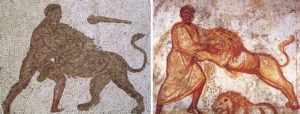
The similarities between Greek myth and more ancient Jewish texts are uncanny. Hercules was a mighty warrior whose first task (of twelve) was to slay a lion, like the mighty Shimshon who first slays a lion in Judges. Deucalion survives a great flood that engulfs the whole world as punishment from an angry Zeus. Like Noah before him, Deucalion has a wife and three sons, and like Noah, Deucalion is associated with wine-making (the root of his name, deukos). Pandora’s curiosity brings about evil just like Eve’s, while Asclepius carries a healing serpent-staff like Moses. Aristophanes even taught that Zeus first made man as male and female in one body, and later split them in half, just as the Torah and Talmud do.

Roman mosaic of Hercules and the Nemean Lion, and a Roman fresco of Samson and the lion, from the same time period.

In Jewish tradition, the Greeks come from the Biblical Yavan, son of Yafet (or Yefet or Japheth), son of Noah (Genesis 10:2). Yavan is the same as the Greek Ion (or Iawones), one of the Greek gods, and Ionia, referring to one of its most important regions, and the dialect of the great Greek poets Homer and Hesiod, as well as the scholars Herodotus and Hippocrates. Meanwhile, the Greeks worshipped Iapetus (same as Yafet) as a major god. Iapetus was the father of Prometheus, the god who supposedly fashioned man from the mud of the earth. So, not surprisingly, the Biblical Yavan and Yafet are firmly in the Greek tradition as well.

In his Was Achilles a Jew? (pgs. 465-468), Larry S. Milner points out many other similarities between Greek myth and the narratives of the Torah. The Greek story of Orion, where his birth was a gift from three deities to an old, childless couple, is nearly identical to the prophesied birth of Isaac, which came with the arrival of three angels. Key aspects of the tales of Odysseus resemble the adventures of Jacob, while the legend of Orpheus and Eurydice is reminiscent of Lot and his wife. The abduction of Helen (leading to the destruction of Troy through an infamous ruse) is strangely similar to the abduction of Dinah (leading to the decimation of Shechem through an infamous ruse). And there are many more.

The Greeks held that the ancient heroes and founders Danaus and Cadmus originally came from Egypt. Milner posits, and eloquently argues, that Danaus and Cadmus were not Egyptians, but Hebrews who had been enslaved in Egypt! They escaped Egypt and settled in Greece. Their names have Semitic origins, and it is possible they were the ones that introduced the Semitic alphabet to the Greeks, as scholars have long ago concluded that the Greeks adapted their alphabet from the Semitic one. The only question among scholars is whether it was the Phoenicians or Hebrews who introduced the alphabet to the Greeks. Milner strongly argues on behalf of the latter. Finally, he notes how ancient Greece was organized by an amphictyony, a “league of neighbours” that consisted of twelve city-states in a loose confederacy. The amphictyony very closely mirrored the organization of, and relationship between, the Twelve Tribes of Israel. In short, we find that not only did the Greeks adopt many of our Biblical narratives and ideas, but even our ancient written language and political structure, too.

In Volume One of Garments of Light (‘Did the Jews Really Defeat the Greeks?’), we saw how Greece had a huge influence on Judaism. Now, we see how tremendous an influence Judaism had on Greece. The two civilizations go hand-in-hand, and between them gave rise to the world we live in. Indeed, this was prophesied by Noah, who blessed his sons: “May God make Yefet great, and he will dwell in the tents of Shem” (Genesis 9:27). Shem is the earliest forefather of Israel, and Yefet of Greece. The two dwell in one tent.

On Chanukah, we celebrate the Jewish victory over the Seleucids. Not of the Greeks as a whole, but of a relatively small faction of Syrian Greeks, far from the Greek heartland which enjoyed a good relationship with Israel, starting with Alexander the Great and through to the Spartans and Maccabees.

[This is part two of a three-part series. See here for part one, and here for part three.]


The above is an excerpt from Garments of Light, Volume Two. Get the book here

Who Was the First Rabbi in History?

Chanukah is the only major Jewish holiday without an explicit basis from the Tanakh. However, there does exist an ancient Book of Maccabees—which recounts the history of Chanukah and the chronicles of Matityahu, Judah and the Hashmonean brothers—but it was not included in the Tanakh. Some say it was not included because by that point (2nd century BCE), the Tanakh had already been compiled by the Knesset haGedolah, the “Great Assembly” which re-established Israel after the Babylonian Exile. Others argue that the Tanakh was not completely sealed by the Knesset, since it appears that the Book of Daniel may have been put together around the same time as the Book of Maccabees, but was included in the Tanakh. This may be why Daniel was included in the Ketuvim, and not in the Nevi’im where we might expect it to be. Later still, the Sages of the Talmud debate whether certain books (such as Kohelet, “Ecclesiastes”, and Shir HaShirim, the “Song of Songs”) should be included in the Tanakh.

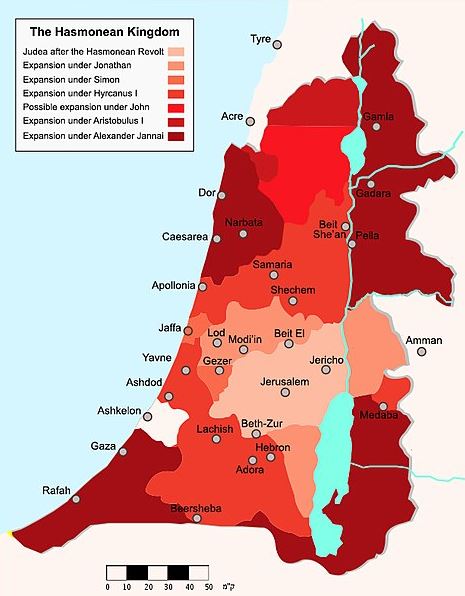
The simplest reason as to why the Book of Maccabees was not added to the Tanakh is probably because it is not a prophetic work, but simply a historical one. Another reason is that the original Hebrew text had been lost, and only Greek translations survived. It is also possible that the Book of Maccabees was not included for the same reason why there is no Talmudic tractate for Chanukah, even though there is a tractate for every other major holiday. (Chanukah is discussed in the Talmud in the tractate of Shabbat). Some argue that the events of Chanukah were so recent at the time that everyone knew them well, so having a large tractate for Chanukah was simply unnecessary. The other, more likely, reason is that although the Hashmonean Maccabees were heroes in the Chanukah period, they soon took over the Jewish monarchy (legally forbidden to them since they were kohanim) and actually adopted the Hellenism that they originally fought so valiantly against!

The first Hashmonean to rule was Shimon, one of the five sons of Matityahu. He was the only son to survive the wars with the Seleucid Greeks. He became the kohen gadol (high priest), and took the title of nasi, “leader” or “prince”, though not a king. Despite being a successful ruler, Shimon was soon assassinated along with his two elder sons. His third son, Yochanan, took over as kohen gadol.

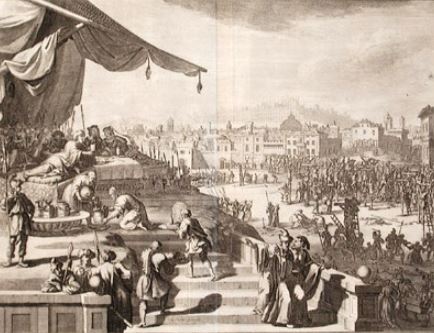
Yochanan saw himself as a Greek-style king, and took on the regnal name Hyrcanus. His son, Aristobulus (no longer having a Jewish name at all!) declared himself basileus, the Greek term for a king, after cruelly starving his own mother to death. Aristobulus’ brother, Alexander Jannaeus (known in Jewish texts as Alexander Yannai) was even worse, starting a campaign to persecute rabbis, including his brother-in-law, the great Shimon ben Shetach. Ultimately, Yannai’s righteous wife Salome (Shlomtzion) Alexandra ended the persecution, brought her brother Shimon and other sages back from exile in Egypt, and ushered in a decade of prosperity. It was Salome that re-established the Sanhedrin, opened up a public school system, and mandated the ketubah, a marriage document to protect Jewish brides. After her death, the kingdom fell apart and was soon absorbed by Rome.

‘Alexander Jannaeus feasting during the crucifixion of the Pharisees’ by Willem Swidde (c. 1690)

Sadducees and Pharisees

While Alexander Yannai was aligned with the Sadducees, Salome Alexandra was, like her brother Shimon ben Shetach, a Pharisee. The Sadducees (Tzdukim) and Pharisees (Perushim) were the two major movements or political parties in Israel at the time. The former only accepted the written Torah as divine, while the latter believed in an Oral Tradition dating back to the revelation at Sinai. Thus, “Rabbinic Judaism” as we know it today is said to have developed from Pharisee Judaism, though this is not quite certain. The Sages of the Talmud didn’t speak so highly of the Pharisees in general, and Judaism also includes key elements from another major group that flourished at the time, the Essenes.

Because the Sadducees only accepted the written Torah, their observance was highly dependent on the Temple and the land of Israel, since most of the Torah is concerned with sacrificial and agricultural laws. When the Romans ultimately destroyed the Temple and the majority of Jews went into exile, Sadducee Judaism simply could not survive. (Later, a similar movement based solely on the written Torah, Karaite Judaism, would develop.) Meanwhile, the Pharisees and their Oral Tradition continued to develop, adapt, and flourish in exile and, together with Essene practices, gave rise to the Judaism of today.

Avot d’Rabbi Natan states that the Sadducees get their name from one Tzadok, a student of the sage Antigonus. Antigonus famously taught (Pirkei Avot 1:3) that one should serve God simply for the sake of serving God, and not in order to receive a reward in the afterlife. It is this teaching that led to Tzadok’s apostasy. Indeed, we know that the Sadducees did not believe in the Resurrection of the Dead or apparently any kind of afterlife at all. This makes sense, since the Sadducees only accepted the Chumash as law, and the Chumash itself never mentions an afterlife explicitly.

In that same first chapter of Pirkei Avot, we read that Antigonus was the student of Shimon haTzadik, the last survivor of the Knesset HaGedolah. Antigonus passed down the tradition to Yose ben Yoezer and Yose ben Yochanan, who passed it down to Yehoshua ben Perachiah and Nitai haArbeli, who passed it down to Shimon ben Shetach and Yehuda ben Tabai. This means that Shimon ben Shetach, brother of Queen Salome Alexandra, lived only three generations after Shimon haTzadik, the last of the Great Assembly. This presents a problem since, according to traditional Jewish dating, the Great Assembly was about 300 years before the rule of Salome. (It is even more problematic according to secular dating, which calculates nearly 500 years!) It is highly unlikely that three generations of consecutive sages could span over 300 years.

The rabbinic tradition really starts with Shimon haTzadik, the earliest sage to be cited in the Talmud. He is said to have received the tradition from the last of the prophets in the Great Assembly, thus tying together the rabbinic period with the Biblical period of prophets. Yet, Shimon haTzadik himself is not called a “rabbi”, and neither is his student Antigonus, or Antigonus’ students, or even Hillel and Shammai. The title “rabban” is later used to refer to the nasi of the Sanhedrin, while the first sages to properly be called “rabbi” are the students of Rabban Yochanan ben Zakkai, the leader at the time of the Temple’s destruction by the Romans.

Despite this, the title “rabbi” is often applied retroactively to earlier sages, including Shimon ben Shetach, Yehoshua ben Perachiah, and others, all the way back to Shimon haTzadik, the first link in the rabbinic chain. Who was Shimon haTzadik?

The Mystery of Shimon haTzadik

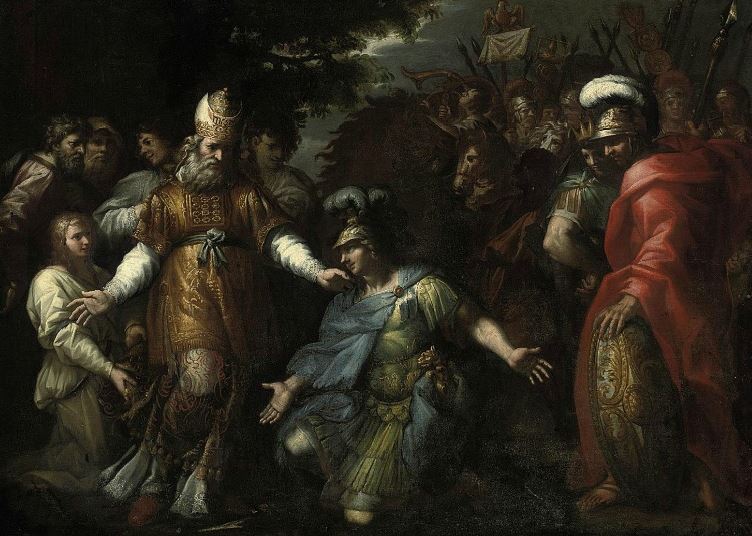
The most famous story of Shimon haTzadik is recounted in the Talmud (Yoma 69a). In this story, Alexander the Great is marching towards Jerusalem, intent on destroying the Temple (due to the activism of a group of Kutim), so Shimon goes out to meet him in his priestly garments (he was the kohen gadol). When Alexander sees him, he halts, gets off his horse, and bows down to the priest. Alexander’s shocked generals ask why he would do such a thing, to which Alexander responds that he would see the face of Shimon before each successful battle.

‘Alexander the Great and Jaddus the High Priest of Jerusalem’ by Pietro da Cortona (1596-1669)

While it is highly doubtful that the egomaniacal Alexander (who had himself declared a god) would ever bow down to anyone, this story is preserved in a number of texts, including that of Josephus, the first-century historian who was an eye-witness to the Temple’s destruction. In Josephus, however, it is not Shimon who meets Alexander, but another priest called Yaddua. Yaddua is actually mentioned in the Tanakh (Nehemiah 12:22), which suggests he was a priest in the days of the Persian emperor Darius. Of course, it was Darius III whom Alexander the Great defeated. It seems Josephus’ account is more accurate historically in this case.

In fact, in Sotah 33a, the Talmud tells another story of Shimon haTzadik, this one during the reign of the Roman emperor Caligula. We know that Caligula reigned between 37 and 41 CE—over three centuries after Alexander the Great! The Talmud thus gives us three different time periods for the life of Shimon haTzadik: a few generations before Shimon ben Shetach, or a few centuries before in the time of Alexander the Great, or centuries after in the time of Caligula. Which is correct?

The First Rabbi

The Book of Maccabees (I, 2:1-2) introduces the five sons of Matityahu in this way:

In those days, Matityahu ben Yochanan ben Shimon, a priest of the descendants of Yoariv, left Jerusalem and settled in Modi’in. He had five sons: Yochanan, called Gaddi; Shimon, called Thassi; Yehuda, called Maccabee; Elazar, called Avaran; and Yonatan, called Apphus.

Each of the five sons of Matityahu has a nickname. The second son, Shimon, is called “Thassi” (or “Tharsi”). This literally means “the wise” or “the righteous”, aka. HaTzadik. It was Shimon who survived the Chanukah wars and re-established an independent Jewish state. In fact, the Book of Maccabees (I, 14:41-46) tells us:

And the Jews and their priests resolved that Shimon should be their leader and high priest forever until a true prophet should appear… And all the people agreed to decree that they should do these things to Shimon, and Shimon accepted them and agreed to be high priest and general and governor of the Jews…

Apparently, Shimon was appointed to lead the Jews by a “great assembly” of sorts, which nominated him and, after his acceptance, decreed that he is the undisputed leader. The Book of Maccabees therefore tells us that Shimon the Maccabee was a righteous and wise sage, a high priest, and leader of Israel that headed an assembly. This is precisely the Talmud’s description of Shimon haTzadik!

Perhaps over time the “great assembly” of Shimon was confused with the Great Assembly of the early Second Temple period. This may be why Pirkei Avot begins by stating that Shimon haTzadik was of the Knesset haGedolah. In terms of chronology, it makes far more sense that Shimon haTzadik was Shimon Thassi—“Simon Maccabeus”—who died in 135 BCE. This fits neatly with Shimon ben Shetach and Salome Alexandra being active a few generations later, in the 60s BCE as the historical record attests. It also makes sense that Shimon haTzadik’s student is Antigonus, who carries a Greek name, just as we saw earlier that following Shimon the leaders of Israel were adopting Greek names.

Thus, of the three main descriptions of Shimon haTzadik in the Talmud, it is the one in Avot that is historically most accurate, and not so much the one in Yoma (where he is placed nearly three centuries before Shimon ben Shetach) or the one in Sotah (where he is in the future Roman era). Thankfully, there is actually one more brief mention of Shimon haTzadik in the Talmud (Megillah 11a) which says Shimon haTzadik was one of the heroes of Chanukah! This is certainly the most accurate reference to the mysterious Shimon haTzadik in the Talmud, and puts him exactly in the right era! This Talmud confirms that Shimon haTzadik was “Shimon Thassi”, the Maccabee.

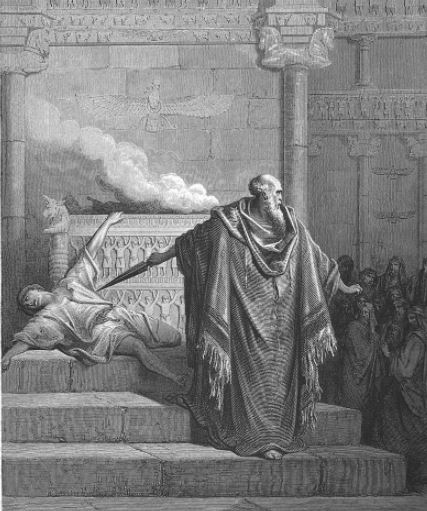
‘Mattathias of Modi’in killing a Jewish apostate’ by Gustav Doré

Lastly, we must not forget that Shimon the Maccabee was one of the instigators of the revolt against the Greeks and their Hellenism. He was the son of Matityahu, a religious, traditional priest, who fled Jerusalem when it was taken over by Hellenizers (as we quoted above, I Maccabees 2:1). Shimon was certainly aligned with the traditional Pharisees, and it was only his grandson Alexander Yannai who turned entirely to the more Hellenized Sadducees and began persecuting the Pharisees. As Rabbinic Judaism came out of Pharisee Judaism, it makes sense that the tradition begins with Shimon the Maccabee, or Simon Thassi, ie. Shimon haTzadik.

Interestingly, the Book of Maccabees states that Matityahu was a descendent of Yoariv. This name is mentioned in the Tanakh. I Chronicles 24:7 lists Yoariv as the head of one of the 24 divisions of kohanim, as established in the days of King David. The same chapter states that Yoariv was himself a descendent of Elazar, the son of Aaron the first kohen. Thus, there is a fairly clear chain of transmission from Aaron, all the way down to Matityahu, and his son Shimon.

Shimon continued to pass down the tradition, not to his son Yochanan—who was swayed by the Greeks and became John Hyrcanus—but to his student Antigonus. (Depending on how one reads Avot, it is possible that Yose ben Yoezer and Yose ben Yochanan were also direct students of Shimon haTzadik.) It appears we have found the historical Shimon haTzadik, and closed the gap on the proper chronology of the Oral Tradition dating back to Sinai.

If this is the case, then Chanukah is a celebration of not only a miraculous victory over the Syrian Greeks, but of the very beginnings of Rabbinic Judaism as we know it, with one of Chanuka’s central heroes being none other than history’s first official rabbi.

Chag sameach!


The above essay is adapted from Garments of Light, Volume Three.
Get the book here!