Tag Archives: Aaron

Embracing Converts, and the Seeds of Amalek

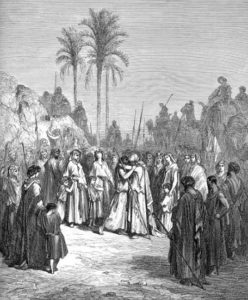
'The Meeting of Jacob and Esau' by Gustav Doré

‘The Meeting of Jacob and Esau’ by Gustav Doré

This week’s parasha is Vayishlach, which recounts Jacob’s return and settlement in the Holy Land after twenty years of living in Charan. At the end of the parasha is a long list of the genealogies of Jacob’s brother, Esau. The list seems unnecessary, and many Sages have wondered why the Torah bothers to spend so much time recounting Esau’s descendants. There have even been debates on whether the entire text of the Torah is equally holy, or if passages like the Ten Commandments are holier than passages such as this list of Esau’s genealogies. Meanwhile, the Arizal states that many of the deepest secrets of Creation are embedded particularly in this seemingly boring and superfluous passage. He draws particular significance from the list of the kings of Edom. The Arizal says these kings are codenames for the Sefirot, and a careful reading of the text reveals the cosmological rectifications (tikkunim) required to repair all of Creation and restore the world to perfection.

About half way through the list we are told that “… the sister of Lotan was Timna” (Genesis 36:22). Again, the Sages are baffled at this extra addition. We already care little enough that there was once an Edomite chief named Lotan – who cares that he had a sister named Timna? The Talmud (Sanhedrin 99b) notes how there were those who scoffed at such verses, saying: “Did Moses have nothing better to write?” And then, the same page of Talmud comes in to explain its tremendous significance:

Timna was a royal princess… Desiring to become a proselyte, she went to Abraham, Isaac and Jacob, but they did not accept her. So she went and became a concubine to Eliphaz the son of Esau, saying, “I’d rather be a servant to this people than a mistress of another nation.” From her, Amalek was descended, who afflicted Israel. Why so? Because they should not have repulsed her!

The Talmud combines the verse in question – which states that Timna was the royal sister of the chief, or prince, Lotan – with an earlier verse (36:12) that says she married Esau’s son Eliphaz and bore Amalek. She wished to convert to Judaism and approached the Patriarchs. All three rebuffed her. So, she ended up with Eliphaz – the closest she could get to being part of the nation. This union gave rise to the evil Amalek, that antagonizing force which has been oppressing Israel for millennia. The Sages state that the Patriarchs should have embraced this potential convert, instead of pushing her away. Their failure to open their arms led to centuries of Jewish suffering. The Talmud sends a pretty clear message: gentiles and converts should not be turned away, and doing so only breeds more resentment against Jews, bringing out all of the world’s “Amaleks”.

Soulmates of Jacob and Moses

The Arizal comments on the Timna passage and points out something even more amazing. He taught (Sha’ar HaMitzvot, Shoftim) that Timna was actually the soulmate of Jacob! Timna contained a great deal of holiness, and Jacob was meant to convert her and marry her, thereby elevating her spiritual sparks. That would have been a massive tikkun of its own, and would have hastened the coming of Mashiach. Instead, Jacob rejected her, and she went on to produce Amalek, bringing evermore evil into the world, and further delaying the coming of Mashiach.

The Arizal highlights that Moses made a similar mistake in not consummating his marriage to the Cushite (Ethiopian) woman. Both Tzipporah and the Cushite woman were Moses’ soulmates, and while Moses did the right thing in converting the Cushite, he never properly married her. Her sparks of holiness were not fully elevated, and the tikkun was left incomplete. This is why Aaron and Miriam were upset with their brother, as we read later in Numbers 12:1, “And Miriam and Aaron spoke against Moses because of the Cushite woman whom he had married…”

Rabbi Akiva’s 24,000 Students in Shechem

In this week’s parasha, too, we read how the people of Shechem genuinely wished to unite with Jacob’s family, agreed to circumcise themselves, and converted en masse. However, Jacob’s sons Shimon and Levi rejected them and resorted to violence in avenging what was done to their sister Dinah. Jacob was horrified at the actions of his sons, and later did not bless the two on his deathbed. It appears their sin was never forgiven, as hundreds of years later the tribes of Shimon and Levi were not given set borders within the Holy Land, but only a handful of cities interspersed among the other tribes. Kabbalistic texts reveal that Shimon and Levi killed 24,000 people in Shechem, and these 24,000 converted souls later reincarnated as the 24,000 students of Rabbi Akiva!

Did You Know These Famous People Converted to Judaism?

All of these narratives point to the same lesson: converts should be welcomed and accepted wholeheartedly. They have the potential for great holiness. The Talmud (Bava Kamma 38a) states that a gentile who occupies himself with Torah is equal to a kohen gadol, a High Priest! The Arizal describes five types of Jewish souls, and the souls of converts are among the purest. (The other types are “Old Souls”, “New Souls”, “True New Souls”, and the “Souls of Cain and Abel”. Of these, the most impure are Old Souls.) It goes without saying that there is no place for racism of any kind within Judaism – Moses himself married a black woman, and was reprimanded for not being diligent in consummating that union.

Historically, Jews were never the proselytizing kind. There are no Jewish missionaries that go out knocking on the doors of gentiles to seek converts. At the same time, Judaism was rarely a popular religion to convert in to. But this will change very soon, and we have to be ready for that day, for the prophet Zechariah (8:23) predicted:

It shall come to pass that ten men shall take hold – from all the languages of the nations – shall take hold of the corners of a Jew’s clothes, saying: “We will go with you, for we have heard that God is with you…”


The above essay is an excerpt from Garments of Light, Volume One. Get the book here!

How Did Adam Live 930 Years?

This week’s parasha is Vayelech, which begins with Moses’ statement that “Today I am one hundred and twenty years old” (Deut. 31:2). It was the 7th of Adar, Moses’ birthday, and also his day of passing. Moses goes on to conclude his final speech to the people, then sings a deeply prophetic farewell song in next week’s portion Ha’azinu, followed by his blessings to the people in the last parasha of the Torah, V’Zot HaBracha.

Moses was the greatest of all prophets, the humblest man to walk the earth, and the central founding figure of Judaism. He was blessed with living a full and healthy life spanning exactly 120 years. It has become common today for people to wish each other 120 years of life. Why is this the specific figure? Can humans not live longer? Don’t we see in Genesis that Adam lived 930 years, Noah lived 950 years, and Methuselah (Metushelach) lived a record 969 years? What happened?

The Flood Generation

Ten generations from Adam, the world had descended into endless sin and immorality. God decreed that man’s days “will be numbered at one hundred and twenty” (Genesis 6:3). Many believe this to mean that God decreed humans will no longer be able to live past 120 years. Indeed, when looking at modern records of longevity, the vast majority of the world’s oldest people die close to 120 years. There has only been one official case of anyone exceeding 120, a Frenchwoman named Jeanne Calment who lived 122 years.

However, the traditional Jewish interpretation is that the Genesis verse above does not mean man is unable to live past 120. After all, our forefathers Abraham, Isaac, and Jacob lived long after this decree, and they lived 175, 180, and 147 years, respectively. Rather, the Jewish Sages state that God decreed the arrival of the Great Flood 120 years hence. God gave mankind 120 years to repent, and possibly avert the Flood. Noah was commissioned to go around and inspire people to mend their ways, and he had 120 years to do it.

Unfortunately, Noah failed in this endeavour, unable to bring even a single person to righteousness (as the Ark only carried his own family at the end). This is one reason for why the Flood is known in Hebrew as mabul Noach, literally “Noah’s Flood” (or mei Noach, “Noah’s waters”), as if he was partially responsible for not doing enough to inspire people to change. Because of this, many (including Rashi) have commented on the verse “Noah was a righteous and pure man in his generation” (Genesis 6:9) to mean that Noah was only righteous in his faulty generation. Had he lived in another generation, such as that of Abraham, he would not have been deemed so righteous!

We see from the Biblical chronology that after the Flood, people’s life spans steadily shorten. Moses’ older siblings Aaron and Miriam lived 123 and 126 years. Moses died at 120, and this appears to have become the new limit. After Moses, there are only a few people noted to have lived longer, one of which is Yehoyada the High Priest, who lived 130 years (II Chronicles 24:16).

What accounts for this steady degeneration in longevity?

Yeridat HaDorot

The Talmud (Shabbat 112b) states: “If the earlier [scholars] were sons of angels, we are sons of men; and if the earlier [scholars] were sons of men, we are like asses…” This is one of many passages that attests to the well-known concept of yeridat hadorot, “the descent of the generations”. It is said that each passing generation falls lower and lower in its wisdom and spiritual greatness. This concept can solve the puzzle of longevity.

The body is a finite lump of matter. It is only animated and vitalized by the infinite soul within it. Thus, the greater the soul, the longer the body can live. As the spiritual potential in each generation falls, so too does the lifespan.

Moreover, it is taught that Adam contained essentially all of the souls of humanity within him (Sha’ar HaGilgulim, ch. 11). As more and more people were born over the centuries, this single universal soul broke down further and further into smaller and smaller fragments. With the exception of a number of “new souls”, the vast majority of the world’s 7 billion people are all parts of the soul of Adam. It is therefore not surprising that today’s spiritual capabilities (and with that, the lifespans) are severely limited.

At the Speed of Light

Science may offer another intriguing possibility. According to modern physics, time as we know it doesn’t really exist. The universe is one interwoven fabric of both time and space. The faster one moves through space, the slower the effects of time for that person. There is actually a formula to measure the impact of this time dilation, known as the Lorentz transformation. It is given by the equation ΔT = t√1-v2/c2 [or: t = t÷ √(1-v2/c2)], where v is one’s speed and c is the speed of light.

Theoretically, the speed of light is the absolute maximum in our universe. At light speed (just under 3.00 x 10⁸ m/s, or 300,000 km/s), time will totally stop for the traveller (if plugging it into the formula, one gets a value of zero). This seems impossible. However, if we plug in a value very close to light speed, such as 2.99 x 10⁸ m/s, we get a very interesting result.* A person who has perceived living 80 years will have actually lived 980 earthly years! That makes Adam’s 930 years a more palatable 76, and Methuselah’s record 969 as 79. This fits in well with the verse in Psalms that a normal lifespan is 70 to 80 years (Psalms 90:10). But how could Adam and Methuselah have lived at near-light speed?

Beautifully, the Sages teach us that Adam was not a human like us. In many texts (such as Bereshit Rabbah 20:12), Adam is described not simply as a being of flesh, but rather as a being of light. Though most will interpret this metaphorically, there are those sages, such as the Arizal (for example, in Sefer HaLikutim, Bereshit, ch. 3) that interpret this quite literally. It remains to be seen what this means exactly, and if it has anything at all to do with physics, but perhaps there is much more to the idea of Adam being a man of light than we can imagine.


The article above is an excerpt from Garments of Light: 70 Illuminating Essays on the Weekly Torah Portion and Holidays. Click here to get the book! 

——–

*To be fair, choosing a value such as 2.99 x 10⁸ m/s may be deemed quite arbitrary. One can also plug in finer values even closer to the speed of light, such as 2.997 or 2.9972, and so on, each of which would give a more refined result. The point of this exercise is simply to illustrate the relativity of time, and what might explain the difference in perceived years between our generations and those of the first people, through a scientific perspective.

Moses and Korach, Abel and Cain, Water and Ice

This week’s Torah reading is named after Moses’ cousin, Korach, and describes his rebellion against the leader of the Jewish people. Rashi’s commentary quotes a number of Midrashic texts to explain Korach’s motivation. Korach was a very wealthy and very wise man. Yet, despite being a distinguished member of the community, and Moses’ cousin, he was not appointed to any prominent roles. The high priesthood was bestowed upon Aaron, while the leadership of the Kohatithes (one of the major divisions of the Levites) was given to Elitzaphan, who was younger than Korach.

Upset by these developments, Korach gathered 250 others and protested: “…the entire congregation, all of them, are holy, and God is in their midst, so why do you raise yourselves above God’s assembly?” (Numbers 16:3) Korach essentially accused Moses of nepotism: putting his own favourites in holy positions to rule over the people, when in reality all the people should be on a high and exalted level, as they are all equally part of God’s assembly.

This was a very good argument, and many were swayed by Korach. After all, God had said to the people that “… you will be a kingdom of priests, and a holy nation” (Exodus 19:6). Amazingly, Rashi writes that Moses himself agreed with Korach! Moses said:

“Among the nations, there are many forms of worship and many priests, and they do not all gather in one temple. We, however, have only one God, one ark, one Torah, one altar, and one High Priest, but you two hundred and fifty men are all seeking the High Priesthood! I, too, would prefer that. Here, take for yourselves the service most dear [to God] of all: it is the incense, more cherished than any other sacrifice, but it contains deadly poison, by which Nadav and Avihu were burnt, so be warned…” (Rashi on 16:6)

The Incense Offering

The ketoret, or incense offering, was the greatest of Temple services, and could only be performed by the High Priest. It is said that anyone else who attempted it (including the High Priest if he was not in the highest state of purity) would die immediately. The Torah already relayed the story of Nadav and Avihu, the sons of Aaron who tried to bring their own incense, and perished.

"Death of Korah, Dathan, and Abiram" by Gustave Doré

“Death of Korah, Dathan, and Abiram” by Gustave Doré

So, Moses told Korach and his supporters that he would have loved for everyone to be at the level of high priesthood. This is how God had originally intended it after all, and one day in the future it would be so. At the present moment, though, the people were simply not ready for it. If they indeed thought they were all capable of being the High Priest, Moses suggested for them to each bring their own incense. He warned them, though, not to forget what had happened to Nadav and Avihu.

The narrative continues with Korach and his supporters bringing their own incense offering, with the result being utter failure, and every one of them losing their life for it (16:35). Korach himself, together with his main supporters Datan and Aviram, was given a more severe punishment: they were swallowed up by the earth. Interestingly, this specific punishment was decreed by Moses. Why did Moses specifically want Korach to be swallowed up by the earth?

Cain and Abel

The Arizal explains that Moses and Korach were reincarnations of Abel and Cain (Sha’ar HaGilgulim, Ch. 29 and 32). Cain had risen up against Abel, argued with him, and then murdered him. The text states that the earth had “opened its mouth” to receive Abel’s blood (Genesis 4:11). This time around, Cain’s soul (within Korach) again rose up against Abel’s soul (within Moses) and quarreled with him. Now, to complete the spiritual rectification, measure for measure, it was Abel that buried Cain in the earth, with the text once again saying that the earth had “opened its mouth” (16:32).

Water and Ice

Practically speaking, Moses and Korach represent two types of people, indicated by their names. Moses, Moshe, was a name given by the Pharaoh’s daughter, who said ki min hamayim meshitihu, “For I drew him out of the water.” Korach, on the other hand, has the exact same Hebrew spelling as kerach, ice. Moses represents water; Korach represents ice. The latter is cold, hard, and unyielding, expanding ever larger as it freezes, symbolic of an inflating ego. The former is fluid, life-giving, and always flows to the lowest possible point, symbolic of humility. The lesson here is for each person to emulate the watery traits of Moses, and not the frozen qualities of Korach.