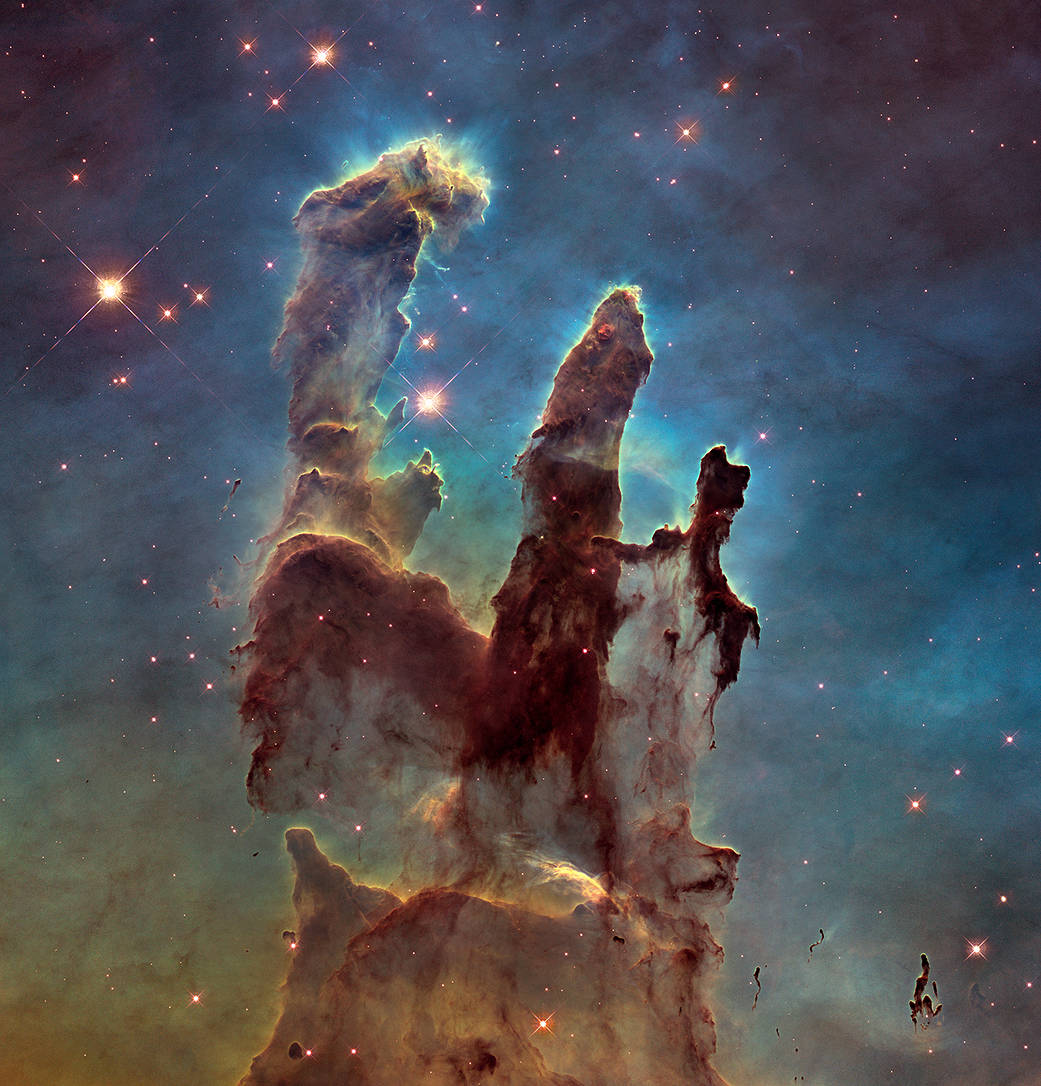
The ‘Pillars of Creation’ in the Eagle Nebula (Courtesy: NASA)
This week’s parasha, Vayak’hel, begins with the command to observe Shabbat. God created the world in six days and rested on the seventh, thus commanding us to organize our lives around the same seven-day week schedule. Observing Shabbat is testifying that Hashem is the Creator of this cosmos, and it is possibly the greatest display of our faith in the Creator. And so, the Torah warns that violating the Sabbath detaches one from their Maker, and ultimately brings about death (Exodus 35:2). The Zohar (II, 199a) comments on this week’s parasha that there are “seven judgements of death”. The soul goes through seven stages in the afterlife, each carrying the possibility of a very unpleasant experience.
The first “judgement” is the actual death itself, when the soul leaves the body. The Talmud (Berakhot 8a) states that there are 903 different ways it might occur. This is based on Psalms 68:21, which says “God is for us a God of deliverance; Hashem Adonai provides escapes from death.” The term “escapes from death” (לַמָּוֶת תֹּצָאוֹת) can also be read to refer to the soul escaping the body at death. The Talmud notes that the gematria of “escapes” (תֹּצָאֽוֹת) is 903, secretly alluding to the 903 ways that the soul might escape the body. It goes on to say that the worst form of death is the mysterious askara, often translated as “croup”, sometimes identified as diphtheria, or perhaps another terrible respiratory illness or asphyxiation. And the best and most pleasant way to die is through a neshikah, a kiss—the “kiss of death”—where the soul comes out of the body gently like “a hair drawn from milk”. Only the most righteous are said to merit dying by a divine kiss. (It is interesting to note that, elsewhere, the Talmud [Yevamot 62b] describes that Rabbi Akiva’s 24,000 students died by the terrible askara.)
The next “judgement” following death is when one’s “actions and words go before him and proclaim about him”. This may be referring to one’s life flashing before their eyes. If one had a good and righteous life, then a replay of their “actions and words” would probably be a pleasant experience. However, if one led a sinful life, a replay would be horrendously shameful. There are those who suggest this is the real torment of hell. It is partly based on Daniel 12:2, which says “Many of those that sleep in the dust of the earth will awake, some to eternal life, others to everlasting shame.” Similarly, Psalm 6:11 says “All my enemies will be shamed and stricken with terror; they will return in an instant and be shamed.” Why does it repeat “shame” twice? Rashi explains here that the wicked will be sentenced to Gehinnom, and when they protest, God will replay their sinful lives again (unraveling their “scrolls”), and they will be doubly shamed.
The Zohar continues to teach that the third “judgement” is the actual burial of the body. If a person lives a solely material existence and is very attached to their body, then the experience of burial will be an unpleasant one. For a spiritual person who is not so attached to their body and is easily able to shed their outer garment, it won’t be distressing at all.
Then comes dina d’kavra, or din hakever, judgement “at the grave” itself. This is likely the same as the hibbut hakever described in other places. In Sefer Chokhmat HaNefesh, Rabbi Elazar of Worms (c. 1176 – 1238) cites a Midrash that when a person is buried, the Angel of Death appears at the grave and asks the soul’s name. The wicked do not remember their names following death (being so disoriented and confused), so the Angel of Death takes them immediately up for judgement. (Later versions have a much worse description, with a beating involving a frightening chain of metal and fire!) Thankfully, the righteous do remember their names, and are spared. Based on this, there is a widespread custom to recite a verse from Tanakh that starts and ends with the first and last letters of one’s name at the conclusion of the Amidah (this is found in most siddurim today). Doing so is supposed to help a person recall their name after death, and avoid hibbut hakever.
Next comes dina d’tolaata, the “judgement of the worms”, referring to the decomposition of the body. For the wicked, who have a hard time detaching their souls from their bodies in the grave, this is particularly painful. For the righteous who can shed their bodies easily, they don’t feel the decomposition. Some uniquely righteous individuals don’t decompose at all (see, for instance, Bava Batra 17a), and avoid the “judgement of worms” entirely.
The sixth judgement is the suffering in Gehinnom. This is not for eternal damnation, but to rectify the soul. As the Mishnah (Eduyot 2:10) says clearly, it carries a maximum sentence of 12 months—which is why it is customary to recite Kaddish for the dead for no more than a year. Now, the “flames” of Gehinnom are said to subside on every Shabbat, giving the souls a reprieve. This is one of the deeper reasons for why lighting fires is forbidden on Shabbat, as commanded at the start of this week’s parasha. God doesn’t “light any fires” in Gehinnom either! The Zohar (II, 150b) adds that the fire subsides on holidays and Rosh Chodesh, too. Those who kept Shabbat while alive get to leave Gehinnom and enjoy a Heavenly Sabbath, but those who desecrated Shabbat stay in Gehinnom (without the flames).
Finally, the seventh judgement is when “the soul wanders around the world, without rest until it fulfills its deeds.” This is referring to reincarnation, where the soul needs to return into this world if it has not yet completed its mission. One who has fulfilled all mitzvot and rectified all aspects of their soul has no need to reincarnate. That said, sometimes righteous people do reincarnate to help others in this world. (For lots more on reincarnation, see the three-part series of videos here.) Before briefly sharing King David’s thoughts on these seven judgements, the Zohar concludes by reminding us how important it is for each person to be very careful with their deeds, and to make sure to do genuine teshuva and return to Hashem.
Shabbat Shalom!