
Tag Archives: Akedah

Superheroes in Judaism, the First Multiverse

This week’s parasha, Vayera, begins with Abraham sitting outside his tent just days after circumcising himself at the age of 99. We would expect him to be weak and frail at this moment, yet he is spry and full of energy. The Torah tells us that it was a very hot day (Genesis 18:1), and the Sages explain (as cited by Rashi on the verse) that God deliberately made it hot so that Abraham should not have any visitors bother him during his recovery. Yet, Abraham was more pained by the lack of visitors than he was from the circumcision! So, God sent him three angelic guests.
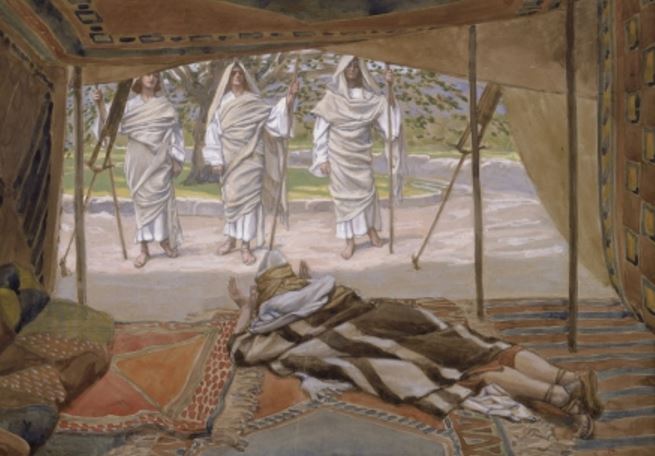
‘Abraham and the Three Angels’ by James Tissot

Abraham immediately sprung into action, bringing water for his guests to wash their feet, and cooking up a feast. Abraham served his guests “cream and milk and the calf that he had made, and he placed [them] before them, and he was standing over them under the tree, and they ate.” (Genesis 18:8) As discussed in the past, the Sages were puzzled at the fact that Abraham served both dairy and meat at the same meal. Although he lived before the official giving of the Torah, and therefore was not bound by Torah law, nonetheless we would expect him to observe the eternal Torah anyway. Jewish tradition holds that the Patriarchs also observed the Torah through an oral tradition and through their direct prophetic knowledge from God.

One solution to the problem comes from another tradition that Abraham had received the secret wisdom of Creation, and was actually the originator of Sefer Yetzirah, the “Book of Formation”. He knew how to use mystical powers to create things out of thin air. Hence, when the Torah says “the calf that he had made [asher asah]” it means that he literally made the calf! Since he had made this hunk of meat, it was never a living animal, and possessed no soul, so it was totally pareve, and he could serve it with “cream and milk”. The Talmud (Sanhedrin 65b) tells us that Rav Chanina and Rav Oshaia would study Yetzirah and similarly create a calf out of thin air which they then consumed.

Meanwhile, in last week’s parasha we saw how Abraham took on the united armies of four powerful kings. The Torah tells us that he fought them off with just 318 of his men (Genesis 14:14). If this wasn’t enough of a miracle, the Sages say (as cited by Rashi on the verse) that Abraham really didn’t have 318 men. Rather, 318 is the gematria of “Eliezer” (אליעזר), Abraham’s devoted servant. It was just Abraham and Eliezer taking on an entire army! How could they do this? The Talmud (Sanhedrin 109a) says that when Abraham would throw dust and straw it would transform into swords and arrows in mid-air. That’s quite the superpower!

Judaism is full of such feats of superpower, whether it’s Jacob pushing off a well-stone on his own (Genesis 29:1-10)—when normally it required a team of shepherds—or Samson crushing a thousand Philistines with a jawbone (Judges 15), or figures like Eliezer and Eliyahu employing kefitzat haderekh, “leaping” or “teleporting” across vast distances (see Sanhedrin 95a-b and Kiddushin 40a). It therefore isn’t surprising that the modern “pantheon” of superheroes was crafted almost entirely by Jewish writers and artists. Continue reading →
In Search of a Definitive List of Abraham’s Ten Tests

In this week’s parasha, Vayera, we read one of the Torah’s most famous narratives, the Akedah, or “Binding of Isaac”. The passage begins by stating that God sought to test Abraham. Although this is the first time the Torah uses such language, Jewish tradition maintains that God tested Abraham a total of ten times (Avot 5:3). What those ten tests were is not exactly clear. There are multiple different lists of the tests, and they don’t all agree with each other. What follows is an attempt to put together a definitive list of Abraham’s ten major life challenges.

Continue reading →

Eye-Openers from the Book of Jubilees

Parashat Behar begins with the command to observe shemitah, the Sabbatical year, and to proclaim a yovel, “Jubilee”, every 50th year after seven such cycles. The 50th year is a particularly special one, where “freedom shall be proclaimed”, slaves are freed, and all property returns to their ancestral owners. This is one of several incredible mitzvot which demonstrate the Torah’s strong emphasis on socio-economic equality and justice.

In the ancient Jewish world, the Jubilee was an important milestone for tracking the passage of time. For example, the Talmud (Arakhin 12b) calculates how long each Temple stood in terms of the number of Sabbaticals and Jubilees elapsed, and that there were exactly 17 Jubilees between Israel’s entry into the Holy Land and their exile by the Babylonians. In fact, there is an entire book, known as Jubilees, written some time in the Second Temple era which divides the early history of Israel and the world into segments of Jubilees. This intriguing text is one of the most controversial books from that era.

It is unknown who wrote Jubilees, but it itself claims to be a revelation given to Moses by the angels upon Mt. Sinai. Moses is the subject of the book, the “you” to whom the angels are speaking. It presents a comprehensive history from Creation until the given of the Torah on Mt. Sinai, organized into 50 Jubilees. The book holds that a Jubilee year, the fiftieth year, is also the first year of the next shemitah cycle. This means that a complete cycle is not 50 years, but 49 years. That’s precisely the debate in the Talmud page cited above. The Sages question whether the Jubilee year is the first year of the next shemitah or not. Rabbi Yehuda insists that it does, which is just one example of the Book of Jubilees overlapping with traditional Judaism.

Having said that, our Sages did not include Jubilees in the Tanakh. Although it reads very much like a Biblical book, it was excluded from the canon. This was not the case among Ethiopian Jews, who surprisingly did include Jubilees in their Tanakh! The same is true for the Ethiopian Orthodox Church. Many ancient Christian scholars referenced Jubilees, too, while modern scholars have shown that Jubilees was an important book for the Maccabees. The Hasmonean dynasty that followed made extensive use of it, as did the priests of the late Second Temple era. Among the Dead Sea Scrolls, Jubilees is one of the most prevalent texts, more than all other books of ‘Nakh except Psalms and Isaiah. All of this proves that the Book of Jubilees was of great significance in olden days, and greatly influenced Judaism (and Christianity). Intriguingly, some scholars have shown that Jubilees had an even greater impact on Islam, and much of the Quran was clearly inspired by it (see the work of Jan van Reeth for more).

In traditional Jewish texts, too, especially in Midrash and Kabbalah, there are numerous teachings which overlap with Jubilees. In fact, Jubilees may be the earliest known written source for some foundational points of Judaism today. For example, in chapter 7 we see the first description of God giving a set of laws to Noah. A careful count shows there are seven. The Torah does not explicitly say anything about a code of law given to Noah, but Jewish tradition of course speaks of seven “Noahide” laws.

In Jubilees, these laws are: 1) be just and righteous, 2) dress modestly, 3) bless the Creator, 4) honour parents, 5) love your fellow, 6) abstain from sexual sins, plus 7) the prohibition of eating the limb of a live animal which was relayed a bit earlier in the text. In the Talmud (Sanhedrin 56a-b), the Noahide laws are: 1) establish courts of law, 2) bless the Creator, 3) do not worship idols, 4) abstain from sexual sins, 5) do not murder, 6) do not steal, and 7) do not eat the limb of a live animal.

The first law in Jubilees and the Talmud is one and the same: being just implies having a justice system, ie. establishing courts of law. The second in the Talmud is phrased as “blessing Hashem”, just like the third in Jubilees, but is taken to mean not to curse Hashem, since we don’t expect gentiles to know Hebrew blessings. In any case, it is the same law. Not to engage in sexual sins and not to consume the limb of a live animal are the same. All in all, four of the seven are identical, and there are some parallels between the other three.

Another idea that finds its earliest expression in Jubilees is the concept of a messianic “millennium” (23:18-29). After a series of great travails, the world will enter an idyllic age that lasts one thousand years, with no evil and Satan destroyed. This is similar to descriptions in the Talmud (see, for instance, Sanhedrin 97a).

A final example: Jubilees states that God created seven things on the First Day: Heaven and Earth, water, spirits, darkness and light, and the abyss (tehom, as in Genesis 1:2). This is essentially identical to the Midrash (Pirkei d’Rabbi Eliezer, ch. 3), which says eight things were created on the First Day: Heaven and Earth, water, the Divine Spirit, darkness and light, and tohu v’vohu (also in Genesis 1:2), which can be seen as two parts of the tehom.

The Book of Jubilees presents many more fascinating details. Although not officially accepted in the Jewish canon, we see that it does contain a great deal of accurate information that is also in accepted Jewish texts. This makes it a potentially very useful tool to shed light on some of the big mysteries in Judaism. What follows is a list of some of the most intriguing and perhaps controversial teachings from the Book of Jubilees.


The above is an excerpt from Garments of Light, Volume Two. To continue reading, get the book here!