
Tag Archives: Ben Ish Chai

The Science & Kabbalah of Salt

Salt emerging from the Dead Sea

This week we begin reading the third book of the Torah, Vayikra, or “Leviticus”, which is primarily concerned with priestly laws and sacrificial rituals. We are commanded that “You shall season your offerings of grain with salt; you shall not omit from your grain offering the salt of your covenant with God; with all your offerings you must offer salt.” (Leviticus 2:13) As is well-known, the sprinkling of salt was an absolute necessity for the offerings brought in the Tabernacle and Temple. Incredibly, the Talmud (Menachot 20a-b) says that even if a person brought a wood offering, the wood had to be sprinkled with salt! The minimum wood offering was two blocks of wood, and some say a handful was chopped off and diced up to be burned upon the altar. Others taught that wood offerings do not require salting, just like wine libations didn’t require it, nor did incense offerings. That said, we know that melach sdomit, “Sodomite salt”, was added to the Ketoret incense as one of the additional ingredients. The big question is: why is salt so important?

In ancient times, salt was an incredibly valuable commodity. It had a wide range of uses, not only for flavouring food, but more importantly for preserving food (in an era without refrigeration), as a cleaning agent and an antimicrobial agent, as a weapon of war (to “salt” the earth of the enemy), and even as a form of payment. In fact, the root of the word salary is the Latin sal, meaning “salt”! Same is true for the root of soldier, from sal dare in Latin meaning to “give salt”, since soldiers were paid in salt. (Wrote a lot more about the fascinating history of salt, including Sodomite salt, in Secrets of the Last Waters.) Agreements and covenants were sealed with salt, which we find throughout the Tanakh. In commenting on the above verse in Leviticus, the Ramban (Rabbi Moshe ben Nachman, 1194-1270) points out that Hashem even forged a “salt covenant”, brit melach, with King David* to establish his eternal dynasty (as it says in II Chronicles 13:5). Similarly, the Temple offerings all had to be brought with salt to affirm that we have a binding and eternal “salt covenant” with God. Continue reading
Sacrifices & Veganism

Where did the concept of animal sacrifices really come from? Why are there so many sacrificial procedures described in the Torah? Will there be sacrifices in the future Third Temple in Jerusalem? And what does it all have to do with human consumption of meat? Is the vegan diet of Adam and Eve ideal for mankind? Find out in this eye-opening class! Plus: Did God really command Abraham to sacrifice his son Isaac? What did meat consumption have to do with the Great Flood? And what did the fallen angels have to do with it?

Understanding Hair Covering for Women in Jewish Law

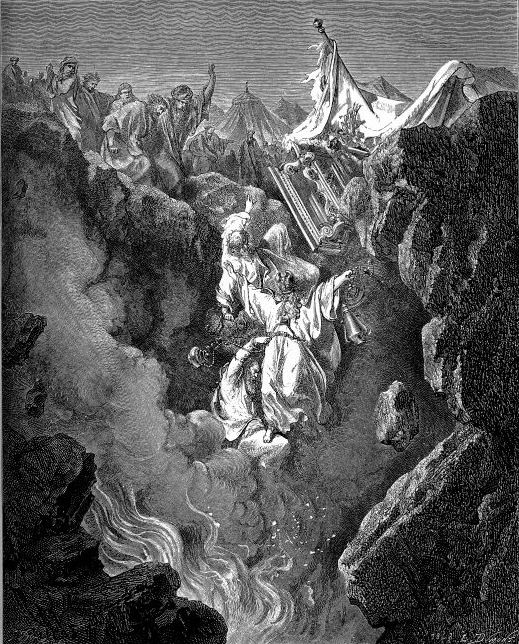
“Death of Korah, Dathan, and Abiram” by Gustave Doré

This week’s parasha, Korach, has a hidden theme: hair. In fact, the name of the villain himself, Korach (קרח), is spelled exactly the same way as kere’ach, “bald”. As we shall see below, Korach’s rebellion began when he saw himself bald-headed following his initiation ritual as a Levite. Hair comes up again in the famous story of one of Korach’s co-conspirators, a man named On ben Pelet. On is strangely mentioned right at the beginning of the parasha (Numbers 16:1), and never again. The Talmud (Sanhedrin 109b-110a) explains that he was saved thanks to his wife: She told her husband that he had nothing to gain from joining the rebellion; now he was subservient to Moses, and if the rebellion would be successful he would just become subservient to Korach!

On understood, but worried that he had already agreed to join the group. So, his clever wife got him drunk and sleepy, and On passed out in bed. Meanwhile, she went out to the entrance of their tent and “exposed her hair”. When Korach’s collaborators approached, the Talmud says they turned away due to the immodest sight of the woman. By the time On recovered from his drunken stupor, the whole episode was over, and he was spared. This story implies that Jewish women cover their hair, and for a woman to expose her hair publicly is immodest. Yet, nowhere in the Torah is there an explicit command for a Jew to cover their hair at all times (male or female). Hair-covering is not listed among the 613 mitzvot! If it isn’t a Torah mitzvah, where did it come from? Continue reading