
Tag Archives: Blessings

Where in the Torah is Chanukah?

Chanukah is the only major Jewish holiday that is not found in the Tanakh. This is mainly because the events of Chanukah took place in the 2nd century BCE, while according to tradition the Tanakh was already compiled and codified long before by the Great Assembly at the start of the Second Temple era. In fact, historians date the earliest Greek translations of Biblical books to the 3rd century BCE. Historical records agree with the Talmud that it was King Ptolemy II Philadelphus (285-247 BCE) who first commissioned the translation of the Torah into Greek, probably for his Great Library in Alexandria. How much of Scripture was translated at that point is not clear.

Although we see that the Sages continued to debate which holy books should be included in the definitive Tanakh nearly into the Talmudic period, the Book of Maccabees was never on the table. One reason is because the Book of Maccabees is not, and does not even claim to be, a prophetic work. It is simply a historical text and, contrary to popular belief, the Tanakh is not at all a history textbook. While it does record historical events—along with laws, ethics, prophecies, and more—its purpose is far greater. The Zohar (III, 152a) goes so far as to say that a person who views the Torah as a history book which simply relates “historical narratives” and “simple tales” has no share in the World to Come! “Every word in the Written Torah is a supernal word containing lofty secrets” it says, and “the narratives of the Written Torah are only the outer garments…”

Of course, it is a fundamental principle of Judaism that the Torah is an encrypted work that contains within it allusions to everything. As such, we should be able to find encoded references to Chanukah. And we do. Where did Moses hide clues to the future events of the Hashmonean Maccabees and the Chanukah festival?
Continue reading

The Spiritual Purpose of Jewish Exile and Wandering

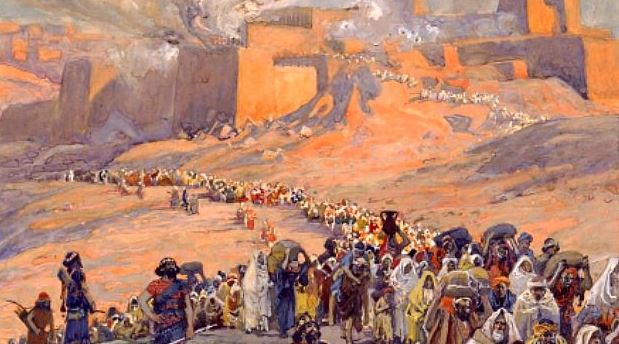
‘The Flight of the Prisoners’ by James Tissot, depicting the Jewish people’s exile after the destruction of the First Temple.

This week’s Torah portion, Nitzavim, has a most unique line when reading it in a proper Torah scroll. We read of a future time where “… Hashem removed them from upon their soil, with anger, with wrath, and with great fury, and He cast them out [וישלכם] to another land, as this very day.” (Deuteronomy 29:27) The Torah prophecies that a time will come when Israel will be exiled out of their land. The word וישלכם, “cast them out” is written with an enlarged letter lamed (ל). As is known, there are instances in the Torah where certain letters are written larger or smaller than normal. What is the significance of this enlarged lamed?

Continue reading

On That Controversial Blessing of “Not Making Me a Woman”

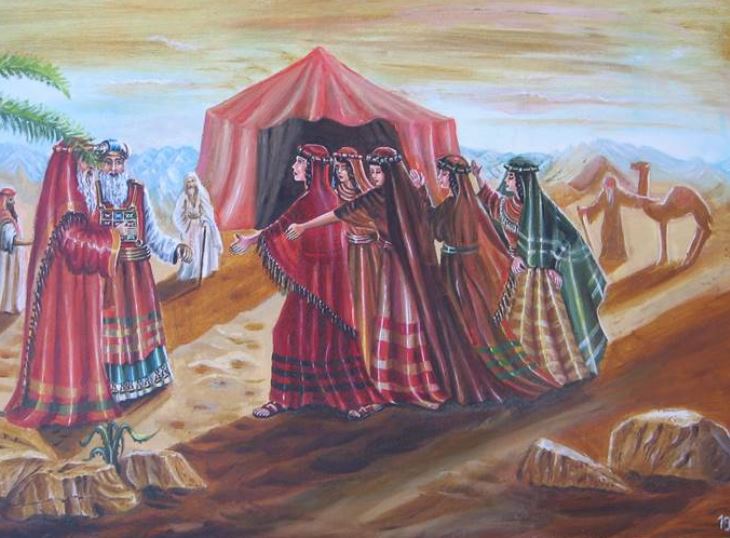
In this week’s parasha, Pinchas, we read about the five daughters of Tzlafchad, named Machlah, Noa, Chaglah, Milkah, and Tirzah. After the partitioning of the Land of Israel, the daughters approached Moses with a complaint. Because their family only has girls, and no boys, the daughters worried about what would happen to their father’s land and inheritance. Moses took the case up to God, who answered that daughters are able to inherit just as sons are in such situations. This is one example in the Torah of what might today be described as “gender equality”. The Torah (and Judaism more broadly) is sometimes criticized for its apparent gender inequality. One of the most common points of contention today is that blessing in Birkot HaShachar where men thank God for “not making me a woman”. Traditionally, women recite the blessing that thanks God “for making me kirtzono”, loosely translated as “like His will” Where did these blessings come from and what do they really mean?

Continue reading