Tag Archives: Exodus

Secrets of the Pesach Seder Plate

This Friday evening marks the start of Passover. At the Passover seder, it is customary to have a plate upon which all the symbolic Passover foods are placed. According to one arrangement, on the top right we place the zeroa bone; parallel to it on the left is an egg; then the maror (bitter herb) in the centre; the sweet charoset on the bottom right, opposite the karpas vegetable; and in the bottom centre the chazeret, horseradish or another serving of maror (which is used in the korech “sandwich”). In addition, we have three matzahs and the cup of wine, to be filled four times. What is the significance of these Pesach elements?

The zeroa represents the fact that God took us out of Egypt “with an outstretched arm” (b’zeroa netuya), as the Torah states. It also represents the korban pesach, the Pesach offering that would be brought and consumed in the days of the Temple. For this reason, it is best to have a zeroa from a lamb shank, since the Pesach offering was a lamb. The lamb itself was in commemoration of the fact that the Israelites smeared the blood of the lamb on their doorposts on the eve of their Exodus, to protect their homes from the tenth and final plague. It was a lamb in particular because the astrological sign for the month of Nisan is Aries, a ram or sheep. This is tied to Egyptian idolatry, where a number of Egyptian gods were depicted as ram-headed, or with the horns of a ram, including Khnum and Osiris. The slaughter of a lamb was thus symbolic of destroying the idols of Egypt, like the Ten Plagues themselves (see ‘The Ten Plagues: Destroying the Idols of Egypt’ in Garments of Light).

The egg symbolizes another offering brought on Passover: the chagigah, or holiday offering. This was the standard offering brought on all festivals in the days of the Temple. The reason that it is specifically an egg is because a whole egg is one of the foods traditionally consumed by mourners. (The round egg represents the cycle of life.) In this case, the egg is a symbol of mourning for the destruction of the Temple. Intriguingly, Rav Sherira Gaon (d. 1006) wrote how it is customary to eat meat, fish, and egg at the Pesach seder to represent the foods that will be eaten in the End of Days at the Feast of Mashiach. According to the Midrash, in that time the righteous will eat the fishy flesh of Leviathan, that great sea-dragon that Mashiach will slay; as well as the meat of the beast called Behemoth; and the egg of the mythical bird Ziz. So, eating an egg at the Pesach meal is symbolic of that future messianic feast.
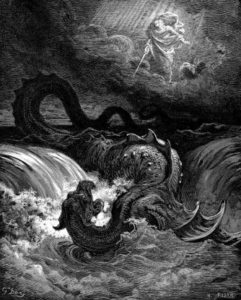
‘Destruction of Leviathan’ by Gustav Doré

The maror famously represents the bitter oppression of the Jews, just as the Torah states that the Egyptians “embittered” (v’imareru) the lives of the Jews with mortar and brick, and hard labour (Exodus 1:14). The need to eat maror actually comes explicitly from the Torah, which commands that Jews should eat the Pesach offering together with matzah and bitter herbs (Exodus 12:8). The Mishnah (Pesachim 2:6) lists five possible maror herbs, though their identity is not entirely clear. The only one that appears to be undisputed is lettuce, and hence it is lettuce that is used for maror in Sephardic communities. Another possibility is that maror is horseradish—not the mustard-like sauce but an actual horseradish root (since maror must be a raw vegetable, as the Shulchan Arukh states in Orach Chaim 473:5). There are other traditions for maror’s identity as well.

Interestingly, the Midrash states that the consumption of maror on Pesach is one of the few things King Solomon did not understand! In Proverbs 30:18, Solomon wrote that “Three things are wondrous to me and four I do not know.” Although the passage continues to state what it is that Solomon wondered about, the Midrash (Vayikra Rabbah 30:14) has an alternate explanation: The three things wondrous to Solomon were the Pesach offering, matzah, and maror; and the four he didn’t know were the mysteries behind the four species of Sukkot!

The Mystery of Karpas and Charoset

The maror is dipped into the sweet charoset. This paste is meant to resemble the clay mortar that the Israelites used, or the mud that was baked into clay bricks. The word charoset comes from cheres, “clay”. There are vastly different traditions as to the ingredients of charoset. One tradition is to use the fruits mentioned in Shir HaShirim, the Song of Songs, among them: apples (2:3), figs (2:13), nuts (6:11), dates (7:7), wine (1:2), and cinnamon (4:14). The romantic lyrics of the Song are interpreted as an allegorical “love story” between God and Israel, and the fruits are used throughout the text in metaphorical fashion to describe that passionate love. It is particularly appropriate to use the Song of Songs recipe since it is customary to read the Song of Songs on the holiday of Pesach. (There are five megillot, “scrolls”, in the Tanakh, and each is read on a particular holiday: Shir HaShirim on Passover, Ruth on Shavuot, Eichah on Tisha b’Av, Kohelet on Sukkot, and Esther on Purim.)

Some have pointed out that charoset may have a Greek origin, as it was common…


The above is an excerpt from Garments of Light, Volume Two. To continue reading, get the book here! 
Did the Jews Build the Pyramids?

The second book of the Torah, Shemot, begins by recounting the Israelite bondage in Egypt, and the Exodus that followed. One often overlooked question is: when did all of this actually happen? The Torah itself never gives any years or specific dates for its events. The accepted Jewish tradition is that the Exodus took place in the Hebrew year 2448, which corresponds to roughly 1312 BCE. What might archaeology and the historical record reveal?

City of Ramses

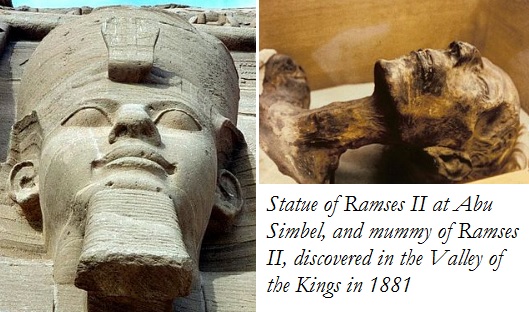
The Torah tells us that one of the major cities that the Israelites built was Ramses (Exodus 1:11). The historical record shows that this city was, not surprisingly, built by the pharaoh Ramses II (the Great). However, his reign spanned 1279-1213 BCE, too late for the Jewish dating of the Exodus. Perhaps it was Ramses’ grandfather, Ramses I – the founder of Egypt’s famous 19th dynasty – that began building a new capital city to be named after him. Ramses I reigned 1292-1290 BCE; still too late to coincide with Jewish tradition.

The Torah never identifies the names of any pharaohs it mentions. It describes at least three different ones: the pharaoh that dealt with Abraham, and the one that appointed Joseph many decades later, as well as the “new pharaoh” that forgot about Joseph’s contributions (Exodus 1:8). The pharaoh at the time of the Exodus was likely a different pharaoh altogether, too. The description we have of Ramses II actually parallels the Torah’s Exodus pharaoh quite well.

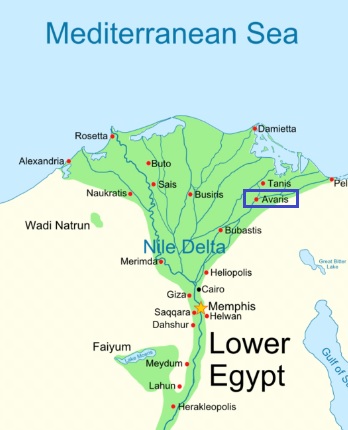
Ramses II was Egypt’s longest-reigning monarch (66 years!) and had over 100 children. He vastly expanded Egypt’s wealth, and stretched its territory and influence as far as the lands of Canaan and Syria. We see that he was a prolific builder, commissioning – among many other projects – a massive temple complex known as the Ramesseum, which still stood over 1000 years later when it marvelled the Greek historian Diodorus. His city of Ramses (or Pi-Ramses) was located in northeastern Egypt, in the land of Goshen, precisely where the Torah says the Israelites dwelled.

The Hyksos

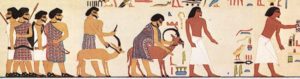
Images of Semites in Egypt, discovered in a Twelvth Dynasty tomb, dated to c. 1900 BCE

The historical record shows that a few centuries before Ramses, a mysterious Semitic tribe migrated to Egypt en masse and ended up taking over the kingdom. They were called heqa khaseshet, “foreign rulers”, which gave rise to the term “Hyksos”. Eventually, the Egyptians fought back and regained control from the foreigners. Most were expelled, many were killed, and it is likely that some were enslaved.

The ancient Jewish historian Josephus wrote that “Hyksos” comes from hekw shasu, “shepherd kings”. Of course, the Torah describes in detail how the Hebrews came down to Egypt and made sure everyone knew they were shepherds, a trade frowned upon in Egypt. Josephus cites historical sources suggesting that 480,000 Hyksos were ultimately expelled, and he concludes that these were the ancient Israelites!

The city of Ramses was discovered 30 kilometres south of Tanis, which is right by Avaris!

It is interesting to point out that the Hyksos’s capital city was also in the northeastern region of Goshen. The city was named Avaris, or Hawara. These sound quite similar to the way the Egyptians refer to the Hebrews in the Torah: ivri.

Historians date the Hyksos period from 1638 to 1530 BCE, totalling just about 110 years. Amazingly, the Zohar (I, 212a-b) states that the Israelites ruled over Egypt for 110 years, then spent the remaining 290 years of their time in Egypt as slaves. This would mean that the Exodus happened 290 years after the end of the Hyksos period. Doing the math, 290 years after 1530 BCE takes us to 1240 BCE – right in the heart of the reign of Ramses II!

Solar Eclipse

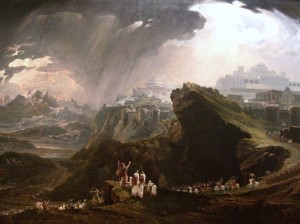
‘Joshua Commanding the Sun to Stand Still upon Gibeon’ by John Martin

All of the above suggests that the Exodus happened closer to the middle of the 13th century BCE. Recently, Israeli scientists discovered what may have been Joshua’s famous “stopping of the Sun” at the Battle of Gibeon (as described in the Book of Joshua, chapter 10). Interpreting this event as a solar eclipse, scientists at Ben Gurion University used NASA data to find any solar eclipses that may have been seen in the area between 1500 and 1000 BCE. They found exactly one, which took place on October 30, 1207 BCE.

This is incredible because the Battle of Gibeon would have happened roughly 40 years after the Exodus (since the Israelites spent 40 years in the Wilderness before Joshua led them to the Promised Land). If the Exodus took place around 1240 BCE, as we suggested above, then the dating of Joshua’s battle and the solar eclipse is right on target!

Reconciliation

The major issue now is that 1240 BCE seems to contradict the traditional Jewish dating of 1312 BCE. The truth is that Ancient Egyptian chronology is notoriously inaccurate. Scholars admit that discrepancies do exist, and are off by anywhere from 30 to 300 years. The discrepancy in our case is only about 70 years, well within the margins of errors.

Compared to the many foggy lists that scholars use to put together Egyptian chronology, the Torah’s chronology is fairly consistent and straight-forward. The years are added up based on peoples’ lifespans and the ages at which they had children, which are explicitly recorded. Historians might therefore want to take another look at Jewish chronology (as brought down in Seder Olam) if they wish to resolve some of their own conflicts.

And did the Jews build the pyramids? They may have built some pyramids (although by that time, pyramids had gone out of style). However, the famous Great Pyramid of Giza was completed by the middle of the third millennium BCE, long before any Israelites were on the scene.


The above article is adapted from Garments of Light: 70 Illuminating Essays on the Weekly Torah Portion and Holidays. Click here to get the book! 

How Long Were the Israelites Actually In Egypt?

Bo chronicles the final events in the exodus from Egypt. We read about the final three plagues (locust, darkness, and the smiting of the firstborn), the first Passover night, and at last, the liberation of the Israelites. Here, we are told that the Israelites left Egypt after having dwelled there for 430 years (Exodus 12:40). However, Jewish tradition (based on counting up all the years mentioned in the Torah) holds that the Israelites were only in Egypt for 210 years! To further complicate things, God had prophesized to Abraham that his descendants would be slaves in a foreign land for 400 years (Genesis 15:13). So, which is it? Were the Israelites in Egypt for 430 years, 210 years, or 400 years? There appears to be a simple answer to this question, and is the one most commonly cited. However, upon closer examination, this explanation breaks down entirely, and the real answer becomes much harder to find.

The Simple Answer

Let’s begin with the simple answer. Rashi’s commentary on the verse in question is that the Israelites were indeed in Egypt for only 210 years, since this is the sum one comes to when counting the lifespans of Jacob, Levi, Kohath, Amram, and Moses. According to this chronology, the Israelites lived prosperously in Egypt for 116 years. By this point, Jacob and his sons (the original immigrants) had all passed away, and a new pharaoh ascended to power in Egypt. Envious of Israelite prosperity and success, and suspicious of their populous numbers, the new pharaoh began instituting various anti-Semitic laws. Tradition holds that this period of segregation and persecution lasted thirty years, after which the Israelites were formally enslaved. Thus, the Israelites were slaves for 86 years. The year of their enslavement corresponds to the year of Miriam’s birth, hence her name, which (according to one explanation) literally means “very bitter”.* Moses was born six years later, and liberated the Israelites when he was eighty.

Rashi states that since 400 or 430 years in Egypt is impossible, one must assume that by “dwelling” and “sojourning”, the Torah refers to all the dwellings and sojourning since the time of Abraham. Rashi points out that if one counts back 400 years from the Exodus, one comes to the year that Isaac was born. Another thirty years before that was when Abraham beheld the “Covenant of the Parts”, and received the prophecy that his descendants will be slaves and foreigners for 400 years. Therefore, when the Torah states that the Israelites were in Egypt for 430 years, it is going all the way back to Abraham’s Covenant, which happened exactly 430 years earlier. And when God told Abraham his descendants would be slaves for 400 years, He literally meant all of Abraham’s descendants, starting with his first son, Isaac, born thirty years later. This explanation seems to work, at least when reinterpreting the definition of what it means to be “enslaved” and what it means to be “in Egypt”.

However, even Rashi is unhappy with this answer. He says that one has no choice but to accept this explanation al karchacha, literally “against one’s will”. He finishes by saying that this was one of the things that the Sages edited when translating the Torah into Greek for King Ptolemy. (Recall that over two millennia ago, Ptolemy gathered seventy rabbis, put them in separate guarded rooms, and forced them to translate the Torah into Greek. Despite their separation, all seventy rabbis produced the exact same translation, making the exact same amendments where necessary, to make the text more palatable to the Greeks. This text became known as the Septuagint, because of the seventy rabbis. According to Yalkut Shimoni, there were seventy-two rabbis, and they made fifteen changes to the text, one of which is the duration of the Israelites’ dwelling in Egypt.)

The Problem with the Simple Answer

Aside from the fact that the Israelites were slaves for 86 years, not 400, and that the Torah states that they dwelled specifically in Egypt for 430 years, and not elsewhere, there is a much more pronounced problem with the simple answer. If we say that the 430 figure comes from the moment when Abraham first received the prophecy, that means that Abraham got it thirty years before Isaac was born, which means Abraham was seventy years old at the time (since Isaac was born when Abraham was 100). However, the Torah tells us that Abraham only came to the land of Israel for the first time when he was 75 (Genesis 12:4). Sometime after this, he descended to Egypt because of a famine, then returned to Israel. Years later, he participated in the war against the Mesopotamian kings (Genesis 14). It is only following this war that the Torah states, “After these things the word of Hashem came to Abram in a vision…” (Genesis 15:1). And it was in this vision that Abraham received the prophecy of 400 years. It is therefore impossible that he was seventy years old at that time! In fact, the very next chapter speaks of the birth of Ishmael, Abraham’s first son through Hagar, who was born when Abraham was 86. Based on this, some commentaries suggest the Covenant of the Parts happened when Abraham was 85 or 86 years old.

So, we may accept the figure of 400 years starting with Isaac, but where did 430 come from? In lieu of a historical answer, we may have to delve into more mystical literature.


The above is an excerpt from Garments of Light, Volume Two. To continue reading, get the book here!