Tag Archives: Heaven

Should Jews Believe in Astrology?

This week’s parasha, the second last of the Torah, is Ha’azinu. This parasha is unique in that it consists almost entirely of one lengthy song – clearly visible when looking at a Torah scroll, where the text of Ha’azinu is split into two narrow columns. Moses sang this prophetic song to the nation right before his passing.
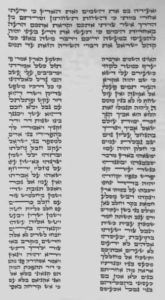
Two columns of parashat Ha'azinu

Two columns of parashat Ha’azinu

In the verses that introduce it (Deut. 31:19), we see God commanding Moses to write the song and “teach it to the Children of Israel. Place it in their mouths so that this song will be for Me a witness for the Children of Israel.” God wanted Moses to diligently teach this song to the entire nation. In fact, the actual wording of the verse has God commanding everyone – each member of the nation – to write the song for themselves. It is based on this verse that the Sages drew the mitzvah of writing a Torah scroll (or participating in writing one), even though the plain text of the verse states only to write this particular song, Ha’azinu.

Perhaps because of this, the Ramban taught that Ha’azinu contains the entire Torah within it. Moreover, he believed that every detail of every person’s life is somehow encoded within this song! In one famous story, when a student of the Ramban, a man named Avner, heard this teaching, he was so baffled by it that he left Judaism entirely, converted to another religion, and became a prominent anti-Semite. When Avner later confronted the Ramban, the Rabbi showed him how one verse in the song did indeed accurately point to this man’s life. Avner was so ashamed that he disappeared, never to be heard from again.

Heavenly Princes

And so, each and every one of the song’s 43 verses has a great deal to teach us. The eighth verse begins by telling us that God gave each nation their lot, and the ninth verse says that “Hashem’s portion is His people, the lot of His inheritance.” The Zohar comments on these words that while God established Heavenly “princes” to watch over every nation in the world, Israel is watched over by God Himself. The Ramban (in his Discourse on Rosh Hashanah) elaborates:

He gave each and every nation… some known star or constellation, as is known by means of the science of astrology… Higher above [the constellations] are the angels of the Supreme One, whom He appointed as “princes” over them… It is further written, “So shall you be My people, and I will be your God, and you will not be subject to other powers at all.” (Jeremiah 11:4)

When we often say that Hashem is our God (as we do in the daily Shema), or when the Tanakh writes that we are God’s people, this does not mean that gentiles cannot have a relationship with God, or that there are other gods out there for the non-Jewish world. Rather, it means that while God oversees absolutely everything in His universe, and has created all people, He has also appointed various Heavenly (or astrological) forces above each nation – except Israel. These forces are not independent in their own right, as they are subject to the angels above them, and these angels ultimately serve God. As such, the nations of the world have various Heavenly intermediaries between themselves and Hashem. Israel, however, has a direct connection to Him. In fact, this is the hidden meaning within the name “Israel” (ישראל), which can be read as yashar El. (ישר-אל), “straight to God”.

Ain Mazal L’Israel

Long before the Ramban, the Sages of the Talmud debated whether the constellations had an effect on people (Shabbat 156a). The consensus of the Rabbis was that constellations do impact people, but Jews are free from this influence. They learn this from the prophet Jeremiah, who prophesied: “Thus said Hashem: Learn not the way of the nations, and be not dismayed at the signs of heaven, for the nations are dismayed at them.” (10:2) God tells Israel not to draw meaning from heavenly signs as the other nations do. The Talmud goes on to tell us a story about Abraham, who cried out to God: “Master of the Universe! I have looked at the constellations and find that I am not fated to have children.” To this, God replied: “Stop your star-gazing! Israel has no constellations.”
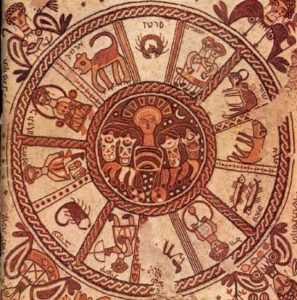
Hebrew Zodiac from a 6th Century Synagogue

Hebrew Zodiac from a 6th-Century Synagogue

Elsewhere, the Talmud tells us that Abraham was once a powerful astrologer, and great men from around the world came to consult with him about their fortunes (Bava Batra 16b). When Abraham looked into his own fate, he saw that he would not have children. God commanded him to desist from astrology, for the Jewish people have the power to transcend the stars. Of course, Abraham went on to have many children.

Later on, Moses would record in the Torah the prohibition for Jews to consult various fortune-tellers and astrologers. The Rambam codifies the law in this way:

It is forbidden to tell fortunes. [This applies] even though one does not perform a deed, but merely relates the falsehoods which the fools consider to be words of truth and wisdom. Anyone who performs a deed because of an astrological calculation or arranges his work or his journeys to fit a time that was suggested by the astrologers is [liable for] lashes, as [Leviticus 19:26] states: “Do not tell fortunes.”
(Sefer HaMadda, Hilchot Avodah Zarah, Chapter 11, Halacha 9)

Transcending Nature

We see from the above that various Heavenly forces, angels, and constellations do exist, and certainly do influence the world. Astrological signs can be potent forces. Ironically, earlier in his discourse, the Ramban points out how astrology is intricately tied into the Jewish calendar: it is no coincidence that Pesach is celebrated in the month of Nisan, the sign of which is Aries (the ram, or sheep), since the main mitzvah of Pesach was to sacrifice a lamb; and it is no coincidence that Rosh Hashanah – judgement day, when each person is put on trial – is in the month of Tishrei, the sign of which is Libra, the scales of justice. The Midrash (Yalkut Shimoni, Shemot 418) even tells us how each of the 12 Tribes of Israel corresponds to one of the 12 astrological signs of the zodiac!

And yet, all the sources are clear: Jews are not to dabble in astrology, for we have no need for intermediaries, and we have all the power to break free from the influence of the constellations. It is precisely when we believe in astrology that it becomes real, just as Abraham had no children as long as he believed in the heavenly signs that he saw. Every Jew must realize that we are Israel, yashar El, and that Hashem alone is our astrological sign. There is no need to believe in what the Rambam calls “emptiness and vanity”. The Rambam ends his laws on this subject by telling us to live up to the Torah’s call (Deut. 18:13) to be of “perfect faith with Hashem, your God.” When one has perfect faith in the Master of the Universe, anything is possible, and this is how God finished his rebuke to Abraham:

“Stop your star-gazing! Ain mazal l’Israel. What is your calculation? Is it because Jupiter stands in the West? Then I will turn it back and place it in the East!”


The article above is an excerpt from Garments of Light: 70 Illuminating Essays on the Weekly Torah Portion and Holidays. Click here to get the book! 
An Honest Look at Death and the Afterlife

This week we once again read a double Torah portion, combining the parashot of Behar and Bechukotai to complete the book of Leviticus. The main themes of these parashas are the Sabbatical and Jubilee years, as well as God’s rewards and punishments for those who follow His ways and those who do not.

One interesting thing that the reader will note is that there is no mention of any kind of afterlife. All of the rewards and punishments that are listed are described in wholly physical terms: ample rains and abundant harvests, military victories and secure borders, good food and the feeling of God’s presence – and the opposite of these if the people are sinful. Why is it that the Torah does not mention any kind of reward and punishment in the afterlife? After all, we are accustomed to hearing that this world is nothing but a transient “hallway”, so to speak, while the next world is the real deal, where people receive what they deserve.

More puzzling is the fact that the Torah essentially never mentions the afterlife in explicit fashion. Everything appears to happen in this physical world. Yet, there is certainly a discussion of souls, and many spiritual entities. So, what is the real Torah conception of the afterlife?

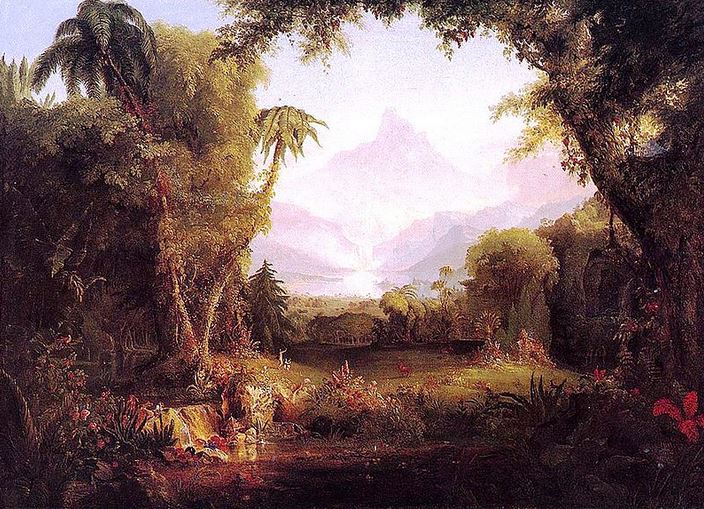
The Garden of Eden

'Garden of Eden', by Thomas Cole

‘Garden of Eden’, by Thomas Cole

Typically, it is common to think that those who have passed away are now in the “Garden of Eden”, and this is indeed how Hebrew-speakers often refer to the dead, wishing them menucha (rest) in Gan Eden. But where exactly is this “Gan Eden”?

The Torah is quite clear on the fact that God created the Garden of Eden right here on Earth. The Genesis account describes God’s creation of the world, and all of its inhabitants, and concludes with the planting of a garden in Eden, where the first man and woman are placed. After their sin of consuming the fruit, Adam and Eve are banished from the Garden, and continue their lives elsewhere on Earth. There is no mention anywhere in the Torah of a spiritual Garden of Eden located somewhere in the Heavens!

Conversely, it is common for people to refer to an afterlife of damnation in a place called Gehinnom, typically translated as “hell”. Again, there is no explicit mention of a “hell” in Scripture. Gehinnom itself simply means “the Valley of Hinnom” (or the Valley of the Son of Hinnom, Gei Ben Hinnom) which is discussed in the Tanakh as a place right outside the Old City walls of Jerusalem. This is described as a place of sinners and idolaters, outcasts that were expelled from the Holy City. Once again, we see that the place usually thought of as hell is simply a physical place here on Earth.

As Above, So Below

By the times of the Talmudic period, the Jewish Sages had developed a unique cosmic worldview. They saw this material world as only a reflection of the spiritual world. What happened down here reflected, in some way, much greater cosmic events that were happening in the Heavens. Thus, just as there was a Jerusalem down here on Earth, there was a Jerusalem shel ma’alah, a “Jerusalem Above” (see, for example, Ta’anit 5a).

Similarly, just as there was a Garden of Eden – a place of utmost peace and pleasure – here on Earth, there must be a similar one above in the Heavens. And just as there was a Gehinnom – a deep valley of evil – here on Earth, there must be such a place in the Heavens, too.

It appears that the idea of righteous souls moving on to a Heavenly Gan Eden, or wicked souls to a Heavenly Gehinnom, came from this view on the nature of God’s universe.

The Big Afterlife Problem

However, this brings about a very large problem: both the Garden of Eden and Gehinnom are described in physical terms. But, after the body dies and decays, only the soul lives on, and how can the soul experience physical pleasures or pains? Additionally, the soul is described as pure and eternal. Why is it the soul that must suffer for the sins accrued by the body? And why should the soul suffer infinitely for a body that had only such a short, finite existence?

This problem was presented to Rabbi Yehuda haNasi by the Roman Emperor Antoninus nearly two millennia ago (Sanhedrin 91a-b).

Antoninus said to Rabbi: “The body and the soul can both free themselves from judgment. Thus, the body can plead: ‘The soul has sinned, since from the day it left me I lie like a dumb stone in the grave.’ While the soul can say: ‘The body has sinned, since from the day I departed from it I fly freely in the air like a bird.’”

He replied: “I will tell you a parable. To what may this be compared? To a human king who owned a beautiful orchard which contained splendid figs. Now, he appointed two watchmen, one lame and the other blind. [One day] the lame man said to the blind, ‘I see beautiful figs in the orchard. Come and take me upon your shoulders, that we may procure and eat them.’ So the lame strode the blind, procured and ate them. Some time after, the owner of the orchard came and inquired of them, ‘Where are those beautiful figs?’ The lame man replied, ‘Do I have feet to walk with?’ The blind man replied, ‘Do I have eyes to see with?’ What did he do? He placed the lame upon the blind and judged them together. So will the Holy One, blessed be He, bring the soul, place it in the body, and judge them together…”

Rabbi Yehuda replied with a wonderful parable, and concluded that God brings the body and soul together again, and only then judges the person, and bestows upon them their due rewards or punishments.

So, if the body and soul go back together again after death, then there is no “Garden of Eden” or “Gehinnom” in the sense that we might commonly think.

Gate of Reincarnations

The only way that the body and soul can go back together again is if, following death, the soul returns into bodily form. This is the definition of reincarnation. Roughly 500 years ago, the great kabbalist Rabbi Isaac Luria, better known as the Arizal, revealed many secrets of reincarnation, and these teachings were recorded by his primary disciple, Rabbi Chaim Vital, in a text called Sha’ar HaGilgulim (Gate of Reincarnations).

This text describes reincarnations in great detail, and affirms that those who have lived sinful lives are reincarnated into new lives that are very challenging, and in this way have to make reparations for the mistakes of their past. The righteous, too, are reincarnated, since no one goes through life without making some mistakes, and even the most minute of these errors must be repaired. However, such people will enjoy much better lives, and be given the opportunity to fix those minor details from their past.

Of course, proper repentance can nullify any trials that a person must bear due to a mishap from a past life. Thus, free will ultimately trumps everything else. And what happens to those who have completely fulfilled their missions? In that case, there is indeed a “Garden of Eden” of sorts.

(For more on reincarnation, click here to read ‘Everything You Wanted to Know About Reincarnation in Judaism’.)

Resurrection of the Dead

One form of afterlife that Scriptures do mention explicitly is the Resurrection of the Dead. It is taught that sometime after the coming of Mashiach, all of the righteous souls will miraculously come back to life. They will then enjoy the world as it was always meant to be: a Garden of Eden.

Ultimately, this is the role of Mashiach: to return the world to that perfect, primordial state. It is interesting to note how the figure responsible for driving mankind out of the Garden was the Serpent, Nachash (נחש) in Hebrew, a word which has a numerical value of 358; and the figure responsible for returning mankind to the Garden is Mashiach (משיח), a word which also has a gematria of 358 – measure for measure. Thus, the final step for each soul, once its mission is complete, is to be resurrected in the restored Garden of Eden, right here in a new Earth, following the arrival of Mashiach.

We can now understand why Bechukotai does not speak of any spiritual rewards or punishments in an afterlife. All of the rewards and punishments are right here in this world, where body and soul unite as one, as Rabbi Yehuda told Antoninus. We can now also see why no “Heaven” or “Hell” is ever explicitly mentioned in Scripture, and why we never even mention them in our prayers. The Amidah prayer recited thrice daily makes no reference to souls in some Heavenly realm, but does have a blessing for techiyat ha’metim, the Resurrection of the Dead in a future, perfected world.

May we merit to see it speedily and in our days.


The article above is adapted from Garments of Light – 70 Illuminating Essays on the Weekly Torah Portion and Holidays. Click here to get the book!
Eliyahu’s Immortality, Passover, and Shabbat HaGadol

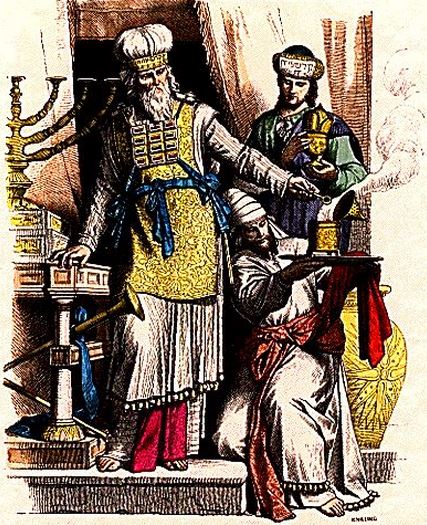
This week’s Torah reading is Tzav, detailing many of the priestly laws that applied to the Kohanim. It begins with God telling Moses to instruct Aaron (the first Kohen) and his children in the proper sacrificial rites, starting with the olah, a type of offering that is wholly consumed by the flames (as opposed to being roasted and eaten). Rashi comments that the term “tzav” – command – has the connotation of commanding not just Aaron, but all of his future descendants, and all generations of kohanim.

Kohen Gadol (High Priest) and Levites. (Braun & Schneider)

Kohen Gadol (High Priest) and Levites. (Braun & Schneider)

One of those descendants is Pinchas, the grandson of Aaron (through his son Elazar). For his heroic efforts, as described in Numbers 25, God blessed him with an eternal priesthood. Pinchas is mentioned as the Kohen Gadol (High Priest) in the book of Joshua (who was the first of the Biblical Judges). According to the Sages, he remained in this role until the times of Yiftach, one of the last Judges. This would mean he served as the High Priest for several hundred years! The Sages suggest that when God promised him an “eternal priesthood”, He literally meant it.

Due to the scandal that concluded the story of Yiftach (Judges 11-12), the commentaries state that Pinchas resigned as the High Priest. He then disappears from the narrative, only to reappear again a couple of centuries down the road. This time, he comes back as Eliyahu HaNavi, Elijah the prophet, as the Sages state: Pinchas ze Eliyahu, “Pinchas is Eliyahu”. The Arizal (Sha’ar HaGilgulim, 33, 2b) explains that Eliyahu was the reincarnation of Pinchas, while many others say it was literally one and the same person, since God’s blessing connoted everlasting life.

Eliyahu himself never passed away, further proving the point that Pinchas was meant to live forever. The Tanakh describes how Eliyahu was taken up to Heaven alive in a whirlwind of flames (II Kings 2:11). It is said that Eliyahu transformed into an angel, and thus lives on. This is why he appears (spiritually speaking) at certain times in the Jewish calendar and life cycle, including during a brit, and for the fifth cup during the Passover seder. Ultimately, it is prophesized that he will return in physical form once more at the End of Days to herald the coming of Mashiach, as it says: “Behold, I will send you Eliyahu the prophet before the coming of the Day of Hashem, the great and awesome” (Malachi 3:23).

The commentary of Abudraham (or Abu Dirham, Rabbi David ben Yosef of 14th century Spain) explains that this is why the Sabbath before Passover is called Shabbat HaGadol, “the Great Sabbath”. The verse in Malachi ends by saying “the great and awesome”, hagadol v’hanora. After all, this passage from Malachi is the Haftarah portion that we read at the synagogue on Shabbat HaGadol!

The basic purpose of Shabbat HaGadol is to get us into the “Pesach spirit” and prepare us for Passover. On this Sabbath, It is customary to review the Haggadah and the pertinent laws of the holiday. Similarly, the Haftarah portion is also designed to get us into the Passover mindset. The Haftarah ends by juxtaposing the first redemption under Moses with the coming redemption ushered in by Eliyahu:

“Remember the Law of Moses, My servant, whom I commanded at Horev [Mt. Sinai] for all Israel, statutes and ordinances. Behold, I will send you Eliyahu the prophet before the coming of the Day of Hashem…” (Malachi 3:23-24)

The Sages tell us that after the final redemption we will no longer need to recall the first redemption, which will pale in comparison. This is based on the verse in Jeremiah 23:7 which prophesizes that in the End of Days, people will no longer describe God as the One who took the children of Israel out of Egypt, but as the One who saved Israel from oppression all over the world, and restored them to their Promised Land.

This is one reason why during the Pesach seder, while commemorating the first redemption, we end by pouring a fifth cup for Eliyahu, who will come to usher in the final redemption. Is it then that Jews will no longer be misunderstood and oppressed, our exile will end, and we will all return to live in the Holy Land in peace, as we say at the conclusion of the seder: “Next year in Jerusalem”.