Tag Archives: High Priest

How the Priestly Garments Atoned for the People

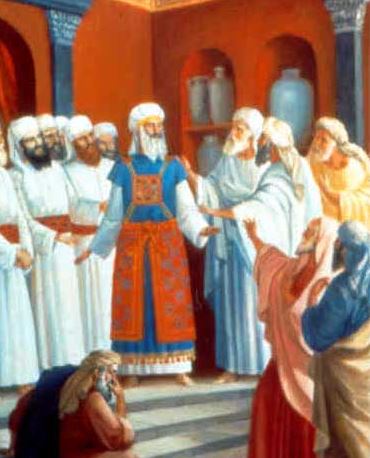
Priests in the Temple (Courtesy: Temple Institute)

This week’s parasha, Pekudei, describes how the Mishkan and all of its vessels were created, together with the special priestly garments. The parasha ends with the formal initiation of Aaron and his sons into the priesthood through their ritual purification, anointment, and donning of the sacred vestments. Our Sages famously state (Zevachim 88b) that the vestments of the Kohen Gadol, the High Priest, atoned for the sins of the people:

The tunic atoned for bloodshed… the breeches atoned for lewdness… the turban made atonement for arrogance… the belt atoned for [impure] meditations of the heart… the breastplate atoned for neglect of civil laws… the apron atoned for idolatry… the cloak atoned for slander… and the crown, worn on the forehead, atoned for brazenness.

The tunic (kutonet) was a simple white garment worn over the body which all of the priests (not only the High Priest) wore. The Talmud says it atoned for bloodshed, and proves it through a gzerah shavah, a form of interpretation where the exact same word (or root of a word) appears in two different contexts, thus allowing a connection between the two to be made. In Genesis 37:31 we read how, following the sale of Joseph, his brothers slaughtered a goat and dipped Joseph’s special robe in the goat’s blood. They used the bloodied robe as proof to show their father Jacob that Joseph had been murdered or devoured by an animal. The word used for Joseph’s robe is kutonet, too, that same word used for the Kohen’s garment. From this we can learn that the kutonet atoned for bloodshed.

The breeches (michnasei bad) were white pants worn to cover up the lower half of the body, and atoned for sexual immorality. The Talmud proves it from an explicit verse in the Torah (Exodus 28:42) where God commanded that the pants be made “to cover up the flesh of their nakedness”. The Hebrew term here is precisely the one used to denote sexual indecency (‘ervah, or gilui arayot).

The white turban (mitznefet) atones for arrogance. Rabbi Hanina explains here that the turban was worn on the head at the very top of the body, and thus atoned for people who similarly put themselves “at the head” above other people.

The last of the four garments worn by the regular priest is the avnet, a sash or belt. Made of red, blue, and purple wool, it was the only multi-coloured garment worn by the regular priest. It atoned for impure thoughts, and the Talmud says we know this from the fact that the sash was worn tied around the heart. Contrary to what we may expect, this was not a belt to hold up the pants, but rather an independent garment wrapped around the upper body.

In Jewish thought, the heart is the seat of the yetzer hara, the evil inclination, which tries to make a person sin by throwing improper thoughts into their head. The heart is also the seat of the yetzer hatov, the good inclination. These two opposing forces both reside in one’s heart. Because of this, the term for “heart” used in the daily Shema is levavecha, and not the more grammatically consistent libecha. The former has an extra letter beit, the doubled language alluding to the two inclinations in the heart.

Our Sages teach that one should always keep their mind above their heart, in full control of their inclinations. The brain should dominate the heart, and the heart should dominate the liver. The Hebrew word for liver, kaved (כבד), is directly related to kavod (כבוד), “honour”. Thus, the liver is the source of pride and arrogance. These organs are arranged physiologically in the body the way they are to teach us a lesson: the brain (or intellect) should be on top, then the emotions of the heart below it, and the ego at the very bottom.

If one accomplishes this, with their brain, moach (מוח) in Hebrew, being above their heart, lev (לב), and their heart being above their liver, kaved (כבד)—then they become a melekh (מלך), “king”. If the letters are reversed, where one’s honour trumps their emotions, which in turn overrule their reasoning, then they are klum (כלם), “nothing”.

The Four Garments of the High Priest
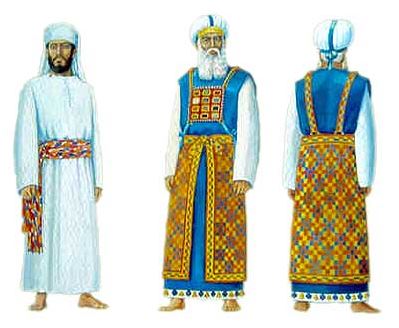
Garments of the regular priest and the high priest (Courtesy: Temple Institute)

The High Priest wore an additional four unique garments. On his forehead was the golden plate known as the tzitz, which atoned for brazenness. This is proven by another gzerah shavah between Exodus 28:38, which commands the priest to wear the plate upon his metzach, “forehead”, and Jeremiah 3:3 which speaks of the brazen “forehead” (again metzach) of a licentious woman.

On top of the regular white tunic, the High Priest wore a meil, a “coat” made entirely of fine blue (tekhelet) wool. The coat atoned for lashon hara, evil speech. Since the Torah states that the coat had bells along its bottom, which jingled as the Kohen walked, Rabbi Hanina explains: “Let an article of sound come and atone for an offence of sound.”

Rav Yitzchak Ginsburgh points out that the term for bell, pa’amon (פעמן) refers to something that resonates, and the same root is used, for example, in describing how the Spirit of God resonated within—l’fa’amo (לפעמו)—the Biblical judge Samson (Judges 13:25). Rav Ginsburgh beautifully notes how the gematria of “Spirit of God” (רוח ה׳) is 240, equal to that of pa’amon (פעמן). It is also equal to meil ha’ephod (מעיל האפד), the full title of the garment, as in Exodus 29:5 or 39:22. He concludes that if one wishes to have the Spirit of God rest upon them, the key is to refrain from any evil speech.

The ephod, or apron, atoned for idolatry. This is derived from Hosea 3:4: “For the children of Israel shall sit solitary many days without king, and without prince, and without sacrifice, and without pillar, and without ephod or teraphim.” The verse is taken to mean that where there is no ephod, there will be teraphim—various implements of idol worship. The word “teraphim” appears multiple times in the Tanakh (as in Genesis 31:19 and Judges 17:5), nearly always in relation to idolatry.

Upon the ephod was the famous choshen, the breastplate that, according to tradition, allowed for communication with the Heavens. The breastplate atoned for violations of dinin, civil law. We know this from the fact that the Torah calls the breastplate choshen mishpat (Exodus 28:15), literally “breastplate of judgement”, with the term mishpat typically referring to court cases and civil law (whereas chukim and edot refer to religious-based, historical, or ritual laws).

In this way, even the very clothes of the Kohen helped him fulfill his main duty of bringing atonement for the people. Yet, in the past two thousand years, there has been no Temple and no priestly service. Might there be something in its stead?

Every Jew is a Priest

When the Temple was destroyed, our Sages instituted a number of practices in place of those Temple rituals. They declared that “as long as the Temple stood, the altar atoned for Israel, but now a man’s table atones for him” (Berakhot 55a). Just as the priests would wash their hands in a special basin before starting their services (and before eating terumah), the Rabbis instituted netilat yadayim, the ritual washing of the hands before starting a meal. Just as the sacrificial meat was required to be brought with salt, it became customary to dip the bread in salt before eating it. In place of the Temple menorah we have the Chanukah menorah, and in place of the Temple showbread we have two challahs, each traditionally braided with six strands to represent the twelve loaves once displayed in the Temple.

In many ways, the Talmudic sages and rabbis saw themselves filling the role once held by the ancient priests. More importantly, they taught that every righteous Jew should see himself as a priest. After all, God intended for all of Israel to be a “kingdom of priests and a holy nation” (Exodus 19:6). In fact, many commentaries agree that it is only because of the Golden Calf incident that the tribe of Levi was appointed to take over the priesthood. Were it not for that tragedy, every firstborn male would be a priest, and any other Jewish male could voluntarily enter the priesthood. To this effect, the Talmud (Bava Kamma 38a) goes so far as to state that “even a non-Jew who occupies himself with Torah is comparable to the High Priest.” A person who lives in Torah and refines himself to the highest degree is likened to the greatest of priests, at least in a spiritual sense.

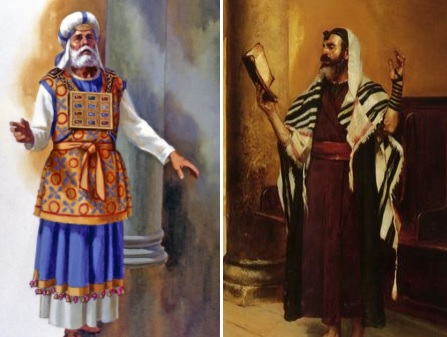
In a wonderful affirmation of this, we see that every Torah-observing Jewish man is wearing “holy garments” that parallel the priestly vestments. Everyone generally wears a shirt and pants with a belt, along with their head-covering, corresponding to the four vestments of the regular priest (kutonet, michnasei bad, avnet, mitznefet). And there are four additional special items that a Jew wears that parallel those unique garments of the High Priest:

The “bells” along the hem of the tallit.

The tzitz headplate worn on the top of the forehead is like the head tefillin worn “between the eyes”, while the choshen breastplate worn over the heart is like the arm tefillin which is supposed to be worn in line with the heart. The ephod that was worn over the shoulders and stretched down below the waist is like the tzitzit katan garment worn over the shoulders with its fringes hanging down below the waist. The woolen tallit with which we wrap ourselves, with its customary blue stripes to remember tekhelet, is like the special blue meil that was made of fine tekhelet wool. And just as the meil had pa’amonim bells along its hem, the tallit, too, customarily has bell-like knots along its hem.

In this way, every Jew has the ability to elevate to a priest-like status, especially in lieu of a Temple, and in light of the Torah’s statement that all of Israel is a “nation of priests” (Exodus 19:6). Each Jew can bring about atonement, not only for himself but for his people as a whole, and each Jew can spread evermore divine light into the world.
Who Was the First Rabbi in History?

Chanukah is the only major Jewish holiday without an explicit basis from the Tanakh. However, there does exist an ancient Book of Maccabees—which recounts the history of Chanukah and the chronicles of Matityahu, Judah and the Hashmonean brothers—but it was not included in the Tanakh. Some say it was not included because by that point (2nd century BCE), the Tanakh had already been compiled by the Knesset haGedolah, the “Great Assembly” which re-established Israel after the Babylonian Exile. Others argue that the Tanakh was not completely sealed by the Knesset, since it appears that the Book of Daniel may have been put together around the same time as the Book of Maccabees, but was included in the Tanakh. This may be why Daniel was included in the Ketuvim, and not in the Nevi’im where we might expect it to be. Later still, the Sages of the Talmud debate whether certain books (such as Kohelet, “Ecclesiastes”, and Shir HaShirim, the “Song of Songs”) should be included in the Tanakh.

The simplest reason as to why the Book of Maccabees was not added to the Tanakh is probably because it is not a prophetic work, but simply a historical one. Another reason is that the original Hebrew text had been lost, and only Greek translations survived. It is also possible that the Book of Maccabees was not included for the same reason why there is no Talmudic tractate for Chanukah, even though there is a tractate for every other major holiday. (Chanukah is discussed in the Talmud in the tractate of Shabbat). Some argue that the events of Chanukah were so recent at the time that everyone knew them well, so having a large tractate for Chanukah was simply unnecessary. The other, more likely, reason is that although the Hashmonean Maccabees were heroes in the Chanukah period, they soon took over the Jewish monarchy (legally forbidden to them since they were kohanim) and actually adopted the Hellenism that they originally fought so valiantly against!

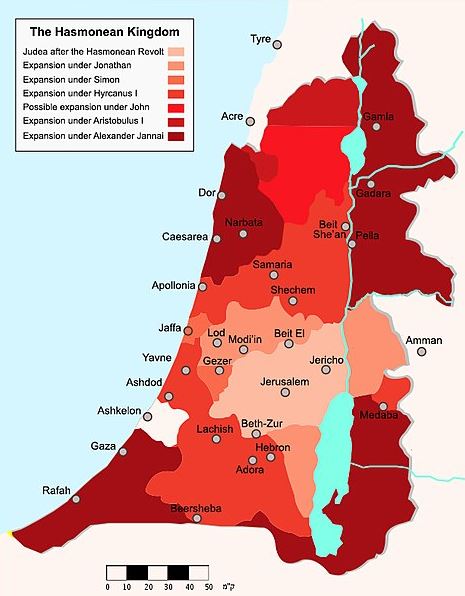
The first Hashmonean to rule was Shimon, one of the five sons of Matityahu. He was the only son to survive the wars with the Seleucid Greeks. He became the kohen gadol (high priest), and took the title of nasi, “leader” or “prince”, though not a king. Despite being a successful ruler, Shimon was soon assassinated along with his two elder sons. His third son, Yochanan, took over as kohen gadol.

Yochanan saw himself as a Greek-style king, and took on the regnal name Hyrcanus. His son, Aristobulus (no longer having a Jewish name at all!) declared himself basileus, the Greek term for a king, after cruelly starving his own mother to death. Aristobulus’ brother, Alexander Jannaeus (known in Jewish texts as Alexander Yannai) was even worse, starting a campaign to persecute rabbis, including his brother-in-law, the great Shimon ben Shetach. Ultimately, Yannai’s righteous wife Salome (Shlomtzion) Alexandra ended the persecution, brought her brother Shimon and other sages back from exile in Egypt, and ushered in a decade of prosperity. It was Salome that re-established the Sanhedrin, opened up a public school system, and mandated the ketubah, a marriage document to protect Jewish brides. After her death, the kingdom fell apart and was soon absorbed by Rome.

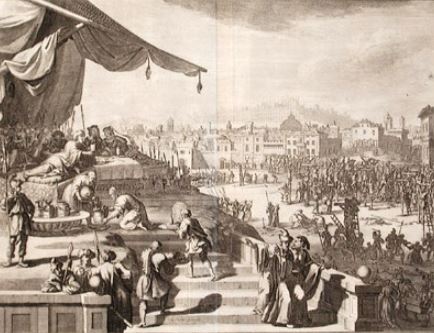
‘Alexander Jannaeus feasting during the crucifixion of the Pharisees’ by Willem Swidde (c. 1690)

Sadducees and Pharisees

While Alexander Yannai was aligned with the Sadducees, Salome Alexandra was, like her brother Shimon ben Shetach, a Pharisee. The Sadducees (Tzdukim) and Pharisees (Perushim) were the two major movements or political parties in Israel at the time. The former only accepted the written Torah as divine, while the latter believed in an Oral Tradition dating back to the revelation at Sinai. Thus, “Rabbinic Judaism” as we know it today is said to have developed from Pharisee Judaism, though this is not quite certain. The Sages of the Talmud didn’t speak so highly of the Pharisees in general, and Judaism also includes key elements from another major group that flourished at the time, the Essenes.

Because the Sadducees only accepted the written Torah, their observance was highly dependent on the Temple and the land of Israel, since most of the Torah is concerned with sacrificial and agricultural laws. When the Romans ultimately destroyed the Temple and the majority of Jews went into exile, Sadducee Judaism simply could not survive. (Later, a similar movement based solely on the written Torah, Karaite Judaism, would develop.) Meanwhile, the Pharisees and their Oral Tradition continued to develop, adapt, and flourish in exile and, together with Essene practices, gave rise to the Judaism of today.

Avot d’Rabbi Natan states that the Sadducees get their name from one Tzadok, a student of the sage Antigonus. Antigonus famously taught (Pirkei Avot 1:3) that one should serve God simply for the sake of serving God, and not in order to receive a reward in the afterlife. It is this teaching that led to Tzadok’s apostasy. Indeed, we know that the Sadducees did not believe in the Resurrection of the Dead or apparently any kind of afterlife at all. This makes sense, since the Sadducees only accepted the Chumash as law, and the Chumash itself never mentions an afterlife explicitly.

In that same first chapter of Pirkei Avot, we read that Antigonus was the student of Shimon haTzadik, the last survivor of the Knesset HaGedolah. Antigonus passed down the tradition to Yose ben Yoezer and Yose ben Yochanan, who passed it down to Yehoshua ben Perachiah and Nitai haArbeli, who passed it down to Shimon ben Shetach and Yehuda ben Tabai. This means that Shimon ben Shetach, brother of Queen Salome Alexandra, lived only three generations after Shimon haTzadik, the last of the Great Assembly. This presents a problem since, according to traditional Jewish dating, the Great Assembly was about 300 years before the rule of Salome. (It is even more problematic according to secular dating, which calculates nearly 500 years!) It is highly unlikely that three generations of consecutive sages could span over 300 years.

The rabbinic tradition really starts with Shimon haTzadik, the earliest sage to be cited in the Talmud. He is said to have received the tradition from the last of the prophets in the Great Assembly, thus tying together the rabbinic period with the Biblical period of prophets. Yet, Shimon haTzadik himself is not called a “rabbi”, and neither is his student Antigonus, or Antigonus’ students, or even Hillel and Shammai. The title “rabban” is later used to refer to the nasi of the Sanhedrin, while the first sages to properly be called “rabbi” are the students of Rabban Yochanan ben Zakkai, the leader at the time of the Temple’s destruction by the Romans.

Despite this, the title “rabbi” is often applied retroactively to earlier sages, including Shimon ben Shetach, Yehoshua ben Perachiah, and others, all the way back to Shimon haTzadik, the first link in the rabbinic chain. Who was Shimon haTzadik?

The Mystery of Shimon haTzadik

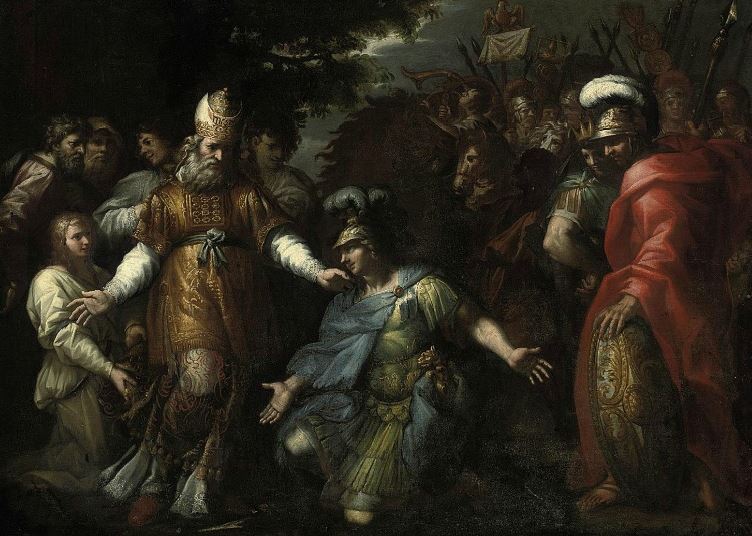
The most famous story of Shimon haTzadik is recounted in the Talmud (Yoma 69a). In this story, Alexander the Great is marching towards Jerusalem, intent on destroying the Temple (due to the activism of a group of Kutim), so Shimon goes out to meet him in his priestly garments (he was the kohen gadol). When Alexander sees him, he halts, gets off his horse, and bows down to the priest. Alexander’s shocked generals ask why he would do such a thing, to which Alexander responds that he would see the face of Shimon before each successful battle.

‘Alexander the Great and Jaddus the High Priest of Jerusalem’ by Pietro da Cortona (1596-1669)

While it is highly doubtful that the egomaniacal Alexander (who had himself declared a god) would ever bow down to anyone, this story is preserved in a number of texts, including that of Josephus, the first-century historian who was an eye-witness to the Temple’s destruction. In Josephus, however, it is not Shimon who meets Alexander, but another priest called Yaddua. Yaddua is actually mentioned in the Tanakh (Nehemiah 12:22), which suggests he was a priest in the days of the Persian emperor Darius. Of course, it was Darius III whom Alexander the Great defeated. It seems Josephus’ account is more accurate historically in this case.

In fact, in Sotah 33a, the Talmud tells another story of Shimon haTzadik, this one during the reign of the Roman emperor Caligula. We know that Caligula reigned between 37 and 41 CE—over three centuries after Alexander the Great! The Talmud thus gives us three different time periods for the life of Shimon haTzadik: a few generations before Shimon ben Shetach, or a few centuries before in the time of Alexander the Great, or centuries after in the time of Caligula. Which is correct?

The First Rabbi

The Book of Maccabees (I, 2:1-2) introduces the five sons of Matityahu in this way:

In those days, Matityahu ben Yochanan ben Shimon, a priest of the descendants of Yoariv, left Jerusalem and settled in Modi’in. He had five sons: Yochanan, called Gaddi; Shimon, called Thassi; Yehuda, called Maccabee; Elazar, called Avaran; and Yonatan, called Apphus.

Each of the five sons of Matityahu has a nickname. The second son, Shimon, is called “Thassi” (or “Tharsi”). This literally means “the wise” or “the righteous”, aka. HaTzadik. It was Shimon who survived the Chanukah wars and re-established an independent Jewish state. In fact, the Book of Maccabees (I, 14:41-46) tells us:

And the Jews and their priests resolved that Shimon should be their leader and high priest forever until a true prophet should appear… And all the people agreed to decree that they should do these things to Shimon, and Shimon accepted them and agreed to be high priest and general and governor of the Jews…

Apparently, Shimon was appointed to lead the Jews by a “great assembly” of sorts, which nominated him and, after his acceptance, decreed that he is the undisputed leader. The Book of Maccabees therefore tells us that Shimon the Maccabee was a righteous and wise sage, a high priest, and leader of Israel that headed an assembly. This is precisely the Talmud’s description of Shimon haTzadik!

Perhaps over time the “great assembly” of Shimon was confused with the Great Assembly of the early Second Temple period. This may be why Pirkei Avot begins by stating that Shimon haTzadik was of the Knesset haGedolah. In terms of chronology, it makes far more sense that Shimon haTzadik was Shimon Thassi—“Simon Maccabeus”—who died in 135 BCE. This fits neatly with Shimon ben Shetach and Salome Alexandra being active a few generations later, in the 60s BCE as the historical record attests. It also makes sense that Shimon haTzadik’s student is Antigonus, who carries a Greek name, just as we saw earlier that following Shimon the leaders of Israel were adopting Greek names.

Thus, of the three main descriptions of Shimon haTzadik in the Talmud, it is the one in Avot that is historically most accurate, and not so much the one in Yoma (where he is placed nearly three centuries before Shimon ben Shetach) or the one in Sotah (where he is in the future Roman era). Thankfully, there is actually one more brief mention of Shimon haTzadik in the Talmud (Megillah 11a) which says Shimon haTzadik was one of the heroes of Chanukah! This is certainly the most accurate reference to the mysterious Shimon haTzadik in the Talmud, and puts him exactly in the right era! This Talmud confirms that Shimon haTzadik was “Shimon Thassi”, the Maccabee.

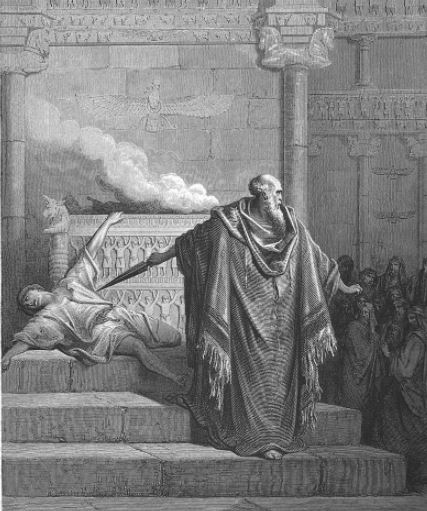
‘Mattathias of Modi’in killing a Jewish apostate’ by Gustav Doré

Lastly, we must not forget that Shimon the Maccabee was one of the instigators of the revolt against the Greeks and their Hellenism. He was the son of Matityahu, a religious, traditional priest, who fled Jerusalem when it was taken over by Hellenizers (as we quoted above, I Maccabees 2:1). Shimon was certainly aligned with the traditional Pharisees, and it was only his grandson Alexander Yannai who turned entirely to the more Hellenized Sadducees and began persecuting the Pharisees. As Rabbinic Judaism came out of Pharisee Judaism, it makes sense that the tradition begins with Shimon the Maccabee, or Simon Thassi, ie. Shimon haTzadik.

Interestingly, the Book of Maccabees states that Matityahu was a descendent of Yoariv. This name is mentioned in the Tanakh. I Chronicles 24:7 lists Yoariv as the head of one of the 24 divisions of kohanim, as established in the days of King David. The same chapter states that Yoariv was himself a descendent of Elazar, the son of Aaron the first kohen. Thus, there is a fairly clear chain of transmission from Aaron, all the way down to Matityahu, and his son Shimon.

Shimon continued to pass down the tradition, not to his son Yochanan—who was swayed by the Greeks and became John Hyrcanus—but to his student Antigonus. (Depending on how one reads Avot, it is possible that Yose ben Yoezer and Yose ben Yochanan were also direct students of Shimon haTzadik.) It appears we have found the historical Shimon haTzadik, and closed the gap on the proper chronology of the Oral Tradition dating back to Sinai.

If this is the case, then Chanukah is a celebration of not only a miraculous victory over the Syrian Greeks, but of the very beginnings of Rabbinic Judaism as we know it, with one of Chanuka’s central heroes being none other than history’s first official rabbi.

Chag sameach!


The above essay is adapted from Garments of Light, Volume Three.
Get the book here! 

Embracing Converts, and the Seeds of Amalek

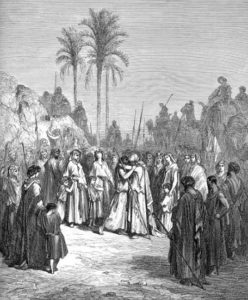
'The Meeting of Jacob and Esau' by Gustav Doré

‘The Meeting of Jacob and Esau’ by Gustav Doré

This week’s parasha is Vayishlach, which recounts Jacob’s return and settlement in the Holy Land after twenty years of living in Charan. At the end of the parasha is a long list of the genealogies of Jacob’s brother, Esau. The list seems unnecessary, and many Sages have wondered why the Torah bothers to spend so much time recounting Esau’s descendants. There have even been debates on whether the entire text of the Torah is equally holy, or if passages like the Ten Commandments are holier than passages such as this list of Esau’s genealogies. Meanwhile, the Arizal states that many of the deepest secrets of Creation are embedded particularly in this seemingly boring and superfluous passage. He draws particular significance from the list of the kings of Edom. The Arizal says these kings are codenames for the Sefirot, and a careful reading of the text reveals the cosmological rectifications (tikkunim) required to repair all of Creation and restore the world to perfection.

About half way through the list we are told that “… the sister of Lotan was Timna” (Genesis 36:22). Again, the Sages are baffled at this extra addition. We already care little enough that there was once an Edomite chief named Lotan – who cares that he had a sister named Timna? The Talmud (Sanhedrin 99b) notes how there were those who scoffed at such verses, saying: “Did Moses have nothing better to write?” And then, the same page of Talmud comes in to explain its tremendous significance:

Timna was a royal princess… Desiring to become a proselyte, she went to Abraham, Isaac and Jacob, but they did not accept her. So she went and became a concubine to Eliphaz the son of Esau, saying, “I’d rather be a servant to this people than a mistress of another nation.” From her, Amalek was descended, who afflicted Israel. Why so? Because they should not have repulsed her!

The Talmud combines the verse in question – which states that Timna was the royal sister of the chief, or prince, Lotan – with an earlier verse (36:12) that says she married Esau’s son Eliphaz and bore Amalek. She wished to convert to Judaism and approached the Patriarchs. All three rebuffed her. So, she ended up with Eliphaz – the closest she could get to being part of the nation. This union gave rise to the evil Amalek, that antagonizing force which has been oppressing Israel for millennia. The Sages state that the Patriarchs should have embraced this potential convert, instead of pushing her away. Their failure to open their arms led to centuries of Jewish suffering. The Talmud sends a pretty clear message: gentiles and converts should not be turned away, and doing so only breeds more resentment against Jews, bringing out all of the world’s “Amaleks”.

Soulmates of Jacob and Moses

The Arizal comments on the Timna passage and points out something even more amazing. He taught (Sha’ar HaMitzvot, Shoftim) that Timna was actually the soulmate of Jacob! Timna contained a great deal of holiness, and Jacob was meant to convert her and marry her, thereby elevating her spiritual sparks. That would have been a massive tikkun of its own, and would have hastened the coming of Mashiach. Instead, Jacob rejected her, and she went on to produce Amalek, bringing evermore evil into the world, and further delaying the coming of Mashiach.

The Arizal highlights that Moses made a similar mistake in not consummating his marriage to the Cushite (Ethiopian) woman. Both Tzipporah and the Cushite woman were Moses’ soulmates, and while Moses did the right thing in converting the Cushite, he never properly married her. Her sparks of holiness were not fully elevated, and the tikkun was left incomplete. This is why Aaron and Miriam were upset with their brother, as we read later in Numbers 12:1, “And Miriam and Aaron spoke against Moses because of the Cushite woman whom he had married…”

Rabbi Akiva’s 24,000 Students in Shechem

In this week’s parasha, too, we read how the people of Shechem genuinely wished to unite with Jacob’s family, agreed to circumcise themselves, and converted en masse. However, Jacob’s sons Shimon and Levi rejected them and resorted to violence in avenging what was done to their sister Dinah. Jacob was horrified at the actions of his sons, and later did not bless the two on his deathbed. It appears their sin was never forgiven, as hundreds of years later the tribes of Shimon and Levi were not given set borders within the Holy Land, but only a handful of cities interspersed among the other tribes. Kabbalistic texts reveal that Shimon and Levi killed 24,000 people in Shechem, and these 24,000 converted souls later reincarnated as the 24,000 students of Rabbi Akiva!

Did You Know These Famous People Converted to Judaism?

All of these narratives point to the same lesson: converts should be welcomed and accepted wholeheartedly. They have the potential for great holiness. The Talmud (Bava Kamma 38a) states that a gentile who occupies himself with Torah is equal to a kohen gadol, a High Priest! The Arizal describes five types of Jewish souls, and the souls of converts are among the purest. (The other types are “Old Souls”, “New Souls”, “True New Souls”, and the “Souls of Cain and Abel”. Of these, the most impure are Old Souls.) It goes without saying that there is no place for racism of any kind within Judaism – Moses himself married a black woman, and was reprimanded for not being diligent in consummating that union.

Historically, Jews were never the proselytizing kind. There are no Jewish missionaries that go out knocking on the doors of gentiles to seek converts. At the same time, Judaism was rarely a popular religion to convert in to. But this will change very soon, and we have to be ready for that day, for the prophet Zechariah (8:23) predicted:

It shall come to pass that ten men shall take hold – from all the languages of the nations – shall take hold of the corners of a Jew’s clothes, saying: “We will go with you, for we have heard that God is with you…”


The above essay is an excerpt from Garments of Light, Volume One. Get the book here!