Tag Archives: Nachash

The Mystical Connection Between Jacob and David

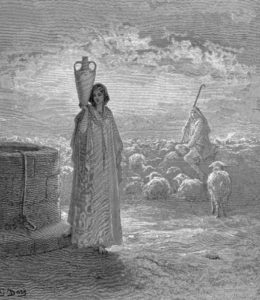
‘Jacob Keeping Laban’s Flocks’ by Gustave Doré

In this week’s parasha, Vayetze, we read how Jacob journeys to his relatives in Charan and the details of his twenty-year sojourn there. He falls in love with Rachel at first sight, then works tirelessly for seven years for the privilege of marrying her. When that fateful day comes, his father-in-law Lavan tricks him into marrying Rachel’s sister, Leah. Jacob is then forced to work another seven gruelling years. We read how Jacob didn’t care very much for Leah, as he only truly wanted to marry Rachel, and Leah felt entirely unloved. One question to ask is why Jacob didn’t simply divorce her? He had no intention of marrying Leah in the first place. One can argue that the marriage was null and void from the beginning, since a person must be aware of whom they are marrying. Why did Jacob stay with her? A number of explanations have been given for this:

The simplest is that Jacob pitied her. Lavan tricked Jacob into marrying Leah because she had no suitors. She would have grown old, all alone, and Jacob did not want to abandon her once they had been “married”. Another take on this is that Rachel was the one that deeply pitied her sister, and herself asked Jacob to stay married to Leah. One version of this story has it that Rachel even instructed Leah in how to play the part of Rachel so that Jacob wouldn’t be able to distinguish between them (see Bava Batra 123a).

From a spiritual perspective, this whole thing can be seen as one big middah k’neged middah—“measure for measure”—consequence: since Jacob had tricked his father into taking his brother’s blessing, he was now, in turn, tricked by his father-in-law. On a deeper level, we have written before how, when Jacob took his brother’s birthright and blessing, he essentially took on his brother’s mission in life. In the original conception of things, Jacob and Esau should have been twin holy warriors, with Jacob fighting the spiritual battles and Esau fighting the physical battles for God. When Esau failed, Jacob took over that mission. This is symbolized by the new name he was given: Israel, one who “fights with [or, alongside] God”. Jacob is unique in that the Torah continues to shift between his new and old name (whereas, for example, once Abram became “Abraham”, he is never again referred to as “Abram”). This is because Jacob and Israel are not old and new names, but rather dual names, for his dual personalities, representing his dual missions.

In the original plan, Jacob was meant to marry Rachel, and Esau was meant to marry Leah. (According to at least one opinion, Rachel and Leah were also fraternal twins, like Jacob and Esau; see Seder Olam Rabbah, ch. 2.) Once Jacob took over Esau’s mission and birthright, he also took on his wife. This is why he had to marry her! And he knew it all along. The Midrash states that Jacob initially feared marrying Leah because Esau would come after him for it! (Midrash Tanchuma, Vayetze 12 in Buber edition.) Meanwhile, another Midrash says that Jacob did love Leah, but turned away from her when she pointed out that her father tricked Jacob in the same way Jacob had tricked his own father, measure for measure (Lekach Tov on Genesis 27).

Whatever the case, their marriage was an unhappy one. Leah always felt unloved, and named all of her kids in relation to her hope that her husband would finally cherish her. He didn’t. Meanwhile, the wife he did love—Rachel—was barren for many years, and this strained their relationship tremendously (Genesis 30:1-2). It is little wonder that when Jacob meets Pharaoh decades later, he tells him that his whole life has been miserable (Genesis 47:9).

Jacob made many mistakes in his life, and such mistakes, of course, need rectification. This is where the Arizal (Rabbi Isaac Luria, 1534-1572) comes in, explaining how Jacob’s life was rectified in the life of King David.

David and Abigail

In Sha’ar HaGilgulim, “Gate of Reincarnations”, Rabbi Chaim Vital (1543-1620, the Arizal’s primary disciple) details Lavan’s various incarnations. Lavan’s soul was originally rooted in Abel, the son of Adam. The holy part of Abel (הבל), symbolized by the letter hei, was reincarnated in Moses (משה, whose other two letters come from Shem, שם, who was also incarnated in him), while his evil part, symbolized by bet-lamed, reincarnated in Lavan (לבן). Lavan was unable to rectify this part of Abel, and descended into sorcery and evil. Unrepaired, he had to reincarnate once more, as Bilaam (בלעם), the “non-Jewish version” of Moses. Thus, when Moses and Bilaam go head-to-head later in the Torah, they are actually two ancient halves of Abel!

As we know, Bilaam also descended into sorcery and evil, so he had to reincarnate again. This time around, he comes back as Naval (נבל). Recall that Naval was a very wealthy man, “with three thousand sheep and a thousand goats” (I Samuel 25:2). At the time, David and his loyal soldiers were encamped in Carmel, and protected Naval’s shepherds. This was before David had consolidated his monarchy, when King Saul had refused to give up the throne and sought to get rid of David.

David eventually reached out to Naval and asked for his help. He reminded Naval that his soldiers had watched over Naval’s flocks and shepherds, and ensured no harm came upon them. Instead of showing his gratitude, Naval rebuffed David’s messengers. This was wrong for a number of reasons, including the fact that David was already the rightfully-anointed king of Israel, and refusing a king in such a way carries a capital punishment. David armed four hundred of his men and headed towards Naval.

Naval’s wife Abigail got word of what was going on, and went out to greet David and pacify him. She took with her “two hundred loaves, and two bottles of wine, and five sheep ready dressed, and five measures of parched corn, and a hundred clusters of raisins, and two hundred cakes of figs” as a gift (25:18). While David was angrily racing towards Naval and thinking “he has returned me evil for good” and intending to exterminate his entire household (25:21-22), Abigail suddenly appeared. She placates him with a beautiful soliloquy (25:24-31), to which David responds:

Blessed be Hashem, the God of Israel, who sent you this day to meet me; and blessed be your discretion, and blessed you be, that you have kept me this day from bloodshed, and from finding redress for myself with my own hand.

David spares Naval, and sends Abigail back home in peace. Although David was merciful, God was not, and He struck Naval with what appears to be a heart attack: “his heart died within him, and he became as a stone” (25:37). In the aftermath of the narrative, David ends up marrying the widowed Abigail, and she becomes one of his most important and beloved wives.

Abigail meets David

Jacob Reincarnated

In the same way that Lavan reincarnated in Naval, Jacob returned in David. Upon closer examination, the parallels between them are striking. Jacob was the father of the Twelve Tribes, and David was the king that unified the Twelve Tribes into one cohesive kingdom (establishing the only divinely-approved dynasty). Jacob is the one that prayed in Jerusalem at Beit El, literally the “House of God”, placing twelve foundation stones there in his vision of the future Temple, and David was the one that actually acquired Jerusalem and paved the foundations for the Temple at that same Beit El site. Jacob is the only patriarch of whom it is said that he never “died”, just as it is common to sing David melekh Israel chai v’kayam, King David lives on. (The Ba’al HaTurim, on Genesis 32:12, points out many more connections between Jacob and David.)

Jacob’s first flaw was in slaving away for Lavan partly because of his physical desire for the beautiful Rachel (as we see in Genesis 29:21). This was rectified in David because he slaved away for Naval without any ulterior motive, and certainly with no desire for the beautiful Abigail (among the most beautiful women of all time, as per Megillah 15a). Just like Lavan tricked Jacob out of his rightful wages, Naval tricked David out of his rightful wage. Whereas Jacob fled from Lavan and was pursued by Lavan’s army, this time around it was David who had the military might on his side and pursued Naval.

Ultimately, David restrained himself from violence—not stooping to the level of Lavan/Naval—and God took care of the problem for him. He was rewarded with Abigail. And who was she? The Arizal reveals that she contained the spirit of Leah! (Incidentally, the gematria of אביגיל is 56, equal to כלאה, “like Leah”). The first time around, Jacob worked for Rachel and spurned Leah, making her feel “hated”. This time, David rectifies the mistake of his past life by essentially working for Leah, and marrying her willingly and lovingly.

To be clear, the Arizal does not state all of the above explicitly, though it may be extracted from his teachings, as recorded in Sha’ar HaGilgulim (particularly chapter 36). We must keep in mind that Rabbi Chaim Vital’s (together with his son Rabbi Shmuel Vital’s) transcription of his master’s teachings was not perfect, as he himself admits in many instances. He often introduces a statement, or an alternate teaching, with the words נראה לפי עניות דעתי, “it appears, from my limited knowledge…” Sometimes, he also adds פעם אחרת, that “another time” he apparently heard something different.

In the present discussion, the main teaching of the Arizal is actually of a different nature, taking the souls of Jacob and Lavan, Rachel, Leah, and David all the way back to Adam and the “Original Sin”.

Adam and the Snake

The Arizal taught that the Nachash (loosely translated as “snake” or “serpent”) caused Adam to waste two seminal drops. These two seminal drops carried the souls of Rachel and Leah. Lavan carried the essence of the Nachash who had imprisoned those souls. Jacob worked hard in order to free them from Lavan and marry them, because Jacob was a reincarnation of Adam and sought to reunite with those lost spiritual sparks of his. Jacob succeeded in fulfilling this tikkun.

Rachel and Leah were actually sparks of Adam, and parts of Jacob’s own soul. (In addition to the fact that, as Rabbi Vital reminds, a man infuses a part of his own soul into a woman when the two are intimate.) That spirit within Rachel then migrated into her son Benjamin, which is why the Torah tells us that Benjamin was born “when her soul left her” (Genesis 35:18), ie. left Rachel and entered him. The spirit within Leah, meanwhile, went into Abigail. This is why, in one place in Scripture (II Samuel 17:25), she is called Avigail bat Nachash, “Abigail, the daughter of Nachash” (or Avigal bat Nachash), as her spirit had come from those souls taken by the Serpent.

Alternatively, Avigail bat Nachash is not the wife of David, but actually the name of his sister, who was also called Abigail (or Abigal). Rabbi Vital points out (introducing it with those uncertain words פעם אחרת נראה לפי עניות דעתי) that the spirit within Leah split between Abigail the wife of David and Abigail the sister of David, for a completely different tikkun. This was a rectification for the fact that Jacob married two sisters—something explicitly forbidden by the Torah. (To be fair, Jacob lived before the official giving of the Torah.) To fix that error, Leah partially came back within David’s own sister whom, of course, he did not marry, and instead loved like a brother.

If all of this soul migration and rectification sounds complicated, that’s because it is! There are countless souls, each made up of thousands of sparks, all of which are dynamically moving through us, passing throughout history, jumping across space and time, and quietly weaving themselves into the tapestries of our intriguing lives.

Mashiach and the Mysterious 13th Zodiac Sign

When Jacob blesses his children before his passing, he begins by telling his sons that he wishes to reveal to them what will happen b’acharit hayamim, “in the End of Days”. Yet, the text we read does not appear to say anything about the End of Days! The Talmud (Pesachim 56a) states that the Shekhinah withdrew from Jacob at that moment so he was unable to reveal those secrets. If that’s the case, how was he able to properly bless his children?

The Talmud states that when the Shekhinah left him, Jacob worried one of his children was unworthy to hear those secrets. His sons then recited the Shema in unison and said, “just as there is only One in your heart, so is there in our heart only One.” Jacob was comforted to know they are all indeed righteous, and it seems the Shekhinah returned to him at this point, allowing him to bless his children in holiness. Nonetheless, Jacob reasoned that to reveal the secret of the End in explicit fashion would be unwise, so he encoded these mysteries within the blessings he recited. In fact, Jacob not only encrypted what will happen in the End, but summarized the breadth of Jewish history (see ‘How Jacob Prophesied All of Jewish History’ in Volume One of Garments of Light).

One place where Jacob appears to make an explicit reference to the End is in blessing Dan, when he says, “I hope for Your salvation, Hashem” (Genesis 49:18). Jacob says Dan will be the one to judge his people—alluding to the great Judgement Day—and wage the final battles like a “snake upon the road… who bites the horse’s heel so that its rider falls backwards”. Jacob is speaking of Mashiach. Although Mashiach is a descendent of David and from the tribe of Judah, the Midrash states that this is only through his father, while through his mother’s lineage Mashiach hails from the tribe of Dan.

Why does Jacob compare Mashiach to a snake?

Snakes of Divination

In cultures around the world, there is a peculiar connection between snakes and prophecy. In ancient Greece, for example, the Oracle went into a prophetic trance when supposedly breathing in the fumes (or spirit) of the dead python upon which the Temple in Delphi was built. According to myth, this great python (a word which has a Hebrew equivalent in the Tanakh, פתן) was slain by Apollo. The Temple was built upon its carcass. For this reason, the Greek prophetess was known as Pythia.

Similarly, the Romans had their sacred hill on the Vatican (later adopted as the centre of Christianity). The second-century Latin author Aulus Gellius explained that the root of the word Vatican is vates, Latin for “prophet”. Others explain that vatican refers more specifically to a “divining serpent”. Meanwhile, on the other side of the world the Aztecs had Quetzalcoatl and the Mayans had Kukulkan, the “feathered serpent” god of wisdom and learning. And such mystical dragons appear just about everywhere else, from Scandinavia to China.

Incredibly, the Torah makes the same connection, where Joseph is described as a diviner who uses a special goblet to nachesh inachesh (Genesis 44:5). This term for divination is identical to nachash, “snake”. In Modern Hebrew, too, the term for guessing or predicting is lenachesh. Why is the snake associated with otherworldly wisdom and prophecy?

Primordial Serpent

Back in the Garden of Eden, it was the Nachash, “Serpent”, who encouraged Eve to consume of the Forbidden Fruit. This was the fruit of the Tree of Knowledge. The Serpent is the one who unlocked the minds of Adam and Eve to higher wisdom so that they could “be like God”. Jewish tradition maintains that Adam and Eve were eventually supposed to eat of the Tree of Knowledge (for otherwise why would God put it there to begin with?) but they simply rushed to do so when they were not yet ready. They transgressed God’s command, and knew not what to do with all of this tremendous information, resulting in the shameful descent of man into sin. The one who instigated it all was the Nachash.

It appears that ever since then, the snake has been a symbol of forbidden wisdom. Such divination and mysticism can be quite dangerous, and most are unable to either grasp or properly use this knowledge. The Talmud cautions as much in its famous story of the four sages who entered “Pardes” (Chagigah 14b). Pardes is an acronym for the depths of Jewish wisdom, from the simple (pshat) and sub-textual (remez) to the metaphorical (drash) and esoteric (sod). The result of entering the mystical dimensions was that Ben Azzai died, Ben Zoma detached from this world, and Elisha ben Avuya became a heretic. Only Rabbi Akiva was able to “enter in peace and depart in peace.” It is important to remember that Rabbi Akiva was the teacher of Rabbi Shimon bar Yochai, the originator of the Zohar. (Still, the Zohar, like most mystical texts, does not speak explicitly of esoteric matters, but cloaks them in layers of garments and complex language which only the most astute can unravel.)

Long before, Joseph was a master of this wisdom, surprising even the Pharaoh and his best mystics, who proclaimed: “Can there be such a man in whom the spirit of God rests?” (Genesis 41:38). Joseph, of course, is a prototype of Mashiach. The sages state that Mashiach is a great prophet and sage in his own right, but can he really surpass the unparalleled prophecy of Moses or the wisdom of Solomon? The Alter Rebbe (Rabbi Schneur Zalman of Liadi, 1745-1812) solved the issue thus:

After the resurrection all will rise… the Patriarchs and Matriarchs, Moses and Aaron, all the righteous ones and the prophets, tens of thousands beyond number. Is it possible that Mashiach will teach them the same Torah that is revealed to us today? …Will all who knew the whole Torah be required to learn new laws from Mashiach? We must therefore say that Mashiach will instruct them in the “good of discernment and knowledge of the secrets of the esoteric teachings of Torah” that the “eyes will not have seen”—Moses and the Patriarchs not having been privileged to that knowledge, for only to Mashiach will it be revealed as it is written of him [Isaiah 52:13] “and he shall be very high.” (Likkutei Torah, Tzav)

Mashiach is the greatest of mystics, the holder of “forbidden” knowledge which will soon no longer be forbidden. The time will come when, as God originally intended, man will eat from the Tree of Knowledge and be “like God”. That first requires a return of mankind to the Garden of Eden, which is the very task of Mashiach. Beautifully, the gematria of Mashiach (משיח)—the one who brings us back into Eden—is 358, the same as Nachash (נחש)—the one who forced us out to begin with. And so, as Jacob foresaw, the snake symbolizes Mashiach himself.

While Mashiach is likened to a serpent, he must also defeat the Primordial Serpent which embodies all evil. Indeed, the Sages speak of two serpents (based on Isaiah 27:1): the “straight” serpent (nachash bariach) and the “twisted” serpent (nachash ‘akalaton). Mashiach is the straight serpent that devours the twisted one. This was all alluded to in Moses’ staff-turned-serpent consuming the Pharaoh’s staff-turned-serpent. In fact, another serpent staff, the nachash nechoshet, is later used by Moses to heal the nation. This healing staff found its way into Greek myth as well, where it was wielded by the healer god Asclepius, and eventually into the modern internationally-recognized medical symbol.

And that brings us back to the End of Days.

The 13th Zodiac

In recent years, there have been whispers of a necessity to change the current 12-sign horoscope to include a 13th zodiac sign. This was featured in the media on a number of occasions, with flashy headlines suggesting that some people’s astrological sign may now have changed. It is based on the fact that there is a “precession of the equinoxes”: Earth’s axis changes very slowly over time, meaning that the constellations which are visible in the night sky change, too.

The astrological signs are based on the 12 major constellations (out of 88 constellations total) that align with the sun and “rule” for about a month’s time every year (each making up 30º of the total 360º). The argument is that due to the precession of the equinoxes, a 13th sign has crept in which we can no longer ignore. The majority of astrologers have rejected this argument, mainly because astrology isn’t really based on the stars but fixed to the vernal equinox. While some in the East (namely Hindus) use “sidereal astrology”, which is based on shifting star positions, the system used in the West (“tropical astrology”) has 12 signs roughly corresponding to the 12 months.

The same is true in traditional Jewish thought, where each sign corresponds to a month on the Hebrew calendar, as well as to one of the twelve tribes of Israel. Having said that, including a 13th month for the Jewish system is not a problem at all. In fact, it is actually a solution, since the Jewish calendar has a 13th month in a leap year. The extra month has an astrological sign, too! Similarly, although we always speak of twelve tribes of Israel, there are really thirteen since, as we read in this week’s parasha, Jacob made Joseph count as two separate tribes: Ephraim and Menashe.

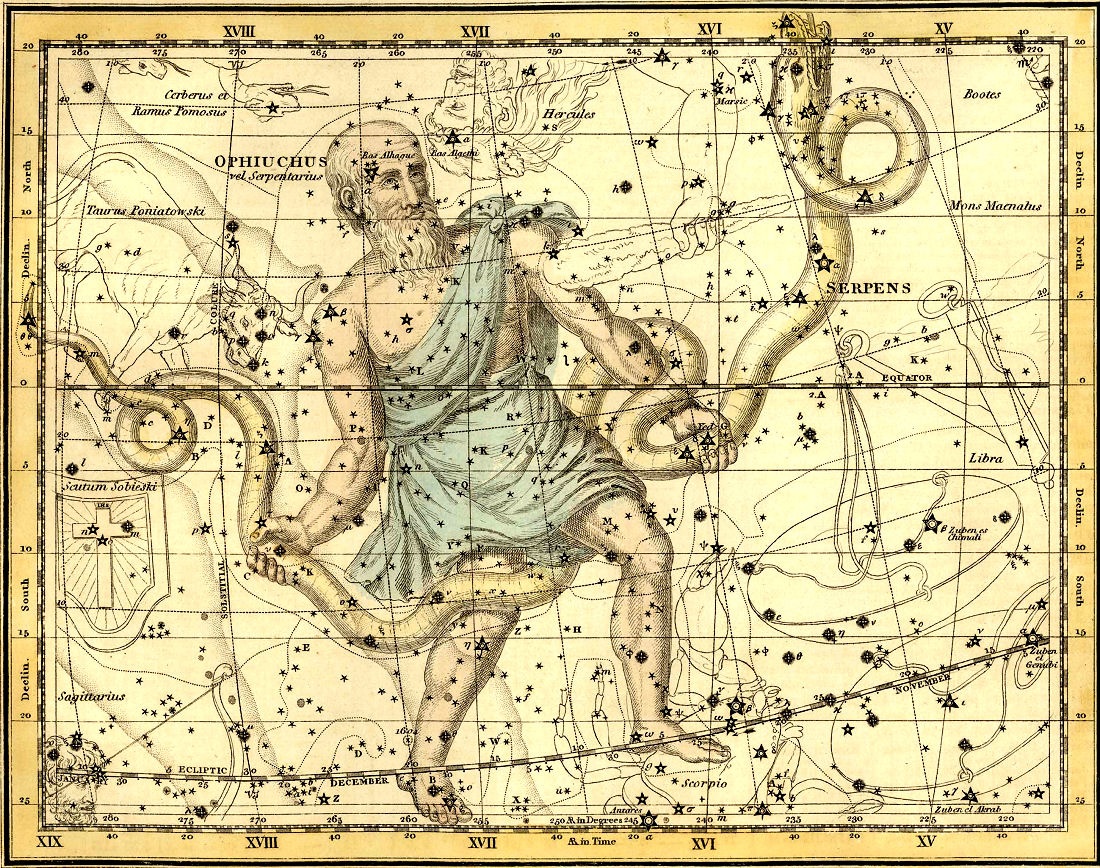
Whatever the case, whether the horoscope requires modification or not is irrelevant to Judaism, which denies any astrological effect on Israel (see ‘Should Jews Believe in Astrology’ in Volume One of Garments of Light). Besides, unlike astrologers, astronomers both ancient and modern have always been aware of this thirteenth constellation. To the ancient Babylonians it was the snake-like Nirah, while to the ancient Greeks it was known as Ophiuchus, the “serpent-bearer”. This constellation is in the shape of a man firmly grasping a twisted snake (the interlinked constellation Serpens). This is, of course, the very symbol of Mashiach, that serpentine saviour who defeats the primordial snake and all of its evil. After being an astrological footnote for a very long time, Ophiuchus has entered the spotlight, as if the cosmos itself is reminding us of Mashiach’s impending arrival.

The constellation Ophiuchus (or Serpentarius) grasping the constellation Serpens, from Alexander Jamieson’s Celestial Atlas of 1822. It is interesting to note that Mashiach must be a direct descendant of King David, whose own father Yishai (Jesse) was also called Nachash! (See Talmud, Shabbat 55b.)


The above is an excerpt from Garments of Light, Volume Two. Get the book here

An Honest Look at Death and the Afterlife

This week we once again read a double Torah portion, combining the parashot of Behar and Bechukotai to complete the book of Leviticus. The main themes of these parashas are the Sabbatical and Jubilee years, as well as God’s rewards and punishments for those who follow His ways and those who do not.

One interesting thing that the reader will note is that there is no mention of any kind of afterlife. All of the rewards and punishments that are listed are described in wholly physical terms: ample rains and abundant harvests, military victories and secure borders, good food and the feeling of God’s presence – and the opposite of these if the people are sinful. Why is it that the Torah does not mention any kind of reward and punishment in the afterlife? After all, we are accustomed to hearing that this world is nothing but a transient “hallway”, so to speak, while the next world is the real deal, where people receive what they deserve.

More puzzling is the fact that the Torah essentially never mentions the afterlife in explicit fashion. Everything appears to happen in this physical world. Yet, there is certainly a discussion of souls, and many spiritual entities. So, what is the real Torah conception of the afterlife?

The Garden of Eden

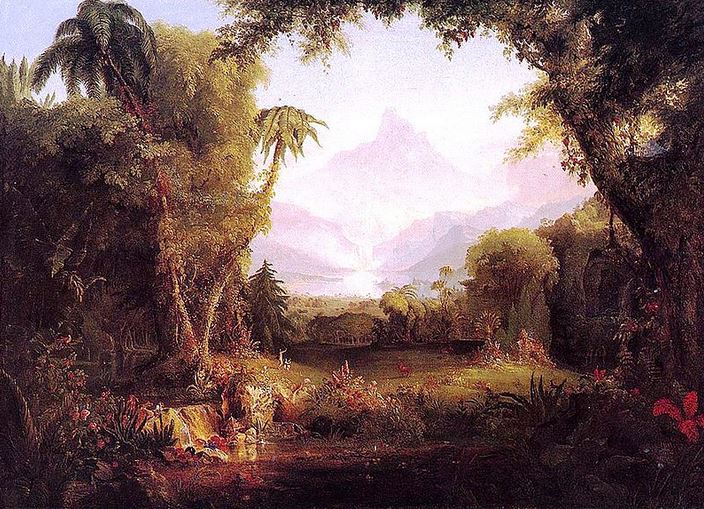
'Garden of Eden', by Thomas Cole

‘Garden of Eden’, by Thomas Cole

Typically, it is common to think that those who have passed away are now in the “Garden of Eden”, and this is indeed how Hebrew-speakers often refer to the dead, wishing them menucha (rest) in Gan Eden. But where exactly is this “Gan Eden”?

The Torah is quite clear on the fact that God created the Garden of Eden right here on Earth. The Genesis account describes God’s creation of the world, and all of its inhabitants, and concludes with the planting of a garden in Eden, where the first man and woman are placed. After their sin of consuming the fruit, Adam and Eve are banished from the Garden, and continue their lives elsewhere on Earth. There is no mention anywhere in the Torah of a spiritual Garden of Eden located somewhere in the Heavens!

Conversely, it is common for people to refer to an afterlife of damnation in a place called Gehinnom, typically translated as “hell”. Again, there is no explicit mention of a “hell” in Scripture. Gehinnom itself simply means “the Valley of Hinnom” (or the Valley of the Son of Hinnom, Gei Ben Hinnom) which is discussed in the Tanakh as a place right outside the Old City walls of Jerusalem. This is described as a place of sinners and idolaters, outcasts that were expelled from the Holy City. Once again, we see that the place usually thought of as hell is simply a physical place here on Earth.

As Above, So Below

By the times of the Talmudic period, the Jewish Sages had developed a unique cosmic worldview. They saw this material world as only a reflection of the spiritual world. What happened down here reflected, in some way, much greater cosmic events that were happening in the Heavens. Thus, just as there was a Jerusalem down here on Earth, there was a Jerusalem shel ma’alah, a “Jerusalem Above” (see, for example, Ta’anit 5a).

Similarly, just as there was a Garden of Eden – a place of utmost peace and pleasure – here on Earth, there must be a similar one above in the Heavens. And just as there was a Gehinnom – a deep valley of evil – here on Earth, there must be such a place in the Heavens, too.

It appears that the idea of righteous souls moving on to a Heavenly Gan Eden, or wicked souls to a Heavenly Gehinnom, came from this view on the nature of God’s universe.

The Big Afterlife Problem

However, this brings about a very large problem: both the Garden of Eden and Gehinnom are described in physical terms. But, after the body dies and decays, only the soul lives on, and how can the soul experience physical pleasures or pains? Additionally, the soul is described as pure and eternal. Why is it the soul that must suffer for the sins accrued by the body? And why should the soul suffer infinitely for a body that had only such a short, finite existence?

This problem was presented to Rabbi Yehuda haNasi by the Roman Emperor Antoninus nearly two millennia ago (Sanhedrin 91a-b).

Antoninus said to Rabbi: “The body and the soul can both free themselves from judgment. Thus, the body can plead: ‘The soul has sinned, since from the day it left me I lie like a dumb stone in the grave.’ While the soul can say: ‘The body has sinned, since from the day I departed from it I fly freely in the air like a bird.’”

He replied: “I will tell you a parable. To what may this be compared? To a human king who owned a beautiful orchard which contained splendid figs. Now, he appointed two watchmen, one lame and the other blind. [One day] the lame man said to the blind, ‘I see beautiful figs in the orchard. Come and take me upon your shoulders, that we may procure and eat them.’ So the lame strode the blind, procured and ate them. Some time after, the owner of the orchard came and inquired of them, ‘Where are those beautiful figs?’ The lame man replied, ‘Do I have feet to walk with?’ The blind man replied, ‘Do I have eyes to see with?’ What did he do? He placed the lame upon the blind and judged them together. So will the Holy One, blessed be He, bring the soul, place it in the body, and judge them together…”

Rabbi Yehuda replied with a wonderful parable, and concluded that God brings the body and soul together again, and only then judges the person, and bestows upon them their due rewards or punishments.

So, if the body and soul go back together again after death, then there is no “Garden of Eden” or “Gehinnom” in the sense that we might commonly think.

Gate of Reincarnations

The only way that the body and soul can go back together again is if, following death, the soul returns into bodily form. This is the definition of reincarnation. Roughly 500 years ago, the great kabbalist Rabbi Isaac Luria, better known as the Arizal, revealed many secrets of reincarnation, and these teachings were recorded by his primary disciple, Rabbi Chaim Vital, in a text called Sha’ar HaGilgulim (Gate of Reincarnations).

This text describes reincarnations in great detail, and affirms that those who have lived sinful lives are reincarnated into new lives that are very challenging, and in this way have to make reparations for the mistakes of their past. The righteous, too, are reincarnated, since no one goes through life without making some mistakes, and even the most minute of these errors must be repaired. However, such people will enjoy much better lives, and be given the opportunity to fix those minor details from their past.

Of course, proper repentance can nullify any trials that a person must bear due to a mishap from a past life. Thus, free will ultimately trumps everything else. And what happens to those who have completely fulfilled their missions? In that case, there is indeed a “Garden of Eden” of sorts.

(For more on reincarnation, click here to read ‘Everything You Wanted to Know About Reincarnation in Judaism’.)

Resurrection of the Dead

One form of afterlife that Scriptures do mention explicitly is the Resurrection of the Dead. It is taught that sometime after the coming of Mashiach, all of the righteous souls will miraculously come back to life. They will then enjoy the world as it was always meant to be: a Garden of Eden.

Ultimately, this is the role of Mashiach: to return the world to that perfect, primordial state. It is interesting to note how the figure responsible for driving mankind out of the Garden was the Serpent, Nachash (נחש) in Hebrew, a word which has a numerical value of 358; and the figure responsible for returning mankind to the Garden is Mashiach (משיח), a word which also has a gematria of 358 – measure for measure. Thus, the final step for each soul, once its mission is complete, is to be resurrected in the restored Garden of Eden, right here in a new Earth, following the arrival of Mashiach.

We can now understand why Bechukotai does not speak of any spiritual rewards or punishments in an afterlife. All of the rewards and punishments are right here in this world, where body and soul unite as one, as Rabbi Yehuda told Antoninus. We can now also see why no “Heaven” or “Hell” is ever explicitly mentioned in Scripture, and why we never even mention them in our prayers. The Amidah prayer recited thrice daily makes no reference to souls in some Heavenly realm, but does have a blessing for techiyat ha’metim, the Resurrection of the Dead in a future, perfected world.

May we merit to see it speedily and in our days.


The article above is adapted from Garments of Light – 70 Illuminating Essays on the Weekly Torah Portion and Holidays. Click here to get the book!