
How can we better understand both the physical and spiritual worlds through the Periodic Table of the Elements? What can we learn about our own lives from the structure and anatomy of the atom? What is so special about the elements mentioned in Tanakh, including iron, copper, silver, and gold? And what is “God’s Element”? Find out in this fascinating class where we explore the profound connections between Torah and chemistry.
Tag Archives: Number 26
Constellations and the Jewish Calendar
Yesterday marked the start of the new month of Nisan, first of the Jewish calendar. According to our ancient mystical texts, like Sefer Yetzirah, each of the twelve months of the Jewish year corresponds to one of the twelve Zodiac constellations (mazalot). The month of Nisan corresponds to Aries, or tal’e in Hebrew. Aries is depicted as a sheep or ram and, of course, the highlight of Nisan is the holiday of Pesach, referring to the korban pesach, the “paschal lamb”—a sheep!
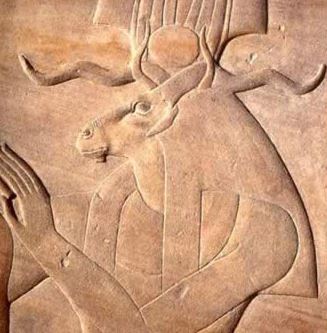
The Ram-headed idol Ra
Our Sages pointed out that God specifically commanded this species to be sacrificed because it was what the Egyptians worshipped at the time. This is likely referring to the ram-headed deity Ra. Amazingly, Ra is actually mentioned in the Torah when Pharaoh tells Moses that Ra neged pneichem (Exodus 10:10), typically translated as “evil [ra] will be before you”. Rashi comments here that Ra is an Egyptian idol and Pharaoh was warning the Israelites that they would perish under the wrath of his god Ra. Of course, the entire Exodus narrative was about showing God’s mastery over all aspects of Creation, and His destruction of Egypt’s false idols, Ra chief among them.
In astrology, Aries is a “fire” sign, which is quite appropriate for the Exodus connection. The fire alludes to the fire of the sacrificial altar for the korban pesach, as well as the pillar of fire that led the Israelites out of Egypt and through the Wilderness. Furthermore, at the Pesach seder, the Haggadah reminds us to say “blood, and fire, and columns of smoke”, dam v’esh v’timrot ashan, in memory of the Ten Plagues and the Exodus. (Actually, this phrase originally comes from Joel 3:3, straight from the prophet’s vision of the End of Days!) Continue reading
Israel and the Iron Age
In this week’s parasha, Ekev, Moses describes the rich land of Israel and says it is “a good land, a land with brooks of water, fountains and depths, that emerge in valleys and mountains, a land of wheat and barley, vines and figs and pomegranates, a land of oil producing olives and honey…” This first part of the description is well-known, and the source for the Seven Species of Israel. These are the seven plants that are particularly praiseworthy, and are native to the Holy Land: wheat, barley, grapes, figs, pomegranates, olives, and dates (which were used to make the honey that Moses is speaking of). The Zohar explains that all other species of plants have various angels appointed over them, but God alone oversees the growth and flourishing of the Seven Species (see Zohar Chadash on Ruth, 106a).
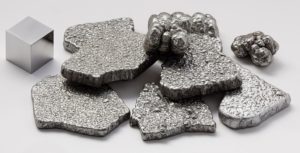 What we often overlook is the next part of Moses description: “a land in which you will eat bread without scarcity, you will lack nothing in it, a land whose stones are iron, and out of whose mountains you will hew copper.” Moses promises the Israelites a land full of iron and copper. This statement is actually just as significant as the Seven Species! What is so special about iron and copper that it was so enticing for Israel? Continue reading