Tag Archives: Pirkei Avot

The Kabbalah of Moses’ Divine Staff

In this week’s parasha, Va’era, we read about the first seven plagues to strike Egypt. These were brought about through the Staff of Moses, as were the later Splitting of the Sea, the victory over Amalek (Exodus 17) and the water brought forth from a rock. What was so special about this particular staff, and what was the source of its power?

Pirkei Avot (5:6) famously states that the Staff was one of ten special things to be created in the twilight between the Sixth Day and the first Shabbat. The Midrash (Pirkei d’Rabbi Eliezer, ch. 40) elaborates:

Rabbi Levi said: That staff which was created in the twilight was delivered to the first man out of the Garden of Eden. Adam delivered it to Enoch, and Enoch delivered it to Noah, and Noah to Shem. Shem passed it on to Abraham, Abraham to Isaac, and Isaac to Jacob, and Jacob brought it down to Egypt and passed it on to his son Joseph, and when Joseph died and they pillaged his household goods, it was placed in the palace of Pharaoh.

And Jethro was one of the magicians of Egypt, and he saw the staff and the letters which were upon it, and he desired it in his heart, and he took it and brought it, and planted it in the midst of the garden of his house. No one was able to approach it any more.

When Moses came to his house, he went into Jethro’s garden, and saw the staff and read the letters which were upon it, and he put forth his hand and took it. Jethro watched Moses, and said: “This one in the future will redeem Israel from Egypt.” Therefore, he gave him Tzipporah his daughter to be his wife…

God gave the staff to Adam, who gave it to Enoch (Hanokh)—who later transformed into the angel Metatron—and Enoch passed it on further until it got to Joseph in Egypt. The Pharaoh confiscated it after Joseph’s death. The passage then alludes to another Midrashic teaching that Jethro (Yitro), Moses’ future father-in-law, was once an advisor to Pharaoh, along with Job and Bila’am (see Sanhedrin 106a). The wicked Bila’am was the one who advised Pharaoh to drown the Israelite male-born in the Nile. While Job remained silent (for which he was so severely punished later), Jethro protested the cruel decree, and was forced to resign and flee because of it. As he fled, he grabbed the divine staff with him. Arriving in Midian, his new home, Jethro stuck the staff in the earth, at which point it seemingly gave forth deep roots and was immovable.

A related Midrash states that all the suitors that sought the hand of his wise and beautiful Tzipporah were asked to take the staff out of the earth, and should they succeed, could marry Jethro’s daughter. None were worthy. (Not surprisingly, some believe that this Midrash may have been the source for the Arthurian legend of the sword Excalibur.) Ultimately, Moses arrived and effortlessly pulled the staff out of the ground.

The passage above states that Moses was mesmerized by the letters engraved upon the staff, as was Jethro before him. What were these letters?

The 72 Names

Targum Yonatan (on Exodus 4:20) explains:

And Moses took the rod which he had brought away from the chamber of his father-in-law, made from the sapphire Throne of Glory; its weight forty se’ah; and upon it was engraved and set forth the Great and Glorious Name by which the signs should be wrought before Hashem by his hand…

God’s Ineffable Name was engraved upon the sapphire staff, which was itself carved out of God’s Heavenly Throne. The staff weighed a whopping 40 se’ah, equivalent to the minimum volume of a kosher mikveh, which is roughly 575 litres (or 575 kilograms) of water. (This might explain why none could dislodge the staff, except he who had God’s favour.)

A parallel Midrash (Shemot Rabbah, 8:3) also confirms that the staff was of pure sapphire, weighing forty se’ah, but says it was engraved with the letters that stand for the Ten Plagues, as we recite at the Passover seder: datzach, adash, b’achav (דצ״ך עד״ש באח״ב).

A final possibility is that the “Great and Glorious Name by which the signs should be wrought” refers to the mystical 216-letter Name of God (or 72-word Name of God). This Name is actually 72 linked names, each composed of three letters. The names are derived from the three verses Exodus 14:19-21:

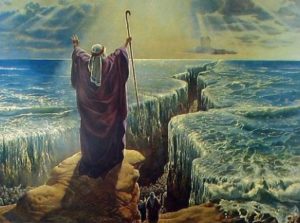
And the angel of God, who went before the camp of Israel, removed and went behind them; and the pillar of cloud removed from before them, and stood behind them; and it came between the camp of Egypt and the camp of Israel; and there was the cloud and the darkness here, yet it gave light by night there; and the one came not near the other all the night. And Moses stretched out his hand over the sea; and Hashem caused the sea to go back by a strong east wind all the night, and made the sea into dry land, and the waters were divided.
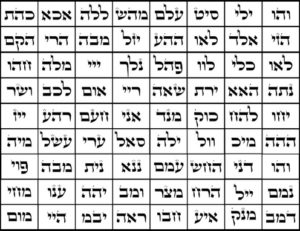
The 72 Three-Letter Names of God

Each of these verses has exactly 72 letters. Hidden within them is this esoteric Name of God, the most powerful, through which came about the miracle of the Splitting of the Sea as the verses themselves describe. The Name (or 72 Names) is derived by combining the first letter of the first verse, then the last letter of the second verse, and then the first letter of the third verse. The same is done for the next letter, and so on, for all 72 Names.

Since the Splitting of the Sea and the plagues were brought about through these Names, the Midrash above may be referring not to the Ineffable Name, but to these 72 Names as being engraved upon the Staff. In fact, it may be both.

Staff from Atzilut

The 72 Names are alluded to by another mystical 72-Name of God. The Arizal taught that God’s Ineffable Name can be expanded in four ways. This refers to a practice called milui,* where the letters of each word are themselves spelled out to express the inner value and meaning of the word. God’s Ineffable Name can be expanded in these ways, with the corresponding values:

יוד הא ואו הא = 45

יוד הה וו הה = 52

יוד הי ואו הי = 63

יוד הי ויו הי = 72

The Name with the 72 value is the highest, not just numerically, but according to the sefirot, partzufim, and universes laid out in Kabbalah. The 52-Name corresponds to Malkhut and the world of Asiyah; the 45-Name to Zeir Anpin (the six “masculine” sefirot) and the world of Yetzirah; and the 63-Name to Binah and the world of Beriah. The 72-Name—which is, of course, tied to the above 72 Names of God—corresponds to the highest universe, Atzilut, the level of God’s Throne, where there is nothing but His Emanation and Pure Light. Here we come full circle, for the Midrash states that the Staff of Moses was itself carved out of God’s Throne. This otherworldly staff came down to this world from the highest Heavenly realm!

Where is the Staff Today?

What happened to Moses’ staff after his passing? Another Midrash (Yalkut Shimoni, Psalms 869) answers:

…the staff with which Jacob crossed the Jordan is identical with that which Judah gave to his daughter-in-law, Tamar. It is likewise the holy staff with which Moses worked, and with which Aaron performed wonders before Pharaoh, and with which, finally, David slew the giant Goliath. David left it to his descendants, and the Davidic kings used it as a sceptre until the destruction of the Temple, when it miraculously disappeared. When the Messiah comes it will be given to him for a sceptre as a sign of his authority over the heathens.

This incredible passage contains a great deal of novel insight. Firstly, Jacob used this divine staff to split the Jordan and allow his large family to safely cross back to Israel, just as the Israelites would later cross the Jordan in miraculous fashion under the leadership of Joshua. It seems Joshua himself, as Moses’ rightful successor, held on to the staff, and passed it down through the Judges and Prophets until it came to the hand of David. Unlike the traditional account of David slaying Goliath with the giant’s own sword (after the slingshot), the Midrash here says he slew Goliath with the staff!

The staff remained in the Davidic dynasty until the kingdom’s end with the destruction of the First Temple. At this point a lot of things mysteriously disappeared, most famously the Ark of the Covenant. It is believed that the Ark was hidden in a special chamber built for it by Solomon, who envisioned the day that the Temple would be destroyed. It is likely that the staff is there, too, alongside the Ark.

Mashiach will restore both of these, and will once again wield the sceptre of the Davidic dynasty. As the staff is forged from God’s own Heavenly Throne, it is fitting that Mashiach—God’s appointed representative, who sits on His corresponding earthly throne—should hold a piece of it. And this symbol, the Midrash concludes, will be what makes even the heathens accept Mashiach’s—and God’s—authority. Jacob prophesied this on his deathbed (Genesis 49:10), in his blessing to Judah:

The sceptre shall not depart from Judah, nor the ruler’s staff from between his feet, until the coming of Shiloh; and unto him shall the obedience of all the peoples be.

Shiloh is one of the titles for Mashiach (see Sanhedrin 98b), and his wielding of the staff will bring about the obedience of all the world’s people to God’s law. We can now also solve a classic problem with the above verse:

The verse states that the sceptre will not depart from Judah until the coming of Mashiach, as if it will depart from Judah when Mashiach comes. This makes no sense, since Mashiach is a descendent of Judah! It should have simply said that the sceptre shall never depart from Judah, from whom the messiah will come. Rather, Jacob is hinting that the Staff will one day be hidden in the land of Judah, deep below “between his feet”, and won’t budge from there for millennia until Mashiach comes and finally restores it.

May we merit to see it soon.

*Interestingly, using the same milui method, one can expand the word staff (מטה) like this: מאם טאת הה, which is 501, equivalent to דצ״ך עד״ש באח״ב, the acronym for the Ten Plagues which the Staff brought about!


The above is an excerpt from Garments of Light, Volume Two. Get the book here

Who Was the First Rabbi in History?

Chanukah is the only major Jewish holiday without an explicit basis from the Tanakh. However, there does exist an ancient Book of Maccabees—which recounts the history of Chanukah and the chronicles of Matityahu, Judah and the Hashmonean brothers—but it was not included in the Tanakh. Some say it was not included because by that point (2nd century BCE), the Tanakh had already been compiled by the Knesset haGedolah, the “Great Assembly” which re-established Israel after the Babylonian Exile. Others argue that the Tanakh was not completely sealed by the Knesset, since it appears that the Book of Daniel may have been put together around the same time as the Book of Maccabees, but was included in the Tanakh. This may be why Daniel was included in the Ketuvim, and not in the Nevi’im where we might expect it to be. Later still, the Sages of the Talmud debate whether certain books (such as Kohelet, “Ecclesiastes”, and Shir HaShirim, the “Song of Songs”) should be included in the Tanakh.

The simplest reason as to why the Book of Maccabees was not added to the Tanakh is probably because it is not a prophetic work, but simply a historical one. Another reason is that the original Hebrew text had been lost, and only Greek translations survived. It is also possible that the Book of Maccabees was not included for the same reason why there is no Talmudic tractate for Chanukah, even though there is a tractate for every other major holiday. (Chanukah is discussed in the Talmud in the tractate of Shabbat). Some argue that the events of Chanukah were so recent at the time that everyone knew them well, so having a large tractate for Chanukah was simply unnecessary. The other, more likely, reason is that although the Hashmonean Maccabees were heroes in the Chanukah period, they soon took over the Jewish monarchy (legally forbidden to them since they were kohanim) and actually adopted the Hellenism that they originally fought so valiantly against!

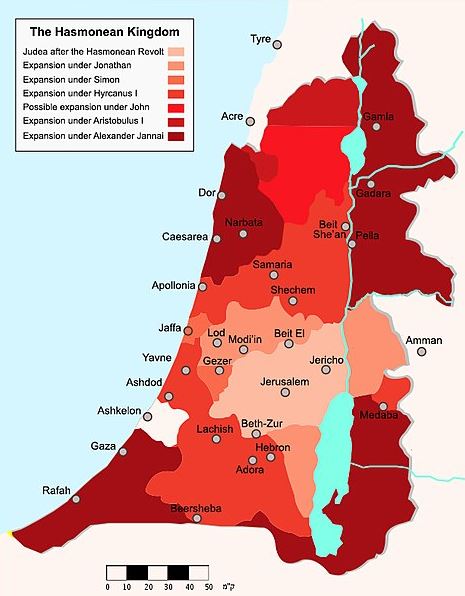
The first Hashmonean to rule was Shimon, one of the five sons of Matityahu. He was the only son to survive the wars with the Seleucid Greeks. He became the kohen gadol (high priest), and took the title of nasi, “leader” or “prince”, though not a king. Despite being a successful ruler, Shimon was soon assassinated along with his two elder sons. His third son, Yochanan, took over as kohen gadol.

Yochanan saw himself as a Greek-style king, and took on the regnal name Hyrcanus. His son, Aristobulus (no longer having a Jewish name at all!) declared himself basileus, the Greek term for a king, after cruelly starving his own mother to death. Aristobulus’ brother, Alexander Jannaeus (known in Jewish texts as Alexander Yannai) was even worse, starting a campaign to persecute rabbis, including his brother-in-law, the great Shimon ben Shetach. Ultimately, Yannai’s righteous wife Salome (Shlomtzion) Alexandra ended the persecution, brought her brother Shimon and other sages back from exile in Egypt, and ushered in a decade of prosperity. It was Salome that re-established the Sanhedrin, opened up a public school system, and mandated the ketubah, a marriage document to protect Jewish brides. After her death, the kingdom fell apart and was soon absorbed by Rome.

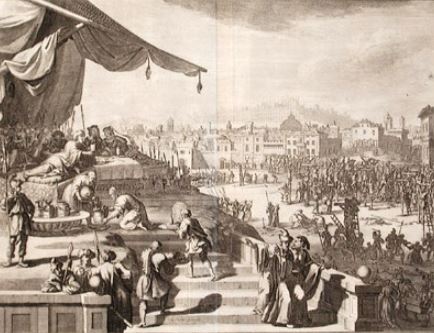
‘Alexander Jannaeus feasting during the crucifixion of the Pharisees’ by Willem Swidde (c. 1690)

Sadducees and Pharisees

While Alexander Yannai was aligned with the Sadducees, Salome Alexandra was, like her brother Shimon ben Shetach, a Pharisee. The Sadducees (Tzdukim) and Pharisees (Perushim) were the two major movements or political parties in Israel at the time. The former only accepted the written Torah as divine, while the latter believed in an Oral Tradition dating back to the revelation at Sinai. Thus, “Rabbinic Judaism” as we know it today is said to have developed from Pharisee Judaism, though this is not quite certain. The Sages of the Talmud didn’t speak so highly of the Pharisees in general, and Judaism also includes key elements from another major group that flourished at the time, the Essenes.

Because the Sadducees only accepted the written Torah, their observance was highly dependent on the Temple and the land of Israel, since most of the Torah is concerned with sacrificial and agricultural laws. When the Romans ultimately destroyed the Temple and the majority of Jews went into exile, Sadducee Judaism simply could not survive. (Later, a similar movement based solely on the written Torah, Karaite Judaism, would develop.) Meanwhile, the Pharisees and their Oral Tradition continued to develop, adapt, and flourish in exile and, together with Essene practices, gave rise to the Judaism of today.

Avot d’Rabbi Natan states that the Sadducees get their name from one Tzadok, a student of the sage Antigonus. Antigonus famously taught (Pirkei Avot 1:3) that one should serve God simply for the sake of serving God, and not in order to receive a reward in the afterlife. It is this teaching that led to Tzadok’s apostasy. Indeed, we know that the Sadducees did not believe in the Resurrection of the Dead or apparently any kind of afterlife at all. This makes sense, since the Sadducees only accepted the Chumash as law, and the Chumash itself never mentions an afterlife explicitly.

In that same first chapter of Pirkei Avot, we read that Antigonus was the student of Shimon haTzadik, the last survivor of the Knesset HaGedolah. Antigonus passed down the tradition to Yose ben Yoezer and Yose ben Yochanan, who passed it down to Yehoshua ben Perachiah and Nitai haArbeli, who passed it down to Shimon ben Shetach and Yehuda ben Tabai. This means that Shimon ben Shetach, brother of Queen Salome Alexandra, lived only three generations after Shimon haTzadik, the last of the Great Assembly. This presents a problem since, according to traditional Jewish dating, the Great Assembly was about 300 years before the rule of Salome. (It is even more problematic according to secular dating, which calculates nearly 500 years!) It is highly unlikely that three generations of consecutive sages could span over 300 years.

The rabbinic tradition really starts with Shimon haTzadik, the earliest sage to be cited in the Talmud. He is said to have received the tradition from the last of the prophets in the Great Assembly, thus tying together the rabbinic period with the Biblical period of prophets. Yet, Shimon haTzadik himself is not called a “rabbi”, and neither is his student Antigonus, or Antigonus’ students, or even Hillel and Shammai. The title “rabban” is later used to refer to the nasi of the Sanhedrin, while the first sages to properly be called “rabbi” are the students of Rabban Yochanan ben Zakkai, the leader at the time of the Temple’s destruction by the Romans.

Despite this, the title “rabbi” is often applied retroactively to earlier sages, including Shimon ben Shetach, Yehoshua ben Perachiah, and others, all the way back to Shimon haTzadik, the first link in the rabbinic chain. Who was Shimon haTzadik?

The Mystery of Shimon haTzadik

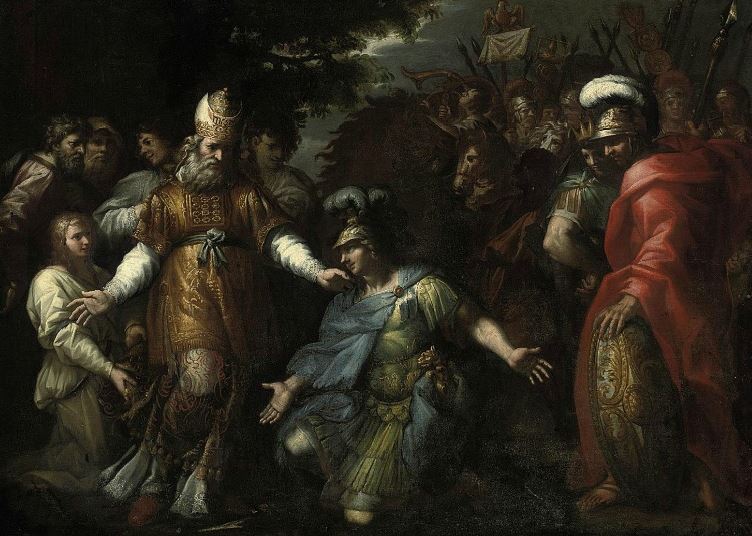
The most famous story of Shimon haTzadik is recounted in the Talmud (Yoma 69a). In this story, Alexander the Great is marching towards Jerusalem, intent on destroying the Temple (due to the activism of a group of Kutim), so Shimon goes out to meet him in his priestly garments (he was the kohen gadol). When Alexander sees him, he halts, gets off his horse, and bows down to the priest. Alexander’s shocked generals ask why he would do such a thing, to which Alexander responds that he would see the face of Shimon before each successful battle.

‘Alexander the Great and Jaddus the High Priest of Jerusalem’ by Pietro da Cortona (1596-1669)

While it is highly doubtful that the egomaniacal Alexander (who had himself declared a god) would ever bow down to anyone, this story is preserved in a number of texts, including that of Josephus, the first-century historian who was an eye-witness to the Temple’s destruction. In Josephus, however, it is not Shimon who meets Alexander, but another priest called Yaddua. Yaddua is actually mentioned in the Tanakh (Nehemiah 12:22), which suggests he was a priest in the days of the Persian emperor Darius. Of course, it was Darius III whom Alexander the Great defeated. It seems Josephus’ account is more accurate historically in this case.

In fact, in Sotah 33a, the Talmud tells another story of Shimon haTzadik, this one during the reign of the Roman emperor Caligula. We know that Caligula reigned between 37 and 41 CE—over three centuries after Alexander the Great! The Talmud thus gives us three different time periods for the life of Shimon haTzadik: a few generations before Shimon ben Shetach, or a few centuries before in the time of Alexander the Great, or centuries after in the time of Caligula. Which is correct?

The First Rabbi

The Book of Maccabees (I, 2:1-2) introduces the five sons of Matityahu in this way:

In those days, Matityahu ben Yochanan ben Shimon, a priest of the descendants of Yoariv, left Jerusalem and settled in Modi’in. He had five sons: Yochanan, called Gaddi; Shimon, called Thassi; Yehuda, called Maccabee; Elazar, called Avaran; and Yonatan, called Apphus.

Each of the five sons of Matityahu has a nickname. The second son, Shimon, is called “Thassi” (or “Tharsi”). This literally means “the wise” or “the righteous”, aka. HaTzadik. It was Shimon who survived the Chanukah wars and re-established an independent Jewish state. In fact, the Book of Maccabees (I, 14:41-46) tells us:

And the Jews and their priests resolved that Shimon should be their leader and high priest forever until a true prophet should appear… And all the people agreed to decree that they should do these things to Shimon, and Shimon accepted them and agreed to be high priest and general and governor of the Jews…

Apparently, Shimon was appointed to lead the Jews by a “great assembly” of sorts, which nominated him and, after his acceptance, decreed that he is the undisputed leader. The Book of Maccabees therefore tells us that Shimon the Maccabee was a righteous and wise sage, a high priest, and leader of Israel that headed an assembly. This is precisely the Talmud’s description of Shimon haTzadik!

Perhaps over time the “great assembly” of Shimon was confused with the Great Assembly of the early Second Temple period. This may be why Pirkei Avot begins by stating that Shimon haTzadik was of the Knesset haGedolah. In terms of chronology, it makes far more sense that Shimon haTzadik was Shimon Thassi—“Simon Maccabeus”—who died in 135 BCE. This fits neatly with Shimon ben Shetach and Salome Alexandra being active a few generations later, in the 60s BCE as the historical record attests. It also makes sense that Shimon haTzadik’s student is Antigonus, who carries a Greek name, just as we saw earlier that following Shimon the leaders of Israel were adopting Greek names.

Thus, of the three main descriptions of Shimon haTzadik in the Talmud, it is the one in Avot that is historically most accurate, and not so much the one in Yoma (where he is placed nearly three centuries before Shimon ben Shetach) or the one in Sotah (where he is in the future Roman era). Thankfully, there is actually one more brief mention of Shimon haTzadik in the Talmud (Megillah 11a) which says Shimon haTzadik was one of the heroes of Chanukah! This is certainly the most accurate reference to the mysterious Shimon haTzadik in the Talmud, and puts him exactly in the right era! This Talmud confirms that Shimon haTzadik was “Shimon Thassi”, the Maccabee.

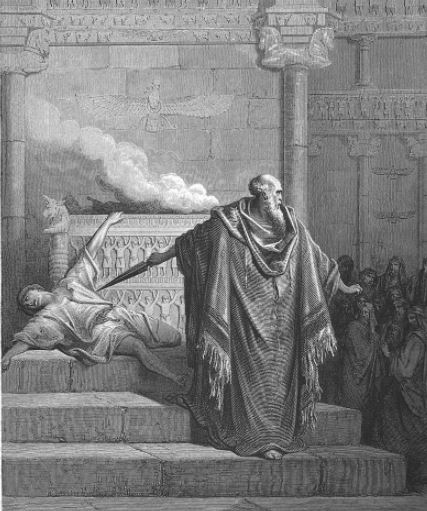
‘Mattathias of Modi’in killing a Jewish apostate’ by Gustav Doré

Lastly, we must not forget that Shimon the Maccabee was one of the instigators of the revolt against the Greeks and their Hellenism. He was the son of Matityahu, a religious, traditional priest, who fled Jerusalem when it was taken over by Hellenizers (as we quoted above, I Maccabees 2:1). Shimon was certainly aligned with the traditional Pharisees, and it was only his grandson Alexander Yannai who turned entirely to the more Hellenized Sadducees and began persecuting the Pharisees. As Rabbinic Judaism came out of Pharisee Judaism, it makes sense that the tradition begins with Shimon the Maccabee, or Simon Thassi, ie. Shimon haTzadik.

Interestingly, the Book of Maccabees states that Matityahu was a descendent of Yoariv. This name is mentioned in the Tanakh. I Chronicles 24:7 lists Yoariv as the head of one of the 24 divisions of kohanim, as established in the days of King David. The same chapter states that Yoariv was himself a descendent of Elazar, the son of Aaron the first kohen. Thus, there is a fairly clear chain of transmission from Aaron, all the way down to Matityahu, and his son Shimon.

Shimon continued to pass down the tradition, not to his son Yochanan—who was swayed by the Greeks and became John Hyrcanus—but to his student Antigonus. (Depending on how one reads Avot, it is possible that Yose ben Yoezer and Yose ben Yochanan were also direct students of Shimon haTzadik.) It appears we have found the historical Shimon haTzadik, and closed the gap on the proper chronology of the Oral Tradition dating back to Sinai.

If this is the case, then Chanukah is a celebration of not only a miraculous victory over the Syrian Greeks, but of the very beginnings of Rabbinic Judaism as we know it, with one of Chanuka’s central heroes being none other than history’s first official rabbi.

Chag sameach!


The above essay is adapted from Garments of Light, Volume Three.
Get the book here! 

Marriage and Prayer: Why They Are the Same, and How to Succeed in Both

This week’s parasha is Toldot, which begins:

And these are the genealogies [toldot] of Isaac, the son of Abraham; Abraham begot Isaac. And Isaac was forty years old when he took Rebecca… for a wife. And Isaac prayed to Hashem opposite his wife, because she was barren, and Hashem accepted his prayer, and Rebecca his wife conceived.

The Torah juxtaposes Isaac’s marriage to Rebecca with Isaac’s successful prayer. One of the Torah’s central principles of interpretation is that when two ideas or passages are placed side by side, there must be an intrinsic connection between them. What is the connection between marriage and prayer?

Another central principle of interpretation is that when a word or concept appears for the first time in the Torah, its context teaches the very epitome of that word or concept. The first time that the word “love” is used between a man and woman in the Torah is with regards to Isaac and Rebecca, and the two thus represent the perfect marital bond (a topic we’ve explored in the past; see: ‘Isaac and Rebecca: the Secret to Perfect Marriage’ in Garments of Light).

So, we see that Isaac and Rebecca were very successful in their love and marriage, and simultaneously very successful in their prayers. In fact, our Sages teach that when the Torah says “Isaac prayed… opposite his wife”, it means that the two prayed together in unison, and some even say they prayed while in a loving embrace, face-to-face, literally “opposite” one another. God immediately answered their prayers. What is the secret of Isaac and Rebecca’s success in love and prayer?

Understanding Prayer

It is commonly (and wrongly) believed that prayer is about asking God for things. Not surprisingly, many people give up on prayer when they feel (wrongly) that God is not answering them, and not fulfilling their heartfelt requests. In reality, prayer is something quite different.

A look through the text of Jewish prayers reveals that there is very little requesting at all. The vast majority of the text is made up of verses of praise, gratitude, and acknowledgement. We incessantly thank God for all that He does for us, and describe over and over again His greatness and kindness. It is only after a long time spent in gratitude and praise that we have the Amidah, when we silently request 19 things from God (and can add some extra personal wishes, too). Following this, we go back to praise and gratitude to conclude the prayers.

Many (rightly) ask: what is the point of this repetitive complimenting of God? Does He really need our flattery? The answer is, of course, no, an infinite God does not need any of it. So why do we do it?

One answer is that it is meant to build within us an appreciation of God; to remind us of all the good that He does for us daily, and to shift our mode of thinking into one of being positive and selfless. Through this, we build a stronger bond with God, and remain appreciative of that relationship.

The exact same is true in marriage. Many go into marriage with the mindset of what they can get out of it. They are in a state of always looking to receive from their spouse. Often, even though they do receive a great deal from their partner, they become accustomed to it, and forget all the good that comes out of being married. They stop appreciating each other so, naturally, the marriage stagnates and the couple drifts apart.

Such a mindset must be altered. The dialogue should be like that of prayer: mostly complimenting, acknowledging, and thanking, with only a little bit of request. The Torah tells us that God created marriage so that man is not alone and has a helper by his side. The Torah says helper, not caretaker. We should appreciate every little bit that our spouses do, for without them in our lives we would be totally alone and would not even have that little bit. The Talmud (Yevamot 62a) tells a famous story of Rabbi Chiya, whose wife constantly tormented him and yet, not only did he not divorce her, but he would always bring her the finest goods. His puzzled students questioned him on this, to which he responded: “It is enough that they rear our children and save us from sin.”

A Kind Word

By switching the dialogue to one of positive words and gratitude, we remain both appreciative of the relationship, and aware of how much good we do receive from our other halves. Moreover, such positive words naturally motivate the spouse to want to do more for us, while constant criticism brings about the very opposite result.

Similarly, our Sages teach that when we constantly praise God and speak positively of Him, it naturally stirs up His mercy, and this has the power to avert even the most severe decrees upon us. We specifically quote this from Jeremiah (31:17-19) in our High Holiday prayers:

I have surely heard Ephraim wailing… Ephraim is my precious child; a child of delight, for as soon as I speak of him, I surely remember him still, and My heart yearns for him. I will surely have compassion for Him—thus said Hashem.

Ephraim is one of the Biblical names for the children of Israel, especially referring to the wayward Israelite tribes of northern Israel. Despite the waywardness, Ephraim’s cries to God spark God’s compassion and love for His people.

A kind, endearing word can go very far in prayer, as in marriage. The same page of Talmud cited above continues to say that Rav Yehudah had a horrible wife, too, yet taught his son that a man “who finds a wife, finds happiness”. His son, Rabbi Isaac, questioned him about this, to which Rav Yehudah said that although Isaac’s mother “was indeed irascible, she could be easily appeased with a kindly word.”

Judging the Self

The Hebrew word for prayer l’hitpalel, literally means “to judge one’s self”. Prayer has a much deeper purpose: it is a time to meditate on one’s inner qualities, both positive and negative, and to do what’s sometimes called a cheshbon nefesh, an “accounting of the soul”. Prayer is meant to be an experience of self-discovery. A person should not just ask things of God, but question why they are asking this of God. Do you really need even more money? What would you do with it? Might it actually have negative consequences rather than positive ones? Would you spend it on another nice car, or donate it to a good cause? Why do you need good health? To have the strength for ever more sins, or so that you can fulfill more mitzvot? Do you want children for your own selfish reasons or, like Hannah, to raise tzadikim that will rectify the world and infuse it with more light and holiness?

Prayer is not simply for stating our requests, but analyzing and understanding them. Through proper prayer, we might come to the conclusion that our requests need to be modified, or sometimes annulled entirely. And when finally making a request, it is important to explain clearly why you need that particular thing, and what good will come out of it.

Central to this entire process is personal growth and self-development. In that meditative state, a person should be able to dig deep into their psyche, find their deepest flaws, and resolve to repair them. In the merit of this, God may grant the person’s request. To paraphrase our Sages (Avot 2:4), when we align our will with God’s will, then our wishes become one with His wishes, and our prayers are immediately fulfilled.

Once more, the same is true in marriage. Each partner must constantly judge their performance, and measure how good of a spouse they have been. What am I doing right and what am I doing wrong? Where can I improve? How can I make my spouse’s life easier today? Where can I be more supportive? What exactly do I need from my spouse and why? In the same way that we are meant to align our will with God’s will, we must also align our will with that of our spouse.

The Torah commands that a husband and wife must “cleave unto each other and become one flesh” (Genesis 2:24). The two halves of this one soul must reunite completely. This is what Isaac and Rebecca did, so much so that they even prayed as one. In fact, Isaac and Rebecca were the first to perfectly fulfil God’s command of becoming one, and this is hinted to in the fact that the gematria of “Isaac” (יצחק) and “Rebecca” (רבקה) is 515, equal to “one flesh” (בשר אחד). More amazing still, 515 is also the value of “prayer” (תפלה). The Torah itself makes it clear that marital union and prayer are intertwined.

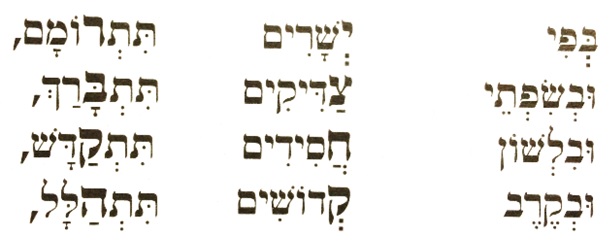
One of the most popular Jewish prayers is “Nishmat Kol Chai”, recited each Shabbat right before the Shema and Amidah. The prayer ends with an acrostic that has the names of Isaac and Rebecca. The names are highlighted to remind us of proper prayer, and that first loving couple which personified it.

Confession

The last major aspect of Jewish prayer is confession. Following the verses of praise and the requests comes vidui, confessing one’s sins and genuinely regretting them. It is important to be honest with ourselves and admit when we are wrong. Among other things, this further instills within us a sense of humility. The Talmud (Sotah 5a) states with regards to a person who has an ego that God declares: “I and he cannot both dwell in the world.” God’s presence cannot be found around a proud person.

In marriage, too, ego has no place. It is of utmost significance to be honest and admit when we make mistakes. It is sometimes said that the three hardest words to utter are “I love you” and “I am sorry”. No matter how hard it might be, these words need to be a regular part of a healthy marriage’s vocabulary.

And more than just saying sorry, confession means being totally open in the relationship. There should not be secrets or surprises. As we say in our prayers, God examines the inner recesses of our hearts, and a couple must likewise know each other’s deepest crevices, for this is what it means to be one. In place of surreptitiousness and cryptic language, there must be a clear channel of communication that is always wide open and free of obstructions.

To summarize, successful prayer requires first and foremost a great deal of positive, praising, grateful language, as does any marriage. Prayer also requires, like marriage, a tremendous amount of self-analysis, self-discovery, and growth. And finally, both prayer and marriage require unfailing honesty, open communication, and forgiveness. In prayer, we make God the centre of our universe. In marriage we make our spouse the centre of our universe. In both, the result is that we ultimately become the centre of their universe, and thus we become, truly, one.