
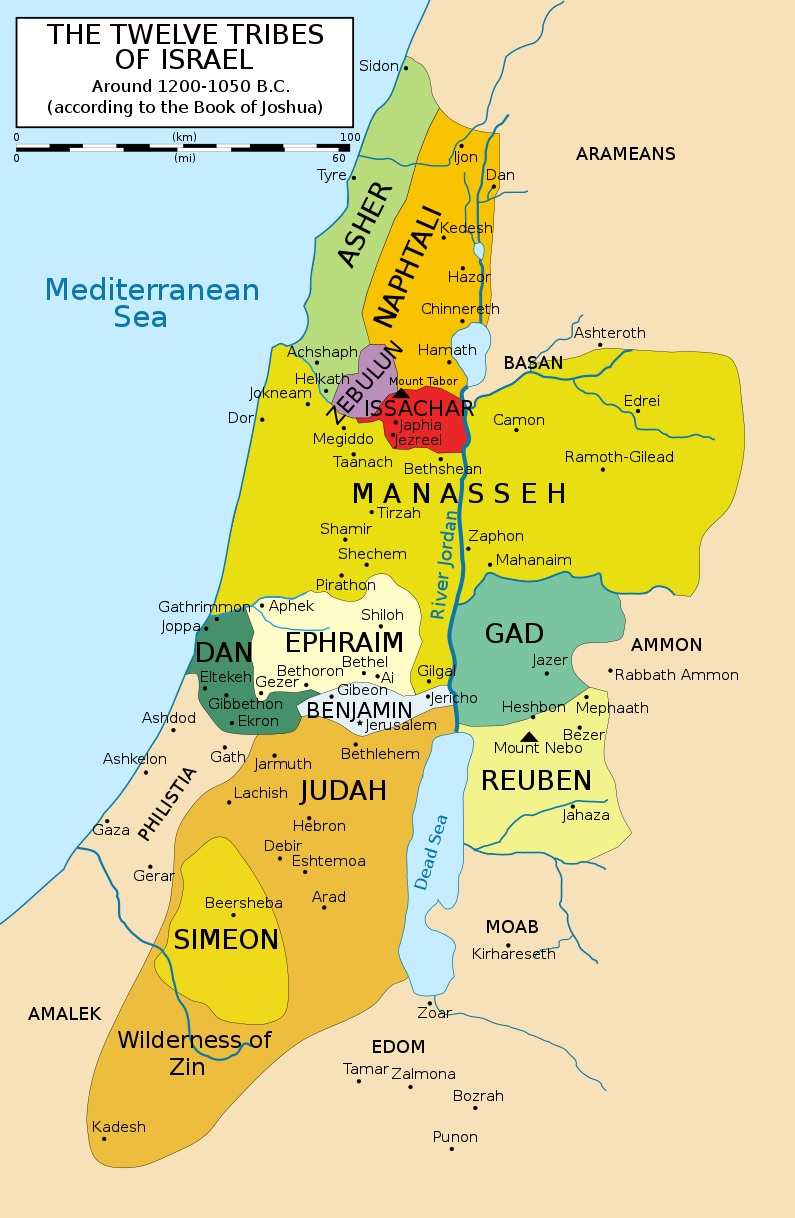
A rough outline of the ancient tribal boundaries of Israel
One of the highlights of this week’s parasha, Ki Tavo, is the instruction for the Twelve Tribes of Israel to split up on two opposing mountains—Gerizim and Eival—to hear a series of curses and blessings. Six of the tribes (Shimon, Levi, Yehudah, Issachar, Yosef, and Binyamin) were on Mount Gerizim, the “mountain of blessing”, and the remaining six (Reuven, Gad, Asher, Zevulun, Dan, and Naphtali) on Mount Eival, the “mountain of curse”. The tribes would later cross the Jordan River and settle across the Holy Land in their allotted territories—with the exception of Reuven, Gad, and half of Menashe, who stayed on the east side of the Jordan.
Centuries later, the tribes split up into two kingdoms: the northern “Kingdom of Israel” or “Kingdom of Ephraim” with ten of the tribes (or more accurately, eleven), and the southern “Kingdom of Judah” that was dominated by the tribe of Yehudah (and its Davidic kings) but also contained a sizeable portion of Binyamin and Shimon. After falling to the Assyrians and Babylonians, the tribal boundaries were erased, and soon tribal affiliations and identities were lost, too. Everyone coalesced into the dominant tribe of Yehudah, and so everyone became a Yehudi. Even Mordechai, who came from the tribe of Benjamin, is identified as a Yehudi in the Purim story.
So, what will happen in the forthcoming Messianic Age when all of Israel will return to their Promised Land and presumably re-establish the ancient tribal borders? How will we see the “return” of all the tribes, when there are no clear tribal affiliations anymore? One possibility is that we actually won’t have tribal borders again, a case one can make based on Ezekiel 37 where God describes fusing together the branches of Yosef and Yehudah and making them one branch. Hashem declares: “I am going to take the children of Israel from among the nations they have gone to, and gather them from every quarter, and bring them to their own land. I will make them a single nation in the land, on the hills of Israel, and one king shall be king of them all. Never again shall they be two nations, and never again shall they be divided into two kingdoms.” (v. 21-22) The implication is that Israel will be a singular nation, with no internal divisions or boundaries, ruled by one king.
Another intriguing possibility is to apply the ancient tribal divisions to the various “tribes” within the house of Israel today. We might be able to associate each of the tribes with the modern-day communities that we find within the Jewish people. If we explore the history, culture, and symbolism of the various groups among us today, we find striking similarities to the ancient tribes. What I would like to suggest in the following is a modern-day recreation of the Twelve Tribes of Israel—not genealogical or biological, but spiritual and symbolic. This would be similar to the way we refer to other peoples of the world:
For example, we refer to all Christians as being part of “Edom”, even though the vast majority of them are not literal descendants of Esau. We refer to all Muslims as “Ishmael”, even though the vast majority of them are not direct descendants of Ishmael, and many are not even Arab at all, including major Muslim communities in Iran, Pakistan, and Indonesia (the world’s most populous Muslim nation). We find Amalek manifest in different peoples of the world who seek the destruction of Israel, even though they are not direct descendants of the ancient Amalek himself. We recognize that the physical aspect is secondary to the spiritual anyway, and entities of times past continue to exist today even without a clear genealogical or biological link. The same can be said for the Twelve Tribes. So, who might the Twelve Tribes be today?
[Warning: what follows is admittedly speculative, and mostly based on symbolic meaning. We live in a generation where identity is a very sensitive topic, so I hope no one is offended or feels “miscategorized”!] Continue reading