Tag Archives: Second Temple

Secrets of Rosh Hashanah

This first of this week’s two Torah portions, Nitzavim, is always read right before Rosh Hashanah, and appropriately begins: “You are all standing today before Hashem, your God…” The verse has traditionally been seen as an allusion to Rosh Hashanah, when each person stands before God and is judged. The Torah says today, implying one day, yet everyone celebrates Rosh Hashanah over two days. This is true even in Israel, where yom tovs are typically observed for only one day.

The reason for this is because in ancient times there was no set calendar, so a new month was declared based on the testimony of two witnesses. Once the new month was declared in Jerusalem, messengers were sent out to inform the rest of the communities in the Holy Land, and beyond. Communities that were far from Israel would not receive the message until two or three weeks later, so they would often have to observe the holidays based on their own (doubtful) opinion of when the holiday should be. They therefore kept each yom tov for two days.

Rosh Hashanah, however, is the only holiday that takes place on the very first day of the month, so as soon as the new month of Tishrei was declared, it was immediately Rosh Hashanah, and messengers could not be sent out! Thus, even communities across Israel would observe the holiday for two days, based on their own observations.

Although today we have a set calendar, and there is no longer a declaration of a new month based on witnesses, two days are still observed since established traditions become permanent laws. Of course, this is only the simplest of explanations, for there are certainly deeper reasons in observing two days, especially when it comes to Rosh Hashanah.

Judgement in Eden

Rosh Hashanah commemorates the day that God fashioned Adam and Eve. On that same day, the first couple consumed the Forbidden Fruit, were judged, and banished from the Garden of Eden. Originally, they had been made immortal. Now, they had brought death into the world, and God decreed that their earthly life would have an end. Adam and Eve were, not surprisingly, the first people to be inscribed in the Book of Death. Each year since, on the anniversary of man’s creation and judgement, every single human being (Jewish or not) is judged in the Heavenly Court, and inscribed in the Book of Life, or the Book of Death.

This is the idea behind the symbolic consumption of apples in honey. In Jewish tradition, the Garden of Eden is likened to an apple orchard, with the scent of the air in Eden being like that of apples. (Having said that, it is not a Jewish tradition that the Forbidden Fruit itself was an apple!) The apple reminds us of the Garden—of Adam and Eve and their judgement—and we dip it in honey so that our judgement should be sweet.

But what happens when Rosh Hashanah falls on Shabbat? It is well-known that there is no judgement on Shabbat. The Heavenly Court rests, and even the souls in Gehinnom are said to have a day off. This is illustrated by a famous exchange in the Talmud (Sanhedrin 65b) between Rabbi Akiva and the Roman governor of Judea at the time, Turnus Rufus:

Turnus Rufus asked Rabbi Akiva: “How does [Shabbat] differ from any other day?”
He replied: “How does one official differ from another?”
“Because my lord [the Roman Emperor], wishes it so.”
Rabbi Akiva said: “the Sabbath, too, is distinguished because the Lord wishes it so.”
He asked: “How do you know that this day is the Sabbath?”
[Rabbi Akiva] answered: “The River Sambation proves it; the ba’al ov proves it; your father’s grave proves it, as no smoke ascends from it on Shabbat.”
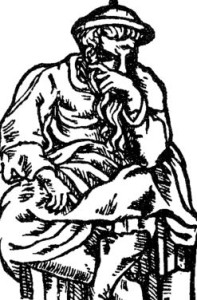
An illustration of Rabbi Akiva from the Mantua Haggadah of 1568

Rufus asks Rabbi Akiva how the Jews are certain that the Sabbath that they keep is actually the correct seventh day since Creation. Rabbi Akiva brings three proofs:

The first is a legendary river called the Sambation (or Sabbation), which was known in those days, and which raged the entire week, but flowed calmly only on Shabbat. The second proof is that people who summon the dead from the afterlife (practicing a form of witchcraft called ov) are unable to channel the dead on Shabbat. (I know of a person who was once involved in such dark arts and became a religious Jew after realizing that he was never able to summon spirits on the Sabbath or on Jewish holidays!) Lastly, Rabbi Akiva notes how Turnus Rufus’ own father’s grave would emit smoke every day of the week, except on Shabbat. This is because the soul of Rufus’ wicked father was in Gehinnom, but all souls in that purgatory get a reprieve on Shabbat. (Historical sources suggest that Rufus’ father was Terentius Rufus, one of the generals involved in the destruction of the Second Temple.)

Based on this, we can understand why Rosh Hashanah must be observed over two days. When the holiday falls on Shabbat, no judgement can take place, so the judgement is pushed off to the next day. This is also related to the fact that when Rosh Hashanah falls on Shabbat, the shofar is not blown. This is not at all because blowing a shofar is forbidden on Shabbat, which is, in fact, permitted.

The simple explanation given for this is that we’re worried the person blowing the shofar might carry it to the synagogue (in a place without an eruv), and carrying is forbidden on Shabbat. The deeper reason is this: Blowing the shofar is supposed to “confound Satan”. Satan is not the trident-carrying, horned demon of the underworld (as popularly believed in Christianity). Rather, Satan literally means the “one who opposes” or the “prosecutor”. It is Satan’s job to serve as the prosecution in the Heavenly Court. The shofar’s blow confuses Satan, and prevents him from working too much against us. On Shabbat, the Heavenly Court rests, and Satan is having a day off, so there is no need to confound him!

The First Shabbat

One might argue that Rosh Hashanah should only be two days long when it falls on Shabbat; in other years, one day would suffice. Other than the fact that this would be confusing—as the holiday would span different lengths in different years—there are other explanations for the two days, including that each day involves different types of judgement (for example, one day for sins bein adam l’Makom, between man and God; and one day for bein adam l’havero, between man and his fellow). Nonetheless, our Sages still describe Rosh Hashanah as really being one day—one unique, extra-long, 48-hour day which our Sages called yoma arichta, literally the “long day”. Perhaps this is another reason for the custom of not sleeping on the “first night” of Rosh Hashanah. (The other reason: how could anyone possibly sleep through their own trial?)

Finally, the story of Rabbi Akiva and Turnus Rufus gives us one more reason to commemorate Rosh Hashanah over two days. Rufus questioned Rabbi Akiva on how he can be so sure that the Sabbath which he keeps is indeed the correct seventh day going back to Creation. If Rosh Hashanah is the day Adam and Eve were created, then it corresponds to the sixth day of Creation. That means the very next day was the seventh day of Creation, and that the second day of Rosh Hashanah always commemorates the very first Sabbath. When we celebrate on the second day of Rosh Hashanah, we mark Adam and Eve’s first Shabbat, and recognize that each seventh day has been observed ever since, and will continue to be observed for another, 5778th upcoming year.

Shana Tova u’Metuka!
The Mysterious Urim and Thummim, and the Dome of the Rock

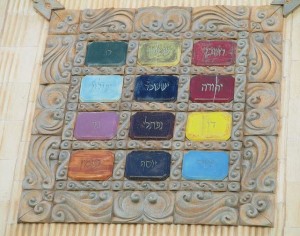
Modern Rendition of the Choshen, the High Priest’s Breastplate

This week’s Torah portion is Tetzave, which focuses on the holy vestments worn by the Kohen Gadol, the High Priest. Perhaps the most enigmatic of these vestments is the choshen hamishpat, the “breastplate of judgement”. This breastplate was embedded with twelve different precious stones, each symbolizing one of the Twelve Tribes. Housed within the breastplate were the Urim v’Tumim, mysterious objects whose nature has been speculated upon for centuries.

The Torah itself does not elaborate on what the Urim and Tumim are. The Talmud (Yoma 21b) states that they were one of the five things that were in the First Temple but missing in the Second Temple. Many believe that these were a couple of stones used to communicate with God. Unseen and unused for some two and a half millennia, it isn’t surprising that the Urim and Tumim are clouded in mystery.

Guilty or Innocent?

Some scholars see urim rooted in the root arur, “cursed”, and tumim from tam, “innocent”. Thus, these stones were used to figure out if a person was guilty or innocent, or if a certain decision was right or wrong. We read in I Samuel 14:36-44 how King Saul debated whether to pursue the Philistines in battle or not, so the High Priest addressed the question to God. God does not respond, so Saul concludes there must be a guilty person among them causing God to turn away. He then separates the people into groups to see which group contains the guilty party. It turns out that it is Saul’s son Jonathan who erred. This passage highlights the use of Urim and Tumim in divine communication, both in finding whether an action is right or wrong, and in determining guilt and innocence.

How did the stones communicate this? The word urim can mean “lights”, so it is thought that the stones glowed: one stone for yes/innocent, and the other for no/guilty. Others hold that the Urim and Tumim gave power to the Breastplate itself, causing the letters engraved upon it to glow. Each of the twelve stones on the Breastplate was engraved with the name of the corresponding tribe. However, the twelve names do not include all twenty-two letters of the Hebrew alphabet! The missing letters—Chet, Tet, Tzadi, Kuf—are in the names of the patriarchs, which were also engraved onto the plate, together with the phrase shivtei yeshurun, “Tribes of Jeshurun”. (Jeshurun was an ancient name for Israel.)

Interestingly, Rabbi Chaim Vital writes that this is how the Arizal could “read” people’s faces, by seeing a sort of Breastplate on their forehead. In Sha’ar Ruach HaKodesh, he explains that each person’s forehead has the twenty-two letters mystically engraved upon it, and the letters glow allowing the adept to penetrate into one’s soul and fortune. Each letter symbolizes different things. If no letters at all are shining, the person is nearing their death!

The Foundation Stone

Meanwhile, Targum Yonatan comments (on Exodus 28:30) that the Urim and Tumim were themselves inscribed with the alphabet, through a mystical name of God—“the name through which He created all three hundred and ten worlds”. Again, the letters would glow in sequence to provide the answer to one’s question. Targum Yonatan appears to suggest that the Urim and Tumim were special stones formed from the great Even HaShetiya, the Foundation Stone. According to tradition, this is the Stone from which Creation began, some seeing it is the very centre of the universe. Targum Yonatan says the Foundation Stone was placed by God to “seal up the mouth of the great deep at the beginning”.

This refers to the account of Creation, where it is stated at the beginning that everything was “chaos and void, with darkness upon the deep” (Genesis 1:2) before God said, “Let there be light.” Looking at these verses carefully, we see that the Torah uses the word tehom for the great deep, before the introduction of light, or. It isn’t difficult to see a connection between or v’tehom and urim v’tumim. The Urim and Tumim are meant to be conduits for communicating with the Divine, while the Foundation Stone has traditionally been seen as the very link between the Heavens and Earth.

Where is this Foundation Stone? The Talmud (Yoma 53b) tells us that the Even Shetiya is precisely the site of the Holy of Holies, the inner sanctum of the Temple, where the High Priest entered just once a year on Yom Kippur. The Stone served as the foundation for the Ark of the Covenant. The Ark, too, was a means of Divine Communication, with a Heavenly Voice emanating from between the Cherubs on the Ark’s Cover. We therefore see a link between the Ark and the Urim v’Tumim. The Talmud tells us that both the Ark and the Urim were missing in the Second Temple, together with the Shekhina and the spirit of prophecy. In short, the Second Temple era was devoid of any real divine communication.

The Dome of the Rock

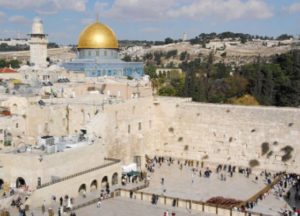
The Dome of the Rock and the Western Wall. Some believe the Temple was located right in front of the Wall, in the forested area pictured above.

So, what stood instead of the Ark in the Holy of Holies of the Second Temple? The Foundation Stone! It protruded “three fingers above the ground” and it is on this Stone that the High Priest would place the burning coals and incense on Yom Kippur (Yoma 53b). It is atop this Stone that the Muslims built the famous gold-topped Dome of the Rock (hence the name).

The Rabbis debate whether the Rock inside the Dome really is the Foundation Stone or not. The Arizal is among those who believed it is not, suggesting instead that the Temple was built right in front of where the Western Wall is today. Meanwhile, the Radbaz and Rav Ovadia of Bartenura maintained that it is indeed the Stone. They are supported by an ancient Midrash which prophesies that the Ishmaelites will do fifteen things in Israel, one of which is building a shrine atop the Holy of Holies (Pirkei d’Rabbi Eliezer, ch. 30). The midrashic passage concludes by presciently saying the Ishmaelites will instigate three great wars at the end: one in Arab lands, one in the Sea, and one in the West. It is in the midst of these wars that Mashiach will come.

A picture from beneath the Rock, the area known as the “Well of Souls”

When that time comes, the Ark of the Covenant—which many believe is currently hidden under the Foundation Stone—will be restored, together with the Priestly Vestments. In light of the fact that we are now quite clearly living out the final verses of that midrashic passage, it seems we shall soon be able to finally unravel the mystery of the Urim v’Tumim.


The above article is adapted from Garments of Light: 70 Illuminating Essays on the Weekly Torah Portion and Holidays. Click here to get the book! 

Tisha B’Av: Why Are We Still Mourning?

This week’s Torah portion is Devarim, which begins the fifth and final book of the Torah. This book (Deuteronomy), is written from the perspective of Moses, and summarizes much of what the Torah discussed earlier. At the same time, it also introduces many new mitzvot, and reveals deeper insights into the Torah’s previous narratives. For example, while the book of Numbers told us that Moses was forbidden to enter the Holy Land because he disobeyed God in striking the rock, here we are told that Moses was forbidden to enter the Land because of the incident of the Spies! (1:22-38) How do we reconcile these differences? The answer can actually be found in next week’s parasha, Va’etchanan.

Va’etchanan (literally “and I beseeched”) describes how Moses begged God to allow him to enter the Holy Land. The Talmud (Berachot 32b) states that Moses prayed so much that God actually relented and forgave him for striking the rock. However, it would have been wrong for Moses to enter the Holy Land at that time, considering that the rest of the men were condemned to perish in the Wilderness because of the sin of the spies. After all, Moses was their leader. Could a shepherd abandon his flock? Would a captain abandon his sinking ship? So, Moses didn’t enter the land not because of the rock, but because of the spies.

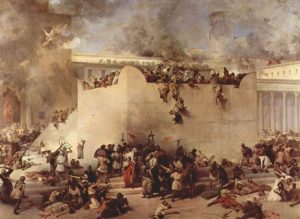
'Destruction of the Temple of Jerusalem' by Francesco Hayez (1867)

‘Destruction of the Temple of Jerusalem’ by Francesco Hayez (1867)

This is all the more pertinent now with Tisha B’Av right around the corner. Tisha B’Av commemorates the destruction of both Holy Temples in Jerusalem, along with a handful of other tragedies said to have happened on, or around, that date – the ninth of the month of Av. According to tradition, the origins of Tisha B’Av lie in the incident of the spies. It was on that day that the spies returned from the land of Israel, and reported negatively about the people’s chances of conquering the land. The faithless nation feared and cried needlessly on that day so, it is said, God subsequently gave the nation many good reasons to truly fear and cry on that day throughout history.

The Problem with the 9th of Av

There are many problems with this classic narrative. First of all, why would God punish generations far in the future for the sins of that one generation long ago? Deuteronomy 24:16 itself states clearly that “Parents shall not be put to death because of their children, nor children because of their parents. Each person shall be put to death for their own crime.” While the Torah does also mention a number of times that God “carries over the iniquity of the fathers onto the children to the third and fourth generations”, the phrase concludes by saying this is only true to those that “hate Him”. In any case, it is only to the third and fourth generations, not millennia into the future! Even so, the Talmud (Makkot 24a) says the prophet Ezekiel came and repealed this divine decree anyway:

Said Rabbi Yose bar Chanina, “Moses pronounced four decrees upon Israel, which four prophets came and cancelled.”
…Moses said, “carries over the iniquity of the fathers onto the children…” (Exodus 34:7) Ezekiel came and cancelled it: “The one who sins will die.” (Ezekiel 18:14)

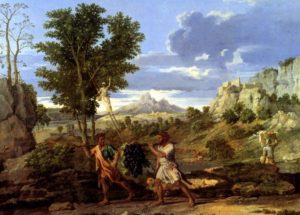
'The Spies With The Grapes Of The Promised Land' by Nicolas Poussin (1664)

‘The Spies With The Grapes Of The Promised Land’ by Nicolas Poussin (1664)

Second of all, did the spies really return on the 9th of Av? The Talmud (Ta’anit 29a) calculates that the spies went forth on the 29th of Sivan and returned forty days later on the 9th of Av. However, the Torah tells us that the spies went to Israel at the start of the grape harvest (Numbers 13:20) and the same tractate of Talmud (Ta’anit 30b) states that the grape harvest season lasted from the 15th of Av until Yom Kippur! How could the spies have returned on the 9th of Av when the grape harvest only began on the 15th? (A simple Google search reveals that the ideal time for grape harvest is September-October, which is right between the 15th of Av and Yom Kippur.)

On the same note, when exactly were the Temples destroyed? The Tanakh tells us that “in the fifth month, on the seventh day of the month, which was the nineteenth year of King Nebuchadnezzar, king of Babylon, came Nebuzaradan, the captain of the guard, a servant of the king of Babylon, to Jerusalem. And he burned the house of Hashem, and the king’s house…” (II Kings 25:8-9) This verse suggests the First Temple was destroyed on the 7th of Av.

Another verse in the Tanakh tells us that “in the fifth month, in the tenth day of the month, which was the nineteenth year of King Nebuchadnezzar, king of Babylon, came Nebuzaradan, the captain of the guard, who stood before the king of Babylon, to Jerusalem; and he burned the house of Hashem, and the king’s house…” (Jeremiah 52:12-13) The verse is nearly identical, except that this one says Nebuzaradan came on the 10th and destroyed the Temple.

We have the 7th of Av and the 10th of Av, but no 9th! The Talmud (Ta’anit 29a) notes this contradiction and tries to reconcile it this way: “On the seventh the heathens entered the Temple and ate therein and desecrated it throughout the seventh and eighth, and towards dusk of the ninth they set fire to it and it continued to burn the whole of that day [the tenth].” Rabbi Yochanan goes on to say that if it were up to him, the mourning day would be the 10th of Av, not the 9th, since this is when the Temple was mostly destroyed.

And what about the Second Temple? Josephus lived through its destruction, and later wrote about it in detail. He says that it was destroyed on the 10th of Av, and writes that the Jews mourn its destruction on the same day that they mourn the destruction of the First Temple. However, he seems to admit that he is uncertain about the exact dates that the Temples fell.

What does the Talmud say? It, too, is uncertain, but concludes that since “good things tend to happen on good days, and bad things on bad days,” it is assumed that the Second Temple was destroyed on the same day as the First Temple!

Postponing, Abolishing, or Redefining?

This year, Tisha B’Av falls on Shabbat, so the fast is postponed, appropriately, to the 10th. While Rabbi Yochanan felt that the 10th is the correct day to fast anyway, Rabbi Yehudah HaNasi – the great redactor of the Mishnah – wanted to have the fast of Tisha B’Av abolished completely! Some say this was only when Tisha B’Av falls on Shabbat and needs to be postponed, while others say he wanted it gone entirely (Megillah 5b).

This idea has been echoed in modern times. The primary reason for mourning on Tisha B’Av is because of Jerusalem’s destruction and the Jewish people’s exile. Today, the Jewish people have returned to the Holy Land and have rebuilt Jerusalem. While there’s no Temple just yet, we are free to travel to, and settle in, the Holy City whenever we wish. Why are we still mourning?

Perhaps Rabbi Yehudah felt the same way. In his day, Jews had also returned to Jerusalem and enjoyed relatively good terms with the Romans. Rabbi Yehudah himself was friends with the Caesar known in the Talmud as ‘Antoninus’ (possibly the Emperor Marcus Aurelius, or maybe a local Roman governor).

Meanwhile, far worse tragedies have befallen the Jewish people since then: crusades, inquisitions, pogroms, the Holocaust, and the list goes on. Why focus on the temples and Jerusalem when there are more recent, greater tragedies? Indeed, former Israeli Prime Minister Menachem Begin intended to combine all the days of commemoration, and move Holocaust Remembrance Day and Israel’s Memorial Day to Tisha B’Av.

Perhaps this is what Tisha B’Av should be: one day to remember all of the suffering that has troubled the Jewish people, and all the suffering that continues to plague the world. A day to remind us that Mashiach has not come yet, the Temple is not yet rebuilt, and the world is not yet whole. A day to ask ourselves: what exactly are we doing to hasten the arrival of that magnificent, forthcoming time? What are we doing that will finally put an end to all the mourning? Tisha B’Av should be a day not about drowning in the sad tears of the past, but about actively working towards the happy tears of the future.

And this is precisely what Rabbi Akiva told his colleagues when they saw the ruins of the Temple. While Rabban Gamliel, Rabbi Elazar ben Azariah, and Rabbi Yehoshua ben Chananiah immediately fell into a bout of weeping, Rabbi Akiva was laughing. Surprised, they asked him to explain himself. He told them that while they were dwelling on the destruction of the first and second temples, he was dwelling on the vision of the coming Third Temple. The rabbis responded – and with this the tractate ends – “Akiva, you have consoled us! Akiva, you have consoled us!”