
Tag Archives: Spanish Expulsion

Mysteries of Shemini Atzeret & Simchat Torah

Tonight we usher in Shemini Atzeret, the final “eighth” day following Sukkot, which is technically a distinct holiday of its own. In the diaspora—where we keep two days of yom tov—the second day of Shemini Atzeret is Simchat Torah, when we start a new Torah reading cycle with a big celebration. In Israel—where one yom tov is observed—Simchat Torah and Shemini Atzeret are on the same day. The Torah does not actually say what the purpose of Shemini Atzeret is, and why it is distinct from Sukkot. Simchat Torah is not mentioned in the Torah at all! What is the real meaning behind these mysterious festivals?
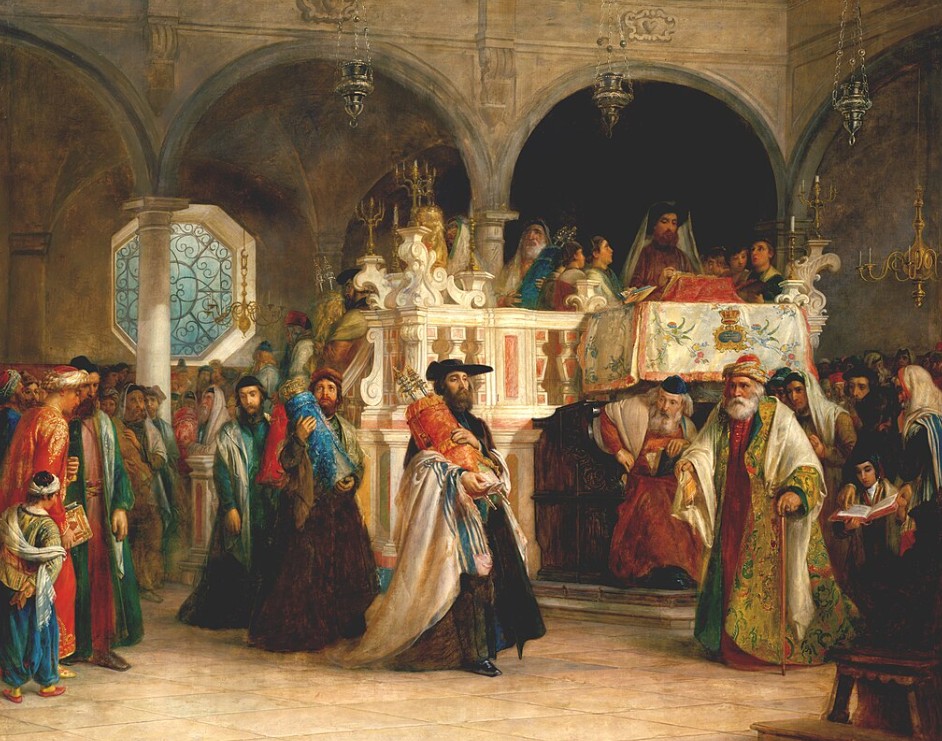
‘The Feast of the Rejoicing of the Law at the Synagogue in Livorno’ by Solomon Hart (1850)

The Torah itself only tells us that we should have one extra holiday after Sukkot, a yom tov in which we should not do any work and in which we should bring offerings to Hashem (Leviticus 23:36, 39). Commenting on this, Rashi famously cites our Sages and quotes God saying “‘I keep you back with Me [atzarti] one more day’—like a king who invited his children to a banquet for a certain number of days. When the time arrived for them to leave, he said, ‘Children, I beg you, please stay one more day with me; it is so hard for me to part from you!’” The Zohar adds to this a beautiful explanation:

As discussed in the recent class here, Sukkot is a holiday envisioning the future, not commemorating the past. The prophet Zechariah tells us (in chapter 14) that in the forthcoming Messianic age, all the nations of the world will come to Jerusalem to celebrate Sukkot with us. Sukkot will become an international festival! And so, the Zohar says, once all the nations of the world leave following seven days of Sukkot in Jerusalem, only the Jewish people will remain for one more day of celebration just for us—Shemini Atzeret. That’s why the Torah says atzeret tihyeh lakhem, “it shall be an atzeret for you” (Numbers 29:35), meaning specifically for the people of Israel and not the other nations of the world who will come to celebrate Sukkot! (See Zohar I, 64a)

But why is this particular date special? What happened in history on Shemini Atzeret to make it a holiday to begin with?

Secrets from Jubilees

The ancient (apocryphal) Book of Jubilees provides an incredible origin to Shemini Atzeret. Recall that Jubilees was excluded from the Tanakh by most Jewish communities (although it was included in the Ethiopian Tanakh and in the ancient Essene Tanakh, and many copies have been found among the Dead Sea Scrolls). Nonetheless, it was always studied and referenced throughout history, and many parallel passages are found in our Midrashim (for more on this, see here).

The setup for Shemini Atzeret begins in Chapter 31 of Jubilees, where we read how Jacob destroyed all the idols in his household (paralleling Genesis 35:2). Jubilees says that it was here that Rachel told her husband about the teraphim she took from Lavan, and handed them over to Jacob to be destroyed. Jacob then finally goes to visit his parents after decades away from them. Instead of taking his entire big family on the journey, he decides to bring only his sons Levi and Judah. Isaac and Rebecca give these two grandsons special blessings, and Isaac gives Levi a blessing to be priestly and Judah to be royal. This is Jubilees’ explanation for why later in history the tribe of Levi would become priests and the tribe of Judah would give rise to the line of kings. It also explains why these are the two tribes that survived throughout history, to this day, while the other tribal lineages have been lost.

In Chapter 32, Jacob fulfils his promise to tithe everything he has to Hashem—and that includes his children! So he lines them all up and counts from the youngest up, the tenth being Levi. Thus, Levi is chosen to be the “tithe”, and to dedicate his life to Hashem. Levi has a dream where God confirms that he will be the family priest. He then builds an altar and begins his work of sacrificial offerings. The family has a seven-day celebration, going out into the fields and dwelling in booths. According to Jubilees, this is the original Sukkot!

On the eighth day, after the seven-day Sukkot is over, Hashem appears to Jacob again. This is where He affirms that “You shall be called Jacob no more, but Israel shall be your name” (Genesis 35:10). The following verses in the Torah tell us that God blesses Jacob to be fruitful, and promises to Jacob the Holy Land, and tells him that nations and kings will emerge from him. This special day is Shemini Atzeret! Fittingly, Jubilees adds that God then reveals to Jacob all the things that will happen in the End of Days, engraved upon seven tablets. Again, we see the link between Sukkot-Shemini Atzeret and the End of Days, the holiday being more about envisioning the future then commemorating the past.

In this way, Jubilees shows how Jacob celebrated Sukkot and Shemini Atzeret long before Sinai, confirming our Sages statement that the Patriarchs observed the whole Torah and marked all the holidays—even though their lives pre-dated Sinai and they did not have a physical Torah in their hands.

What about Simchat Torah? There is no explicit mention of it in Tanakh, and not in Mishnah or Talmud (and not in Jubilees either). This is a much more recent holiday. Where did it come from, and why?

Celebrating the Torah

In olden times, the Torah was typically read over the course of not one year, but three years. (Earlier still, in Biblical times, it was read publicly over the course of seven years—more on that below.) It was in the Persian Empire that the Babylonian sages sped up the cycle to read the whole Torah once a year (see Megillah 29b). Even as late as the Rambam (Rabbi Moshe ben Maimon, 1138-1204), he writes in the Mishneh Torah that there were still some minority communities who followed a three-year cycle, although it had become nearly universal to follow a one-year cycle (Hilkhot Tefillah 13:1). The Rambam codifies that the Torah begins anew with parashat Beresheet on the Shabbat following Sukkot. He then states that it was Ezra the Scribe who instituted the yearly cycle. There is no contradiction here, because Ezra came to Israel from Babylon.

Why start with Beresheet in the fall? Why not in Nisan, which is the first month of the Jewish calendar? This goes back to the debate between Rabbi Eliezer and Rabbi Yehoshua on when Creation took place (Rosh Hashanah 10b-11a). The former said that Creation took place in Tishrei, while the latter argued it took place in Nisan. Rabbi Eliezer brings multiple proofs for his position, including the fact that the Torah states there had not yet been precipitation and then God “raised a mist” and made it rain before creating Adam (Genesis 2:5-6). So, the creation of Adam is clearly tied to the start of the rainy season, meaning Creation must have been in Tishrei!

Another proof is that the Torah says God created every species in its mature, adult form, including trees already containing fruits on their branches. When do find that trees are full of fruit and ready for harvest? In Tishrei! (Sukkot marks the final fruit harvest of the year.) Thus, it is fitting to read Beresheet in the fall, since the Torah begins with a description of a divine spirit “hovering over the waters”, the separation of upper and lower waters and establishment of the water cycle, the first rains, and trees full of fruit. And by the Rambam’s time, the yearly Torah-reading cycle had become essentially universal. However, the Rambam does not mention Simchat Torah.

Some four hundred years later, the Shulchan Arukh (in Orach Chaim 669) does mention Simchat Torah, but very briefly. The way Rav Yosef Karo (c. 1488-1575) phrases it makes it seem like it’s only outside of Israel—where people have to keep two yom tovs—that the second yom tov is called Simchat Torah. The Ashkenazi gloss of the Rama (Rabbi Moshe Isserles, 1530-1572) adds the details that we are familiar with: to remove all the Torah scrolls from the ark and have a big celebration, with hakafot, song and dance, and aliyot for all. The Rama’s language suggests this was the practice specifically in European lands. He cites the Arba’ah Turim of Rabbi Yakov ben Asher (“Ba’al haTurim”, c. 1269-1343) who explicitly says it was “the custom in Ashkenaz” to hold a big celebration and feast in honour of the completion of the Torah reading cycle and the start of a new one. The Ba’al haTurim was born in Ashkenaz but moved with his family to Spain around the year 1300, and became a rabbi among Sephardim. It could well be that his family of Ashkenazi rabbis introduced Simchat Torah to the Sephardic world. By the time of the great Abarbanel (1437-1508)—who was advisor to the Spanish crown and was given an exemption from the Spanish Expulsion, but famously chose to leave with his people—we see that Simchat Torah was observed in Spain, too, and Abarbanel explains (in his commentary on Deuteronomy 31:9):

It is written that each and every year, the high priest or the prophet or judge or gadol hador would read on Sukkot a portion of Torah, and would conclude reading the books of Genesis, Exodus, Leviticus, and Numbers over the course of six years, and then in the seventh year (the Sabbatical), the king would read on Sukkot the book of Deuteronomy, and would complete the Torah. Thus, the custom has remained until our days, that on the eighth day festival, Shemini Atzeret, on the last day we have Simchat Torah, on which we complete the Torah…

Rav Yosef Karo himself was born in Spain, and ultimately settled in Tzfat where he was the chief rabbi. His contemporary was the great Arizal (Rabbi Isaac Luria, 1534-1572), who lived out his final years in Tzfat and revolutionized Judaism with his mystical teachings. The Arizal had an Ashkenazi father and a Mizrachi mother, and was raised in Egypt by his uncle, studying under great rabbis like the Radbaz (Rabbi David ben Solomon ibn Zimra, 1479-1573, also born in Spain). The Arizal played a big role in fusing together Sephardic, Mizrachi, and Ashkenazi practices. He revealed various mystical meditations on Simchat Torah, and particularly on the hakafot. And so, from Tzfat, Simchat Torah spread to the Mizrachi world as well, and it soon become universal to hold a big Simchat Torah celebration—with the additional details and practices mentioned by the Ba’al haTurim and Rama that first originated in Ashkenaz.

Celebrating the Tree of Life

We can now clearly piece together the evolution of Simchat Torah. It officially began in Central Europe. The first explicit mention of the term “Simchat Torah” appears to be in the 11th century Machzor Vitry, written by Rav Simcha of Vitry, France, a student of Rashi. Simchat Torah might trace back to an earlier custom among the Geonim to have a big celebration upon completion of the Torah-reading cycle. The Rambam, who came from a long line of Sephardic rabbis, does not mention Simchat Torah in the 12th century, but the Sephardi gadol Abarbanel does speak of it in the 15th century, meaning it was adopted among Sephardim at some point in those intervening three centuries. It may have been due to the Ba’al haTurim’s family who immigrated from Ashkenaz to Sepharad around the end of the 13th century.

At the same time, in 1290 CE, came the first publication of the Zohar, in Spain. The Zohar (III, 97a) does mention Simchat Torah, calling it by its Aramaic name Hedvata d’Oraita (which is likely what it would have originally been called among the Babylonian Geonim). The Zohar gives a beautiful explanation as to why we celebrate with the Torah specifically on Shemini Atzeret. As noted above, Shemini Atzeret is the festival that is only for Israel, once all the nations of the world leave after Sukkot, and once the seventy bulls offered on behalf of the seventy nations was complete. Now, only Israel remains, delighting with Hashem once last time before going off to start a new year. And what makes our relationship with Hashem special? What makes us unique compared to the other nations? The Torah! It is our covenant with Hashem, with Torah as contract, and our devotion to its laws and its study. So, Shemini Atzeret is the ideal time to celebrate the Torah, to dance with the Torah, renew our commitment to Torah, and start a new Torah-reading cycle.

We see how, between the Zohar and the Arba’ah Turim, Simchat Torah spread throughout Sepharad; and after the Spanish Expulsion, to North Africa and the Middle East and Mizrachi communities as well. Today it has become a beautiful, universal practice in all Jewish communities, a public display of faith and commitment to Hashem and His Torah. And this ties right back into what the Zohar says about Simchat Torah:

Intriguingly, the Zohar gives it another name, calling it Hedvata d’Ilana, a celebration of the Tree of Life. The simple meaning is that King Solomon called the Torah a “Tree of Life for those who grasp it” (Proverbs 3:18). On Simchat Torah we grasp the Torah quite literally! On a deeper level, connecting Simchat Torah to the Tree of Life is yet another allusion to Creation, and to Adam and Eve in the Garden of Eden. At the start of the year, we have a new opportunity to “choose life” (Deuteronomy 30:19), to live a godly life of divine service, a life of blessing, righteousness, kindness, and goodness. It is the opportune time to set resolutions for the new year, so that it should be a fruitful, productive, happy, and blessed year for all.

Chag sameach!
The Blood Libels

In this week’s parasha, the Torah devotes an entire chapter (Leviticus 17) to the prohibition of consuming blood. God first forbids idolatrous and improper sacrifices before declaring that “if anyone of the house of Israel or of the strangers who reside among them partakes of any blood, I will set My face against the person who partakes of the blood; I will cut that person off from among kin.” (17:10) The Torah goes on to say that any land animal or bird that is slaughtered for food must have its blood entirely drained and buried under earth, before emphasizing again that “the soul of all flesh—its blood contains its soul. Therefore, I say to the Children of Israel: you shall not partake of the blood of any flesh, for the soul of all flesh is in its blood. Anyone who partakes of it shall be cut off.” (17:14)

Because of this, Jews throughout history have been exceedingly careful not to consume any blood whatsoever, even a tiny speck in a chicken egg. It is therefore tragically ironic that one of the most grotesque antisemitic accusations leveled against Jews for centuries is the “blood libel”—that Jews consume the blood of gentiles or use gentile blood to prepare matzot, or engage in some form of ritual murder. Where did this disgusting accusation come from, how did it evolve over the centuries, and how did it shape Jewish history? Continue reading

The Three Oaths & the Three Gifts

“And it will be, when you come into the land which YHWH, your God, gives you for an inheritance, and you possess it and settle in it…” (Deuteronomy 26:1)

This week’s parasha, Ki Tavo, begins with the command for Israel to go to the Holy Land, possess it, inherit it, work the land, and then give thanks for its wonderful produce. The Torah is clear on the fact that the Jewish people belong in the Land of Israel. In fact, the Talmud (Ketubot 110b) states that a Jew who lives outside of Israel is likened to an atheist that doesn’t have a God:

תָּנוּ רַבָּנַן: לְעוֹלָם יָדוּר אָדָם בְּאֶרֶץ יִשְׂרָאֵל אֲפִילּוּ בְּעִיר שֶׁרוּבָּהּ גּוֹיִם, וְאַל יָדוּר בְּחוּצָה לָאָרֶץ וַאֲפִילּוּ בְּעִיר שֶׁרוּבָּהּ יִשְׂרָאֵל, שֶׁכׇּל הַדָּר בְּאֶרֶץ יִשְׂרָאֵל דּוֹמֶה כְּמִי שֶׁיֵּשׁ לוֹ אֱלוֹהַּ, וְכׇל הַדָּר בְּחוּצָה לָאָרֶץ דּוֹמֶה כְּמִי שֶׁאֵין לוֹ אֱלוֹהַּ. שֶׁנֶּאֱמַר: ״לָתֵת לָכֶם אֶת אֶרֶץ כְּנַעַן לִהְיוֹת לָכֶם לֵאלֹהִים״

The Sages taught: A person should always reside in the Land of Israel, even in a city that is mostly populated by gentiles; and should not reside outside of Israel, even in a city that is mostly populated by Jews, because anyone who resides in Israel is considered as one who has a God, and anyone who resides outside of Israel is considered as one who does not have a God, as it is stated: “To give to you the land of Canaan, to be your God.” (Leviticus 25:38)

The Talmud then challenges this statement, arguing that it can’t be that living outside of Israel makes a Jew an atheist. So, it gives a better answer: “Anyone who lives outside of Israel is likened to an idolater!” At this point, we are presented with a story about how Rabbi Zeira really wanted to make aliyah, but his teacher Rav Yehuda disapproved. Rav Yehuda took the following verse quite literally: “They shall be taken to Babylonia and there they shall remain until the day that I recall them, said the Lord.” (Jeremiah 27:22) Rav Yehuda believed leaving Babylon for Israel without a clear sign from God was a transgression.

‘The Flight of the Prisoners’ by James Tissot, depicting the Jewish people’s exile after the destruction of the First Temple.

Of course, that verse in Jeremiah is speaking of the period between the First and Second Temples, and had no direct relevance to Rav Yehuda’s generation many centuries later. But this was not the approach that Rabbi Zeira took to refute his teacher’s position. Instead, he reminded Rav Yehuda that the previous verse in Jeremiah is “concerning the vessels that remain in the house of the Lord”. The whole thing is clearly talking about the Temple items, not about the Jewish people, who are always welcome in their own Promised Land.

Rav Yehuda changes course and rebuts with a different verse from Tanakh: “I adjure you [ishba’ati], O daughters of Jerusalem, by the gazelles and by the hinds of the field, that you not awaken nor stir up love, until it please.” (Song of Songs 2:7) He uses this as proof that Jews shouldn’t go back to Israel until it pleases God. Rabbi Zeira counters that this verse refers to an oath (shvu’a, based on the term ishba’ati) that the Jewish nation apparently took upon themselves when going into exile. There are actually three verses in Shir haShirim (2:7, 3:5, 8:4) that begin the exact same way, with the same ishba’ati word that implies an oath. Thus, there were three oaths that God adjured:

First, that the Jewish people should not return to Israel en masse, “like a wall”, through an organized political or social movement. Second, that the Jewish people should not rebel in exile against their gentile overlords. The third oath was that, in turn, the gentile nations would not oppress the Jews too much. In other words, Jews should be allowed to live in relative peace and safety among the gentiles, in exchange for not seeking to go back “like a wall” to the Holy Land. So, Rabbi Zeira believes that while large groups and mass movements of Jews should not make aliyah en masse, individuals and families could make aliyah to Israel if they wish. Rabbi Zeira thus argued that it was permissible for him to move to Israel.

Rav Yehuda didn’t give up, and countered that the phrasing of “not waken nor stir up” in the Shir haShirim verse implies both large groups and individuals. At this point, Rabbi Levi enters the fray and says that the extra language is for a different reason: each oath is actually two oaths, and there are a total of six oaths, not three! The extra three oaths are that Jewish scholars should not reveal when the End of Days and the Final Redemption would come; but that they should also not “distance” the Final Redemption and cause it to be postponed; and finally that Jews shouldn’t reveal “the secret” to the nations of the world. It is unclear what exactly this “secret” is. Rashi suggests it refers to the secrets of the divine Jewish calendar and intercalation of months (as does Yalkut Shimoni II, 986), or perhaps the deeper mystical secrets of the Torah. One might also read it simply as not revealing the secret time of the Redemption to anyone, Jew or gentile.

The Talmud then explains what is the meaning of the latter words in the Shir haShirim verse, “by the gazelles and by the hinds of the field.” Rabbi Elazar quotes God saying to the Jewish people: “If you fulfill the oath, it is good, and if not, I will abandon your flesh ‘like the gazelles and like the hinds of the field.’” In other words, if we don’t fulfil the oath, we will be left alone in the field, without any divine protection, presumably to be hunted down like gazelles. Then Rabbi Elazar adds one final statement before the Talmud moves on to a different discussion about burial: “Anyone who resides in the Land of Israel dwells without transgression…” So, what do we make of this puzzling passage?

Violating Oaths, Fulfilling Oaths

On the surface, the Talmud seems to be telling us that Rav Yehuda held that Jews shouldn’t seek to live in Israel until the coming of Mashiach and the Final Redemption. Rabbi Zeira, on the other hand, believed that Jews should move to Israel and it is praiseworthy for them to do so—but they should immigrate individually, and not as a mass movement. This is evidently the majority position of the Talmudic sages, since the whole passage begins by saying that any Jew who doesn’t live in Israel is an atheist or idolater, and goes on to say how wonderful it is for a Jew to live in Israel. Rabbi Elazar’s concluding opinion is most intriguing, and seems to suggest that while he also agrees Jews shouldn’t move to Israel en masse, if they have already done so anyway then, bedieved, it is fine and they are sinless.

In the previous century, many Hasidic and Haredi rabbis took an anti-Zionist stance because of this Talmudic passage of the “Three Oaths”. Yet, ironically, some of the earliest figures who made aliyah to Israel en masse, “like a wall”, were actually Hasidim and Haredim! (For more on this, see the class on ‘The Hidden History of Zionism’.) The first was probably Rabbi Yehuda haHasid Segal (c. 1660-1700) who led a group of 1200 Jews to Israel from across Eastern Europe and the Ottoman Empire in 1697. Then came 300 Hasidim with Rabbi Menachem Mendel of Vitebsk (c. 1730-1788) in 1777. In 1808 arrived someone from the opposite side of the spectrum, the Litvish Rabbi Menachem Mendel of Shklov (d. 1827), a disciple of the Vilna Gaon, who brought with him 150 Mitnagdim. Meanwhile, the Sefardi world, led by Sir Moses Montefiore, Rabbi Yehuda Alkali, and Rabbi Yehuda Bibas, sent many more Jews to Israel throughout the 1800s. And, of course, the First Aliyah (which began in 1881 and totalled some 25,000 people) was made up almost entirely of Hasidim fleeing the pogroms of the Russian Empire! And this brings us back to the Three Oaths.

The Oaths state that Jews would remain in exile without protest on condition that the nations would not oppress Israel too harshly. Clearly, history shows that the nations did not uphold their end of the deal. Jews were tormented endlessly and brutally, whether by Crusaders or Inquisitors, Almohads, Cossacks, or Nazis. It is clear that the Oaths were violated by the nations, and thus rendered null and void. Jews had no choice but to move to Israel en masse.

The first major wave actually came following the Spanish Expulsion of 1492. It was those Sephardic Jews—coming in the many thousands—that rebuilt the four holy cities of Jerusalem, Hebron, Tzfat, and Tiberias and re-established vibrant communities there in the 16th century. There would be no Shulchan Arukh and no Kitvei Arizal and no Lecha Dodi (all of which were composed in 16th-century Tzfat) were it not for the “wall” of Sephardim that migrated there. The “wall” of religious Jews that came in the 1800s and early 1900s set the foundations for the modern State of Israel, and established some of the most religious Jewish neighbourhoods in the world like Mea Shearim and Bnei Brak.

So, it seems no one made a particularly big deal about the Three Oaths until recently. It was just a little-known idea from a short passage in the Talmud that is almost never mentioned in any other ancient texts. In fact, it wasn’t until Religious Zionism was hijacked by more secular Political Zionism that people started to remember the old Talmudic oaths. Now, one might argue those oaths don’t matter anyway because they are not halakhah, and just part of a personal debate between Rav Yehuda and Rabbi Zeira. (After all, the Jews never literally took any such oaths, and neither did the nations of the world.) However, even if one goes with the position that the oaths were firm and binding, the modern State of Israel still does not violate them.

The Maharsha (Rabbi Shmuel Eidels, 1555-1631) comments here on Ketubot 111a (appropriately, in his Chiddushei Aggadot, not Chiddushei Halakhot!) that there is an exception to ascending “like a wall” to Israel. He connects the mysterious term “like a wall”, chomah, to Nehemiah 2:17, where Nehemiah says to the exiled Jews: “You see the bad state we are in—Jerusalem lying in ruins and its gates destroyed by fire. Come, let us rebuild the wall of Jerusalem [chomat yerushalayim] and suffer no more disgrace.” The Maharsha asks how could it be that Nehemiah was inspiring thousands of Jews to return to Israel “like a wall” and rebuild it? Doesn’t this violate the oath? The Maharsha answers that it didn’t violate the oath because Nehemiah had the king’s permission to do so. This was not an act of rebellion against the nations! Which brings us back to the case of modern Israel.

The Jews that were returning to Israel en masse, starting in the 15th century, were doing so with the full permission of the Ottoman Empire who ruled over the land. In fact, Don Joseph Nasi (1524-1579) was given a charter by the Ottomans to recreate a semi-autonomous Jewish state with its capital in Tiberias, and was given the official title “Lord of Tiberias”. This is essentially the same situation as Nehemiah was in. The Jews in the 1800s were similarly buying plots of land from the Ottomans legally. Then the British took over and became the new overlords of the land. The Balfour Declaration demonstrated the intent of the British to establish a Jewish state in the Holy Land. The San Remo Conference of 1920 adopted and affirmed the Balfour Declaration, with the international powers agreeing to establish a Jewish state in Israel. And finally, the UN voted to establish a Jewish state in November 1947 through the consensus of a majority of nations. (As many have pointed out, far from being an “illegal occupier”, the State of Israel is possibly the most legal state on the planet!) Thus, the creation of the modern State of Israel would mirror the times of Nehemiah and, according to the reasoning of the Maharsha, would not be a violation of the Three Oaths.

Finally, if we go back to the Scriptural source for the Three Oaths, the verses say that we shouldn’t “awaken until it pleases” God. How exactly would we know if it pleases God? Perhaps through a series of miracles and signs? Supernatural occurrences and clear divine favour? Does modern Israel not fit the bill? Turning swamps and deserts into high-tech metropolises, re-establishing forests with literally hundreds of millions of new trees, exporting fruit to the world, desalinating water so that the land and its people no longer have to worry about being parched, and fighting off wave after wave of attack from aggressive neighbours. Do we ignore the miracles of 1948 and 1967 and 1973? Did we forget all the prophecies in Tanakh that have come true right before our eyes? How many more signs do we need to confirm that, indeed, “it pleases God”?

It hasn’t been easy, of course, and there has been a great deal of suffering along the way, but it was never meant to be easy, and Rabbi Shimon bar Yochai told us long ago that three gifts are acquired through pain: “The Holy One, Blessed be He, gave Israel three precious gifts, all of which were given only by means of suffering: Torah, the Land of Israel, and the World to Come.” (Berakhot 5a) We have thankfully already received the first two gifts. Hopefully, the suffering we are experiencing now as a nation is the necessary bit of pain before the third and final gift which is right around the corner.