
In this week’s parasha, Lech Lecha, we read of God’s covenant with Abraham, which was sealed with a circumcision. For centuries, the most important honour given at a traditional brit milah is the role of sandak, or sandek, the person who holds the child during the circumcision. While everyone knows what a sandak is, few actually know what a sandak is! Where did this role come from? What does it mean? And what is the deeper spiritual significance behind it?
Category Archives: Jewish Law & Life Cycle
How to Structure Your Day Productively According to Kabbalah
 This week we began a new Jewish year, and it is a perfect time to make resolutions. One of the most important is to ensure that this year we don’t waste time. While it is certainly beneficial to have moments of relaxation and “down” time, we often fail to realize just how much valuable time goes to waste.
Perhaps the worst of the culprits is television. In the old days, a person could simply avoid having a television set at home altogether, as is normal in Orthodox households. Today, however, no place is safe from its tentacles—with “streaming” videos accessible on phones, laptops, and even wristwatches! Be very careful, lest you get sucked in to a multi-season show that will drain literally hundreds of hours from your life. It is appropriate to quote Charles Darwin, who once said that a person “who dares to waste one hour of time has not discovered the value of life.”
Why Break a Glass at a Jewish Wedding?
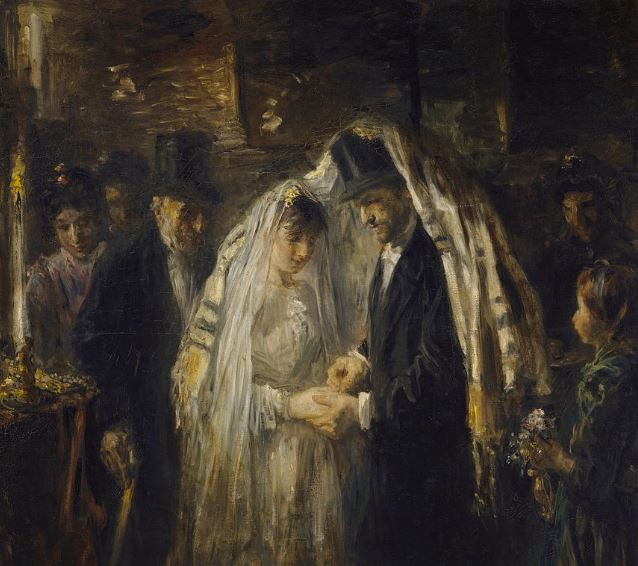
‘Jewish Wedding’ by Jozef Israëls (1824-1911)
In this week’s parasha, Ki Tetze, we find the verse that is traditionally used as the source for the mitzvah of marriage (Deuteronomy 24:1). One of the most famous and salient features of the Jewish wedding ceremony is the breaking of the glass. Where did this custom come from, and what does it mean?
The first and most common answer is that it is meant to symbolize the destruction of the Holy Temple in Jerusalem. As much as the wedding is an extremely joyous occasion, we must not forget that we are still in exile mode, and the world is far from where it needs to be. The verses recited by the groom before breaking the glass remind us of this: “If I forget you Jerusalem, let my right hand forget [its skill]. Let my tongue stick to the roof of my mouth if I remember you not; if I not set Jerusalem above my greatest joy.” (Psalms 137:5-6)
Exactly when this custom began is not clear. The earliest known reference to breaking a glass at a wedding does come from the Talmud (Berakhot 30b-31a), though for a different reason: