
Category Archives: Jewish Law & Life Cycle

A Mystical Look at Pregnancy and Abortion

Parashat Tazria begins by stating that a woman who gives birth to a son is spiritually impure for seven days, and requires another 33 days of purification afterwards. If she gives birth to a female, the impurity lasts fourteen days, followed by 66 days of purification. The Zohar (III, 43b) comments on this section by first reminding us that each soul has male and female halves, and when the soul enters this world, it splits and enters two different bodies, male and female. If the two soulmates merit it, they will find each other and reunite. We are then told that the female part of the soul is larger and more powerful, which is why a woman who gives birth to a female needs double the purification time.

The Zohar explains why the Torah prescribes these specific time periods: 7 and 33 days for boys; 14 and 66 days for girls. It states that at birth, the soul first enters the body and is in complete disarray. For the first seven days, the unsettled soul “roams the body to find its place”. On the eighth day, the soul is finally getting comfortable in its new home. This is one reason why circumcision is done on the eighth day, once the soul is no longer distressed. The soul then needs an additional 33 days to acclimatize to its new environment until it has completely settled into the body. For the greater female souls, the time periods are doubled.

Note how these time periods are referring to the soul of the newborn, yet it is the mother that is described as being “impure”. This is because the mother carried the child, and its soul was housed within her temporarily. (Perhaps this extra soul is responsible for the well-known “pregnancy glow”.) Once the baby is born, its soul leaves the mother’s shelter and is now independent in the baby’s body. (And that pregnancy glow is gone!) The sudden loss of spiritual energy is difficult on the mother as well, and she requires forty (or eighty) days to get back to herself.

A major question arises here: if the soul only enters the newborn at birth, why is abortion forbidden? Religious groups of various faiths have argued for centuries on when exactly the soul enters the body, and many have taken the stance that a fetus already carries a soul, making abortion indistinguishable from murder. What do Jewish texts say?

Abortion and Gestation in the Talmud

In one passage, the Talmud includes abortion under the category of murder. However, it also famously states that if the mother’s life is at risk—at any point in the pregnancy—the fetus must be removed, “limb by limb” if necessary. In such cases, the fetus is seen as a rodef, a “pursuer”, referring to the Torah law that if one is “pursuing” another to kill them, it is permitted to kill the pursuer first. The Talmud concludes that a fetus can be aborted at any point until its head has emerged. Once the head has emerged, the newborn is considered completely alive, and in cases of life-risk, it is no longer clear who the “pursuer” is. The Sages suggest that the soul fully enters the newborn only at birth, and it is only then that the newborn is a complete person.

Three-month old fetus (Courtesy: BabyCentre)

Elsewhere in the Talmud (Niddah 8b), we are told that the fetus already resembles a person at the three-month mark. We now know that it is precisely around this point that the developing baby has the features of a human (and is no longer called an “embryo”, but a “fetus”). The Talmud adds (Berakhot 60a) that until this three-month mark, a person should pray every day that there shouldn’t be a miscarriage. After three months, a person should pray that the fetus will not be stillborn, and after six months, a person should pray that the mother has an easy delivery. We are told that one should pray for the baby’s desired gender only before the 40-day mark. This, too, shows incredible wisdom on the part of our Sages. Today we know scientifically that the sex organs begin their development around day 42. The ancient rabbis knew that after day 40, gender development is already in progress, and there is no point praying for something different.

In a related passage, we are told that until day 40, the fetus is insignificant and more lifeless than living (Yevamot 69b). Today we know that the neural tube which will make the brain forms around day 40, and this is when the first neurons start signalling. Scientifically speaking, there could be no talk of any kind of consciousness or brain activity before day 40.

Because of this, most rabbinic authorities are far more lenient when it comes to abortions before the 40th day of pregnancy. Rabbi Chaim Ozer Grodzinski (1863-1940), who was widely recognized as the greatest posek of his generation, even suggested that abortions before the 40th day are not Biblically prohibited (Achiezer, III, 65:14). Nevertheless, even before the 40th day there is a potential to produce a living human being, and life is valued above all else, which is why abortions are still forbidden except for cases of absolute necessity.

By the 20-week mark (midway through pregnancy), fetuses are seen rolling around, sucking their thumbs, and responding to the prodding of the ultrasound. There is no doubt that the fetus is alive and aware at this point, and any abortion other than a life risk is hardly distinguishable from murder.

Soul Infusion

The fact that the fetus is aware by the 20-week mark (if not sooner) suggests that it does indeed have some level of soul. Yet, earlier we saw sources seemingly propose that the soul does not enter until birth. How do we reconcile these apparent contradictions?

To answer this question it is important to keep in mind that the soul is not one uniform entity. Rather, the soul is composed of multiple layers, each made up of countless sparks. The lowest level of soul is called nefesh, the basic life essence. Above that is the ruach, “spirit”, an animating force that, among other things, gives a person their drives and inclinations. Then comes the neshamah, a higher level of consciousness and the part that gives one their unique traits and qualities. Further still is the chayah, the aura that emanates from the body, followed by the loftiest level, the yechidah, which may be described as a spiritual umbilical cord between each soul and its Creator.

The Arizal taught that ever-higher levels of soul are accessed gradually over the course of one’s life. At birth, a person has only a complete nefesh. As they grow, they are infused with ruach, which becomes fully accessible at bar or bat mitzvah age. At this point one starts to tap into their neshamah, which is wholly available only at age 20. (For this reason, the Torah considers an adult one who is over 20 years of age. Only those over 20 were counted in the census and allowed to join the military. Our Sages state that although one may be judged for their crimes before age 20 here on Earth, only those sins accrued after age 20 are judged in Heaven. Meanwhile, the Midrash notes that Adam and Eve were created as 20 year olds.) The Arizal taught that most people never end up accessing their entire neshamah, and only the most refined individuals ever unlock their chayah and yechidah.

Based on this model, we see that right from conception the developing embryo is steadily infused with nefesh, the basic life force. By day 40, there is enough nefesh for the embryo to be considered alive. In fact, it is said that this is why the gematria of אם, “mother”, is 41, since a woman becomes a mother on the 41st day of pregnancy.

Once its entire nefesh has been infused, the baby is ready to be born. At birth, it begins to receive its next soul level, the ruach. A careful look at the Zohar passage with which we started reveals that this is precisely what the Zohar meant, as it explicitly mentions the ruach entering at birth, requiring forty days to fully settle in. Therefore, a developing fetus does indeed have a soul, which is why abortion is so highly discouraged—reserved only for true medical cases—and why it has been compared to murder.

Solving a Scientific Mystery

The above also answers a mystery that has been perplexing biologists for decades: what is it that drives an embryo to grow? Why do the cells multiply, and how do they know to differentiate? Each cell is exactly the same, with the exact same set of DNA, yet one clump of cells knows to form the eyes while another knows to form the liver, and so on. Scientists have still not been able to figure out how the embryo “knows” what to do. (For that matter, we can’t figure out how any cell really “knows” what to do.)

The Kabbalists have an answer: it is the steady infusion of soul that drives a mass of undifferentiated cells to do what it needs to. It is the soul that gives the instructions for how the DNA is to be transcribed and translated in each cell, and how the cells are to interact with one another. As the soul grows, so too does the body. It is therefore not surprising that around the age when most people’s bodies stop growing, their souls tend to stop “growing” as well.

This should remind us that our education does not end with formal schooling, nor does maturing stop with the end of puberty. The process of growth and refinement, both physical and spiritual, must continue throughout life. This is the key to true self-fulfillment and happiness.


The article above is an excerpt from Garments of Light. Click here to get the book.
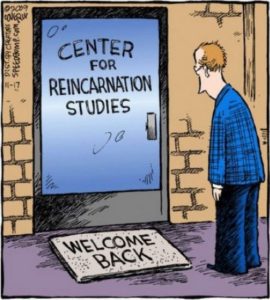
Everything You Wanted to Know About Reincarnation in Judaism

This week’s Torah portion is Mishpatim, which is concerned with the first major set of laws that the Israelites received following the Ten Commandments. While the term mishpatim literally means “ordinances” or “judgements”, the Zohar (II, 94a) suggests a very different interpretation:

“And these are the judgements which you shall set before them…” These are the rules concerning reincarnation, the judgement of souls that are sentenced according to their acts.

The Zohar goes on to interpret the laws in the Torah with regards to the mechanisms of reincarnation. For example, whereas the Torah begins by describing a Hebrew servant who is indentured for six years of labour and must then be freed in the seventh year, the Zohar interprets that this is really speaking of souls which must reincarnate in order to repair the six middot before they could be freed. (The middot are the primary character traits: chessed, kindness; gevurah, restraint; tiferet, balance and truth; netzach, persistence and faith; hod, gratitude and humility; and yesod, sexual purity.)
While the Zohar speaks at length about reincarnation, it is the Arizal who systematically laid down the rules of reincarnation and explained the Zohar in depth. His primary disciple, Rabbi Chaim Vital, recorded these teachings in a famous treatise known as Sha’ar HaGilgulim, “Gate of Reincarnation”. The following is a brief condensation of the basic rules of reincarnation that are defined in this tremendous text, answering many of the common questions people have about spiritual transmigration.

Why Do People Reincarnate?

At the start of the eighth chapter, Rabbi Vital writes:

למה מתגלגלים. דע, כי הנשמות יתגלגלו לכמה סבות, הראשונה הוא, לפי שעבר על איזו עבירה מעבירות שבתורה, ובא לתקן. הב’ הוא, לתקן איזו מצוה שחסר ממנו. השלישית היא, שבא לצורך אחרים, להדריכם ולתקנם… לפעמים יתגלגל, ליקח את בת זוגו, כי לא זכה בראשונה לקחתה

Why do people reincarnate? Know that souls reincarnate for several reasons: The first is that one transgressed one of the prohibitions in the Torah, and returns to repair it. The second is to fulfil a mitzvah that one lacks. The third is in order to assist others, to guide them, and rectify them… Sometimes one reincarnates to marry their soulmate, which they did not merit to do in a previous life.

The Ari explains that people mainly reincarnate in order to atone for sins of past lives, or to fulfil mitzvahs that they didn’t do previously. Later, in Chapter 16, we read that people who return do not have to fulfil all the mitzvahs in one lifetime, but only have to accomplish those that their souls are still lacking. Some reincarnate not for their own rectification, but to assist others. We are told elsewhere that these are usually very righteous individuals who agree to return to this world in order to help others.

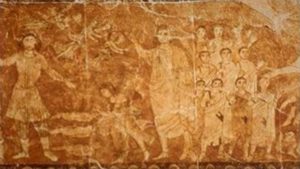
Fresco of the Resurrection of the Dead from the ancient Dura-Europos Synagogue

Some also reincarnate because they either did not marry, or married the wrong person. They must return to reunite with their true soulmate. The Arizal teaches that, unfortunately, some people are so deeply mired in kelipot, negative spiritual “husks”, that they are unable to find their soulmate in this world. These people will reunite with their other half only in Olam HaBa, the “next world” at the time of the Resurrection. With regards to finding soulmates, this is directed particularly at male souls, for it is primarily a man’s responsibility to find his soulmate.

On that note, the following chapter tells us that female souls actually reincarnate very rarely. To begin with, female souls are more refined than male ones, and are unlikely to require more rectifications. What does happen more commonly is that male souls are reincarnated into female bodies! This opens up a number of fascinating scenarios which Rabbi Chaim Vital describes.

What Do People Reincarnate Into?

In Chapter 22, we read that people can reincarnate not only into human bodies, but also animals, vegetation, and even inanimate matter. For example, a person who feeds others non-kosher food reincarnates as a tree; one who sheds blood reincarnates into water; those who transgress various sexual prohibitions reincarnate into bats, rabbits, and other animals; while proud people and those who talk too much reincarnate into bees. (We are told that this is what happened to the judge Deborah who, despite her greatness and wisdom, had a bit of pride and was required to reincarnate into a bee, hence her name devorah, which literally means “bee”!)

It is important to mention, though, that an entire human soul does not fully reincarnate into another organism. Rather, souls are complex entities made up of many different interacting sparks. It is only those sparks that require rectification that return to this world (Chapter 14). Interestingly, the Arizal teaches that when two people really dislike each other, and are constantly in conflict with one another, this is often because the two are sharing sparks from one soul!

How Many Times May One Reincarnate?

Sha’ar HaGilgulim records that a person can reincarnate thousands of times—but only on the condition that they improve at least a little bit in each incarnation. If they fail to improve, they can only reincarnate a maximum of three times. After three strikes, that particular spark is sent to Gehinnom (loosely translated as “hell”) where it will be purified. However, the souls of those who regularly learn Torah are never sent to Gehinnom, and always merit reincarnation. This is one of the incredible protective powers of regular Torah study.

In multiple places, the Arizal teaches about the reincarnations of Abel, the son of Adam. Abel (הבל) had a good side and a bad one. The good side was represented by the letter Hei (ה) of his name, and the bad by the Beit and Lamed (בל). In order to be rectified, the bad part reincarnated in Laban (לבן), the wicked father-in-law of Jacob. Laban didn’t do much better, so he was reincarnated in the gentile prophet Bilaam (בלעם). He, too, was an ungodly person, so the Beit-Lamed soul was reincarnated for the third time in Naval (נבל), the ungrateful man who rejected David. Naval was strike three, and that Beit-Lamed soul no longer returned in the same way in a human reincarnation. It did suffer a punishment at some point in the form of a stone, which is why we read in the Tanakh (I Samuel 25:37) that when Naval died, “he became a stone” secretly alluding to a reincarnation in stone!

We see from the above how a person’s name may offer tremendous hints as to their soul sparks, previous lives, tests, challenges, and character traits. When we read about the above individuals in the Tanakh, we see how similar they were. All three were very wealthy, famous, and participated in divination and sorcery. All were cunning, greedy, and deceitful individuals. The Arizal explains in detail what rectifications each was supposed to do, and how one life affected the next, weaving together these three seemingly unrelated Biblical narratives that span nearly a thousand years into one beautiful tapestry.

Which Body Will A Person Have at the End?

Perhaps the most famous question: if a soul has so many different bodies over so many different lifetimes, which body will that soul inhabit in the afterlife, or in the world of Resurrection? Rabbi Vital writes:

וכן הענין בכל נשמה ונשמה, וכאשר יהיה זמן התחיה, כל גוף וגוף יקח חלקו של נשמתו, כפי חלק הזמן שלו באיזו מדרגה היתה

And with each and every soul, when the time of the Resurrection comes, each and every body will take its corresponding soul, according to the part that it had at that particular time.

Thus, each part of the soul will have its own body, and all reincarnations will exist simultaneously as distinct individuals in Olam HaBa!

Breaking Free from Materialism

In Chapter 23, Rabbi Vital suggests that the most important thing to take from all of this is to live a meaningful, spiritual life. When a person is mired in materialism, and cares only for their physical aspects, they become so attached to their bodies that they cannot exist without one. And so, when that person’s body dies their soul is in complete disarray; frightened, pained, and unable to ascend onwards. Angels must come and quickly place the soul in a new body. As such, this person can never free themselves from endless reincarnations into this imperfect, difficult world.

However, those who in their lifetimes tap into their souls, and are comfortable with their spiritual side, are able to simply take off their dead bodies like an old garment, and move on. For such people, their wonderful portion in Olam HaBa is not too far away.


The above is an excerpt from Garments of Light: 70 Illuminating Essays on the Weekly Torah Portion and Holidays. Click here to get the book! 

Embracing Converts, and the Seeds of Amalek

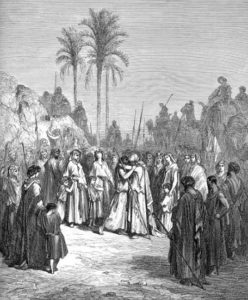
'The Meeting of Jacob and Esau' by Gustav Doré

‘The Meeting of Jacob and Esau’ by Gustav Doré

This week’s parasha is Vayishlach, which recounts Jacob’s return and settlement in the Holy Land after twenty years of living in Charan. At the end of the parasha is a long list of the genealogies of Jacob’s brother, Esau. The list seems unnecessary, and many Sages have wondered why the Torah bothers to spend so much time recounting Esau’s descendants. There have even been debates on whether the entire text of the Torah is equally holy, or if passages like the Ten Commandments are holier than passages such as this list of Esau’s genealogies. Meanwhile, the Arizal states that many of the deepest secrets of Creation are embedded particularly in this seemingly boring and superfluous passage. He draws particular significance from the list of the kings of Edom. The Arizal says these kings are codenames for the Sefirot, and a careful reading of the text reveals the cosmological rectifications (tikkunim) required to repair all of Creation and restore the world to perfection.

About half way through the list we are told that “… the sister of Lotan was Timna” (Genesis 36:22). Again, the Sages are baffled at this extra addition. We already care little enough that there was once an Edomite chief named Lotan – who cares that he had a sister named Timna? The Talmud (Sanhedrin 99b) notes how there were those who scoffed at such verses, saying: “Did Moses have nothing better to write?” And then, the same page of Talmud comes in to explain its tremendous significance:

Timna was a royal princess… Desiring to become a proselyte, she went to Abraham, Isaac and Jacob, but they did not accept her. So she went and became a concubine to Eliphaz the son of Esau, saying, “I’d rather be a servant to this people than a mistress of another nation.” From her, Amalek was descended, who afflicted Israel. Why so? Because they should not have repulsed her!

The Talmud combines the verse in question – which states that Timna was the royal sister of the chief, or prince, Lotan – with an earlier verse (36:12) that says she married Esau’s son Eliphaz and bore Amalek. She wished to convert to Judaism and approached the Patriarchs. All three rebuffed her. So, she ended up with Eliphaz – the closest she could get to being part of the nation. This union gave rise to the evil Amalek, that antagonizing force which has been oppressing Israel for millennia. The Sages state that the Patriarchs should have embraced this potential convert, instead of pushing her away. Their failure to open their arms led to centuries of Jewish suffering. The Talmud sends a pretty clear message: gentiles and converts should not be turned away, and doing so only breeds more resentment against Jews, bringing out all of the world’s “Amaleks”.

Soulmates of Jacob and Moses

The Arizal comments on the Timna passage and points out something even more amazing. He taught (Sha’ar HaMitzvot, Shoftim) that Timna was actually the soulmate of Jacob! Timna contained a great deal of holiness, and Jacob was meant to convert her and marry her, thereby elevating her spiritual sparks. That would have been a massive tikkun of its own, and would have hastened the coming of Mashiach. Instead, Jacob rejected her, and she went on to produce Amalek, bringing evermore evil into the world, and further delaying the coming of Mashiach.

The Arizal highlights that Moses made a similar mistake in not consummating his marriage to the Cushite (Ethiopian) woman. Both Tzipporah and the Cushite woman were Moses’ soulmates, and while Moses did the right thing in converting the Cushite, he never properly married her. Her sparks of holiness were not fully elevated, and the tikkun was left incomplete. This is why Aaron and Miriam were upset with their brother, as we read later in Numbers 12:1, “And Miriam and Aaron spoke against Moses because of the Cushite woman whom he had married…”

Rabbi Akiva’s 24,000 Students in Shechem

In this week’s parasha, too, we read how the people of Shechem genuinely wished to unite with Jacob’s family, agreed to circumcise themselves, and converted en masse. However, Jacob’s sons Shimon and Levi rejected them and resorted to violence in avenging what was done to their sister Dinah. Jacob was horrified at the actions of his sons, and later did not bless the two on his deathbed. It appears their sin was never forgiven, as hundreds of years later the tribes of Shimon and Levi were not given set borders within the Holy Land, but only a handful of cities interspersed among the other tribes. Kabbalistic texts reveal that Shimon and Levi killed 24,000 people in Shechem, and these 24,000 converted souls later reincarnated as the 24,000 students of Rabbi Akiva!

Did You Know These Famous People Converted to Judaism?

All of these narratives point to the same lesson: converts should be welcomed and accepted wholeheartedly. They have the potential for great holiness. The Talmud (Bava Kamma 38a) states that a gentile who occupies himself with Torah is equal to a kohen gadol, a High Priest! The Arizal describes five types of Jewish souls, and the souls of converts are among the purest. (The other types are “Old Souls”, “New Souls”, “True New Souls”, and the “Souls of Cain and Abel”. Of these, the most impure are Old Souls.) It goes without saying that there is no place for racism of any kind within Judaism – Moses himself married a black woman, and was reprimanded for not being diligent in consummating that union.

Historically, Jews were never the proselytizing kind. There are no Jewish missionaries that go out knocking on the doors of gentiles to seek converts. At the same time, Judaism was rarely a popular religion to convert in to. But this will change very soon, and we have to be ready for that day, for the prophet Zechariah (8:23) predicted:

It shall come to pass that ten men shall take hold – from all the languages of the nations – shall take hold of the corners of a Jew’s clothes, saying: “We will go with you, for we have heard that God is with you…”


The above essay is an excerpt from Garments of Light, Volume One. Get the book here!