
Category Archives: Jewish Law & Life Cycle

Understanding Hair Covering for Women in Jewish Law

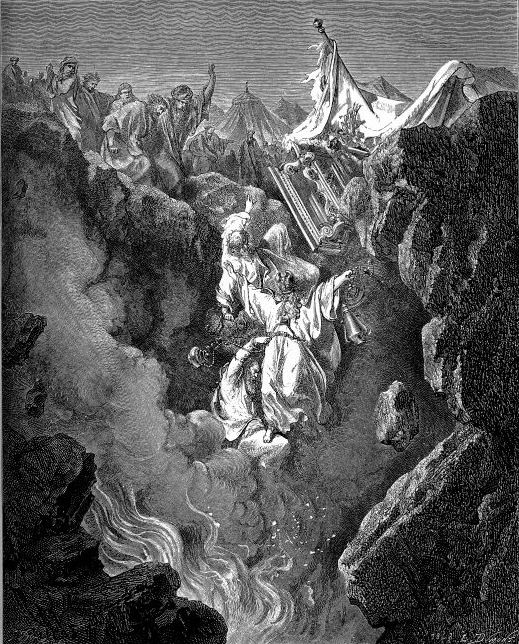
“Death of Korah, Dathan, and Abiram” by Gustave Doré

This week’s parasha, Korach, has a hidden theme: hair. In fact, the name of the villain himself, Korach (קרח), is spelled exactly the same way as kere’ach, “bald”. As we shall see below, Korach’s rebellion began when he saw himself bald-headed following his initiation ritual as a Levite. Hair comes up again in the famous story of one of Korach’s co-conspirators, a man named On ben Pelet. On is strangely mentioned right at the beginning of the parasha (Numbers 16:1), and never again. The Talmud (Sanhedrin 109b-110a) explains that he was saved thanks to his wife: She told her husband that he had nothing to gain from joining the rebellion; now he was subservient to Moses, and if the rebellion would be successful he would just become subservient to Korach!

On understood, but worried that he had already agreed to join the group. So, his clever wife got him drunk and sleepy, and On passed out in bed. Meanwhile, she went out to the entrance of their tent and “exposed her hair”. When Korach’s collaborators approached, the Talmud says they turned away due to the immodest sight of the woman. By the time On recovered from his drunken stupor, the whole episode was over, and he was spared. This story implies that Jewish women cover their hair, and for a woman to expose her hair publicly is immodest. Yet, nowhere in the Torah is there an explicit command for a Jew to cover their hair at all times (male or female). Hair-covering is not listed among the 613 mitzvot! If it isn’t a Torah mitzvah, where did it come from? Continue reading

Kabbalah of the Omer

What is the deeper significance behind the 49 days between Passover and Shavuot? Why do we count the days, and what is their mystical connection to the Sefirot? Also, where did “mourning” during Sefirat haOmer really originate, and what is the proper way to approach these customs? Find out in this eye-opening class as we dive into Sefirat haOmer and explore what it takes to become a complete, refined human. Plus, the primordial elements associated with the Sefirot, and a Kabbalistic look at Yom ha’Atzmaut, Yom Yerushalayim, and Yom haShoah.


The Blood Libels

In this week’s parasha, the Torah devotes an entire chapter (Leviticus 17) to the prohibition of consuming blood. God first forbids idolatrous and improper sacrifices before declaring that “if anyone of the house of Israel or of the strangers who reside among them partakes of any blood, I will set My face against the person who partakes of the blood; I will cut that person off from among kin.” (17:10) The Torah goes on to say that any land animal or bird that is slaughtered for food must have its blood entirely drained and buried under earth, before emphasizing again that “the soul of all flesh—its blood contains its soul. Therefore, I say to the Children of Israel: you shall not partake of the blood of any flesh, for the soul of all flesh is in its blood. Anyone who partakes of it shall be cut off.” (17:14)

Because of this, Jews throughout history have been exceedingly careful not to consume any blood whatsoever, even a tiny speck in a chicken egg. It is therefore tragically ironic that one of the most grotesque antisemitic accusations leveled against Jews for centuries is the “blood libel”—that Jews consume the blood of gentiles or use gentile blood to prepare matzot, or engage in some form of ritual murder. Where did this disgusting accusation come from, how did it evolve over the centuries, and how did it shape Jewish history? Continue reading