Category Archives: Personal Development

Can a Husband and Wife Speak Lashon HaRa To Each Other?

This week’s parasha, Metzora, is primarily concerned with the laws of various skin diseases. Jewish tradition holds that the main reason for a person to contract these skin afflictions is for the sin of evil speech. The term metzora, loosely translated as “leper”, is said to be a contraction of motzi ra or motzi shem ra, “one who brings out evil” or gives someone a “bad name”. The Sages described lashon hara, a general category referring to all kinds of negative speech (even if true), as the gravest of sins.

The Ba’al HaTurim (Rabbi Yakov ben Asher, 1269-1343) comments on the parasha (on Leviticus 13:59) that the word “Torah” is used in conjunction with words like tzaraat or metzora five times, alluding to the fact that one who speaks lashon hara is likened to one who has transgressed all five books of the Torah! The Talmud (Arakhin 15b) famously states that one who speaks lashon hara “kills” three people: the subject of the evil speech, the speaker, and the listener. The same page states that lashon hara is equal to the three cardinal sins: murder, idolatry, and adultery. Other opinions (all supported by Scriptural verses) include: one who speaks lashon hara is considered a heretic, deserves death by stoning, and God personally declares that He and the speaker of lashon hara cannot dwell in the same space.

Having said that, the Talmud’s definition of lashon hara is quite narrow. It doesn’t include general tale-bearing, but specifically refers to slandering another person. It also states that lashon hara is only applicable when two people are speaking in private, secretly. If one slanders before three or more people, then it is evident that he doesn’t care that the subject will know he said it. It is like saying it publicly, or to the person’s face directly, which does not constitute lashon hara. (It is still a horrible thing to do, of course.) This is why God says (Psalms 101:5) that “Whoever slanders his fellow in secret, him I will destroy.” It is specifically when done in secret that it is such a terrible, cowardly sin.

Since Talmudic times, the definition of lashon hara has broadened considerably. It has come to include rechilut, “gossiping”, saying negative things about another person that are true, saying them publicly, and even to suggest or imply something disparaging about another, without naming a person specifically. When it comes to gossiping, one can find an allusion to its severity from the Torah itself, which states “You shall not go as a talebearer among your people, neither shall you stand idly by the blood of your fellow” (Leviticus 19:16). In a single verse, the Torah juxtaposes gossiping with failing to prevent bloodshed. One can learn from this that one who listens to gossip (specifically where another person is spoken of unfavourably) without trying to stop it is like one standing idly while the “blood” of another is being shed.

One question frequently asked about this is whether lashon hara applies between a husband and wife. We saw that the Talmud states lashon hara is especially horrible when spoken in secret between two people. Does this include a married couple as well? On the one hand, we want to distance ourselves from negative speech as much as possible, at all times. On the other hand, we expect a married couple to be allowed to speak freely between one another as they wish. After all, they are two halves of one soul and considered a singular unit.
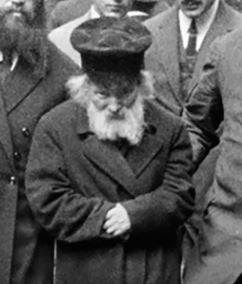
A still of the Chafetz Chaim from a rare, recently released video of the great rabbi. Click the image to see the video.

The Chafetz Chaim (Rabbi Israel Meir Kagan, 1839-1933), generally considered the greatest authority on lashon hara, forbids such speech even between husband and wife. However, many other great authorities before and after him (including Rav Shlomo Zalman Auerbach, 1910-1995, and the Chazon Ish, Rabbi Avraham Isaiah Karelitz, 1878-1953) ruled on the contrary, and permitted a husband and wife to speak about whatever is on their mind, particularly if something bothers them. Technically, even the Chafetz Chaim is lenient in a case where a spouse is in distress and needs to get something off their shoulders.

Still, all agree that we should limit negative words as much as possible, and certainly keep gossip to a minimum. Of course, when negative words have a constructive purpose, it is not considered lashon hara at all, whether between spouses or fellows. This is the case if a person undoubtedly knows, for example, that a particular contractor or salesman is dishonest, and tells a friend in order to protect them from harm.

Repairing Evil Speech, Repairing the World

In the days of the Temple, the kohanim would bring about atonement for the nation through sacrifices and various offerings and rituals. The most important time for atonement was Yom Kippur, and the greatest atonement ritual of the day was when the Kohen Gadol, the high priest, would enter the Holy of Holies (just once a year) and fill it with incense smoke. What was the ultimate purpose of this? The Talmud (Arakhin 16a) states that it served to atone for lashon hara! This was especially necessary because, elsewhere, the Talmud (Bava Batra 165a) states: “Many transgress the law of stealing, few transgress the prohibition of adultery, and all transgress lashon hara.” Everyone is guilty of negative speech, at least to some degree. How do we repair this sin, especially when we don’t have a Temple today?

The Talmud (Arakhin 15b) states that if one is a Torah scholar, they should learn more Torah, and if one is not a Torah scholar, they should strive to be more humble. Like all the other statements, support is brought from verses in Tanakh. King Solomon said “A healing tongue is a tree of life” (Proverbs 15:4). The Sages see the use of the word tongue (lashon) as alluding to lashon hara, and therefore if one wants to heal their lashon hara, they should cleave to the Tree of Life. What is the Tree of Life? King Solomon himself said in another place (Proverbs 3:18) that the Torah is a Tree of Life! Therefore, to rectify the sin of lashon hara one should study Torah.

Upon closer examination, we see that Torah study is actually the perfect remedy for lashon hara. When a person speaks lashon hara they are using their tongue in a negative way and infusing bad energy into the world. When a person learns Torah (which is traditionally done vocally), they are using their tongue in a positive way and infusing good energy into the world. The balance is thereby restored, measure for measure. On top of this, the purpose of Torah study is ultimately to make a person better. The Torah is the best tool to counter the yetzer hara, the evil inclination, as God Himself declared: “I have created the evil inclination, and I have created the Torah as its remedy” (Sifre Devarim, 45). Thus, a person who learns Torah simultaneously neutralizes the evil speech they have spoken and refines their inner qualities so that they will not participate in evil speech in the future.

On that note, there are two kinds of people when it comes to lashon hara: those that like to speak it, and those that love listening to it. The latter often quell their conscience by telling themselves that they never speak lashon hara, God forbid, but only passively, faultlessly, hear it. As we’ve seen above, the listener is almost as culpable as the speaker. Thankfully, there is a remedy for this, too. While many don’t necessarily learn Torah directly from a sefer or on their own, today we have unlimited potential to learn Torah by listening to lectures. These are shared widely on social media, and through digital devices, on apps, and over the radio. Every person today is a click away from Torah learning.

This takes us back to the Talmud, which stated that a Torah scholar can repair lashon hara by learning, while one who is not a Torah scholar should become more humble. The big question here is how can a person just “become more humble”? Humility is one of the most difficult traits to attain! We might even say that the Talmud should have required the Torah scholar—who is constantly learning, growing, and working on themselves—to “become more humble”, not the other way around! How can we make sense of the Talmud?

To prove the point about the non-Torah scholar, the Talmud uses that same verse from Proverbs: “A healing tongue is a tree of life, while perverseness through it will break the spirit.” The plain reading of the verse is that a person who uses their tongue for positive, healing purposes is likened to a Tree of Life, while one who uses their tongue for perverseness is destroying their soul. The Sages take the latter half of the verse to mean, on a simple level, that one who uses their tongue for perverseness should “break their spirit”, ie. become more humble, in order to rectify the sin. There is also a deeper way to read that same verse.

To solve the puzzle, one needs to re-examine what “it” (bah, in Hebrew) refers to. The simple meaning is that “it” refers to the tongue, and one who speaks perverseness through it (the tongue) will break their spirit. However, the verse can just as easily be read so that “it” refers to the Tree of Life. If so, the verse is read this way: “A healing tongue is a tree of life while perverseness, through it [the Tree of Life] will break the spirit.” What is it that will “break” one’s spirit and cause them to become humble? The Tree of Life itself!

Therefore, it is specifically the learning of Torah, the Tree of Life, that brings one to more humility. With this in mind, if we go back to the Talmudic statement of our Sages, what they are saying is: The Torah scholar should rectify their sin by learning more Torah, as they have yet to attain the proper level of holiness, while a non-Torah scholar should learn by listening to more Torah, for this will have the same effect of bringing a person to humility, and rectifying lashon hara.

At the end, this rectification is what will bring Mashiach. In Kabbalistic texts, the generation before Mashiach is in the sefirah of Yesod, which is concerned primarily with sexuality. It is not a coincidence that this is one of the major global issues today. The time following Mashiach’s coming is that of the final sefirah, Malkhut, “Kingdom”. One of the most famous passages from the Tikkunei Zohar is “Patach Eliyahu”, customarily recited before the prayers. There we are told that “Malkhut is the mouth, the Oral Torah.” While Yesod is the sexual organ, Malkhut is the mouth; it is Torah sh’be’al Peh, the Oral Torah, literally “Torah on the mouth”. The key path to realizing Mashiach, Malkhut, is by rectifying the mouth, which is done through the study of Torah.*

As we prepare for Pesach, we should remember the Midrash (Vayikra Rabbah, ch. 32) which states that the Israelites were redeemed from Egypt in the merit of four things: for not changing their names, not forgetting their language, not engaging in sexual sins, and not speaking lashon hara. The same is true if we wish to bring about the Final Redemption. Not engaging in sexual immorality is a direct reference to Yesod, while the other three all deal with the holy tongue, with proper speech and Malkut: using holy names, speaking the Holy Language, and making sure to speak only positive words.

‘Going Up To The Third Temple’ by Ofer Yom Tov


*More specifically, the first rectification is that of the “lower mouth”, Yesod, a tikkun that will be fulfilled by Mashiach ben Yosef. This is followed by the tikkun of the upper mouth, Malkhut, fulfilled by Mashiach ben David (of whom the Prophet says he will slay evil with his mouth, Isaiah 11:4) bringing about God’s perfect Kingdom on Earth.


Do Men Have More Mitzvot than Women?

This week’s parasha, Tazria, begins by describing the rituals that a mother must perform upon giving birth to a new child. If the child is male, the mother is considered “impure” for seven days following her delivery, and then spends an additional 33 days in purification. For a female child, the durations are doubled, with the mother “impure” for 14 days, and purifying for another 66 days. Why is the duration of purification for a female doubly longer than a male?

‘Garden of Eden’, by Thomas Cole

The apocryphal Book of Jubilees (3:8) suggests an interesting idea: Adam was made on the Sixth Day of Creation but, apparently, Eve wasn’t made until a whole week after. This is why a mother of a male child is impure for a week, but a mother of a female child for two weeks! Jubilees also holds that Adam was only brought into Eden forty days after being created, while Eve was brought in after eighty days. This is why a mother of a male child needs a total of forty days to purify, and a mother of a female child needs eighty days. Of course, Rabbinic tradition rejects the Book of Jubilees, and it is accepted that Adam and Eve were both created on the Sixth Day, and were in Eden from the beginning.

Commenting on this week’s parasha, the Zohar (III, 43b) states that it takes a soul 33 days to settle in the body. This is primarily referring to the new soul that enters a newborn baby, as it takes time for the ethereal soul to get used to its descent into a physical world. The Zohar doesn’t add too much more on this, but we might assume that, based on the words of the Torah, it takes a male soul 33 days to settle, and a female soul 66 days to settle. At the same time, the Zohar may be referring to the soul of the mother, too, as she is the one that spends 33 or 66 days in purification. As we’ve explained in the past, the severing of the mother’s direct connection to her child distresses her soul for 33 or 66 days following childbirth.

Whatever the case, the implication is that a female soul is somehow greater than a male soul. It has more spiritual power, taking longer to settle. The notion that female souls are greater is found throughout Jewish texts, especially mystical ones. Sefer HaBahir, one of the most ancient Kabbalistic texts, states that the female soul is the most beautiful of all, and an aspect of the Shekhinah, the Divine Presence (chs. 173-175). It explicitly makes clear that life on Earth would be impossible without the life-giving mother, who in this regard is much closer to God.

On that note, it has been said that God created the world sequentially from simple to complex, starting with the basic elements: light, air, water, earth; progressing to plants, then simple animals, then mammals, then man, and finally woman. The woman is the last of God’s creation, and therefore the most intricate and the most refined. It may be because of this that the Arizal taught that while male souls typically reincarnate to rectify themselves, female souls rarely if ever reincarnate at all (Sha’ar HaGilgulim, ch. 9).

It is important to mention here that we are speaking of female souls, not necessary to all women. The Arizal (as well as the Zohar cited above) speak of the possibility of female souls in male bodies, or male souls in female bodies. And it should also be mentioned that this does not necessarily affect the body’s sexuality. A “female” soul in a male body can still very much be a heterosexual male, and vice versa. (For more on this, see Rav Yitzchak Ginsburgh’s lecture here on the female soul of the forefather Isaac, as well as the prophets Samuel, Jonah, and Habakkuk.)

There are a number of consequences to the greater souls of females. For one, it gives them binah yeterah, an “extra understanding” sometimes referred to as “women’s intuition” (Niddah 45b). This is one reason why the women of the Exodus generation, for example, did not participate in the sin of the Golden Calf, nor the sin of the Spies. In fact, the Kli Yakar (Rabbi Shlomo Ephraim Luntschitz, 1550-1619, on Numbers 13:2) states that, had Moses sent female spies, there would have been no problem at all!

On the other hand, a more elevated soul and an extra depth of understanding means a greater sensitivity to the world, which makes women generally less prone to violence and drug abuse, but significantly more prone to depression and anxiety. The greater female soul has the amazing potential to bring life, yet simultaneously (to balance the equation) the potential for severe destruction, “more bitter than death”, to borrow from King Solomon in Kohelet 7:26. This is symbolically reflected in the menstrual cycle, where a lack of conception of life necessarily results in the shedding of blood, a “minor death” that is then rectified in the living waters of the mikveh.

Finally, a greater soul means that women require slightly less mitzvot than men. After all, the “mitzvot were given only in order that human beings might be purified by them… their purpose is to refine…” (Beresheet Rabbah 44:1) A more refined female soul does not need the same mitzvot that a male soul does. Unfortunately, this has sometimes been a point of contention in modern times. Yet, upon closer examination, we see that the differences in mitzvot between men and women are actually minimal and, contrary to the general belief, there is a perfect balance between those mitzvot done exclusively by men and those done exclusively by women.

“Time-Bound” Mitzvot?

The general rule is that, at least in principle, women are exempt from any mitzvah that can only be done at a particular time. This includes mitzvot like prayer, tefillin, and tzitzit. However, in practical terms we see that this “rule” isn’t really a thing, and there are many time-bound mitzvot that women are obligated in. For example,


The above is an excerpt from Garments of Light, Volume Two. To continue reading, get the book here

How the Priestly Garments Atoned for the People

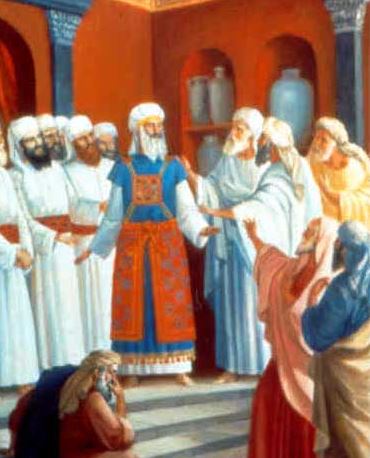
Priests in the Temple (Courtesy: Temple Institute)

This week’s parasha, Pekudei, describes how the Mishkan and all of its vessels were created, together with the special priestly garments. The parasha ends with the formal initiation of Aaron and his sons into the priesthood through their ritual purification, anointment, and donning of the sacred vestments. Our Sages famously state (Zevachim 88b) that the vestments of the Kohen Gadol, the High Priest, atoned for the sins of the people:

The tunic atoned for bloodshed… the breeches atoned for lewdness… the turban made atonement for arrogance… the belt atoned for [impure] meditations of the heart… the breastplate atoned for neglect of civil laws… the apron atoned for idolatry… the cloak atoned for slander… and the crown, worn on the forehead, atoned for brazenness.

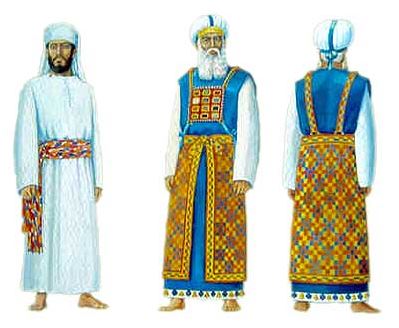
The tunic (kutonet) was a simple white garment worn over the body which all of the priests (not only the High Priest) wore. The Talmud says it atoned for bloodshed, and proves it through a gzerah shavah, a form of interpretation where the exact same word (or root of a word) appears in two different contexts, thus allowing a connection between the two to be made. In Genesis 37:31 we read how, following the sale of Joseph, his brothers slaughtered a goat and dipped Joseph’s special robe in the goat’s blood. They used the bloodied robe as proof to show their father Jacob that Joseph had been murdered or devoured by an animal. The word used for Joseph’s robe is kutonet, too, that same word used for the Kohen’s garment. From this we can learn that the kutonet atoned for bloodshed.

The breeches (michnasei bad) were white pants worn to cover up the lower half of the body, and atoned for sexual immorality. The Talmud proves it from an explicit verse in the Torah (Exodus 28:42) where God commanded that the pants be made “to cover up the flesh of their nakedness”. The Hebrew term here is precisely the one used to denote sexual indecency (‘ervah, or gilui arayot).

The white turban (mitznefet) atones for arrogance. Rabbi Hanina explains here that the turban was worn on the head at the very top of the body, and thus atoned for people who similarly put themselves “at the head” above other people.

The last of the four garments worn by the regular priest is the avnet, a sash or belt. Made of red, blue, and purple wool, it was the only multi-coloured garment worn by the regular priest. It atoned for impure thoughts, and the Talmud says we know this from the fact that the sash was worn tied around the heart. Contrary to what we may expect, this was not a belt to hold up the pants, but rather an independent garment wrapped around the upper body.

In Jewish thought, the heart is the seat of the yetzer hara, the evil inclination, which tries to make a person sin by throwing improper thoughts into their head. The heart is also the seat of the yetzer hatov, the good inclination. These two opposing forces both reside in one’s heart. Because of this, the term for “heart” used in the daily Shema is levavecha, and not the more grammatically consistent libecha. The former has an extra letter beit, the doubled language alluding to the two inclinations in the heart.

Our Sages teach that one should always keep their mind above their heart, in full control of their inclinations. The brain should dominate the heart, and the heart should dominate the liver. The Hebrew word for liver, kaved (כבד), is directly related to kavod (כבוד), “honour”. Thus, the liver is the source of pride and arrogance. These organs are arranged physiologically in the body the way they are to teach us a lesson: the brain (or intellect) should be on top, then the emotions of the heart below it, and the ego at the very bottom.

If one accomplishes this, with their brain, moach (מוח) in Hebrew, being above their heart, lev (לב), and their heart being above their liver, kaved (כבד)—then they become a melekh (מלך), “king”. If the letters are reversed, where one’s honour trumps their emotions, which in turn overrule their reasoning, then they are klum (כלם), “nothing”.

The Four Garments of the High Priest

Garments of the regular priest and the high priest (Courtesy: Temple Institute)

The High Priest wore an additional four unique garments. On his forehead was the golden plate known as the tzitz, which atoned for brazenness. This is proven by another gzerah shavah between Exodus 28:38, which commands the priest to wear the plate upon his metzach, “forehead”, and Jeremiah 3:3 which speaks of the brazen “forehead” (again metzach) of a licentious woman.

On top of the regular white tunic, the High Priest wore a meil, a “coat” made entirely of fine blue (tekhelet) wool. The coat atoned for lashon hara, evil speech. Since the Torah states that the coat had bells along its bottom, which jingled as the Kohen walked, Rabbi Hanina explains: “Let an article of sound come and atone for an offence of sound.”

Rav Yitzchak Ginsburgh points out that the term for bell, pa’amon (פעמן) refers to something that resonates, and the same root is used, for example, in describing how the Spirit of God resonated within—l’fa’amo (לפעמו)—the Biblical judge Samson (Judges 13:25). Rav Ginsburgh beautifully notes how the gematria of “Spirit of God” (רוח ה׳) is 240, equal to that of pa’amon (פעמן). It is also equal to meil ha’ephod (מעיל האפד), the full title of the garment, as in Exodus 29:5 or 39:22. He concludes that if one wishes to have the Spirit of God rest upon them, the key is to refrain from any evil speech.

The ephod, or apron, atoned for idolatry. This is derived from Hosea 3:4: “For the children of Israel shall sit solitary many days without king, and without prince, and without sacrifice, and without pillar, and without ephod or teraphim.” The verse is taken to mean that where there is no ephod, there will be teraphim—various implements of idol worship. The word “teraphim” appears multiple times in the Tanakh (as in Genesis 31:19 and Judges 17:5), nearly always in relation to idolatry.

Upon the ephod was the famous choshen, the breastplate that, according to tradition, allowed for communication with the Heavens. The breastplate atoned for violations of dinin, civil law. We know this from the fact that the Torah calls the breastplate choshen mishpat (Exodus 28:15), literally “breastplate of judgement”, with the term mishpat typically referring to court cases and civil law (whereas chukim and edot refer to religious-based, historical, or ritual laws).

In this way, even the very clothes of the Kohen helped him fulfill his main duty of bringing atonement for the people. Yet, in the past two thousand years, there has been no Temple and no priestly service. Might there be something in its stead?

Every Jew is a Priest

When the Temple was destroyed, our Sages instituted a number of practices in place of those Temple rituals. They declared that “as long as the Temple stood, the altar atoned for Israel, but now a man’s table atones for him” (Berakhot 55a). Just as the priests would wash their hands in a special basin before starting their services (and before eating terumah), the Rabbis instituted netilat yadayim, the ritual washing of the hands before starting a meal. Just as the sacrificial meat was required to be brought with salt, it became customary to dip the bread in salt before eating it. In place of the Temple menorah we have the Chanukah menorah, and in place of the Temple showbread we have two challahs, each traditionally braided with six strands to represent the twelve loaves once displayed in the Temple.

In many ways, the Talmudic sages and rabbis saw themselves filling the role once held by the ancient priests. More importantly, they taught that every righteous Jew should see himself as a priest. After all, God intended for all of Israel to be a “kingdom of priests and a holy nation” (Exodus 19:6). In fact, many commentaries agree that it is only because of the Golden Calf incident that the tribe of Levi was appointed to take over the priesthood. Were it not for that tragedy, every firstborn male would be a priest, and any other Jewish male could voluntarily enter the priesthood. To this effect, the Talmud (Bava Kamma 38a) goes so far as to state that “even a non-Jew who occupies himself with Torah is comparable to the High Priest.” A person who lives in Torah and refines himself to the highest degree is likened to the greatest of priests, at least in a spiritual sense.

In a wonderful affirmation of this, we see that every Torah-observing Jewish man is wearing “holy garments” that parallel the priestly vestments. Everyone generally wears a shirt and pants with a belt, along with their head-covering, corresponding to the four vestments of the regular priest (kutonet, michnasei bad, avnet, mitznefet). And there are four additional special items that a Jew wears that parallel those unique garments of the High Priest:

The “bells” along the hem of the tallit.

The tzitz headplate worn on the top of the forehead is like the head tefillin worn “between the eyes”, while the choshen breastplate worn over the heart is like the arm tefillin which is supposed to be worn in line with the heart. The ephod that was worn over the shoulders and stretched down below the waist is like the tzitzit katan garment worn over the shoulders with its fringes hanging down below the waist. The woolen tallit with which we wrap ourselves, with its customary blue stripes to remember tekhelet, is like the special blue meil that was made of fine tekhelet wool. And just as the meil had pa’amonim bells along its hem, the tallit, too, customarily has bell-like knots along its hem.

In this way, every Jew has the ability to elevate to a priest-like status, especially in lieu of a Temple, and in light of the Torah’s statement that all of Israel is a “nation of priests” (Exodus 19:6). Each Jew can bring about atonement, not only for himself but for his people as a whole, and each Jew can spread evermore divine light into the world.