20 Things That Will Happen When Mashiach Comes

This week’s parasha, Vayikra, begins the third book of the Torah. The parasha is unique in that it is only one of two parashas (along with next week’s Tzav) where the word Mashiach appears. All four cases of the word in the Torah refer to the anointed High Priest, not to the messiah at the End of Days. Nonetheless, on a deeper level it certainly is alluding to the messiah of the End of Days. All the verses in question deal with the anointed High Priest (“HaKohen HaMashiach”) atoning for sins—both his own and the people’s—and purifying his nation. Indeed, one of the roles of Mashiach will be to prepare Israel for that final purification at the End of Days. This includes identifying one last Red Cow to produce those special waters which alone are capable of removing the impurity of death.

The early Christians saw these verses as allusions to their purported saviour, Jesus. In one place, for example, they wrote:

the Law [ie. the Torah] made those high priests who had infirmity, and who needed daily to offer up sacrifices, first for their own sins, and then for the people’s; but our high priest, Christ Jesus, was holy, harmless, undefiled, and separate from sinners, and made higher than the heavens. (Hebrews 7:27-28)

For the Christians, Jesus was the ultimate anointed high priest. Yet, Jesus accomplished essentially nothing of what Mashiach is supposed to. This was perhaps best explained in the 16th century by Isaac ben Abraham of Troki (1533-1594). He was a Karaite Jew, and a renowned Karaite scholar. His magnum opus was a book called Hizzuk Emunah, “Strengthening of Faith”, written to debunk Christianity, silence missionaries, and convince Jews to remain Jewish. The book was so popular that it spread like wildfire, not just among Karaites but all Jews, and even Christians. In fact, it played an important role in the start of the Enlightenment, leading countless Christians to abandon their faith. One of these was the French philosopher Voltaire (1694-1778), who called the Latin translation of Hizzuk Emunah (first published in 1681) a “masterpiece”.

Because it was a Karaite text, traditional rabbis were wary of consulting it. The great Rabbi Menashe ben Israel (Manoel Dias Soeiro, 1604-1657), who opened the first Hebrew printing press in Amsterdam in 1626, ultimately refused to print it. Still, Abba Hillel Silver, in his A History of Messianic Speculation in Israel (pg. 225), points out how Troki’s text borrowed from earlier Rabbinic texts, including Mashmia Yeshua, “Announcing Salvation”, of Rabbi Isaac Abarbanel (1437-1508).

Silver goes on to summarize the sixth chapter of Troki’s Hizzuk Emunah, which includes a list of twenty clear prophecies in Scripture that must be fulfilled upon the coming of Mashiach—none of which were fulfilled by Jesus (thereby necessitating for Christians some future “second coming” yet to materialize after nearly two millennia). Briefly going over these twenty events is enlightening both as a reminder for why Jesus could not be the messiah, and for what to expect when the true Mashiach does come.

Living Waters and Dead Waters
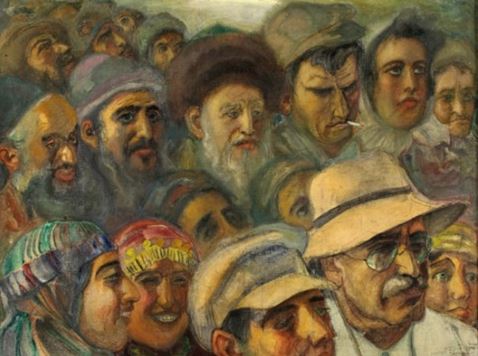
‘Israelis – The Ingathering of the Exiles’ by Saul Raskin (1878-1966)

The first prophecy is the return of the Lost Tribes of Israel. In ancient times, following the reign of King Solomon, the Twelve Tribes of Israel split into two kingdoms: the southern Judah and the northern Israel (or Ephraim). The more sinful northern kingdom was eventually overrun by the Assyrians, who exiled its tribes. These are sometimes referred to as the Ten Lost Tribes. It should be noted, though, that they weren’t necessarily ten tribes, nor were the tribes completely expunged. In reality, there were many Benjaminites, Simeonites, and Levites already living inside the Kingdom of Judah, and members of all the northern tribes fled to Judah when the northern kingdom was destroyed.

What happened was that all the tribes eventually assimilated into the larger, ruling tribe of Judah. Over time, the tribes lost knowledge of their lineage, and today everyone is simply a Yehudi, a Judahite, or Jew. (Levites, because of their unique role, retain knowledge of their ancestry). One of the prophesied events of the End of Days is that the identity of the Lost Tribes will once more be known. Though this idea is much more developed in later Rabbinic literature, it comes from numerous places in Scripture. Troki chooses to use Ezekiel 37:15-22:

And the word of God came to me, saying: “And you, son of man, take one stick, and write upon it: For Judah, and for the children of Israel his companions; then take another stick, and write upon it: For Joseph, the stick of Ephraim, and of all the house of Israel his companions; and join them one to another into one stick, that they may become one in your hand… And say to them: ‘Thus says the Lord God: Behold, I will take the children of Israel from among the nations, wherever they have gone, and will gather them on every side, and bring them into their own land…’”

Related to this is the second great prophecy, that of Gog u’Magog. This refers to the great world war at the End of Days, described in detail in Ezekiel 38, among other places. During the course of this war, Zechariah 14:4 states that the Mount of Olives in Jerusalem will be split in half. Then, new “living waters” will go out of Jerusalem to make Israel flourish (Zechariah 14:8).
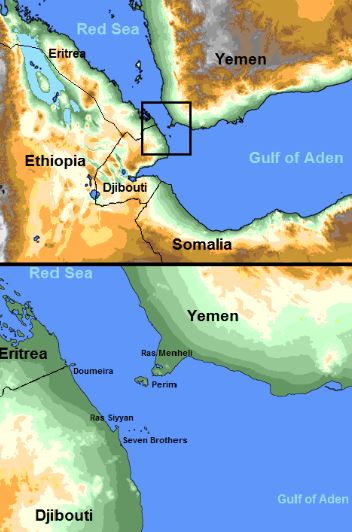
Bab-el-Mandeb Strait (Credit: Skilla1st)

Meanwhile, Isaiah 11:15 states that God “will utterly destroy the tongue of the Egyptian Sea; and with His scorching wind will He shake His hand over the River, and will smite it into seven streams, and cause men to march over dry-shod.” The identity of the “Egyptian Sea” and the “River” is unclear, though Silver has it as the Red Sea and the Euphrates. On the possibility of the Red Sea drying up, we know today from geological records that the Red Sea had once (and possibly more than once) become a dry chunk of land due to the narrow and shallow Bab-el-Mandeb closing up.

As for the “River”, in context it would make more sense if it referred to the Nile, the lifeline of Egypt. Today, we are indeed seeing the Nile drying up rapidly, and the Washington Post recently reported that the Nile Delta is losing as much as 20 metres per year in some areas. With this in mind, when Isaiah prophesies that the “tongue of the Egyptian Sea” will be destroyed, it may be referring to the Nile Delta, which opens up into the Egyptian Mediterranean, ie. the “Egyptian Sea”. The Post article is quite an accurate realization of Isaiah’s prophecy, with images of men that “march over dry-shod”.

(Having said that, the Euphrates River isn’t doing much better than the Nile, so whether Isaiah meant the Nile or the Euphrates is irrelevant in light of the mass devastation that has plagued both rivers.)

A Renewed Jerusalem

The sixth prophecy in Troki’s list is also from Zechariah (8:23):

Thus said the Lord of Hosts: “In those days it shall come to pass, that ten men shall take hold, out of all the languages of the nations, shall take hold of the garment of him that is a Jew, saying: We will go with you, for we have heard that God is with you.”

The tremendous anti-Semitism that Jews have experienced throughout history, into the present day, will finally end. The nations will be at peace with the Jews, and wish to learn from them. This is related to another prophecy: that gentiles from all over the world will come to Jerusalem to worship the God of Israel on every Rosh Chodesh and every Shabbat (Isaiah 66:20-23):

“…upon horses, and in chariots, and in litters, and upon mules, and upon swift beasts, to My holy mountain Jerusalem,” said God, “as the children of Israel bring their offering in a clean vessel into the house of God. And of them also will I take for the priests and for the Levites,” said God. “For as the new heavens and the new earth, which I will make, shall remain before Me,” said God, “so shall your seed and your name remain. And it shall come to pass, that from one new moon to another, and from one Sabbath to another, all flesh shall come to worship before Me, said God.

The gentiles—“all flesh”—will come to Jerusalem, upon every kind of transport. One of these is a rekhev, “chariot” in ancient Hebrew, and “vehicle” in Modern Hebrew. Another two of the transports are unique words that aren’t found elsewhere in Scripture and are impossible to translate: a tzab, and a kirkar. It is possible that the former refers to some kind of slow transport (as the word is written the same as that for a “turtle”) while the latter conversely refers to a very fast form of transport. In our day and age we have no shortage of either.

Troki lists separately a related prophecy from Zechariah (14:16): “And it shall come to pass, that every one that is left of all the nations that came against Jerusalem shall go up from year to year to worship the King, the Lord of Hosts, and to keep the feast of tabernacles.” Once a year, during the holiday of Sukkot, those nations that warred against Israel at the End of Days will come to Jerusalem to worship. The fact that it must be during Sukkot is no coincidence, for it is during Sukkot that our Sages say the offerings in the Temple atone for all the gentiles. This is why the Torah requires seventy bulls to be offered over the course of the holiday, corresponding to the seventy root nations of the world.

A Renewed World

If all the nations are coming to worship the God of Israel in Jerusalem, there is certainly no need for any “idols… false prophets… and unclean spirits” which God will entirely “cut off” (Zechariah 13:2). Zechariah further adds: “And God [YHWH] shall be King over all the earth; in that day God shall be One, and His name one.” (14:9) There will be world peace (Isaiah 2:4, Micah 4:3), which will be ensured and enforced by Israel, to whom all the kings and nations will listen (Isaiah 60:10-12, Daniel 7:27). Even the animals will be at peace with each other, as Isaiah (11:6-8) famously writes:

And the wolf shall dwell with the lamb, and the leopard shall lie down with the kid; and the calf and the young lion and the fatling together; and a little child shall lead them. And the cow and the bear shall feed; their young ones shall lie down together; and the lion shall eat straw like the ox…

On that last prophecy there is an interesting debate. Will the animals miraculously stop fighting and consuming one another? Or, is the prophecy only metaphorical and the natural order will remain? The Rambam (Rabbi Moshe ben Maimon, 1135-1204) held by the latter. Silver translates here that peace will be “between wild and domestic animals”. When reading Isaiah’s verses, this makes perfect sense: a wolf with a lamb, a leopard with a goat; calf and lion, cow and bear. So perhaps what Isaiah meant is that farmers and ranchers will no longer have to worry about wild animals devouring their livestock—once a common, and particularly disturbing, problem. (Or maybe there will be no need to raise livestock at all, for we are now at the dawn of the synthetic meat revolution.)

Israel will finally be completely righteous and free of sin (Deuteronomy 30:6, Isaiah 60:21, Ezekiel 36:25), and lead the rest of the world in doing the same (Jeremiah 3:17). There will no longer be any kind of suffering or sorrow in Israel, for the prophet said “the voice of weeping shall be no more heard in her, nor the voice of crying” (Isaiah 65:19).
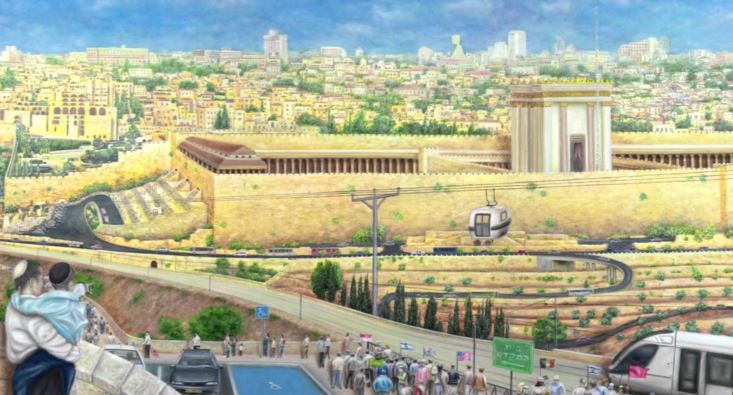
‘Going Up To The Third Temple’ by Ofer Yom Tov

Finally, the prophet Eliyahu will return (Micah 3:24), and the Temple will be rebuilt (Ezekiel 40-45). The Shekhinah will return to Israel (Ezekiel 37:26), as will the ability to prophecy (Jeremiah 31:32-33), and there will be great knowledge in the world (Isaiah 11:9). The Holy Land will be redistributed among the Twelve Tribes of Israel (Ezekiel 47:13). Lastly, at the very end, will come the long-awaited Resurrection of the Dead (Daniel 12:2).

To summarize:

  1. Return of the Lost Tribes
  2. Gog u’Magog
  3. Mount of Olives splitting
  4. Egyptian Sea and River destroyed
  5. Living waters emerge from Jerusalem
  6. Gentiles declaring to Jews “we will go with you”
  7. Israel’s former enemies coming to Jerusalem each year on Sukkot
  8. Gentile pilgrims coming to Jerusalem to worship on the new moons and Sabbaths
  9. Destruction of all idols, false prophets, and unclean spirits
  10. One religion around the world, and recognition of one God
  11. Israel’s recognized leadership on the international stage
  12. World peace
  13. Peace between wild and domesticated animals
  14. A sinless Israel and a sinless world
  15. No more suffering or sorrow in the Land of Israel and for the Jewish people
  16. Shekhinah and prophecy return
  17. Eliyahu reappears
  18. Rebuilding of the Temple in Jerusalem
  19. Redistribution of the Holy Land among the restored Twelve Tribes
  20. Resurrection of the Dead

How the Priestly Garments Atoned for the People

Priests in the Temple (Courtesy: Temple Institute)

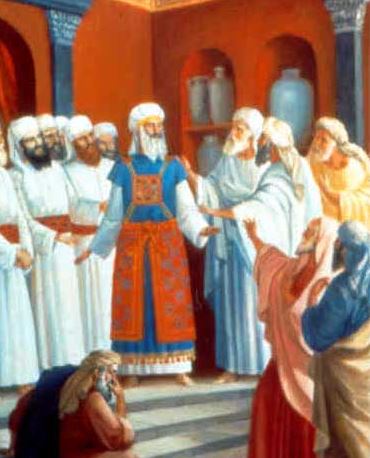
This week’s parasha, Pekudei, describes how the Mishkan and all of its vessels were created, together with the special priestly garments. The parasha ends with the formal initiation of Aaron and his sons into the priesthood through their ritual purification, anointment, and donning of the sacred vestments. Our Sages famously state (Zevachim 88b) that the vestments of the Kohen Gadol, the High Priest, atoned for the sins of the people:

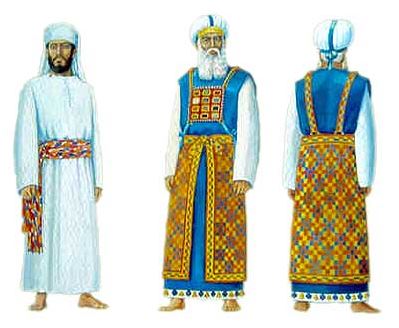
The tunic atoned for bloodshed… the breeches atoned for lewdness… the turban made atonement for arrogance… the belt atoned for [impure] meditations of the heart… the breastplate atoned for neglect of civil laws… the apron atoned for idolatry… the cloak atoned for slander… and the crown, worn on the forehead, atoned for brazenness.

The tunic (kutonet) was a simple white garment worn over the body which all of the priests (not only the High Priest) wore. The Talmud says it atoned for bloodshed, and proves it through a gzerah shavah, a form of interpretation where the exact same word (or root of a word) appears in two different contexts, thus allowing a connection between the two to be made. In Genesis 37:31 we read how, following the sale of Joseph, his brothers slaughtered a goat and dipped Joseph’s special robe in the goat’s blood. They used the bloodied robe as proof to show their father Jacob that Joseph had been murdered or devoured by an animal. The word used for Joseph’s robe is kutonet, too, that same word used for the Kohen’s garment. From this we can learn that the kutonet atoned for bloodshed.

The breeches (michnasei bad) were white pants worn to cover up the lower half of the body, and atoned for sexual immorality. The Talmud proves it from an explicit verse in the Torah (Exodus 28:42) where God commanded that the pants be made “to cover up the flesh of their nakedness”. The Hebrew term here is precisely the one used to denote sexual indecency (‘ervah, or gilui arayot).

The white turban (mitznefet) atones for arrogance. Rabbi Hanina explains here that the turban was worn on the head at the very top of the body, and thus atoned for people who similarly put themselves “at the head” above other people.

The last of the four garments worn by the regular priest is the avnet, a sash or belt. Made of red, blue, and purple wool, it was the only multi-coloured garment worn by the regular priest. It atoned for impure thoughts, and the Talmud says we know this from the fact that the sash was worn tied around the heart. Contrary to what we may expect, this was not a belt to hold up the pants, but rather an independent garment wrapped around the upper body.

In Jewish thought, the heart is the seat of the yetzer hara, the evil inclination, which tries to make a person sin by throwing improper thoughts into their head. The heart is also the seat of the yetzer hatov, the good inclination. These two opposing forces both reside in one’s heart. Because of this, the term for “heart” used in the daily Shema is levavecha, and not the more grammatically consistent libecha. The former has an extra letter beit, the doubled language alluding to the two inclinations in the heart.

Our Sages teach that one should always keep their mind above their heart, in full control of their inclinations. The brain should dominate the heart, and the heart should dominate the liver. The Hebrew word for liver, kaved (כבד), is directly related to kavod (כבוד), “honour”. Thus, the liver is the source of pride and arrogance. These organs are arranged physiologically in the body the way they are to teach us a lesson: the brain (or intellect) should be on top, then the emotions of the heart below it, and the ego at the very bottom.

If one accomplishes this, with their brain, moach (מוח) in Hebrew, being above their heart, lev (לב), and their heart being above their liver, kaved (כבד)—then they become a melekh (מלך), “king”. If the letters are reversed, where one’s honour trumps their emotions, which in turn overrule their reasoning, then they are klum (כלם), “nothing”.

The Four Garments of the High Priest

Garments of the regular priest and the high priest (Courtesy: Temple Institute)

The High Priest wore an additional four unique garments. On his forehead was the golden plate known as the tzitz, which atoned for brazenness. This is proven by another gzerah shavah between Exodus 28:38, which commands the priest to wear the plate upon his metzach, “forehead”, and Jeremiah 3:3 which speaks of the brazen “forehead” (again metzach) of a licentious woman.

On top of the regular white tunic, the High Priest wore a meil, a “coat” made entirely of fine blue (tekhelet) wool. The coat atoned for lashon hara, evil speech. Since the Torah states that the coat had bells along its bottom, which jingled as the Kohen walked, Rabbi Hanina explains: “Let an article of sound come and atone for an offence of sound.”

Rav Yitzchak Ginsburgh points out that the term for bell, pa’amon (פעמן) refers to something that resonates, and the same root is used, for example, in describing how the Spirit of God resonated within—l’fa’amo (לפעמו)—the Biblical judge Samson (Judges 13:25). Rav Ginsburgh beautifully notes how the gematria of “Spirit of God” (רוח ה׳) is 240, equal to that of pa’amon (פעמן). It is also equal to meil ha’ephod (מעיל האפד), the full title of the garment, as in Exodus 29:5 or 39:22. He concludes that if one wishes to have the Spirit of God rest upon them, the key is to refrain from any evil speech.

The ephod, or apron, atoned for idolatry. This is derived from Hosea 3:4: “For the children of Israel shall sit solitary many days without king, and without prince, and without sacrifice, and without pillar, and without ephod or teraphim.” The verse is taken to mean that where there is no ephod, there will be teraphim—various implements of idol worship. The word “teraphim” appears multiple times in the Tanakh (as in Genesis 31:19 and Judges 17:5), nearly always in relation to idolatry.

Upon the ephod was the famous choshen, the breastplate that, according to tradition, allowed for communication with the Heavens. The breastplate atoned for violations of dinin, civil law. We know this from the fact that the Torah calls the breastplate choshen mishpat (Exodus 28:15), literally “breastplate of judgement”, with the term mishpat typically referring to court cases and civil law (whereas chukim and edot refer to religious-based, historical, or ritual laws).

In this way, even the very clothes of the Kohen helped him fulfill his main duty of bringing atonement for the people. Yet, in the past two thousand years, there has been no Temple and no priestly service. Might there be something in its stead?

Every Jew is a Priest

When the Temple was destroyed, our Sages instituted a number of practices in place of those Temple rituals. They declared that “as long as the Temple stood, the altar atoned for Israel, but now a man’s table atones for him” (Berakhot 55a). Just as the priests would wash their hands in a special basin before starting their services (and before eating terumah), the Rabbis instituted netilat yadayim, the ritual washing of the hands before starting a meal. Just as the sacrificial meat was required to be brought with salt, it became customary to dip the bread in salt before eating it. In place of the Temple menorah we have the Chanukah menorah, and in place of the Temple showbread we have two challahs, each traditionally braided with six strands to represent the twelve loaves once displayed in the Temple.

In many ways, the Talmudic sages and rabbis saw themselves filling the role once held by the ancient priests. More importantly, they taught that every righteous Jew should see himself as a priest. After all, God intended for all of Israel to be a “kingdom of priests and a holy nation” (Exodus 19:6). In fact, many commentaries agree that it is only because of the Golden Calf incident that the tribe of Levi was appointed to take over the priesthood. Were it not for that tragedy, every firstborn male would be a priest, and any other Jewish male could voluntarily enter the priesthood. To this effect, the Talmud (Bava Kamma 38a) goes so far as to state that “even a non-Jew who occupies himself with Torah is comparable to the High Priest.” A person who lives in Torah and refines himself to the highest degree is likened to the greatest of priests, at least in a spiritual sense.

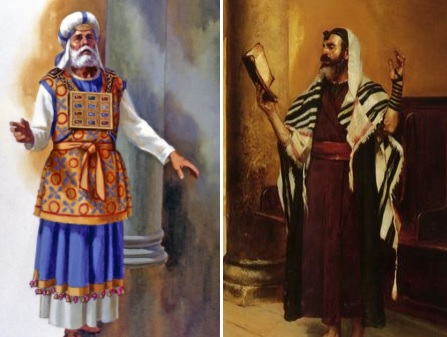
In a wonderful affirmation of this, we see that every Torah-observing Jewish man is wearing “holy garments” that parallel the priestly vestments. Everyone generally wears a shirt and pants with a belt, along with their head-covering, corresponding to the four vestments of the regular priest (kutonet, michnasei bad, avnet, mitznefet). And there are four additional special items that a Jew wears that parallel those unique garments of the High Priest:

The “bells” along the hem of the tallit.

The tzitz headplate worn on the top of the forehead is like the head tefillin worn “between the eyes”, while the choshen breastplate worn over the heart is like the arm tefillin which is supposed to be worn in line with the heart. The ephod that was worn over the shoulders and stretched down below the waist is like the tzitzit katan garment worn over the shoulders with its fringes hanging down below the waist. The woolen tallit with which we wrap ourselves, with its customary blue stripes to remember tekhelet, is like the special blue meil that was made of fine tekhelet wool. And just as the meil had pa’amonim bells along its hem, the tallit, too, customarily has bell-like knots along its hem.

In this way, every Jew has the ability to elevate to a priest-like status, especially in lieu of a Temple, and in light of the Torah’s statement that all of Israel is a “nation of priests” (Exodus 19:6). Each Jew can bring about atonement, not only for himself but for his people as a whole, and each Jew can spread evermore divine light into the world.

Time Travel in the Torah

This week’s parasha is Ki Tisa, in which we read of Moses’ return from Mt. Sinai where he had spent forty days with God. During that time, he had composed the first part of the Torah and received the Two Tablets. The Talmud (Menachot 29b) tells us of another incredible thing that happened:

…When Moses ascended on High, he found the Holy One, Blessed be He, sitting and tying crowns on the letters of the Torah. Moses said before God: “Master of the Universe, who is preventing You from giving the Torah [without these additions]?” God said to him: “There is a man who is destined to be born after many generations, and Akiva ben Yosef is his name. He is destined to derive from each and every tip of these crowns mounds upon mounds of halakhot.” [Moses] replied: “Master of the Universe, show him to me.” God said to him: “Return behind you.”

Moses went and sat at the end of the eighth row [in Rabbi Akiva’s classroom] and did not understand what they were saying. Moses’ strength waned, until [Rabbi Akiva] arrived at the discussion of one matter, and his students said to him: “My teacher, from where do you derive this?” [Rabbi Akiva] said to them: “It is an halakha transmitted to Moses from Sinai.” When Moses heard this, his mind was put at ease…

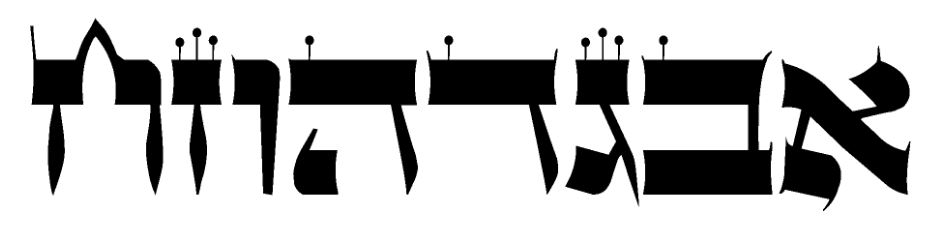
Up on Sinai, Moses saw a vision of God writing the Torah—this is how Moses himself composed the Torah, as he was shown what to inscribe by God—and he saw God adding the little tagim, the crowns that adorn certain Torah letters. Moses was puzzled by the crowns, and asked why there were necessary. God replied that in the future Rabbi Akiva would extract endless insights from these little crowns.

Moses then asked to see Rabbi Akiva, and was permitted to sit in on his class. Moses could not follow the discussion! In fact, the Talmud later says how Moses asked God: “You have such a great man, yet you choose to give the Torah through me?” At the end of the lesson, Rabbi Akiva’s students ask him where he got that particular law from, and he replied that it comes from Moses at Sinai. Moses was comforted to know that even what Rabbi Akiva would teach centuries later is based on the Torah that Moses would compose and deliver to Israel.

This amazing story is often told to affirm that all aspects of Torah, both Written and Oral, and those lessons extracted by the Sages and rabbis, stems from the Divine Revelation at Sinai, and from Moses’ own teachings. It is a central part of Judaism that everything is transmitted in a chain starting from Moses at Sinai, down through the prophets, to the Anshei Knesset HaGedolah, the “Men of the Great Assembly” and the earliest rabbis, all the way through to the present time.

What is usually not discussed about this story, though, is the deeper and far more perplexing notion that Moses travelled through time! The Talmud does not say that Moses saw a vision of Rabbi Akiva; it says that he literally went and sat in his classroom. He was there, sitting inconspicuously at the end of the eighth row. As a reminder, Moses received the Torah in the Hebrew year 2448 according to tradition, which is 3331 years ago. Rabbi Akiva, meanwhile, was killed during the Bar Kochva Revolt, 132-136 CE, less than 2000 years ago. How did Moses go 1400 years into the future?

Transcending Time and Space

In his commentary on Pirkei Avot (Magen Avot 5:21), Rabbi Shimon ben Tzemach Duran (1361-1444) explains:

Moshe Rabbeinu, peace be upon him, while standing on the mountain forty days and forty nights, from the great delight that he had learning Torah from the Mouth of the Great One, did not feel any movement, and time did not affect him at all.

As we read at the end of this week’s parasha, Moses “was there with God for forty days and forty nights; he ate no bread and drank no water, and He inscribed upon the tablets the words of the Covenant…” (Exodus 34:28) At Sinai, Moses had no need for any bodily functions. Rabbi Duran explains that from his Divine union with God, Moses transcended the physical realm. In such a God-like state, he was no longer subject to the limitations of time and space.

In this regard, Moses became like a photon of light. Modern physics has shown that light behaves in very strange ways, and does not appear to be subject to time and space. Fraser Cain of Universe Today explains how

From the perspective of a photon, there is no such thing as time. It’s emitted, and might exist for hundreds of trillions of years, but for the photon, there’s zero time elapsed between when it’s emitted and when it’s absorbed again. It doesn’t experience distance either.

Light transcends time and space. In this way, Moses was like light. And this is quite fitting, for this week’s parasha ends with the following (Exodus 34:29-33):

And it came to pass when Moses descended from Mount Sinai, and the Two Tablets of the Testimony were in Moses’ hand when he descended from the mountain, and Moses did not know that the skin of his face had become radiant while He had spoken with him. And Aaron and all the children of Israel saw Moses, and behold, the skin of his face had become radiant, and they were afraid to come near him… When Moses had finished speaking with them, he placed a covering over his face.

Moses glowed with a bright light, so much so that the people couldn’t look at him, and he would wear a mask over his face. Moses had become light. And light doesn’t experience time and space like we do. There is something divine about light. It therefore isn’t surprising that the Kabbalists referred to God as Or Ain Sof, “light without end”, an infinite light, or simply Ain Sof, the “Infinite One”. Beautifully, the gematria of Ain Sof (אין סוף) is 207, which is equal to light (אור)!

Travelling to the Future

While Moses was instantly teleported into the future, we currently have no scientifically viable way for doing so. However, the notion of travelling into the future is a regular fixture of modern science fiction, and the way it usually presents itself is through some form of “cryosleep”. This is when people are either frozen or placed into a state of deep sleep, or both, for a very long time (usually because they are flying to distant worlds many light years away), and are reanimated in the distant future. For this there is a good scientific foundation, as there are species of frogs in Siberia, for example, that are able to freeze themselves for the winter, and thaw in the spring. They can do this without compromising the integrity of their cellular structure, in a process not yet fully understood. If we could mimic this biological process, then humans, too, could potentially freeze themselves for long periods of time, “thawing” in the future. And this, too, has a precedent in the Talmud (Ta’anit 23a):

[Honi the Circle-Drawer] was throughout the whole of his life troubled about the meaning of the verse, “A song of ascents, when God brought back those that returned to Zion, we were like them that dream.” [Psalms 126:1] Is it possible for a man to dream continuously for seventy years? One day he was journeying on the road and he saw a man planting a carob tree. He asked him: “How long does it take [for this tree] to bear fruit?” The man replied: “Seventy years.” He then further asked him: “Are you certain that you will live another seventy years?” The man replied: “I found [ready-grown] carob trees in the world; as my forefathers planted these for me so I too plant these for my children.”

Honi sat down to have a meal and sleep overcame him. As he slept a rocky formation enclosed upon him which hid him from sight and he continued to sleep for seventy years. When he awoke he saw a man gathering the fruit of the carob tree and he asked him: “Are you the man who planted the tree?” The man replied: “I am his grandson.” Thereupon he exclaimed: “It is clear that I slept for seventy years!” He then caught sight of his donkey who had given birth to several generations of mules, and he returned home. He there enquired: “Is the son of Honi the Circle-Drawer still alive?” The people answered him: “His son is no more, but his grandson is still living.” Thereupon he said to them: “I am Honi the Circle-Drawer”, but no one would believe him.

He then went to the Beit Midrash and overheard the scholars say: “The law is as clear to us as in the days of Honi the Circle-Drawer”, for whenever he used to come to the Beit Midrash he would settle for the scholars any difficulty that they had. Whereupon he called out: “I am he!” but the scholars would not believe him nor did they give him the honour due to him. This hurt him greatly and he prayed [for death] and he died…

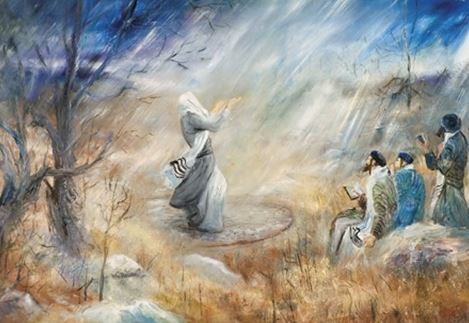
“Honi HaMeagel”, by Huvy. Honi is famous for drawing a circle in the ground around him and not moving away until God would make it rain. Josephus wrote that Honi was killed during the Hasmonean civil war, around 63 BCE. The Maharsha (Rabbi Shmuel Eidels, 1555-1631) said that people thought he was killed in the war, but actually fell into a deep sleep as the Talmud records.

Honi HaMa’agel, “the Circle-Drawer”, who was renowned for his ability to have his prayers answered, entered a state of deep sleep for seventy years and thereby journeyed to the future! This type of time travel is, of course, not true time travel, and he was unable to go back to his own generation. He prayed for death and was promptly answered.

Travelling back in time, meanwhile, presents far more interesting challenges.

Back to the Future

In 2000, scientists at Princeton University found evidence that it may be possible to exceed the speed of light. As The Guardian reported at the time, “if a particle could exceed the speed of light, the time warp would become negative, and the particle could then travel backwards in time.” This is one of several ways proposed to scientifically explain the possibility of journeying back in time.

The problem with this type of travel is as follows: what happens when a person from the future changes events in the past? The result may be what is often referred to as a “time paradox” or “time loop”. The classic example is a person who goes back to a time before they were born and kills their parent. If they do so, they would never be born, so how could they go back in time to do it?

Remarkably, just as I took a break from writing this, I saw that my son had brought a book from the library upstairs. Out of over 500 books to choose from, he happened to bring Harry Potter and the Prisoner of Azkaban. Now, he is far too young to have read it, or to even known who Harry Potter is. And yet, this is the one book in the Harry Potter series—and possibly the one book in our library—that presents a classic time paradox!

In Prisoner of Azkaban, we read how Harry is about to be killed by a Dementor when he is suddenly saved by a mysterious figure who is, unbeknownst to him, his own future self. After recovering from the attack, he later gets his hands on a “time turner” and goes back in time. It is then that he sees his past self about to be killed by a Dementor, and saves his past self. The big problem, of course, is that Harry could have never gone back in time to save himself had he not already gone back in time to save himself in the first place!

Perhaps a more famous example is James Cameron’s 1984 The Terminator. In this story, John Connor is a future saviour of humanity who is a thorn in the side of the evil, world-ruling robots. Those evil robots decide to send one of their own back to a time before John Connor was born in order to kill his mother—so that John could never be born. Aware of this, Connor sends one of his own soldiers back in time to protect his mother. The soldier and the mother fall in love, and the soldier impregnates her, giving birth to John Connor! In other words, future John Connor sent his own father back in time to protect his mother and conceive himself! This is a time paradox.

Could we find such a time paradox in the Torah? At first glance, there doesn’t appear to be anything like this. However, a deeper look reveals that there may be such a case after all.

When God Wanted to “Kill” Moses

In one of the most perplexing passages in the Torah, we read that when Moses took his family to head back to Egypt and save his people, “God encountered him and sought to kill him.” (Exodus 4:24) To save Moses, his wife Tziporah quickly circumcises their son, sparing her husband’s life. The standard explanation for this is that Moses’ son Eliezer was born the same day that he met God for the first time at the Burning Bush. Moses spent seven days communicating with God, then descended on the eighth day and gathered his things to go fulfil his mission.

However, the eighth day is when he needed to circumcise his son, as God had already commanded his forefather Abraham generations earlier. Moses intended to have the brit milah when they would stop at a hotel along the way, but got caught up with other things. An angel appeared, threatening Moses for failing to do this important mitzvah, so Tziporah took the initiative and circumcised her son. Alternatively, some say it was the baby whose life was at risk.

Whatever the case, essentially all the commentaries agree that God had sent an angel to remind Moses of the circumcision. Who was that angel? It may have been a persecuting angel, and some say he took the form of a frightening snake. Others, like the Malbim (Rabbi Meir Leibush Weisser, 1809-1879) say it was an “angel of mercy” as Moses was entirely righteous and meritorious. Under the circumstances, one’s natural inclination might point to it being the angel in charge of circumcision, as suggested by Sforno (Rabbi Ovadiah ben Yakov, 1475-1550). Who is the angel in charge of circumcision? Eliyahu! In fact, Sforno proposes that the custom of having a special kise kavod, chair of honour, or “chair of Eliyahu” (though Sforno doesn’t say “Eliyahu” by name), might originate in this very Torah passage. Every brit milah today has such an Eliyahu chair, for it is an established Jewish tradition that the prophet-turned-angel Eliyahu visits every brit.

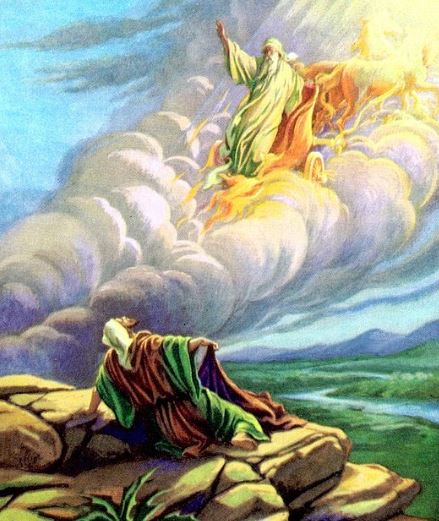
‘Elijah Taken Up to Heaven’

Yet, Eliyahu could not have been there at the brit of Moses’ son, for Eliyahu would not be born for many years! Eliyahu lived sometime in the 9th century BCE. He was a prophet during the reign of the evil king Ahab and his even-more-evil wife Izevel (Jezebel). The Tanakh tells us that Eliyahu never died, but was taken up to Heaven in a fiery chariot (II Kings 2). As is well-known, he transformed into an angel.

The Zohar (I, 93a) explains that when Eliyahu spoke negatively of his own people and told God that the Jews azvu britekha, “have forsaken Your covenant” (I Kings 19:10), God replied:

I vow that whenever My children make this sign in their flesh, you will be present, and the mouth which testified that the Jewish people have abandoned My covenant will testify that they are keeping it.

He henceforth became known as malakh habrit, “angel of the covenant” (Pirkei D’Rabbi Eliezer, 29), a term first used by the later prophet Malachi (3:1).

If Eliyahu is Malakh haBrit, and is present at every circumcision, does this only apply to future circumcisions after his earthly life, or all circumcisions, even those before his time? As an angel that is no longer bound by physical limitations, could he not travel back in time and be present at brits of the past, too? God certainly does transcend time and space, and exists in past, present, and future all at once. This is in God’s very name, a fusion of haya, hoveh, and ihyeh, “was, is, will be”, all in one (see Zohar III, 257b, as well as the Arizal’s Etz Chaim, at the beginning of Sha’ar Rishon, anaf 1). And we already saw how God could send Moses to the distant future and bring him right back to the past. Could He have sent Eliyahu back to the brit of Moses’ son? Such a scenario would result in a classic time loop. How could Eliyahu, a future Torah prophet, save Moses, the very first Torah prophet? Eliyahu could not exist without Moses!

It is important to note here that there were those Sages who believed that Eliyahu was always an angel, from Creation, and came down into bodily form for a short period of time during the reign of Ahab. This is why the Tanakh does not describe Eliyahu’s origins. It does not state who his parents were, or even which tribe he hailed from. Others famously state that “Pinchas is Eliyahu”, ie. that Eliyahu was actually Pinchas, the grandson of Aaron. Pinchas was blessed with eternal life, and after leaving the priesthood, reappeared many years later as Eliyahu to save the Jewish people at a difficult time. He was taken up to Heaven alive as God promised. In the Torah, we read how God blessed Pinchas with briti shalom (Numbers 25:12). Again, that key word “brit” appears—a clue that Pinchas would become Eliyahu, malakh habrit.

While it is hard to fathom, or accept, the possibility of an Eliyahu time paradox, there is one last time paradox that deserves mention. And on this time paradox, all of our Sages do agree…


The above essay is an excerpt from Garments of Light, Volume Three.
To continue reading, get the book here!