Is Your Brain a Quantum Computer? (A Scientific Explanation for the Soul and Afterlife)

This week’s parasha, Chayei Sarah, begins with the passing of the matriarch Sarah. The Torah states that “the lives of Sarah were one hundred years, and twenty years, and seven years…” Traditionally, two big questions were asked of this verse: the first is why the Torah describes her life as one hundred, twenty, and seven years instead of simply saying that she was 127 years old when she died. The second is why the Torah says these were the lives of Sarah, instead of life in the singular, especially in light of the fact that the parasha actually describes her death, not life!

The classic answer to the first question is that Sarah was as beautiful at 100 as she was at 20, and she was as pure at 20 as she was at 7 years old. The answer to the second question, as we’ve explored in the past (see ‘A Mystical Journey through the Lives of Sarah’ in Garments of Light), is that Sarah – or at least a part of her soul – was immediately reincarnated in Rebecca, and thus Sarah’s life and life’s work continued with her future daughter-in-law. In general, the word for “life” in Hebrew is in plural, chaim, which alludes to the fact that there are really two lives: the transient life in this current physical world, and the everlasting life of the soul.

Today, many question (or outright reject) the possibility of an afterlife. Such people argue that there is no evidence or scientifically plausible explanation for such things. When the body dies, the person dies with it, and that’s it. In reality, there is a great deal of evidence to support the notion of a soul and an afterlife, and even one solid scientific explanation that is slowly gaining popularity and acceptance.

The Quantum Brain

Although there have been millions of cases of “near death experiences” and medically-induced “clinical deaths”—many of which end with the victim or patient describing other worlds and relating accurate information that would have been impossible for them to know—these are all relegated to “anecdotal evidence” and generally not taken seriously in the scientific community. We can put all of that aside (together with countless people’s personal stories of prophetic dreams and premonitions, “out-of-body” experiences, miraculous occurrences, and other inexplicable phenomena), and focus strictly on accepted science.

In recent decades, neurologists studying the human brain have sought to uncover what it is that generates consciousness and actually makes the brain work. Why and how is it that this network of cells produces a “mind”? Biology and chemistry have given us the general mechanisms of electrical signals and neurotransmitters, but have not been able to answer the real fundamental questions. To solve the mystery actually requires the most complex of sciences: quantum physics.

In 1989, world-renowned physicist Sir Roger Penrose published The Emperor’s New Mind in which he argued that classical physics simply cannot explain consciousness, nor can the brain be compared in any way to a typical computer, or be explained with familiar algorithms. Penrose suggested that the only plausible explanation for consciousness can come from quantum physics.

To go into the major principles of quantum physics is far beyond our scope. Indeed, one of the great quantum physicists, Richard Feynman, once noted: “I think I can safely say that nobody understands quantum mechanics.” Suffice it to say that quantum physics has completely revolutionized science and our entire understanding of reality. It has turned the universe into a funky place where just about anything is possible, and where things at the sub-atomic level behave in totally bizarre ways. Niels Bohr, one of the early quantum physicists (and a Nobel Prize winner) offered that “If quantum mechanics hasn’t profoundly shocked you, you haven’t understood it yet.” Meanwhile, the man who is often called “the father of quantum physics”, Max Planck, stated:

As a man who has devoted his whole life to the most clear headed science, to the study of matter, I can tell you as a result of my research about atoms this much: There is no matter as such. All matter originates and exists only by virtue of a force which brings the particle of an atom to vibration and holds this most minute solar system of the atom together. We must assume behind this force the existence of a conscious and intelligent mind. This mind is the matrix of all matter.

From his lifetime of studies, Planck concluded that reality as we know it doesn’t exist, and all of matter is held together by some kind of universal mind or consciousness. Building on these ideas, and the complex math and science behind them, Penrose proposed that the brain is a “quantum computer” of sorts, and may be intricately linked to the very fabric of the universe.

Quantum Biology and the Soul

Penrose’s hypothesis inspired a psychology professor in Arizona named Stuart Hameroff. As a practicing anesthesiologist, Hameroff knew that anesthesia works by shutting down small proteins inside neurons called microtubules, and this shuts off a person’s consciousness. Penrose and Hameroff teamed up to continue researching the possibility of the brain as quantum computer. Incredibly, their conclusions suggest that the brain can actually store its quantum information in the universe itself, so that even if the brain was to die, its information would not die with it. That information can be held indefinitely in the universe, and can return to a revived brain, or even into another brain. This would explain near death experiences and clinical deaths, and provides a scientific explanation for reincarnation and a life after death. The death of the body does not at all mean the death of the person, or that person’s memories and thoughts.

While there are those who are quick to criticize the theory and reject it, no one has been able to actually refute it. In fact, since the theory was first proposed, more and more evidence has accumulated to support it. In 2014, quantum biologist Anirban Bandyopadhyay (based in Japan’s National Institute for Materials Science and a visiting professor at MIT) successfully demonstrated the quantum activity of microtubules.

It appears that science has finally discovered the soul. There are now valid, empirical evidence-based theories to explain the existence of an eternal mind or spirit, a universal consciousness, the possibility of an afterlife and reincarnation. The scientific community needs to stop aggressively denying anything that seems “spiritual”, and instead delve deeper into this exciting and promising new field. This sentiment was already expressed long ago by Nikola Tesla, considered by many to be the greatest scientist of all time: “The day science begins to study non-physical phenomena, it will make more progress in one decade than in all the previous centuries of its existence.” It was the genius Tesla who first noted that his brain “is only a receiver,” and stated that “In the Universe there is a core from which we obtain knowledge, strength, inspiration. I have not penetrated into the secrets of this core, but I know it exists.”


The above is an excerpt from Garments of Light, Volume Two. Get the book here

Torah on the Big Bang and the Age of the Universe

The Torah begins with Beresheet, the famous account of Creation.  In recent times, many have questioned the validity of this narrative in light of the findings of modern science. In reality, the Torah’s account is quite accurate in scientific terms, and the Jewish tradition described the origins of the universe and its age with stunning precision centuries before modern science caught up.

According to Science

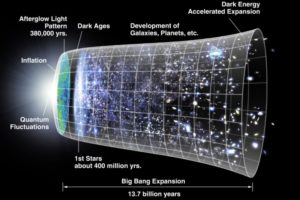
The current scientific model holds that 13.7 billion years ago, the entire universe was compacted into a super tiny point with infinite density. For some unknown reason, this point suddenly burst in a massively vast and rapid expansion of energy and radiation. As the early universe cooled and expanded, particles began to form, and then whole atoms, starting with hydrogen. Hydrogen atoms fused into helium atoms, and later on heavy elements formed from further fusion in the cores of stars and their explosions. Everything that we see today—the entire universe and all matter within it—emerged from that initial expansion, “the Big Bang”.

The evidence for a Big Bang is extensive. In fact, you can see some of it when you look at the “snow” on an old television that is not tuned to any channel. The antenna is picking up some of the cosmic microwave background radiation, the “afterglow” of the Big Bang. The entire universe is still glowing from that initial expansion! Popular physicist Brian Greene writes in his bestselling The Hidden Reality (pg. 43):
…if you were to shut off the sun, remove the other stars from the Milky Way, and even sweep away the most distant galaxies, space would not be black. To the human eye it would appear black, but if you could see radiation in the microwave part of the spectrum, then every which way you turned, you’d see a uniform glow. It’s origin? The origin.

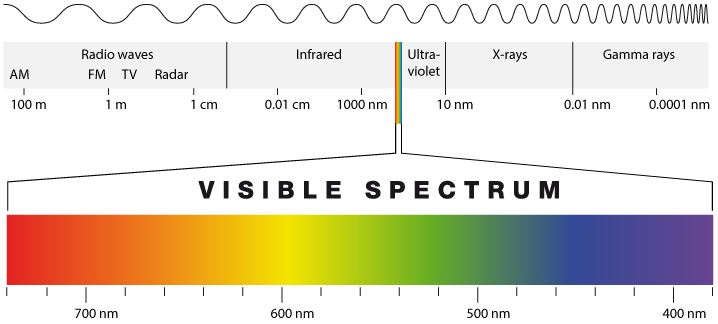
The universe is glowing, it’s just that most people cannot see it because human eyes perceive only a very narrow part of the electromagnetic spectrum, which we call “visible light”. Light of a higher energy and frequency includes dangerous x-rays and gamma rays, while light of lower energy and frequency includes microwaves and radio waves. The seeming blackness of the universe is actually radiating with light—we simply cannot see it. Incredibly, this is precisely what the Torah states.

The electromagnetic spectrum. Visible light makes up just a tiny sliver of the spectrum. Some living organisms can see in UV or infrared wavelengths.

Zohar haRakia

We read in the Tanakh (Daniel 12:3) that “they who are wise shall shine as bright as the rakia…” The Torah tells us that God established a rakia (wrongly translated as “firmament”) on the second day of Creation, and this is where all the stars and planets are suspended (Genesis 1:15). The Talmud (Chagigah 12a), composed over 1500 years ago, further elaborates that above the earth is the vilon, the atmosphere that stretches over the planet, and beyond the vilon is the rakia, a vast expanse within which are all the stars. Beyond the rakia is a region called shechakim, the interface between the physical and spiritual realms, and further still are the highest levels of the Heavens, inhabited by angels and transcendental beings. From this, and other ancient sources, it is clear that rakia refers to outer space.

Daniel tells us that the wise will shine like the rakia, and goes on to state that “they who turn the many to righteousness [shall shine] as the stars”. We can understand how people might shine bright like stars, but why would Daniel say the rakia is shining? Outer space is totally dark! Of course, as Brian Greene described, today we know that the universe is indeed glowing.

One of the most ancient Jewish mystical texts is Sefer HaBahir. According to tradition, it dates back some two thousand years, and was first published at least seven hundred years ago. This book gets its name from another verse in the Tanakh (Job 37:21), which states “And now, men do not see the light that is bright [bahir] in the skies.” Once again, Scripture tells us that the universe is glowing with a bright light that humans are unable to perceive. Science has found that this glow comes from the Big Bang, and this too is accurately described by the most famous of Jewish mystical texts, the Zohar.

Cosmic Microwave Background Radiation, the glow of the universe, discovered in the 1960s by Robert Wilson and Jewish physicist Arno Penzias.

The Secret of Beresheet and the Big Bang

Like Sefer HaBahir, the Zohar was first published around seven hundred years ago, with its teachings dating back two millennia. The Zohar is a parasha-by-parasha commentary on the Torah, and naturally begins with the first section in describing Creation. The book gets its name from the above verse in Daniel which speaks of Zohar haRakia, the glow of the universe. It elaborates (I, 2a, 15a):

בְּשַׁעְתָּא דִּסְתִימָא דְכָל סְתִימִין בָּעָא לְאִתְגַּלְּיָא, עֲבַד בְּרֵישָׁא נְקוּדָה חֲדָא, וְדָא סָלֵיק לְמֶהֱוֵי מַחֲשָׁבָה. צַיֵּיר בָּהּ כָּל צִיּוּרִין חָקַק בָּהּ כָּל גְּלִיפִין… וְרָזָא דָא, בְּרֵאשִׁית בָּרָא אֱלֹהִים. זֹהַר, דְּמִנֵּיהּ כָּלְהוֹ מַאֲמָרוֹת אִתְבְּרִיאוּ בְּרָזָא דְאִתְפַּשְׁטוּתָא דִנְקוּדָה דְּזֹהַר סְתִים דָּא

When the Most Concealed One [God] began to create, He first made a singular point, with which he then brought forth all thought, drew all blueprints, and carved out all things… And the secret of “In the beginning, God created…” [Genesis 1:1] is radiance [zohar], from which all Utterances were created, in the secret of the expansion of that point of radiance.

Many centuries ago, the Zohar accurately and elegantly sums up the findings of modern science. God first created a tiny singular point which burst forth in light, and from which He “carved out” all things in existence. All of God’s Utterances (since the Torah says God created by speaking: “And God said ‘Let there be light.’”) came forth from the expansion of that initial primordial radiance.

Time is Relative

All that remains is the seeming contradiction in time. Science estimates 13.7 billion years, while the Torah speaks of six days. Of course, the nature of a “day” in the account of Creation is flexible, considering there was no Earth, sun, or moon until the third and fourth days (so how could there be a 24 hour day as we know it before this?) There were also no humans at this point, and the Torah describes Creation from the perspective of God, for whom “a thousand years is like one passing day” (Psalms 90:4). The fact that time runs differently for man and God actually highlights another scientific principle, as revealed by Albert Einstein.

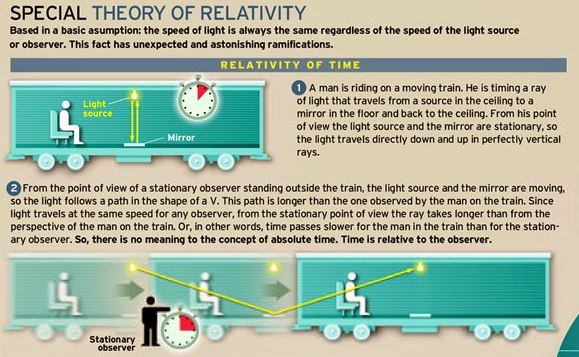
Einstein’s theory of relativity holds that the passing of time varies depending on an entity’s speed. A person who could board a spaceship and fly near light-speed would experience very slow time. A few days for this person would be equivalent to many years on Earth. (This theme has been explored in countless science fiction books and films, including 2014’s Interstellar.) The Lubavitcher Rebbe often cited this fact to conclude that arguing about apparent space-time contradictions is therefore quite pointless. Meanwhile, physicist Gerald Schroeder has mathematically calculated that six days could be equivalent to 13.7 billion years when factoring in the universe’s expansion. After all, we are looking back in time at an ancient universe through human eyes, while God was looking forward in time from the universe’s first moments.

An infographic explaining the relativity of time. Note the conclusion: “there is no meaning to the concept of absolute time.” The whole debate of 6 days vs 13.7 billion years is therefore quite meaningless.

Physicist and Rabbi Aryeh Kaplan explored this issue extensively and cites multiple ancient Jewish texts that support the notion of a very ancient universe (see his book Kabbalah and the Age of the Universe). In multiple places, the Midrash states that before creating this world, God was creating and destroying many previous worlds (see, for example, Kohelet Rabbah 3:14), while the Talmud calculates that “there were 974 generations before Adam” (Chagigah 13b, Shabbat 88a).

On this last point, it has been shown that a generation according to the Torah is forty years (Numbers 32:13), and as we saw, a day for God is likened to 1000 human years (Psalms 90:4), therefore:

            974 generations × 40 years/generation × 365 days/year × 1000 human years/divine day =

14.2 billion years

Compared to the current best estimate of science at 13.7 billion years, it is amazing that one can come to a very similar number by simply putting together a few Torah verses.

What we see from all of the above is that ancient Jewish texts describe the universe’s origins in absolutely perfect detail. And it is only in recent decades that science has finally caught up. In many other ways, too, science has a lot of catching up to do.


The above is an excerpt adapted from Garments of Light: 70 Illuminating Essays on the Weekly Torah Portion and Holidays. Click here to get the book! 

The Most Important Torah Reading

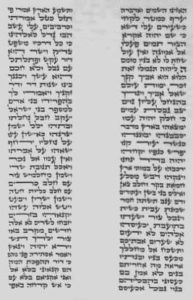
Two columns of parashat Ha’azinu in a Torah scroll

This Shabbat we will be reading Ha’azinu, a unique parasha written in two poetic columns. Ha’azinu is a song; the song that God instructed Moses to teach all of Israel: “And now, write for yourselves this song, and teach it to the Children of Israel. Place it into their mouths, in order that this song will be for Me as a witness for the children of Israel.” (Deut. 31:19) Of course, the entire Torah is a song, chanted with specific ta’amim, musical cantillations. In fact, the mitzvah for each Jew to write a Torah scroll of their own (one of the 613) is derived from the verse above, where God commands the Children of Israel to write this song for themselves. While the simple meaning is that God meant to write the song of Ha’azinu, our Sages interpreted it to refer to the entire Torah. (Since most people are unable to write an entire kosher Torah scroll by themselves, the mitzvah can be fulfilled by writing in a single letter, or by financially contributing to the production of a Torah scroll.)

Why is the song of Ha’azinu so special that God commanded Moses to ensure it will always remain in the mouths of Israel? A careful reading shows that Ha’azinu essentially incorporates all of the central themes of the Torah. We are first reminded that God is perfect, “and all His ways are just” (32:4). While it is common for people to become angry at God and wonder why He is seemingly making life so difficult for them, Ha’azinu reminds us that there is no injustice in God, and that all suffering is self-inflicted (32:5). The Talmud reminds us that hardships are issurim shel ahavah, “afflictions of love”, meant to inspire us to change, grow, repent, learn, and draw us closer to God. Isaac Newton said it well:

Trials are medicines which our gracious and wise Physician gives because we need them; and the proportions, the frequency, and weight of them, to what the case requires. Let us trust His skill and thank Him for the prescription.

History is the Greatest Proof

In the second aliyah, we are told to “remember the days of old and reflect upon the years of previous generations” (32:7). Is there any greater proof for God and the truth of the Torah than Jewish history? Despite all the hate, persecution, exile, and genocide, the Jewish people are still alive and well, prospering as much as ever.

Does it make sense that 0.2% of the world’s population wins over 20% of the world’s Nobel Prizes? (Out of 881 Nobels awarded thus far, 197 were awarded to Jews, who number just 14 million or so. Compare that to the 1.8 billion Muslims in the world—roughly 25% of the world’s population—who have a grand total of three Nobel Prizes in the sciences.) Does it make sense that a nation in exile for two millennia can return to its ancestral homeland, defeat five professional armies that invade it simultaneously (and outnumber it at least 10 to 1), and go on to establish a flourishing oasis in a barren desert in just a few short decades? Does it make sense that tiny Israel is a global military, scientific, democratic, and economic powerhouse? And yet, does it make any sense that the United Nations has passed more resolutions against Israel than all of the rest of the world combined?

There is no greater proof for God’s existence, for the truth of His Torah, and the distinctiveness of the Jewish people than history itself. It is said that King Louis XIV once asked the French polymath and Catholic theologian Blaise Pascal for proof of the supernatural, to which the latter simply replied: “the Jews”. Although Pascal—who was not a big fan of the Jews—probably meant it in a less than flattering way, he was totally correct.
The Consequences of Forgetting God

From the third aliyah onwards, Ha’azinu describes what the Jewish people have unfortunately experienced through the centuries: God gives tremendous blessings, which eventually leads to the Jews becoming “fat and rebellious”. They forget “the God who delivered” them (32:18). This is precisely when God hides His face (32:20), and just as the Jews provoked God with their foolishness and assimilation, God in turn “provokes [them] with a foolish nation”. God sends a wicked foreign nation to punish the Jews—whether Babylonians or Romans, Cossacks or Nazis—to remind the Jews who they are supposed to be: a righteous, Godly people; a light unto the nations. If the Jews will not be righteous and divine, God has no use for them.

Having said that, this does not exonerate those Cossacks and Nazis, for they, too, have been judged. They are a “foolish nation”, a “non-people”, who themselves merit destruction, and God “will avenge the blood of His servants” (32:43). The song ends with a promise: Israel will atone and fulfil its role, its enemies will be defeated, and God will restore His people to their land.

The Spiritual Power of Ha’azinu

The song of Ha’azinu beautifully summarizes the purpose and history of the Jewish people, and elegantly lays down the responsibilities, benefits, and consequences of being the nation tasked with God’s mission. Not surprisingly then, God wanted all of Israel to know Ha’azinu very well, and meditate upon this song at all times. This is why it was given in the format of a song, since songs are much easier to memorize and internalize then words alone. Music has the power to penetrate into the deepest cores of our souls.

In fact, the Zohar on this parasha writes that music is the central way to elevate spiritually, and can be used to attain Ruach HaKodesh, the prophetic Divine Spirit. Elsewhere, the Zohar goes so far as to say that Moses’ prophecy was unique in that all other prophets needed music to receive visions, while Moses alone could prophesy without the help of song!

Today, we have scientific evidence that music deeply affects the mind. It triggers the release of various neurotransmitters, and can rewire the brain. It has a profound impact on mood and wellbeing, and can be used to induce all sorts of mental and emotional states. Music is powerful.

And so, the Torah concludes with a song. After relaying Ha’azinu, the Torah says that “Moses finished speaking all of these words to Israel” (32:45). The lyrics were the last of the Torah’s instructions. Indeed, Ha’azinu is the last weekly Torah reading in the yearly cycle. (Although there is one more parasha, it is not read on its own Shabbat, but on the holiday of Simchat Torah, at which point we jump right ahead to Beresheet, the first parasha.)

So important is Ha’azinu that it is always read during the High Holiday period, usually on Shabbat Shuvah, the Sabbath of Repentance, or Return. So important is Ha’azinu that it is most often the first parasha read in the New Year. And so important is Ha’azinu that it was commonly believed the entire Torah is encoded within it. When our Sages derived the mitzvah of writing the Torah from the command of writing Ha’azinu, they literally meant that Ha’azinu encapsulates the whole Torah! The Ramban went so far as to teach that all of history, including the details of every individual, is somehow encrypted in Ha’azinu. This prompted one of the Ramban’s students, Rabbi Avner, to abandon Judaism and become an apostate. In a famous story, the Ramban later confronts Avner, and proves that Avner’s own name and fate is embedded in one of Ha’azinu’s verses.

In past generations, many people customarily memorized Ha’azinu. The Rambam (Hilkhot Tefillah 7:13) cites another custom to recite Ha’azinu every morning at the end of Shacharit, and the Talmud (Rosh Hashanah 31a) states that in those days it was read every Shabbat. This Shabbat, take the time to read Ha’azinu diligently, and see why it was always considered the most important Torah reading. Perhaps you will even find your own life encoded in its enigmatic verses.


The above essay is adapted from Garments of Light, Volume Three.
Get the book here!