Tag Archives: Brain

How the Priestly Garments Atoned for the People

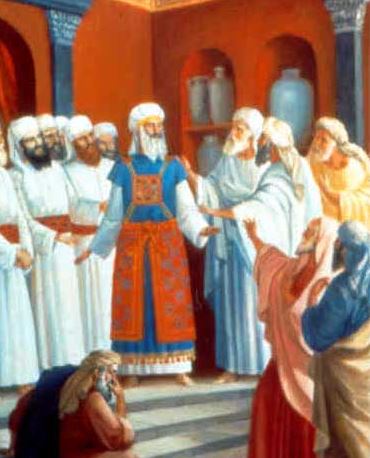
Priests in the Temple (Courtesy: Temple Institute)

This week’s parasha, Pekudei, describes how the Mishkan and all of its vessels were created, together with the special priestly garments. The parasha ends with the formal initiation of Aaron and his sons into the priesthood through their ritual purification, anointment, and donning of the sacred vestments. Our Sages famously state (Zevachim 88b) that the vestments of the Kohen Gadol, the High Priest, atoned for the sins of the people:

The tunic atoned for bloodshed… the breeches atoned for lewdness… the turban made atonement for arrogance… the belt atoned for [impure] meditations of the heart… the breastplate atoned for neglect of civil laws… the apron atoned for idolatry… the cloak atoned for slander… and the crown, worn on the forehead, atoned for brazenness.

The tunic (kutonet) was a simple white garment worn over the body which all of the priests (not only the High Priest) wore. The Talmud says it atoned for bloodshed, and proves it through a gzerah shavah, a form of interpretation where the exact same word (or root of a word) appears in two different contexts, thus allowing a connection between the two to be made. In Genesis 37:31 we read how, following the sale of Joseph, his brothers slaughtered a goat and dipped Joseph’s special robe in the goat’s blood. They used the bloodied robe as proof to show their father Jacob that Joseph had been murdered or devoured by an animal. The word used for Joseph’s robe is kutonet, too, that same word used for the Kohen’s garment. From this we can learn that the kutonet atoned for bloodshed.

The breeches (michnasei bad) were white pants worn to cover up the lower half of the body, and atoned for sexual immorality. The Talmud proves it from an explicit verse in the Torah (Exodus 28:42) where God commanded that the pants be made “to cover up the flesh of their nakedness”. The Hebrew term here is precisely the one used to denote sexual indecency (‘ervah, or gilui arayot).

The white turban (mitznefet) atones for arrogance. Rabbi Hanina explains here that the turban was worn on the head at the very top of the body, and thus atoned for people who similarly put themselves “at the head” above other people.

The last of the four garments worn by the regular priest is the avnet, a sash or belt. Made of red, blue, and purple wool, it was the only multi-coloured garment worn by the regular priest. It atoned for impure thoughts, and the Talmud says we know this from the fact that the sash was worn tied around the heart. Contrary to what we may expect, this was not a belt to hold up the pants, but rather an independent garment wrapped around the upper body.

In Jewish thought, the heart is the seat of the yetzer hara, the evil inclination, which tries to make a person sin by throwing improper thoughts into their head. The heart is also the seat of the yetzer hatov, the good inclination. These two opposing forces both reside in one’s heart. Because of this, the term for “heart” used in the daily Shema is levavecha, and not the more grammatically consistent libecha. The former has an extra letter beit, the doubled language alluding to the two inclinations in the heart.

Our Sages teach that one should always keep their mind above their heart, in full control of their inclinations. The brain should dominate the heart, and the heart should dominate the liver. The Hebrew word for liver, kaved (כבד), is directly related to kavod (כבוד), “honour”. Thus, the liver is the source of pride and arrogance. These organs are arranged physiologically in the body the way they are to teach us a lesson: the brain (or intellect) should be on top, then the emotions of the heart below it, and the ego at the very bottom.

If one accomplishes this, with their brain, moach (מוח) in Hebrew, being above their heart, lev (לב), and their heart being above their liver, kaved (כבד)—then they become a melekh (מלך), “king”. If the letters are reversed, where one’s honour trumps their emotions, which in turn overrule their reasoning, then they are klum (כלם), “nothing”.

The Four Garments of the High Priest
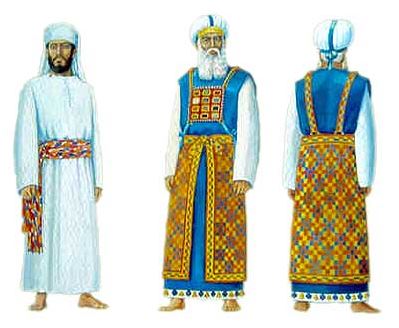
Garments of the regular priest and the high priest (Courtesy: Temple Institute)

The High Priest wore an additional four unique garments. On his forehead was the golden plate known as the tzitz, which atoned for brazenness. This is proven by another gzerah shavah between Exodus 28:38, which commands the priest to wear the plate upon his metzach, “forehead”, and Jeremiah 3:3 which speaks of the brazen “forehead” (again metzach) of a licentious woman.

On top of the regular white tunic, the High Priest wore a meil, a “coat” made entirely of fine blue (tekhelet) wool. The coat atoned for lashon hara, evil speech. Since the Torah states that the coat had bells along its bottom, which jingled as the Kohen walked, Rabbi Hanina explains: “Let an article of sound come and atone for an offence of sound.”

Rav Yitzchak Ginsburgh points out that the term for bell, pa’amon (פעמן) refers to something that resonates, and the same root is used, for example, in describing how the Spirit of God resonated within—l’fa’amo (לפעמו)—the Biblical judge Samson (Judges 13:25). Rav Ginsburgh beautifully notes how the gematria of “Spirit of God” (רוח ה׳) is 240, equal to that of pa’amon (פעמן). It is also equal to meil ha’ephod (מעיל האפד), the full title of the garment, as in Exodus 29:5 or 39:22. He concludes that if one wishes to have the Spirit of God rest upon them, the key is to refrain from any evil speech.

The ephod, or apron, atoned for idolatry. This is derived from Hosea 3:4: “For the children of Israel shall sit solitary many days without king, and without prince, and without sacrifice, and without pillar, and without ephod or teraphim.” The verse is taken to mean that where there is no ephod, there will be teraphim—various implements of idol worship. The word “teraphim” appears multiple times in the Tanakh (as in Genesis 31:19 and Judges 17:5), nearly always in relation to idolatry.

Upon the ephod was the famous choshen, the breastplate that, according to tradition, allowed for communication with the Heavens. The breastplate atoned for violations of dinin, civil law. We know this from the fact that the Torah calls the breastplate choshen mishpat (Exodus 28:15), literally “breastplate of judgement”, with the term mishpat typically referring to court cases and civil law (whereas chukim and edot refer to religious-based, historical, or ritual laws).

In this way, even the very clothes of the Kohen helped him fulfill his main duty of bringing atonement for the people. Yet, in the past two thousand years, there has been no Temple and no priestly service. Might there be something in its stead?

Every Jew is a Priest

When the Temple was destroyed, our Sages instituted a number of practices in place of those Temple rituals. They declared that “as long as the Temple stood, the altar atoned for Israel, but now a man’s table atones for him” (Berakhot 55a). Just as the priests would wash their hands in a special basin before starting their services (and before eating terumah), the Rabbis instituted netilat yadayim, the ritual washing of the hands before starting a meal. Just as the sacrificial meat was required to be brought with salt, it became customary to dip the bread in salt before eating it. In place of the Temple menorah we have the Chanukah menorah, and in place of the Temple showbread we have two challahs, each traditionally braided with six strands to represent the twelve loaves once displayed in the Temple.

In many ways, the Talmudic sages and rabbis saw themselves filling the role once held by the ancient priests. More importantly, they taught that every righteous Jew should see himself as a priest. After all, God intended for all of Israel to be a “kingdom of priests and a holy nation” (Exodus 19:6). In fact, many commentaries agree that it is only because of the Golden Calf incident that the tribe of Levi was appointed to take over the priesthood. Were it not for that tragedy, every firstborn male would be a priest, and any other Jewish male could voluntarily enter the priesthood. To this effect, the Talmud (Bava Kamma 38a) goes so far as to state that “even a non-Jew who occupies himself with Torah is comparable to the High Priest.” A person who lives in Torah and refines himself to the highest degree is likened to the greatest of priests, at least in a spiritual sense.

In a wonderful affirmation of this, we see that every Torah-observing Jewish man is wearing “holy garments” that parallel the priestly vestments. Everyone generally wears a shirt and pants with a belt, along with their head-covering, corresponding to the four vestments of the regular priest (kutonet, michnasei bad, avnet, mitznefet). And there are four additional special items that a Jew wears that parallel those unique garments of the High Priest:

The “bells” along the hem of the tallit.

The tzitz headplate worn on the top of the forehead is like the head tefillin worn “between the eyes”, while the choshen breastplate worn over the heart is like the arm tefillin which is supposed to be worn in line with the heart. The ephod that was worn over the shoulders and stretched down below the waist is like the tzitzit katan garment worn over the shoulders with its fringes hanging down below the waist. The woolen tallit with which we wrap ourselves, with its customary blue stripes to remember tekhelet, is like the special blue meil that was made of fine tekhelet wool. And just as the meil had pa’amonim bells along its hem, the tallit, too, customarily has bell-like knots along its hem.

In this way, every Jew has the ability to elevate to a priest-like status, especially in lieu of a Temple, and in light of the Torah’s statement that all of Israel is a “nation of priests” (Exodus 19:6). Each Jew can bring about atonement, not only for himself but for his people as a whole, and each Jew can spread evermore divine light into the world.
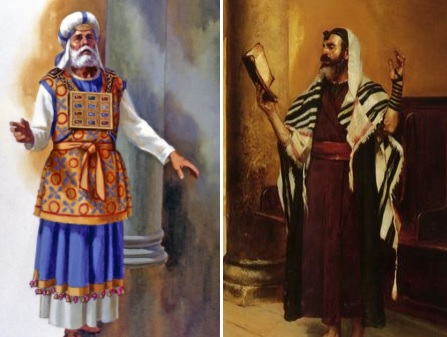
Is Your Brain a Quantum Computer? (A Scientific Explanation for the Soul and Afterlife)

This week’s parasha, Chayei Sarah, begins with the passing of the matriarch Sarah. The Torah states that “the lives of Sarah were one hundred years, and twenty years, and seven years…” Traditionally, two big questions were asked of this verse: the first is why the Torah describes her life as one hundred, twenty, and seven years instead of simply saying that she was 127 years old when she died. The second is why the Torah says these were the lives of Sarah, instead of life in the singular, especially in light of the fact that the parasha actually describes her death, not life!

The classic answer to the first question is that Sarah was as beautiful at 100 as she was at 20, and she was as pure at 20 as she was at 7 years old. The answer to the second question, as we’ve explored in the past (see ‘A Mystical Journey through the Lives of Sarah’ in Garments of Light), is that Sarah – or at least a part of her soul – was immediately reincarnated in Rebecca, and thus Sarah’s life and life’s work continued with her future daughter-in-law. In general, the word for “life” in Hebrew is in plural, chaim, which alludes to the fact that there are really two lives: the transient life in this current physical world, and the everlasting life of the soul.

Today, many question (or outright reject) the possibility of an afterlife. Such people argue that there is no evidence or scientifically plausible explanation for such things. When the body dies, the person dies with it, and that’s it. In reality, there is a great deal of evidence to support the notion of a soul and an afterlife, and even one solid scientific explanation that is slowly gaining popularity and acceptance.

The Quantum Brain

Although there have been millions of cases of “near death experiences” and medically-induced “clinical deaths”—many of which end with the victim or patient describing other worlds and relating accurate information that would have been impossible for them to know—these are all relegated to “anecdotal evidence” and generally not taken seriously in the scientific community. We can put all of that aside (together with countless people’s personal stories of prophetic dreams and premonitions, “out-of-body” experiences, miraculous occurrences, and other inexplicable phenomena), and focus strictly on accepted science.

In recent decades, neurologists studying the human brain have sought to uncover what it is that generates consciousness and actually makes the brain work. Why and how is it that this network of cells produces a “mind”? Biology and chemistry have given us the general mechanisms of electrical signals and neurotransmitters, but have not been able to answer the real fundamental questions. To solve the mystery actually requires the most complex of sciences: quantum physics.

In 1989, world-renowned physicist Sir Roger Penrose published The Emperor’s New Mind in which he argued that classical physics simply cannot explain consciousness, nor can the brain be compared in any way to a typical computer, or be explained with familiar algorithms. Penrose suggested that the only plausible explanation for consciousness can come from quantum physics.

To go into the major principles of quantum physics is far beyond our scope. Indeed, one of the great quantum physicists, Richard Feynman, once noted: “I think I can safely say that nobody understands quantum mechanics.” Suffice it to say that quantum physics has completely revolutionized science and our entire understanding of reality. It has turned the universe into a funky place where just about anything is possible, and where things at the sub-atomic level behave in totally bizarre ways. Niels Bohr, one of the early quantum physicists (and a Nobel Prize winner) offered that “If quantum mechanics hasn’t profoundly shocked you, you haven’t understood it yet.” Meanwhile, the man who is often called “the father of quantum physics”, Max Planck, stated:

As a man who has devoted his whole life to the most clear headed science, to the study of matter, I can tell you as a result of my research about atoms this much: There is no matter as such. All matter originates and exists only by virtue of a force which brings the particle of an atom to vibration and holds this most minute solar system of the atom together. We must assume behind this force the existence of a conscious and intelligent mind. This mind is the matrix of all matter.

From his lifetime of studies, Planck concluded that reality as we know it doesn’t exist, and all of matter is held together by some kind of universal mind or consciousness. Building on these ideas, and the complex math and science behind them, Penrose proposed that the brain is a “quantum computer” of sorts, and may be intricately linked to the very fabric of the universe.

Quantum Biology and the Soul

Penrose’s hypothesis inspired a psychology professor in Arizona named Stuart Hameroff. As a practicing anesthesiologist, Hameroff knew that anesthesia works by shutting down small proteins inside neurons called microtubules, and this shuts off a person’s consciousness. Penrose and Hameroff teamed up to continue researching the possibility of the brain as quantum computer. Incredibly, their conclusions suggest that the brain can actually store its quantum information in the universe itself, so that even if the brain was to die, its information would not die with it. That information can be held indefinitely in the universe, and can return to a revived brain, or even into another brain. This would explain near death experiences and clinical deaths, and provides a scientific explanation for reincarnation and a life after death. The death of the body does not at all mean the death of the person, or that person’s memories and thoughts.

While there are those who are quick to criticize the theory and reject it, no one has been able to actually refute it. In fact, since the theory was first proposed, more and more evidence has accumulated to support it. In 2014, quantum biologist Anirban Bandyopadhyay (based in Japan’s National Institute for Materials Science and a visiting professor at MIT) successfully demonstrated the quantum activity of microtubules.

It appears that science has finally discovered the soul. There are now valid, empirical evidence-based theories to explain the existence of an eternal mind or spirit, a universal consciousness, the possibility of an afterlife and reincarnation. The scientific community needs to stop aggressively denying anything that seems “spiritual”, and instead delve deeper into this exciting and promising new field. This sentiment was already expressed long ago by Nikola Tesla, considered by many to be the greatest scientist of all time: “The day science begins to study non-physical phenomena, it will make more progress in one decade than in all the previous centuries of its existence.” It was the genius Tesla who first noted that his brain “is only a receiver,” and stated that “In the Universe there is a core from which we obtain knowledge, strength, inspiration. I have not penetrated into the secrets of this core, but I know it exists.”


The above is an excerpt from Garments of Light, Volume Two. Get the book here

The Most Important Torah Reading

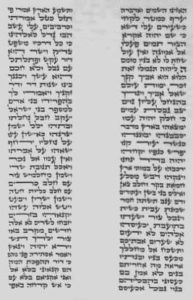
Two columns of parashat Ha’azinu in a Torah scroll

This Shabbat we will be reading Ha’azinu, a unique parasha written in two poetic columns. Ha’azinu is a song; the song that God instructed Moses to teach all of Israel: “And now, write for yourselves this song, and teach it to the Children of Israel. Place it into their mouths, in order that this song will be for Me as a witness for the children of Israel.” (Deut. 31:19) Of course, the entire Torah is a song, chanted with specific ta’amim, musical cantillations. In fact, the mitzvah for each Jew to write a Torah scroll of their own (one of the 613) is derived from the verse above, where God commands the Children of Israel to write this song for themselves. While the simple meaning is that God meant to write the song of Ha’azinu, our Sages interpreted it to refer to the entire Torah. (Since most people are unable to write an entire kosher Torah scroll by themselves, the mitzvah can be fulfilled by writing in a single letter, or by financially contributing to the production of a Torah scroll.)

Why is the song of Ha’azinu so special that God commanded Moses to ensure it will always remain in the mouths of Israel? A careful reading shows that Ha’azinu essentially incorporates all of the central themes of the Torah. We are first reminded that God is perfect, “and all His ways are just” (32:4). While it is common for people to become angry at God and wonder why He is seemingly making life so difficult for them, Ha’azinu reminds us that there is no injustice in God, and that all suffering is self-inflicted (32:5). The Talmud reminds us that hardships are issurim shel ahavah, “afflictions of love”, meant to inspire us to change, grow, repent, learn, and draw us closer to God. Isaac Newton said it well:

Trials are medicines which our gracious and wise Physician gives because we need them; and the proportions, the frequency, and weight of them, to what the case requires. Let us trust His skill and thank Him for the prescription.

History is the Greatest Proof

In the second aliyah, we are told to “remember the days of old and reflect upon the years of previous generations” (32:7). Is there any greater proof for God and the truth of the Torah than Jewish history? Despite all the hate, persecution, exile, and genocide, the Jewish people are still alive and well, prospering as much as ever.

Does it make sense that 0.2% of the world’s population wins over 20% of the world’s Nobel Prizes? (Out of 881 Nobels awarded thus far, 197 were awarded to Jews, who number just 14 million or so. Compare that to the 1.8 billion Muslims in the world—roughly 25% of the world’s population—who have a grand total of three Nobel Prizes in the sciences.) Does it make sense that a nation in exile for two millennia can return to its ancestral homeland, defeat five professional armies that invade it simultaneously (and outnumber it at least 10 to 1), and go on to establish a flourishing oasis in a barren desert in just a few short decades? Does it make sense that tiny Israel is a global military, scientific, democratic, and economic powerhouse? And yet, does it make any sense that the United Nations has passed more resolutions against Israel than all of the rest of the world combined?

There is no greater proof for God’s existence, for the truth of His Torah, and the distinctiveness of the Jewish people than history itself. It is said that King Louis XIV once asked the French polymath and Catholic theologian Blaise Pascal for proof of the supernatural, to which the latter simply replied: “the Jews”. Although Pascal—who was not a big fan of the Jews—probably meant it in a less than flattering way, he was totally correct.
The Consequences of Forgetting God

From the third aliyah onwards, Ha’azinu describes what the Jewish people have unfortunately experienced through the centuries: God gives tremendous blessings, which eventually leads to the Jews becoming “fat and rebellious”. They forget “the God who delivered” them (32:18). This is precisely when God hides His face (32:20), and just as the Jews provoked God with their foolishness and assimilation, God in turn “provokes [them] with a foolish nation”. God sends a wicked foreign nation to punish the Jews—whether Babylonians or Romans, Cossacks or Nazis—to remind the Jews who they are supposed to be: a righteous, Godly people; a light unto the nations. If the Jews will not be righteous and divine, God has no use for them.

Having said that, this does not exonerate those Cossacks and Nazis, for they, too, have been judged. They are a “foolish nation”, a “non-people”, who themselves merit destruction, and God “will avenge the blood of His servants” (32:43). The song ends with a promise: Israel will atone and fulfil its role, its enemies will be defeated, and God will restore His people to their land.

The Spiritual Power of Ha’azinu

The song of Ha’azinu beautifully summarizes the purpose and history of the Jewish people, and elegantly lays down the responsibilities, benefits, and consequences of being the nation tasked with God’s mission. Not surprisingly then, God wanted all of Israel to know Ha’azinu very well, and meditate upon this song at all times. This is why it was given in the format of a song, since songs are much easier to memorize and internalize then words alone. Music has the power to penetrate into the deepest cores of our souls.

In fact, the Zohar on this parasha writes that music is the central way to elevate spiritually, and can be used to attain Ruach HaKodesh, the prophetic Divine Spirit. Elsewhere, the Zohar goes so far as to say that Moses’ prophecy was unique in that all other prophets needed music to receive visions, while Moses alone could prophesy without the help of song!

Today, we have scientific evidence that music deeply affects the mind. It triggers the release of various neurotransmitters, and can rewire the brain. It has a profound impact on mood and wellbeing, and can be used to induce all sorts of mental and emotional states. Music is powerful.

And so, the Torah concludes with a song. After relaying Ha’azinu, the Torah says that “Moses finished speaking all of these words to Israel” (32:45). The lyrics were the last of the Torah’s instructions. Indeed, Ha’azinu is the last weekly Torah reading in the yearly cycle. (Although there is one more parasha, it is not read on its own Shabbat, but on the holiday of Simchat Torah, at which point we jump right ahead to Beresheet, the first parasha.)

So important is Ha’azinu that it is always read during the High Holiday period, usually on Shabbat Shuvah, the Sabbath of Repentance, or Return. So important is Ha’azinu that it is most often the first parasha read in the New Year. And so important is Ha’azinu that it was commonly believed the entire Torah is encoded within it. When our Sages derived the mitzvah of writing the Torah from the command of writing Ha’azinu, they literally meant that Ha’azinu encapsulates the whole Torah! The Ramban went so far as to teach that all of history, including the details of every individual, is somehow encrypted in Ha’azinu. This prompted one of the Ramban’s students, Rabbi Avner, to abandon Judaism and become an apostate. In a famous story, the Ramban later confronts Avner, and proves that Avner’s own name and fate is embedded in one of Ha’azinu’s verses.

In past generations, many people customarily memorized Ha’azinu. The Rambam (Hilkhot Tefillah 7:13) cites another custom to recite Ha’azinu every morning at the end of Shacharit, and the Talmud (Rosh Hashanah 31a) states that in those days it was read every Shabbat. This Shabbat, take the time to read Ha’azinu diligently, and see why it was always considered the most important Torah reading. Perhaps you will even find your own life encoded in its enigmatic verses.


The above essay is adapted from Garments of Light, Volume Three.
Get the book here!