
This week’s parasha, Ki Tetze, begins by describing the procedure when Israelite men “go out to war” and encounter a beautiful woman behind enemy lines. The Torah permits taking this woman for a wife, but on condition that the soldier waits for one month. He is to bring her to his home, where she shaves her head and cuts her nails while mourning for a month for the loss of her family. Only then, if the soldier still wants her, he can take her as a wife. If he no longer wants her, then she is to be set free unconditionally. The Torah cautions that she must not be treated as a slave or sold. A big question here is: is the soldier permitted to have relations with the “beautiful captive” immediately, or must he wait one month until she is eligible to be his wife? Continue reading
Tag Archives: King David
Physical Blemishes & Spiritual Heights
In this week’s parasha, Emor, we read:
Speak to Aaron and say: No man of your offspring throughout the ages who has a defect shall be qualified to offer the food of his God. No one at all who has a defect shall be qualified: no man who is blind, or lame, or has a limb too short or too long; no man who has a broken leg or a broken arm; or who is a hunchback, or a dwarf, or who has a growth in his eye, or who has a boil-scar, or scurvy, or crushed testes. No man among the offspring of Aaron the priest who has a defect shall be qualified to offer to God by fire; having a defect, he shall not be qualified to offer the food of his God. (Leviticus 21:17-21)
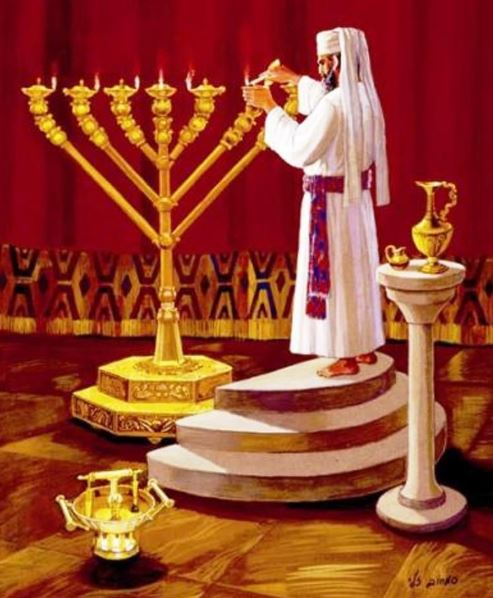
Kohen Lighting Temple Menorah (Courtesy: Temple Institute)
The Torah seems to be saying that any kohen with a physical disability or serious blemish is disqualified from serving God. Some are understandably distraught by this—after all, is it a person’s fault that they were born lame, or with dwarfism, or have a cancerous growth, or suffered a serious injury resulting in a disability? Why should this disqualify a person from serving God? Are they somehow “less” because of a disability? Why the apparent discrimination?
This position appears to be exacerbated by a Talmudic teaching that “the Shekhinah only rests upon a person who is wise, strong, wealthy, and of great statute.” (Shabbat 92a) A similar teaching elsewhere is that “the Holy One, Blessed be He, rests His Shekhinah only upon one who is strong, and wealthy, and wise, and humble.” (Nedarim 38a) So, does that mean that if one is not physically strong or healthy, they cannot merit to have the Shekhinah dwell upon them? How do we make sense of these perplexing statements? Continue reading
Ten Divine Songs
In this week’s parasha, Beshalach, the Israelites safely traverse the Red Sea and erupt in joyous song. This song, Shirat haYam, the “Song of the Sea”, is so important that it was included in our daily prayers. The Zohar (II, 131a) describes it as a song of redemption, and one that causes Israel to be “crowned” when we sing it, which is why it is the very climax of Pesukei d’Zimra, right before going into the Shema and Amidah at the height of our prayers. The Zohar says one who sings Shirat haYam with full kavanah will merit to see the coming of Mashiach. At the same time, Midrash Shir haShirim Zuta lists it among history’s ten special divine songs. What are these ten unique songs and how do they parallel Creation and the Ten Sefirot? Continue reading