Tag Archives: Davidic Dynasty

Secrets of the Priestly Blessing

This week’s parasha (in the diaspora) is Nasso, the longest in the Torah. In it, we read how God commanded Moses to instruct Aaron and his priestly descendants to bless the people with the following formula:

יְבָרֶכְךָ יְהוָה, וְיִשְׁמְרֶךָ. יָאֵר יְהוָה פָּנָיו אֵלֶיךָ, וִיחֻנֶּךָּ. יִשָּׂא יְהוָה פָּנָיו אֵלֶיךָ, וְיָשֵׂם לְךָ שָׁלוֹם

Loosely translated: “God bless you and protect you; God shine His Face upon you, and be gracious to you; God lift His Face upon you, and place peace upon you.” (Numbers 6:25-27) This unique, enigmatic phrase carries tremendous meaning, and an interesting history, too. In fact, the oldest Hebrew inscription of a Torah verse ever found is this blessing!

In 1979, archaeologists in Ketef Hinnom near the Old City of Jerusalem discovered two small silver scrolls. After painstakingly unravelling the fragile scrolls (a feat that took three years), they discovered that they were inscribed with Birkat Kohanim, the priestly blessing, along with a few introductory lines. The scrolls have been dated back to the 7th century BCE, and are considered among the greatest finds in the history of Biblical archaeology.

What secrets are buried within the words of Birkat Kohanim?
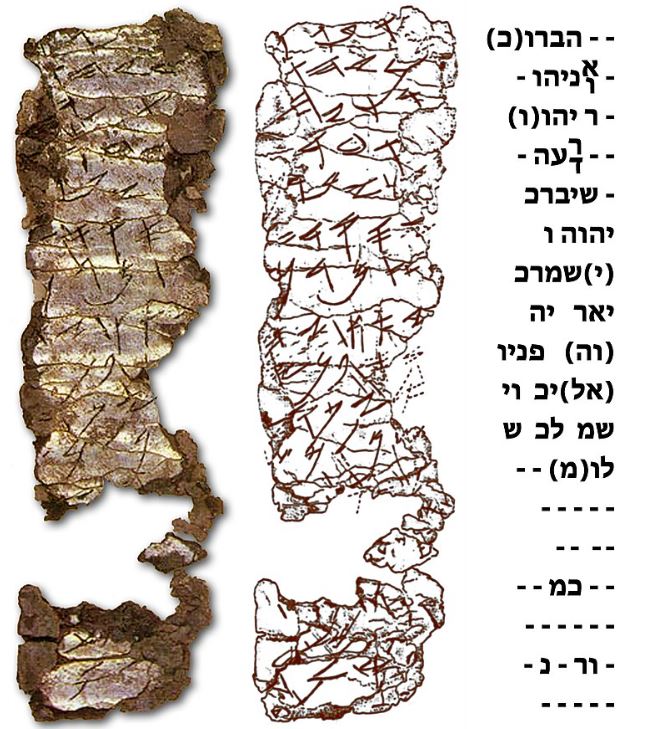
Silver scroll with priestly blessing, discovered near Jerusalem in 1979

Restoring Divine Light

In introducing the Priestly Blessing, the Torah commands koh tevarkhu, (כֹּ֥ה תְבָרְכ֖וּ), “thus shall you bless…” The Zohar (III, 146a) reminds us that koh is an allusion to the divine light of Creation. The value of koh (כה) is 25, hinting to the 25th word of the Torah, “light”. When Adam and Eve consumed the Fruit, that original divine light of Creation was concealed. This is the secret behind God calling to Adam: ayekah (איכה), usually translated simply as “where are you?” but really meaning ayeh koh, “where is the divine light?” Indeed, the very purpose of the kohen is to help restore some of that hidden divine light. This is why he is called a kohen!
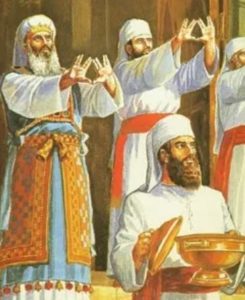
It is also why it is customary not to look directly at the kohanim when they relay the blessing. The hidden light may be far too intense, and might cause the observer’s eyes to dim (Chagigah 16a). The ancient mystical text Sefer haBahir (#124) adds that the kohanim put together their ten fingers in that unique arrangement in order to channel the energy of all Ten Sefirot. Elsewhere, we learn that the hands of the kohanim come together to roughly form an inner samekh, the only circular letter in the Hebrew alphabet, representing infinite cycles and endless blessings. Sefer haTemunah teaches that the proper shape of a samekh is a combination of a kaf and a vav. (The sum of the values of kaf and vav is 26, equal to the Tetragrammaton, God’s Ineffable Name.) Kaf literally means the “palm” of the hand, and the linear vav represents a shining ray of light.  These are the hidden rays of light, the light of koh, emerging through the hands of the kohanim as they bless.

In his commentary on the Torah, the Ba’al haTurim (Rabbi Yakov ben Asher, 1269-1340) states that koh reminds us also of the Akedah, when Abraham told his attendants that he and Isaac would go ‘ad koh, “until there”. The deeper meaning is that Abraham saw the divine light emanating from the top of Mt. Moriah, the future site of the Holy of Holies. This is how he knew exactly where to bind Isaac. Previously, God had already blessed Abraham with the words כה יהיה זרעך, that his offspring would be luminous (and numerous) like the stars (Genesis 15:5). The Ba’al haTurim adds that the Shema has 25 letters for the same reasons and, amazingly, the term “blessing” is mentioned 25 times in the Torah, as is the word “peace”!

The first line of Birkat Kohanim has three words and fifteen letters, the Ba’al haTurim points out, alluding to the three Patriarchs—Abraham, Isaac, and Jacob—whose lives overlapped for 15 years. Recall that Abraham had Isaac when he was 100 years old, and Isaac had Jacob at 60 years old, ie. when Abraham was 160. Since we know Abraham passed away at the age of 175, there were 15 years when all three Avot lived together.

More specifically, the first line of the blessing is for Abraham, the second is for Isaac, and the third is for Jacob. This is why the second line speaks of illumination since, as is well-known, Isaac saw the intensely bright divine light unfiltered at the Akedah, and this is the reason he later became (physically) blind. The Sforno (Rabbi Ovadia ben Yakov Sforno, 1475-1550) adds that within the second line of the blessing is a request for God to give light to our eyes so that we could see God within all things, in all the wonders of the world, and in all the wealth (material and otherwise) that God has blessed us with.

The Ba’al haTurim continues that the third line of Birkat Kohanim is for Jacob, which is why it begins with the word yisa (יִשָּׂ֨א), reminding us of Genesis 29:1 when Jacob fled (וישא יעקב רגליו). It has seven words to indicate the subsequent births of the Twelve Tribes, who were (except for Benjamin) born to Jacob over a span of 7 years. The last line again has 25 letters to remind us of koh, and further alludes to the Sinai Revelation—another burst of divine light—when God said (Exodus 19:3) “thus [koh] you shall speak to the House of Jacob” (כה תאמר לבית יעקב). The Ba’al haTurim concludes that the final word of the blessing, shalom, has the same numerical value as Esau (376) to teach us that one should spread peace among all people, gentiles included, and even Esau!

Ibn Ezra (Rabbi Abraham ben Meir ibn Ezra, 1089-1167) says that “peace” means complete peace, with not even a little stone or a wild animal to bother a person. Meanwhile, the Ramban (Rabbi Moshe ben Nachman, 1194-1270) says that “peace” here refers to shalom malkhut beit David, peace upon the kingdom of David and his dynasty. We may infer from this that it refers as well to geopolitical peace in Israel, and a request to hasten the coming of Mashiach. This is related to the Sforno’s interpretation, as he says the verse refers specifically to the World to Come in which, as described in the Talmud (Berakhot 17a), the righteous will bask peacefully in God’s glory.

May we merit to see it soon!


The above essay is an excerpt from Garments of Light, Volume Three.
Get the book here! 

The Zohar Prophecy of the Six-Day War

Tonight, we usher in Yom Yerushalayim, Jerusalem Day, commemorating the liberation of Jerusalem on the 28th of Iyar, 5727 (June 7, 1967) during the Six-Day War. As explored in depth before, Yom Yerushalayim happens to be on the day of Sefirat haOmer that corresponds to Chessed sh’b’Malkhut, literally “Kindness in Kingdom”. It is the first day, and first step, of the Malkhut week. In the same way, the liberation of Jerusalem on that day in 1967 was the first step towards re-establishing the ultimate Malkhut, God’s Kingdom, here on Earth, and restoring Malkhut David, the Kingdom of David in Israel. After all, it is King David who first established Jerusalem as Israel’s eternal capital. The aspect of Chessed on this day was that Yom Yerushalayim—and the entire miraculous Six-Day War in general—was a clear display of God’s Kindness. More amazing still, the Zohar seems to have exactly predicted this day many centuries earlier.

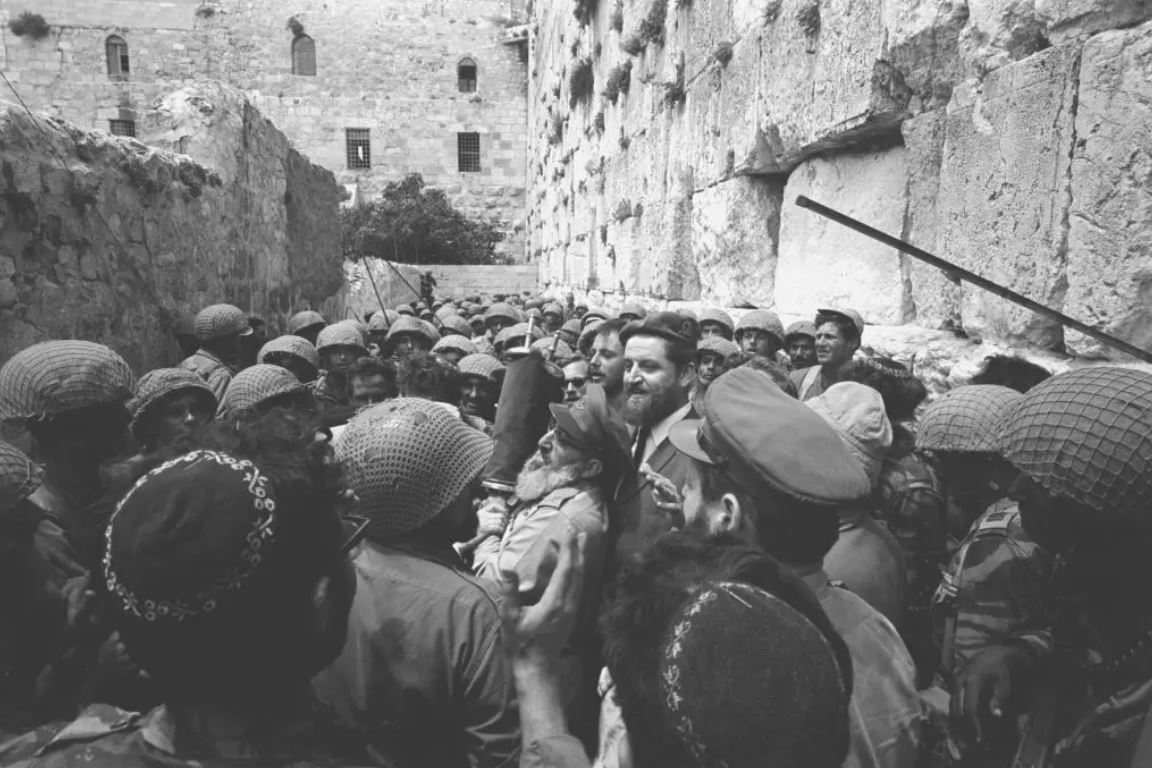
IDF Paratroopers that liberated Jerusalem, with Rabbi Shlomo Goren holding a Torah scroll, at the Western Wall on June 7, 1967.

In Zohar Chadash on parashat Balak, the Zohar comments on the End of Days prophecy of Bilaam. Recall that the gentile prophet Bilaam was hired by King Balak of Moab to curse Israel, but instead ended up blessing Israel. Within his blessing, he gave a prophecy of Acharit haYamim, the “End of Days” (Numbers 24:14, one of four places in the Torah where Acharit haYamim is mentioned). One of the things that Bilaam predicted was that in the far future (“I see it, but not now…”) the princes of Moab would be subdued. The Zohar Chadash expounds upon this verse and says:

In the End of Days, (according to the metaphorical “days”) when the sun will rise in the “Sixth Day”, when the cycle of years will work out in such a way that the Sabbatical and Jubilee will come together, which will happen 274 years [before the end] of the “Sixth Day”, a sound will go forth to arouse the great heights of the heavens…

The Zohar goes on to describe in detail the events that will happen in those final years, the “birth pangs of the Messiah”, culminating in the coming of Mashiach and his subsequent kingship. The Zohar employs the famous notion that each day of Creation corresponds to a millennium of civilization. Civilization as we know it is meant to last for 6000 years. The Messianic Age must come before the end of the sixth millennium, ie. the cosmic “Sixth Day”, to usher in the final Cosmic Shabbat millennium. The Zohar says that 274 years before the end of the Sixth Day there will be a Sabbatical Shemittah year, followed by a Jubilee (the 50th year of the Sabbatical cycle). So, if we count 274 years from the end of 6000, we get to the Jewish year 5726, or 1966. That year was indeed observed as a Sabbatical year in Israel. The following year, 5727 (corresponding to the end of 1966 and most of 1967), would have been a Jubilee. We also know that the Messianic Age is meant to begin after the conclusion of a Sabbatical year (as stated in multiple places in Midrash and Talmud, such as Sanhedrin 97a). Thus, it seems the Zohar posited long ago that the “Footsteps of the Messiah” period would begin in 1967.

This fits perfectly with what actually happened in 1967, when Israel miraculously routed all of its enemies in a mere six days (which, I think, is further symbolic of this Zohar prophecy that repeatedly speaks of the “Sixth Day” over and over again). More significantly, after two millennia, the Jewish people were once more in control of their holiest city and eternal capital, as well as the surrounding Biblical heartland of Judea and Samaria. Recall that Israel recaptured Jerusalem and the “West Bank” from the Jordanians. Jordan lies on the ancient territory of Moab, and the Zohar specifically gives this prophecy in its discourse on the verse that says the princes of Moab would be subdued!

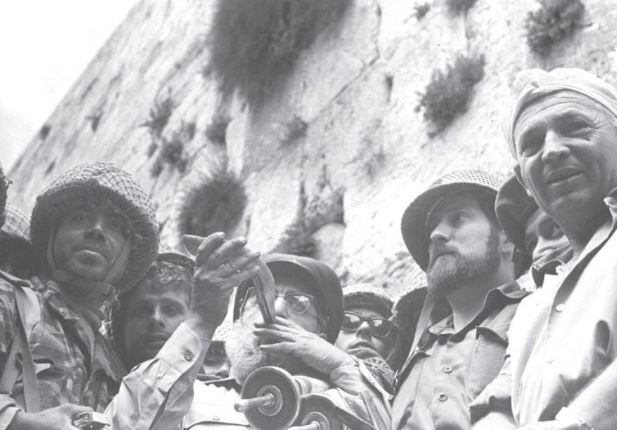
Rabbi Shlomo Goren blows the shofar by the Western Wall during the 1967 liberation of Jerusalem.

Finally, we can deduce from the Zohar that 1967 was a Jubilee year. The Torah states that in a Jubilee year, a shofar should be blown and “freedom should be proclaimed in all the land…” (Leviticus 25:10) This makes Rabbi Shlomo Goren’s blowing of the shofar at the Western Wall during the liberation of Jerusalem even more significant. It may very well be that the recapture and reunification of Jerusalem in 1967 formally began the pre-Messianic Age, and we are undoubtedly nearing the fulfilment of the rest of the incredible prophecies, too.

Happy Jerusalem Day!


*Postscript: Since first publishing this article, there have been some requests at clarification of the Zohar chronology. The exact language of the Zohar is רע”ד מן יומא שתיתאה, meaning “274 years from the sixth day”. Some interpret it to mean 274 years into the sixth day, meaning the year 5274. However, that year was not a shemittah year, so it cannot be the meaning of the Zohar. We have to say the Zohar means 274 years from the end of the sixth day, meaning 5726, and that year was indeed a shemittah. (Besides, the passage begins by saying this will happen at the End of Days, so we would expect a year closer to the final 6000.) Some have pointed out that certain commentaries say there is an alternate version of this Zohar that says 384 years, not 274, but using 384 is even more problematic since we do not get a shemittah year either counting from the start or from the end of the sixth day! I believe the only possible accurate reading is indeed “274 years from the end of the sixth day”.

Mashiach’s Ancestry

In this week’s parasha, Vayechi, we read how Jacob gives a final blessing to his children before his passing. In concluding Dan’s blessing, Jacob says that he is eagerly awaiting God’s salvation, liyeshuatkha kiviti Hashem (Genesis 49:18). What is this referring to? We would think that the salvation will come through Judah, progenitor of David and Mashiach, not through Dan! Indeed, when Jacob blesses Judah (49:10), he says that the royal scepter will remain in his hands all the way until the coming of Shiloh, traditionally interpreted as a name for Mashiach.

On Dan’s blessing, Rashi comments that Jacob foresaw the rise of Samson—from the tribe of Dan—and was praying that Samson would be successful. In fact, as we’ve discussed before, Samson was the potential Mashiach of his generation. (This is first brought down in the Midrash, Beresheet Rabbah 98:14.) Upon closer examination, there is actually a profound connection between the tribes of Judah and Dan.

Our Sages taught that Judah was the most illustrious of the tribes, while Dan was the lowliest. In the Wilderness, the tribe of Judah led the way, while Dan was at the back of the camp. Dan was tasked with being the “lost and found”, and picking up all the things left behind by the other tribes ahead of them. This brought them tremendous merit. On a mystical level, Dan’s role is really symbolic of our mission in “finding” and restoring the lost sparks of Creation to rectify the cosmos. Although people saw Judah as the greatest and Dan as the lowliest, God saw them both as equal, and declared that He will bring representatives from the two together to build His house (Shemot Rabbah 40:4).

As such, God chose Betzalel from the tribe of Judah, and Oholiav from the tribe of Dan to build the Mishkan. The same happened with the Temple in Jerusalem, built by King Solomon from the tribe of Judah, by using resources and labour from King Hiram, whose mother was from the tribe of Dan! (Midrash Tanchuma, Ki Tisa 13) And finally, in the same vein, Mashiach will come from the tribe of Judah paternally, but from the tribe of Dan through his maternal line. (Interestingly, it is possible that King David himself had this lineage, since some hold that his mother, Nitzevet bat Ada’el, was from the tribe of Dan, too.) The root of Yehudah is lehodot, to “thank” and be “grateful”, which is partly an aspect of Chessed, the right pole of “kindness”. The root of Dan is din, “judgement”, representing Gevurah, the left side of “severity”. It is fitting that we need both aspects, right and left, in balance to bring about rectification in the universe. Mashiach is an embodiment of that balance.

Jerusalem’s Coat of Arms

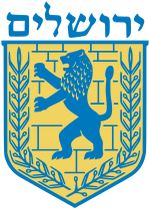
Another Midrash ties this to the reason why both Judah and Dan are described in the Torah as gur aryeh, a “lion cub”, the lion being the symbol of David and of Jerusalem. In Jacob’s finally blessing in this week’s parasha, it is Judah who is called gur aryeh, but in Moses’ final blessing (Deuteronomy 33), it is Dan who is the gur aryeh. The Midrash concludes that Mashiach will come from these two tribes, “his father from Judah and his mother from Dan” (Yalkut Shimoni I, 160). There is also an allusion to it in last week’s parasha, where we read the names of the 70 members of Jacob’s family that came down to Egypt. The only progeny of Dan is Chushim (חשים), an exact anagram of “Mashiach” (משיח)! According to a well-known tradition, it was Chushim who finally put an end to Esau, and so too will Mashiach put an end to the oppression of Edom.

While Dan is called a “lion” by Moses, in this week’s parasha he is called a “snake” by Jacob. This is because the lion was the symbol of the Davidic dynasty, but more specifically, the symbol of Mashiach himself is a snake (as explored in depth here). The famous gematria of “snake” (נחש) is equal to “Mashiach” (משיח), both being 358. This really goes all the way back to Eden, where the Serpent caused man’s downfall, and so it will be the “serpentine” Mashiach who reverses that event. In Kabbalistic sources, this is the meaning of Isaiah’s description of the great final battle between the nachash bariach and the nachash ‘akalaton, the “straight serpent” and the “twisted serpent” (Isaiah 27:1). The former is Mashiach, and the latter is the embodiment of evil that will be destroyed at the End of Days.

Mashiach’s Complex Lineage

When it comes to the specific lineage of Mashiach, we know that he is a direct descendant of King David, but do we have more exact information about his lineage? The pre-Davidic lineage is somewhat clear. It begins with Abraham, from whom there are 14 generations up to David (alluded to by the value of “David”, דוד, being 14!) The key figures in between are Judah, Peretz, and Boaz. Meanwhile, Abraham’s nephew Lot plays a big role, too. Following the destruction of Sodom and Gomorrah, Lot ended up being seduced by his own daughters—who assumed the whole world was destroyed and they had to repopulate the planet—giving birth to Moab and Ben-Ammi, the progenitors of the Moabite and Ammonite nations. From Moab came forth the princess Ruth, wife of Boaz and great-grandmother of King David. From Ammon came Na’amah, wife of King Solomon and mother of Rehoboam, who continued the Davidic dynasty in its third generation.

While we would assume that Mashiach is a direct descendant of David through his son Solomon, there is actually another opinion. The Zohar (III, 173b), for instance, notes that Mashiach might actually come not from Solomon, but from David and Batsheva’s third son, Nathan. (It appears that the Christians wanted to satisfy both rabbinic opinions when providing two different, contradictory genealogies for Jesus in the New Testament: one going through Solomon and one going through Nathan! The irony, of course, is that Christians think Jesus is the literal son of God, so what use is a human lineage anyway?) The dilemma gets more puzzling:

The Zohar says Nathan’s wife was called Heftzibah, and their son was Menachem ben Amiel, an epithet for Mashiach. The problem is that we also know King Hezekiah’s wife was named Heftzibah. Hezekiah was the most righteous king since his forefather David, and is certainly a progenitor in the line of Mashiach. The Talmud (Sanhedrin 98b) states that Hezekiah himself should have been Mashiach, and despite being totally righteous, had one missing quality (for more, see ‘Who is Mashiach?’). The son of Hezekiah and Heftzibah was Menashe, Judah’s longest-serving monarch. Menashe had the potential to be Mashiach, too (and did merit the longest royal reign) but fell to idolatry and wickedness. King Menashe was yet another failed messiah. Some have argued that Menachem ben Amiel and Menashe must be referring to the same person (at least spiritually). Yet Menashe comes from Solomon, and Menachem is supposed to come from Nathan. How do we solve this dilemma?

Pirkei d’Rabbi Eliezer comes in and, at first glance, complicates the problem further. It states (in Ch. 19) that Menachem ben Amiel is a descendant of Joseph, so he is more likely Mashiach ben Yosef, not Mashiach ben David. We might therefore conclude two things: That both Mashiach ben David and Mashiach ben Yosef are actually descendants of King David, the former through Solomon and the latter through Nathan. And, perhaps, just as the former is maternally descended from the tribe of Dan, the latter is maternally descended from the tribe of Joseph. (Maybe Heftzibah the wife of Nathan was a descendant of Joseph?)

The reality is that a person can be a direct descendant of multiple figures, especially after so many generations and so many marriages in between. Today, all Jews are Yehudim, and by default “Judeans”—even Kohanim and Levi’im are Yehudim! So, there is no reason why Mashiach ben Yosef cannot be a descendant both of Joseph and of David. He would undoubtedly be a Yehudi after all! Intriguingly, even David is called an Efrati, apparently with Ephraimite lineage in his past (see I Samuel 17:12, which begins וְדָוִד בֶּן־אִישׁ אֶפְרָתִי).

As it stands today, all the tribes have long thoroughly intermixed, and the exact lineage is no longer of significance (nor is it even traceable). What’s important are the key qualities that Mashiach must possess, and the ability for inspiring leadership and for dignified kingship, as well as, most significantly, to accomplish the tasks set out in the Tanakh (and as codified by the Rambam in Hilkhot Melakhim).

When Mashiach does come, he will merit to wield the serpentine Staff of Moses—that special tool fashioned by God at the twilight of the Sixth Day of Creation (Avot 5:6). And who will provide him with that staff? None other than the returning Heftzibah, the Mevaseret Tzion, and a fierce warrior in her own right who has the power to “slay kings”, as described in the little-known ancient Sefer Zerubavel:

“…the staff of Aaron and Moses and David king of Israel, the staff which flowered in the Tent of Meeting, and brought forth blossoms and produced almonds. And Eliyahu son of Elazar hid it in Raqat [in the territory of Naftali], which is Tiberias, and there was hidden Mashiach ben Ephraim.”

And Zerubavel ben She’altiel said to Michael [the angel]: “If it please my Lord, when will come the light of Israel? And what will be after all this?” And he said to me: “Mashiach ben Yosef will come five years after Heftzibah, and will gather all Israel as one man, and then the king of Persia will come up against Israel and there will be great distress in Israel. And Heftzibah the wife of the prophet Nathan will go out with the staff which the Lord will give her, and the Lord will make a spirit of confusion enter them, and they will slay one another, and there the wicked will die…”

Liyeshuatkha kiviti Hashem!