
In this week’s parasha, Pinchas, we read about the righteous daughters of Tzelofchad. Recall that the five daughters (Machlah, Noa, Haglah, Milkah, and Tirzah) had no male siblings, and their father had passed away, so they inquired about their inheritance. Are daughters allowed to inherit? It might sound like a straight-forward “yes”, but it was much more complicated in ancient Israel. Continue reading
Tag Archives: Leah
Eye-Openers from the Book of Jubilees
Parashat Behar begins with the command to observe shemitah, the Sabbatical year, and to proclaim a yovel, “Jubilee”, every 50th year after seven such cycles. The 50th year is a particularly special one, where “freedom shall be proclaimed”, slaves are freed, and all property returns to their ancestral owners. This is one of several incredible mitzvot which demonstrate the Torah’s strong emphasis on socio-economic equality and justice.
In the ancient Jewish world, the Jubilee was an important milestone for tracking the passage of time. For example, the Talmud (Arakhin 12b) calculates how long each Temple stood in terms of the number of Sabbaticals and Jubilees elapsed, and that there were exactly 17 Jubilees between Israel’s entry into the Holy Land and their exile by the Babylonians. In fact, there is an entire book, known as Jubilees, written some time in the Second Temple era which divides the early history of Israel and the world into segments of Jubilees. This intriguing text is one of the most controversial books from that era.
It is unknown who wrote Jubilees, but it itself claims to be a revelation given to Moses by the angels upon Mt. Sinai. Moses is the subject of the book, the “you” to whom the angels are speaking. It presents a comprehensive history from Creation until the given of the Torah on Mt. Sinai, organized into 50 Jubilees. The book holds that a Jubilee year, the fiftieth year, is also the first year of the next shemitah cycle. This means that a complete cycle is not 50 years, but 49 years. That’s precisely the debate in the Talmud page cited above. The Sages question whether the Jubilee year is the first year of the next shemitah or not. Rabbi Yehuda insists that it does, which is just one example of the Book of Jubilees overlapping with traditional Judaism.
Having said that, our Sages did not include Jubilees in the Tanakh. Although it reads very much like a Biblical book, it was excluded from the canon. This was not the case among Ethiopian Jews, who surprisingly did include Jubilees in their Tanakh! The same is true for the Ethiopian Orthodox Church. Many ancient Christian scholars referenced Jubilees, too, while modern scholars have shown that Jubilees was an important book for the Maccabees. The Hasmonean dynasty that followed made extensive use of it, as did the priests of the late Second Temple era. Among the Dead Sea Scrolls, Jubilees is one of the most prevalent texts, more than all other books of ‘Nakh except Psalms and Isaiah. All of this proves that the Book of Jubilees was of great significance in olden days, and greatly influenced Judaism (and Christianity). Intriguingly, some scholars have shown that Jubilees had an even greater impact on Islam, and much of the Quran was clearly inspired by it (see the work of Jan van Reeth for more).
In traditional Jewish texts, too, especially in Midrash and Kabbalah, there are numerous teachings which overlap with Jubilees. In fact, Jubilees may be the earliest known written source for some foundational points of Judaism today. For example, in chapter 7 we see the first description of God giving a set of laws to Noah. A careful count shows there are seven. The Torah does not explicitly say anything about a code of law given to Noah, but Jewish tradition of course speaks of seven “Noahide” laws.
In Jubilees, these laws are: 1) be just and righteous, 2) dress modestly, 3) bless the Creator, 4) honour parents, 5) love your fellow, 6) abstain from sexual sins, plus 7) the prohibition of eating the limb of a live animal which was relayed a bit earlier in the text. In the Talmud (Sanhedrin 56a-b), the Noahide laws are: 1) establish courts of law, 2) bless the Creator, 3) do not worship idols, 4) abstain from sexual sins, 5) do not murder, 6) do not steal, and 7) do not eat the limb of a live animal.
The first law in Jubilees and the Talmud is one and the same: being just implies having a justice system, ie. establishing courts of law. The second in the Talmud is phrased as “blessing Hashem”, just like the third in Jubilees, but is taken to mean not to curse Hashem, since we don’t expect gentiles to know Hebrew blessings. In any case, it is the same law. Not to engage in sexual sins and not to consume the limb of a live animal are the same. All in all, four of the seven are identical, and there are some parallels between the other three.
Another idea that finds its earliest expression in Jubilees is the concept of a messianic “millennium” (23:18-29). After a series of great travails, the world will enter an idyllic age that lasts one thousand years, with no evil and Satan destroyed. This is similar to descriptions in the Talmud (see, for instance, Sanhedrin 97a).
A final example: Jubilees states that God created seven things on the First Day: Heaven and Earth, water, spirits, darkness and light, and the abyss (tehom, as in Genesis 1:2). This is essentially identical to the Midrash (Pirkei d’Rabbi Eliezer, ch. 3), which says eight things were created on the First Day: Heaven and Earth, water, the Divine Spirit, darkness and light, and tohu v’vohu (also in Genesis 1:2), which can be seen as two parts of the tehom.
The Book of Jubilees presents many more fascinating details. Although not officially accepted in the Jewish canon, we see that it does contain a great deal of accurate information that is also in accepted Jewish texts. This makes it a potentially very useful tool to shed light on some of the big mysteries in Judaism. What follows is a list of some of the most intriguing and perhaps controversial teachings from the Book of Jubilees.
The above is an excerpt from Garments of Light, Volume Two. To continue reading, get the book here!
The Mystical Connection Between Jacob and David
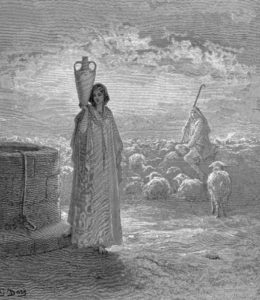
‘Jacob Keeping Laban’s Flocks’ by Gustave Doré
In this week’s parasha, Vayetze, we read how Jacob journeys to his relatives in Charan and the details of his twenty-year sojourn there. He falls in love with Rachel at first sight, then works tirelessly for seven years for the privilege of marrying her. When that fateful day comes, his father-in-law Lavan tricks him into marrying Rachel’s sister, Leah. Jacob is then forced to work another seven gruelling years. We read how Jacob didn’t care very much for Leah, as he only truly wanted to marry Rachel, and Leah felt entirely unloved. One question to ask is why Jacob didn’t simply divorce her? He had no intention of marrying Leah in the first place. One can argue that the marriage was null and void from the beginning, since a person must be aware of whom they are marrying. Why did Jacob stay with her? A number of explanations have been given for this:
The simplest is that Jacob pitied her. Lavan tricked Jacob into marrying Leah because she had no suitors. She would have grown old, all alone, and Jacob did not want to abandon her once they had been “married”. Another take on this is that Rachel was the one that deeply pitied her sister, and herself asked Jacob to stay married to Leah. One version of this story has it that Rachel even instructed Leah in how to play the part of Rachel so that Jacob wouldn’t be able to distinguish between them (see Bava Batra 123a).
From a spiritual perspective, this whole thing can be seen as one big middah k’neged middah—“measure for measure”—consequence: since Jacob had tricked his father into taking his brother’s blessing, he was now, in turn, tricked by his father-in-law. On a deeper level, we have written before how, when Jacob took his brother’s birthright and blessing, he essentially took on his brother’s mission in life. In the original conception of things, Jacob and Esau should have been twin holy warriors, with Jacob fighting the spiritual battles and Esau fighting the physical battles for God. When Esau failed, Jacob took over that mission. This is symbolized by the new name he was given: Israel, one who “fights with [or, alongside] God”. Jacob is unique in that the Torah continues to shift between his new and old name (whereas, for example, once Abram became “Abraham”, he is never again referred to as “Abram”). This is because Jacob and Israel are not old and new names, but rather dual names, for his dual personalities, representing his dual missions.
In the original plan, Jacob was meant to marry Rachel, and Esau was meant to marry Leah. (According to at least one opinion, Rachel and Leah were also fraternal twins, like Jacob and Esau; see Seder Olam Rabbah, ch. 2.) Once Jacob took over Esau’s mission and birthright, he also took on his wife. This is why he had to marry her! And he knew it all along. The Midrash states that Jacob initially feared marrying Leah because Esau would come after him for it! (Midrash Tanchuma, Vayetze 12 in Buber edition.) Meanwhile, another Midrash says that Jacob did love Leah, but turned away from her when she pointed out that her father tricked Jacob in the same way Jacob had tricked his own father, measure for measure (Lekach Tov on Genesis 27).
Whatever the case, their marriage was an unhappy one. Leah always felt unloved, and named all of her kids in relation to her hope that her husband would finally cherish her. He didn’t. Meanwhile, the wife he did love—Rachel—was barren for many years, and this strained their relationship tremendously (Genesis 30:1-2). It is little wonder that when Jacob meets Pharaoh decades later, he tells him that his whole life has been miserable (Genesis 47:9).
Jacob made many mistakes in his life, and such mistakes, of course, need rectification. This is where the Arizal (Rabbi Isaac Luria, 1534-1572) comes in, explaining how Jacob’s life was rectified in the life of King David.
David and Abigail
In Sha’ar HaGilgulim, “Gate of Reincarnations”, Rabbi Chaim Vital (1543-1620, the Arizal’s primary disciple) details Lavan’s various incarnations. Lavan’s soul was originally rooted in Abel, the son of Adam. The holy part of Abel (הבל), symbolized by the letter hei, was reincarnated in Moses (משה, whose other two letters come from Shem, שם, who was also incarnated in him), while his evil part, symbolized by bet-lamed, reincarnated in Lavan (לבן). Lavan was unable to rectify this part of Abel, and descended into sorcery and evil. Unrepaired, he had to reincarnate once more, as Bilaam (בלעם), the “non-Jewish version” of Moses. Thus, when Moses and Bilaam go head-to-head later in the Torah, they are actually two ancient halves of Abel!
As we know, Bilaam also descended into sorcery and evil, so he had to reincarnate again. This time around, he comes back as Naval (נבל). Recall that Naval was a very wealthy man, “with three thousand sheep and a thousand goats” (I Samuel 25:2). At the time, David and his loyal soldiers were encamped in Carmel, and protected Naval’s shepherds. This was before David had consolidated his monarchy, when King Saul had refused to give up the throne and sought to get rid of David.
David eventually reached out to Naval and asked for his help. He reminded Naval that his soldiers had watched over Naval’s flocks and shepherds, and ensured no harm came upon them. Instead of showing his gratitude, Naval rebuffed David’s messengers. This was wrong for a number of reasons, including the fact that David was already the rightfully-anointed king of Israel, and refusing a king in such a way carries a capital punishment. David armed four hundred of his men and headed towards Naval.
Naval’s wife Abigail got word of what was going on, and went out to greet David and pacify him. She took with her “two hundred loaves, and two bottles of wine, and five sheep ready dressed, and five measures of parched corn, and a hundred clusters of raisins, and two hundred cakes of figs” as a gift (25:18). While David was angrily racing towards Naval and thinking “he has returned me evil for good” and intending to exterminate his entire household (25:21-22), Abigail suddenly appeared. She placates him with a beautiful soliloquy (25:24-31), to which David responds:
Blessed be Hashem, the God of Israel, who sent you this day to meet me; and blessed be your discretion, and blessed you be, that you have kept me this day from bloodshed, and from finding redress for myself with my own hand.
David spares Naval, and sends Abigail back home in peace. Although David was merciful, God was not, and He struck Naval with what appears to be a heart attack: “his heart died within him, and he became as a stone” (25:37). In the aftermath of the narrative, David ends up marrying the widowed Abigail, and she becomes one of his most important and beloved wives.

Abigail meets David
Jacob Reincarnated
In the same way that Lavan reincarnated in Naval, Jacob returned in David. Upon closer examination, the parallels between them are striking. Jacob was the father of the Twelve Tribes, and David was the king that unified the Twelve Tribes into one cohesive kingdom (establishing the only divinely-approved dynasty). Jacob is the one that prayed in Jerusalem at Beit El, literally the “House of God”, placing twelve foundation stones there in his vision of the future Temple, and David was the one that actually acquired Jerusalem and paved the foundations for the Temple at that same Beit El site. Jacob is the only patriarch of whom it is said that he never “died”, just as it is common to sing David melekh Israel chai v’kayam, King David lives on. (The Ba’al HaTurim, on Genesis 32:12, points out many more connections between Jacob and David.)
Jacob’s first flaw was in slaving away for Lavan partly because of his physical desire for the beautiful Rachel (as we see in Genesis 29:21). This was rectified in David because he slaved away for Naval without any ulterior motive, and certainly with no desire for the beautiful Abigail (among the most beautiful women of all time, as per Megillah 15a). Just like Lavan tricked Jacob out of his rightful wages, Naval tricked David out of his rightful wage. Whereas Jacob fled from Lavan and was pursued by Lavan’s army, this time around it was David who had the military might on his side and pursued Naval.
Ultimately, David restrained himself from violence—not stooping to the level of Lavan/Naval—and God took care of the problem for him. He was rewarded with Abigail. And who was she? The Arizal reveals that she contained the spirit of Leah! (Incidentally, the gematria of אביגיל is 56, equal to כלאה, “like Leah”). The first time around, Jacob worked for Rachel and spurned Leah, making her feel “hated”. This time, David rectifies the mistake of his past life by essentially working for Leah, and marrying her willingly and lovingly.
To be clear, the Arizal does not state all of the above explicitly, though it may be extracted from his teachings, as recorded in Sha’ar HaGilgulim (particularly chapter 36). We must keep in mind that Rabbi Chaim Vital’s (together with his son Rabbi Shmuel Vital’s) transcription of his master’s teachings was not perfect, as he himself admits in many instances. He often introduces a statement, or an alternate teaching, with the words נראה לפי עניות דעתי, “it appears, from my limited knowledge…” Sometimes, he also adds פעם אחרת, that “another time” he apparently heard something different.
In the present discussion, the main teaching of the Arizal is actually of a different nature, taking the souls of Jacob and Lavan, Rachel, Leah, and David all the way back to Adam and the “Original Sin”.
Adam and the Snake
The Arizal taught that the Nachash (loosely translated as “snake” or “serpent”) caused Adam to waste two seminal drops. These two seminal drops carried the souls of Rachel and Leah. Lavan carried the essence of the Nachash who had imprisoned those souls. Jacob worked hard in order to free them from Lavan and marry them, because Jacob was a reincarnation of Adam and sought to reunite with those lost spiritual sparks of his. Jacob succeeded in fulfilling this tikkun.
Rachel and Leah were actually sparks of Adam, and parts of Jacob’s own soul. (In addition to the fact that, as Rabbi Vital reminds, a man infuses a part of his own soul into a woman when the two are intimate.) That spirit within Rachel then migrated into her son Benjamin, which is why the Torah tells us that Benjamin was born “when her soul left her” (Genesis 35:18), ie. left Rachel and entered him. The spirit within Leah, meanwhile, went into Abigail. This is why, in one place in Scripture (II Samuel 17:25), she is called Avigail bat Nachash, “Abigail, the daughter of Nachash” (or Avigal bat Nachash), as her spirit had come from those souls taken by the Serpent.
Alternatively, Avigail bat Nachash is not the wife of David, but actually the name of his sister, who was also called Abigail (or Abigal). Rabbi Vital points out (introducing it with those uncertain words פעם אחרת נראה לפי עניות דעתי) that the spirit within Leah split between Abigail the wife of David and Abigail the sister of David, for a completely different tikkun. This was a rectification for the fact that Jacob married two sisters—something explicitly forbidden by the Torah. (To be fair, Jacob lived before the official giving of the Torah.) To fix that error, Leah partially came back within David’s own sister whom, of course, he did not marry, and instead loved like a brother.
If all of this soul migration and rectification sounds complicated, that’s because it is! There are countless souls, each made up of thousands of sparks, all of which are dynamically moving through us, passing throughout history, jumping across space and time, and quietly weaving themselves into the tapestries of our intriguing lives.