Tag Archives: Shabbat (Tractate)

Torah on the Big Bang and the Age of the Universe

The Torah begins with Beresheet, the famous account of Creation.  In recent times, many have questioned the validity of this narrative in light of the findings of modern science. In reality, the Torah’s account is quite accurate in scientific terms, and the Jewish tradition described the origins of the universe and its age with stunning precision centuries before modern science caught up.

According to Science

The current scientific model holds that 13.7 billion years ago, the entire universe was compacted into a super tiny point with infinite density. For some unknown reason, this point suddenly burst in a massively vast and rapid expansion of energy and radiation. As the early universe cooled and expanded, particles began to form, and then whole atoms, starting with hydrogen. Hydrogen atoms fused into helium atoms, and later on heavy elements formed from further fusion in the cores of stars and their explosions. Everything that we see today—the entire universe and all matter within it—emerged from that initial expansion, “the Big Bang”.
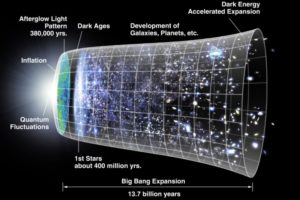
The evidence for a Big Bang is extensive. In fact, you can see some of it when you look at the “snow” on an old television that is not tuned to any channel. The antenna is picking up some of the cosmic microwave background radiation, the “afterglow” of the Big Bang. The entire universe is still glowing from that initial expansion! Popular physicist Brian Greene writes in his bestselling The Hidden Reality (pg. 43):

…if you were to shut off the sun, remove the other stars from the Milky Way, and even sweep away the most distant galaxies, space would not be black. To the human eye it would appear black, but if you could see radiation in the microwave part of the spectrum, then every which way you turned, you’d see a uniform glow. It’s origin? The origin.

The universe is glowing, it’s just that most people cannot see it because human eyes perceive only a very narrow part of the electromagnetic spectrum, which we call “visible light”. Light of a higher energy and frequency includes dangerous x-rays and gamma rays, while light of lower energy and frequency includes microwaves and radio waves. The seeming blackness of the universe is actually radiating with light—we simply cannot see it. Incredibly, this is precisely what the Torah states.
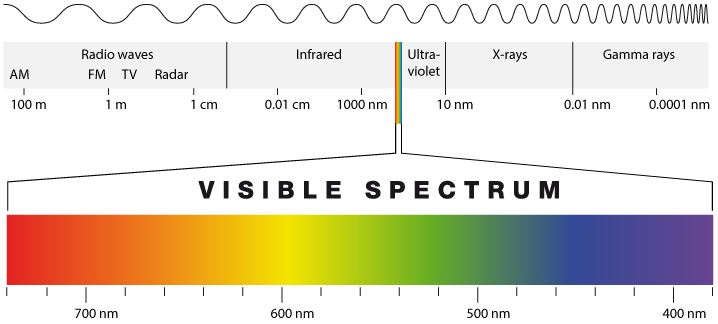
The electromagnetic spectrum. Visible light makes up just a tiny sliver of the spectrum. Some living organisms can see in UV or infrared wavelengths.

Zohar haRakia

We read in the Tanakh (Daniel 12:3) that “they who are wise shall shine as bright as the rakia…” The Torah tells us that God established a rakia (wrongly translated as “firmament”) on the second day of Creation, and this is where all the stars and planets are suspended (Genesis 1:15). The Talmud (Chagigah 12a), composed over 1500 years ago, further elaborates that above the earth is the vilon, the atmosphere that stretches over the planet, and beyond the vilon is the rakia, a vast expanse within which are all the stars. Beyond the rakia is a region called shechakim, the interface between the physical and spiritual realms, and further still are the highest levels of the Heavens, inhabited by angels and transcendental beings. From this, and other ancient sources, it is clear that rakia refers to outer space.

Daniel tells us that the wise will shine like the rakia, and goes on to state that “they who turn the many to righteousness [shall shine] as the stars”. We can understand how people might shine bright like stars, but why would Daniel say the rakia is shining? Outer space is totally dark! Of course, as Brian Greene described, today we know that the universe is indeed glowing.

One of the most ancient Jewish mystical texts is Sefer HaBahir. According to tradition, it dates back some two thousand years, and was first published at least seven hundred years ago. This book gets its name from another verse in the Tanakh (Job 37:21), which states “And now, men do not see the light that is bright [bahir] in the skies.” Once again, Scripture tells us that the universe is glowing with a bright light that humans are unable to perceive. Science has found that this glow comes from the Big Bang, and this too is accurately described by the most famous of Jewish mystical texts, the Zohar.

Cosmic Microwave Background Radiation, the glow of the universe, discovered in the 1960s by Robert Wilson and Jewish physicist Arno Penzias.

The Secret of Beresheet and the Big Bang

Like Sefer HaBahir, the Zohar was first published around seven hundred years ago, with its teachings dating back two millennia. The Zohar is a parasha-by-parasha commentary on the Torah, and naturally begins with the first section in describing Creation. The book gets its name from the above verse in Daniel which speaks of Zohar haRakia, the glow of the universe. It elaborates (I, 2a, 15a):

בְּשַׁעְתָּא דִּסְתִימָא דְכָל סְתִימִין בָּעָא לְאִתְגַּלְּיָא, עֲבַד בְּרֵישָׁא נְקוּדָה חֲדָא, וְדָא סָלֵיק לְמֶהֱוֵי מַחֲשָׁבָה. צַיֵּיר בָּהּ כָּל צִיּוּרִין חָקַק בָּהּ כָּל גְּלִיפִין… וְרָזָא דָא, בְּרֵאשִׁית בָּרָא אֱלֹהִים. זֹהַר, דְּמִנֵּיהּ כָּלְהוֹ מַאֲמָרוֹת אִתְבְּרִיאוּ בְּרָזָא דְאִתְפַּשְׁטוּתָא דִנְקוּדָה דְּזֹהַר סְתִים דָּא

When the Most Concealed One [God] began to create, He first made a singular point, with which he then brought forth all thought, drew all blueprints, and carved out all things… And the secret of “In the beginning, God created…” [Genesis 1:1] is radiance [zohar], from which all Utterances were created, in the secret of the expansion of that point of radiance.

Many centuries ago, the Zohar accurately and elegantly sums up the findings of modern science. God first created a tiny singular point which burst forth in light, and from which He “carved out” all things in existence. All of God’s Utterances (since the Torah says God created by speaking: “And God said ‘Let there be light.’”) came forth from the expansion of that initial primordial radiance.

Time is Relative

All that remains is the seeming contradiction in time. Science estimates 13.7 billion years, while the Torah speaks of six days. Of course, the nature of a “day” in the account of Creation is flexible, considering there was no Earth, sun, or moon until the third and fourth days (so how could there be a 24 hour day as we know it before this?) There were also no humans at this point, and the Torah describes Creation from the perspective of God, for whom “a thousand years is like one passing day” (Psalms 90:4). The fact that time runs differently for man and God actually highlights another scientific principle, as revealed by Albert Einstein.

Einstein’s theory of relativity holds that the passing of time varies depending on an entity’s speed. A person who could board a spaceship and fly near light-speed would experience very slow time. A few days for this person would be equivalent to many years on Earth. (This theme has been explored in countless science fiction books and films, including 2014’s Interstellar.) The Lubavitcher Rebbe often cited this fact to conclude that arguing about apparent space-time contradictions is therefore quite pointless. Meanwhile, physicist Gerald Schroeder has mathematically calculated that six days could be equivalent to 13.7 billion years when factoring in the universe’s expansion. After all, we are looking back in time at an ancient universe through human eyes, while God was looking forward in time from the universe’s first moments.
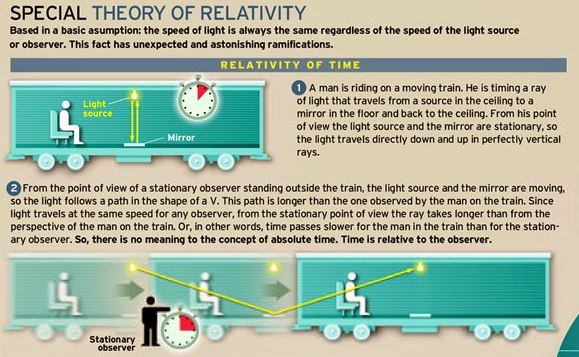
An infographic explaining the relativity of time. Note the conclusion: “there is no meaning to the concept of absolute time.” The whole debate of 6 days vs 13.7 billion years is therefore quite meaningless.

Physicist and Rabbi Aryeh Kaplan explored this issue extensively and cites multiple ancient Jewish texts that support the notion of a very ancient universe (see his book Kabbalah and the Age of the Universe). In multiple places, the Midrash states that before creating this world, God was creating and destroying many previous worlds (see, for example, Kohelet Rabbah 3:14), while the Talmud calculates that “there were 974 generations before Adam” (Chagigah 13b, Shabbat 88a).

On this last point, it has been shown that a generation according to the Torah is forty years (Numbers 32:13), and as we saw, a day for God is likened to 1000 human years (Psalms 90:4), therefore:

            974 generations × 40 years/generation × 365 days/year × 1000 human years/divine day =

14.2 billion years

Compared to the current best estimate of science at 13.7 billion years, it is amazing that one can come to a very similar number by simply putting together a few Torah verses.

What we see from all of the above is that ancient Jewish texts describe the universe’s origins in absolutely perfect detail. And it is only in recent decades that science has finally caught up. In many other ways, too, science has a lot of catching up to do.


The above is an excerpt adapted from Garments of Light: 70 Illuminating Essays on the Weekly Torah Portion and Holidays. Click here to get the book! 
Should Jews Believe in Astrology?

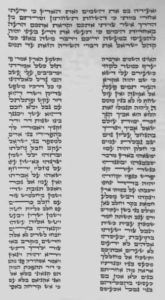
This week’s parasha, the second last of the Torah, is Ha’azinu. This parasha is unique in that it consists almost entirely of one lengthy song – clearly visible when looking at a Torah scroll, where the text of Ha’azinu is split into two narrow columns. Moses sang this prophetic song to the nation right before his passing.

Two columns of parashat Ha'azinu

Two columns of parashat Ha’azinu

In the verses that introduce it (Deut. 31:19), we see God commanding Moses to write the song and “teach it to the Children of Israel. Place it in their mouths so that this song will be for Me a witness for the Children of Israel.” God wanted Moses to diligently teach this song to the entire nation. In fact, the actual wording of the verse has God commanding everyone – each member of the nation – to write the song for themselves. It is based on this verse that the Sages drew the mitzvah of writing a Torah scroll (or participating in writing one), even though the plain text of the verse states only to write this particular song, Ha’azinu.

Perhaps because of this, the Ramban taught that Ha’azinu contains the entire Torah within it. Moreover, he believed that every detail of every person’s life is somehow encoded within this song! In one famous story, when a student of the Ramban, a man named Avner, heard this teaching, he was so baffled by it that he left Judaism entirely, converted to another religion, and became a prominent anti-Semite. When Avner later confronted the Ramban, the Rabbi showed him how one verse in the song did indeed accurately point to this man’s life. Avner was so ashamed that he disappeared, never to be heard from again.

Heavenly Princes

And so, each and every one of the song’s 43 verses has a great deal to teach us. The eighth verse begins by telling us that God gave each nation their lot, and the ninth verse says that “Hashem’s portion is His people, the lot of His inheritance.” The Zohar comments on these words that while God established Heavenly “princes” to watch over every nation in the world, Israel is watched over by God Himself. The Ramban (in his Discourse on Rosh Hashanah) elaborates:

He gave each and every nation… some known star or constellation, as is known by means of the science of astrology… Higher above [the constellations] are the angels of the Supreme One, whom He appointed as “princes” over them… It is further written, “So shall you be My people, and I will be your God, and you will not be subject to other powers at all.” (Jeremiah 11:4)

When we often say that Hashem is our God (as we do in the daily Shema), or when the Tanakh writes that we are God’s people, this does not mean that gentiles cannot have a relationship with God, or that there are other gods out there for the non-Jewish world. Rather, it means that while God oversees absolutely everything in His universe, and has created all people, He has also appointed various Heavenly (or astrological) forces above each nation – except Israel. These forces are not independent in their own right, as they are subject to the angels above them, and these angels ultimately serve God. As such, the nations of the world have various Heavenly intermediaries between themselves and Hashem. Israel, however, has a direct connection to Him. In fact, this is the hidden meaning within the name “Israel” (ישראל), which can be read as yashar El. (ישר-אל), “straight to God”.

Ain Mazal L’Israel

Long before the Ramban, the Sages of the Talmud debated whether the constellations had an effect on people (Shabbat 156a). The consensus of the Rabbis was that constellations do impact people, but Jews are free from this influence. They learn this from the prophet Jeremiah, who prophesied: “Thus said Hashem: Learn not the way of the nations, and be not dismayed at the signs of heaven, for the nations are dismayed at them.” (10:2) God tells Israel not to draw meaning from heavenly signs as the other nations do. The Talmud goes on to tell us a story about Abraham, who cried out to God: “Master of the Universe! I have looked at the constellations and find that I am not fated to have children.” To this, God replied: “Stop your star-gazing! Israel has no constellations.”

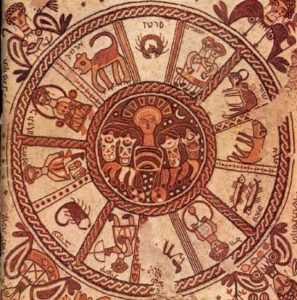
Hebrew Zodiac from a 6th Century Synagogue

Hebrew Zodiac from a 6th-Century Synagogue

Elsewhere, the Talmud tells us that Abraham was once a powerful astrologer, and great men from around the world came to consult with him about their fortunes (Bava Batra 16b). When Abraham looked into his own fate, he saw that he would not have children. God commanded him to desist from astrology, for the Jewish people have the power to transcend the stars. Of course, Abraham went on to have many children.

Later on, Moses would record in the Torah the prohibition for Jews to consult various fortune-tellers and astrologers. The Rambam codifies the law in this way:

It is forbidden to tell fortunes. [This applies] even though one does not perform a deed, but merely relates the falsehoods which the fools consider to be words of truth and wisdom. Anyone who performs a deed because of an astrological calculation or arranges his work or his journeys to fit a time that was suggested by the astrologers is [liable for] lashes, as [Leviticus 19:26] states: “Do not tell fortunes.”
(Sefer HaMadda, Hilchot Avodah Zarah, Chapter 11, Halacha 9)

Transcending Nature

We see from the above that various Heavenly forces, angels, and constellations do exist, and certainly do influence the world. Astrological signs can be potent forces. Ironically, earlier in his discourse, the Ramban points out how astrology is intricately tied into the Jewish calendar: it is no coincidence that Pesach is celebrated in the month of Nisan, the sign of which is Aries (the ram, or sheep), since the main mitzvah of Pesach was to sacrifice a lamb; and it is no coincidence that Rosh Hashanah – judgement day, when each person is put on trial – is in the month of Tishrei, the sign of which is Libra, the scales of justice. The Midrash (Yalkut Shimoni, Shemot 418) even tells us how each of the 12 Tribes of Israel corresponds to one of the 12 astrological signs of the zodiac!

And yet, all the sources are clear: Jews are not to dabble in astrology, for we have no need for intermediaries, and we have all the power to break free from the influence of the constellations. It is precisely when we believe in astrology that it becomes real, just as Abraham had no children as long as he believed in the heavenly signs that he saw. Every Jew must realize that we are Israel, yashar El, and that Hashem alone is our astrological sign. There is no need to believe in what the Rambam calls “emptiness and vanity”. The Rambam ends his laws on this subject by telling us to live up to the Torah’s call (Deut. 18:13) to be of “perfect faith with Hashem, your God.” When one has perfect faith in the Master of the Universe, anything is possible, and this is how God finished his rebuke to Abraham:

“Stop your star-gazing! Ain mazal l’Israel. What is your calculation? Is it because Jupiter stands in the West? Then I will turn it back and place it in the East!”


The article above is an excerpt from Garments of Light: 70 Illuminating Essays on the Weekly Torah Portion and Holidays. Click here to get the book! 
The Problem With Kapparot

In the early morning hours before Yom Kippur, many Jews will seek to perform the custom of kapparot, which involves taking a live rooster (or chicken), swinging it over one’s head, and then having it slaughtered. In the process, the person states how the rooster will be their “atonement”, and while the rooster will die, the person will go on to live a good life. The rooster’s meat is typically donated. Others swing money over their heads instead of a rooster, and then donate the money to charity. Of course, this strange-sounding custom is not mentioned anywhere in the Torah or Talmud. In fact, throughout history many Jewish Sages tried hard to extinguish this custom, for a number of important reasons.

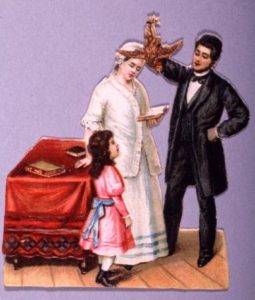
19th Century Lithograph of Kapparot

19th Century Lithograph of Kapparot

First of all, kapparot sounds much too similar to a korban, a sacrificial offering. In the days of the Temple, the kohanim sacrificed animals in order to atone for the people. The kapparot ritual explicitly states that the rooster serves as atonement, and the rooster is then killed. Despite some people’s claims that kapparot is not a true sacrifice, it clearly mimics the Temple’s sacrificial procedures, and intends to accomplish the same goal. The Mishnah Berurah (605:2) openly admits this, saying that kapparot is basically like a sacrifice. Indeed, an outsider would hardly be able to tell the difference. The problem is that the Torah forbids bringing sacrifices anywhere other than the place that God specifically designates (Deut. 12:5-6), which was the Temple Mount in Jerusalem. The Torah also commands that only kohanim are allowed to oversee sacrificial procedures. From this perspective alone, kapparot is contrary to the Torah.

Thirteen Years of Pain

Secondly, kapparot fits squarely under the category of unnecessary cruelty to animals. Commenting on the verse in Psalms (145:9) which states that God has mercy and compassion upon all of His creations, Rav Shimshon Raphael Hirsch wrote:

Here you are faced with God’s teaching which obliges you not only to refrain from inflicting unnecessary pain on any animal, but to help and, when you can, to lessen the pain whenever you see an animal suffering, even through no fault of yours.
(Horeb, Chapter 60, Section 416)

The Jewish Sages have always been concerned about animal welfare. The Talmud considers it a Torah mitzvah to treat animals with respect and prevent any harm to them (Bava Metzia 32b), so much so that one is allowed to violate various Shabbat prohibitions to help a suffering animal (Shabbat 128b). Let us not forget the story of Rabbi Yehuda HaNasi, who suffered excruciating pains for thirteen years. Why was he afflicted with such pain?

A calf was being taken to the slaughter when it broke away, hid its head under [Rabbi Yehuda’s] clothes, and lowed [in terror]. “Go”, he said, “for this you were created.” Thereupon it was said [in Heaven], “Since he has no pity, let us bring suffering upon him.”
(Bava Metzia 85a)

The great Rabbi Yehuda – the compiler of the Mishnah – made one uncompassionate remark to a fearful calf that was about to be slaughtered. For this, Heaven rained upon him tremendous pain – six years of kidney stones, and seven of scurvy, so unbearable that his cries could be heard over three miles away. When did his suffering end?

One day [Rabbi Yehuda’s] maidservant was sweeping the house; [seeing] some young weasels lying there, she made to sweep them away. “Let them be,” he said to her; “It is written, ‘And his tender mercies are over all his works.’” It was said [in Heaven], “Since he is compassionate, let us be compassionate to him.”

Rabbi Yehuda quotes the same verse (Psalms 145:9) that Rav Hirsch expounded upon, and has mercy on the young animals in his home. For this, his suffering is finally taken away. If even one little remark to an animal is worth thirteen years of suffering, how much more so if an animal is swung around wildly, then slaughtered needlessly – which is precisely what happens with kapparot. (It has also been pointed out that chickens used in kapparot are usually starving and thirsty, and often have their limbs dislocated or bones broken during the procedure.)

Idolatrous Practices

Lastly, kapparot appears to be connected with various idolatrous practices and non-Jewish customs. The Ramban, among others, considered it darkei emori, the way of idolaters. The Shulchan Arukh, the central halachic text of Judaism, is also staunchly opposed to kapparot, and its author, Rabbi Yosef Karo, called it a “foolish custom”.

Many modern-day authorities, too, from across the Torah-observant world, have been vocally against kapparot. Rabbi Joseph B. Soloveitchik and the entire Brisker rabbinic lineage before him opposed the custom, considering it irrational. The rabbi of Beit El and rosh yeshiva of Ateret Yerushalaim, Shlomo Chaim Aviner, a prominent authority within the Dati Leumi community, has described it as a “superstition”. And the former Sephardic Chief Rabbi of Tel Aviv, Chaim David HaLevy, beautifully wrote in his Aseh Lekha Rav:

Why should we, specifically on the eve of the holy day of Yom Kippur, be cruel to animals for no reason, and slaughter them without mercy, just as we are about to request compassion for ourselves from the living God?

Kapparot with Money

While it is clearly evident that one should completely avoid kapparot with chickens, some might argue that it is still worth doing kapparot with money. The problem is that the procedure and text are still the same: waving coins or bills over one’s head, stating that the money serves as an atonement, and that donating it will save one’s life.

The truth is that there is no need to do this at all, since any giving to charity automatically fulfils a mitzvah, assists in one’s repentance and atonement, and is said to be life-saving. The Talmud famously tells us (Bava Batra 10a) that charity is the greatest of all forces, and quotes the verse in Proverbs that “charity saves from death” (10:2).

Thus, any charitable contribution, at any time of the year, already does what kapparot claims to do. And so, awkwardly waving money around one’s head and reciting the kapparot verses is nothing more than a funny-looking waste of time, associated with a cruel, idolatrous, nonsensical, and nonJewish custom.

In his list of the 613 Torah mitzvot, the Rambam (who was also opposed to kapparot) lists the 185th positive commandment of the Torah as eradicating any traces of idolatry from Israel. Since many great Sages held the view that kapparot is associated with idolatrous ways, including the Ramban, Rashba, and the authoritative Shulchan Arukh, it is undoubtedly a mitzvah to not only avoid kapparot, but to encourage others to abandon this practice, and to expunge it from Judaism.


The article above is adapted from Garments of Light – 70 Illuminating Essays on the Weekly Torah Portion and Holidays. Click here to get the book!