In this week’s parasha, Ekev, we read: “And now, Israel, what does Hashem, your God, ask of you? Only to fear Hashem, your God, to walk in all of His ways, and to love Him, and to serve Hashem, your God, with all your heart and with all your soul.” (Deuteronomy 10:12) Moses instructs his people that they should sincerely love, fear, and serve God. We have written in the past how the Sages say that loving God and serving God is often best done by loving and serving His creations. The Midrash compares this to a servant who takes care of the king’s son. Surely, the king will love such a servant and wish to bestow goodness upon him, for the servant cares for the king’s beloved child. As the Torah calls us all children of Hashem, the King, it goes without saying that those who take care of God’s children are naturally beloved by God.
This is the quality that made Aaron so special, and, according to some, earned him the merit of being chosen the progenitor of the priestly lineage. Pirkei Avot (1:12) famously instructs us to be, above all else, like Aaron (and his disciples): “loving peace and pursuing peace, loving all people, and bringing them closer to Torah.” Elsewhere in Avot (3:10), we are told that “One with whom his fellows are pleased with, God is pleased with.” The Kabbalists beautifully point out that the gematria of the command to love God (ואהבת את יי אלהיך) is 907, the same as the command to love your fellow (ואהבת לרעך כמוך אני יי), for one is impossible without the other.
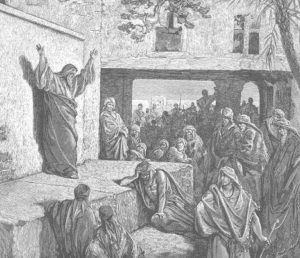
‘Micah Extorting the Israelites to Repentance’, by Gustave Doré
This is what the prophet Michah concluded when he, too, asked the same question as Moses did: “… And what does Hashem request of you? Only to act justly, and to love kindness, and to walk modestly with your God.” (Micah 6:8) Be just and treat everyone fairly; be kind and genuinely love to help others—and do it all humbly and modestly.
The Talmud (Shabbat 31a) takes a more literal approach, with Rava stating that God will ask each person six specific questions upon their death:
When man is led in for Judgment, he is asked: Did you deal faithfully? Did you fix times for learning? Did you engage in procreation? Did you hope for salvation? Did you engage in the dialectics of wisdom? Did you understand one thing from another?
The first question implies dealing honestly in business or in financial matters. Judaism has always taught the necessity of being scrupulously honest when it comes to money. The Kabbalists state that a person will be forced to reincarnate into this world if they so much as owe a single penny. They discuss how the value of shekel (שקל) is 430, equal to nefesh (נפש), “soul”, for each person’s material wealth is intricately tied to their spiritual nature. This is why giving money to charity can actually alter a person’s fate, as explained in the past. (See ‘How Charity Can Save Your Life’ in Garments of Light.)
Meanwhile, the Talmud holds that even though the Torah allows Jews to loan with interest to non-Jews, one shouldn’t charge interest from anyone, and a usurer might not even be a kosher witness in court (Sanhedrin 24b-25b). The same is true for someone who owes a lot of money. A person should not get themselves into great debt, and should ensure as much as possible that they will be able to repay a loan. This is why Rabbi Shimon, one of the five great students of Rabbi Yochanan ben Zakkai, held that the worst possible trait is that of a person who takes on debt and fails to repay (Avot 2:10). He bases himself on the words of King David: “The wicked man borrows and does not repay, but the righteous one is benevolent and gives.” (Psalms 37:21)
The wording of the Talmud is that a person will be asked if they took care of their finances b’emunah, “in faith”. Unfortunately, there are plenty of people who seem faithful, but engage in all kinds of financial tricks under the table. A person cannot be of great emunah if, at the same time, they cheat in financial matters, or are even a little bit dishonest with money. This includes gambling, stock market speculation, and all sorts of tax deceptions which have become so commonplace in our time.
Upholding Creation
The second question asked in the afterlife is whether a person set aside regular times to learn Torah. The Sages state that learning Torah is the most important mitzvah. Indeed, without learning Torah a person won’t know the right way to fulfil any mitzvah. The Torah is a “Tree of life for those who grasp it” (Proverbs 3:18), and the Sages quoted God stating: “I created the evil inclination, and I created the Torah as its antidote.” (Sifre Devarim 45) One who learns Torah is upholding the Covenant between God and Israel—since the Torah is the very text of that Covenant—and hence God states “If not for My covenant day and night, I would not have set the ordinances of Heaven and Earth.” (Jeremiah 33:25) God declares that He would not have created this universe were it not for His Torah—and His people upholding it day and night. (Some have therefore said that the world has time zones so that at any given moment, a Jew somewhere in the world is learning Torah.)
Similarly, the third question refers to procreation, for without it, too, humanity would cease to exist. More specifically, without Jewish procreation, there would be no Jews, and therefore no one to uphold that Covenant. The schools of Hillel and Shammai debated what it takes to fulfil the mitzvah of procreation (Yevamot 62a). According to Hillel, a person must have one boy and one girl, while according to Shammai, a person must have two boys and two girls. The reasoning of the latter is that Eve initially had four children: Cain, Abel, and the sisters each was born with. The first instance of pru u’rvu in the Torah resulted in two boys and two girls, so this is the standard for fulfilling the mitzvah.
However, the Talmud goes on to note another opinion that it was Shammai that taught one must have at least one boy and one girl, whereas Hillel taught that a person must simply have at least one child, whether boy or girl. The most lenient opinion, therefore, is that a person fulfils the mitzvah by having a single child, while the praiseworthy has at least two of each. A person who adopts a child or “raises an orphan” fulfils the mitzvah as well (Megillah 13a).
Of course, it isn’t enough just to have the kids. Parents need to invest their time and energy to ensure the children will be both righteous and successful. The Talmud (Kiddushin 29a) reminds us that, among other things, a parent is obligated to teach their child Torah, and also some kind of craft or career to ensure an honest livelihood. After all, “If there is no Torah, there is no flour; if there is no flour, there is no Torah.” (Avot 3:17) To raise children solely with Torah and assume a livelihood will come on its own, or to rely on the charity of others, is a gross sin. The Rambam (Hilkhot Talmud Torah 3:10) is particularly vocal about it:
Anyone who comes to the conclusion that he should involve himself in Torah study without doing work and derive his livelihood from charity, desecrates God’s Name, dishonors the Torah, extinguishes the light of faith, brings evil upon himself, and forfeits the life of the World to Come, for it is forbidden to derive benefit from the words of Torah in this world.
Our Sages declared: “Whoever benefits from the words of Torah forfeits his life in the world.” Also, they commanded and declared: “Do not make them a crown to magnify oneself, nor an axe to chop with.” Also, they commanded and declared: “Love work and despise rabbinic positions.” All Torah that is not accompanied by work will eventually be negated and lead to sin. Ultimately, such a person will steal from others.

Rabbi Moshe ben Maimon, the Rambam, aka. Maimonides, 1135-1204
Although the Rambam makes it clear that Torah study is of absolute importance, and should take precedence over one’s worldly occupation, he nonetheless reminds us that “the greatest sages of Israel were lumberjacks and water-drawers…” (ibid., 1:9) To be fair, there are other rabbinic authorities that allow for full-time Torah scholars who make learning their occupation, but this must only be for a minority of distinguished thinkers. It is certainly not a standard for everyone, for that would be completely unsustainable.
To get back to the third question, the Sages state that having children “hastens the Redemption”. There are a certain number of souls (in a Heavenly repository called “guf”) that must be born, and only when all of these souls have been born can Mashiach come. Thus, having children accelerates the time of Redemption.
This ties into the fourth question a person is asked: did they look forward to the Redemption? The wording is not if they waited for the Redemption, or hoped for it. Instead, whether they looked forward to it, suggesting a more active form. It isn’t enough to passively wait for the Redemption. Each person must do what they can to hasten it. This includes things like doing more acts of kindness and showing ahavat chinam, expressing baseless, non-judgemental love for all fellow Jews (Yoma 9b); engaging in kiruv; and, of course, repenting wholeheartedly (Sanhedrin 97b). Each person has to continue working on themselves to be ever-more righteous. Increasing one’s charitable donations hastens the Redemption, too (Isaiah 1:27 and Bava Batra 10a).
Garment for the Soul
The final two questions deal with one’s knowledge and understanding. It isn’t enough to engage in light learning here and there. A person must be steeped in dialectics (pilpul) and understand the depths of one thing from another (davar mitokh davar). The Arizal taught that a person must learn Torah on all four of its levels; pshat (simple), remez (sub-textual), drash (metaphorical), and sod (secret). These levels are collectively known by the acronym pardes, “orchard”—a word that is also the origin of the English “paradise”. One who doesn’t learn Torah on all four levels has not fulfilled the mitzvah of Torah study and will return in a reincarnation to do so (Sha’ar HaGilgulim, 16).
The Arizal also taught that Torah study not only strengthens a person spiritually, but literally creates a “garment” for the soul to be worn in the World to Come (Sha’ar HaPesukim, Tehillim). This is the meaning of the verse “The Torah of Hashem is perfect, it restores the soul” (Psalms 19:8). Meanwhile, the power of Torah study is so great that it creates angels, and these angels could eventually communicate with the student and bestow Ruach HaKodesh, divine inspiration, upon them (Sha’ar Ruach HaKodesh, 1).
The Talmud specifies that one should spend a third of their time studying Tanakh, then a third studying Mishnah, and a third studying Gemara (Kiddushin 30a). This was at a time when no other texts were available, so one should probably make another “third” for the many other areas of Jewish study we have today, including halachic and midrashic literature, mussar, hashkafa, various responsas and commentaries, as well as Kabbalah. The Arizal divided up his Torah study routine as follows (Sha’ar HaMitzvot, Va’etchanan):
First, he would read the weekly Torah portion. On Sunday, he would focus on the first six verses. On Monday, the next four. On Tuesday, the next five, and on Wednesday the next six. Another five on Thursday, making a total of 26 verses, and then the whole parasha on Friday. This was done in the traditional manner, shnaim mikra v’echad targum—reading each verse twice in Hebrew, and once in Aramaic.
Next, he would study a portion of Nevi’im, the Prophets, followed by Ketuvim, the other Holy Writings that make up the Tanakh. This, too, was done with shnaim mikra and a targum. The Arizal then studied the Mishnah, followed by Gemara, together with the various commentaries. Finally, he engaged in Kabbalah.
Yirat Hashem
Rava derived the six questions above from Isaiah 33:6, where the prophet declares, “And there shall be faith in your times; strength, salvation, wisdom and knowledge…” Faith refers to the first question regarding faithful business, times refers to the second question of setting times for Torah-learning, strength to procreation, salvation to the Redemption, wisdom and knowledge to the last two questions.
The Isaiah verse concludes with “… the fear of Hashem is His treasure.” One’s rewards (treasure) in the afterlife are contingent upon these six questions. Yet, what unifies them all is yirat Hashem, “fear” or “awe” of God.
One who is truly God-fearing will undoubtedly be scrupulously honest with financial matters, and strive to hasten the Redemption. It is doubtful that a Jew can be truly God-fearing without constantly meditating upon Torah and understanding its depths. Thus, complete yirat Hashem encompasses all of these things. Conversely, a person who does not live these ideals is probably not as God-fearing or faithful as they might believe themselves to be.

 The Arizal taught that ever-higher levels of soul are accessed gradually over the course of one’s life. At birth, a person has only a complete nefesh. As they grow, they are infused with ruach, which becomes fully accessible at bar or bat mitzvah age. At this point one starts to tap into their neshamah, which is wholly available only at age 20. (For this reason, the Torah considers an adult one who is over 20 years of age. Only those over 20 were counted in the census and allowed to join the military. Our Sages state that although one may be judged for their crimes before age 20 here on Earth, only those sins accrued after age 20 are judged in Heaven. Meanwhile, the Midrash notes that Adam and Eve were created as 20 year olds.) The Arizal taught that most people never end up accessing their entire neshamah, and only the most refined individuals ever unlock their chayah and yechidah.