Tag Archives: Psalms

The Problem With Kapparot

In the early morning hours before Yom Kippur, many Jews will seek to perform the custom of kapparot, which involves taking a live rooster (or chicken), swinging it over one’s head, and then having it slaughtered. In the process, the person states how the rooster will be their “atonement”, and while the rooster will die, the person will go on to live a good life. The rooster’s meat is typically donated. Others swing money over their heads instead of a rooster, and then donate the money to charity. Of course, this strange-sounding custom is not mentioned anywhere in the Torah or Talmud. In fact, throughout history many Jewish Sages tried hard to extinguish this custom, for a number of important reasons.
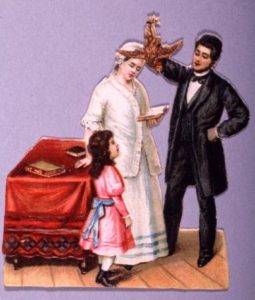
19th Century Lithograph of Kapparot

19th Century Lithograph of Kapparot

First of all, kapparot sounds much too similar to a korban, a sacrificial offering. In the days of the Temple, the kohanim sacrificed animals in order to atone for the people. The kapparot ritual explicitly states that the rooster serves as atonement, and the rooster is then killed. Despite some people’s claims that kapparot is not a true sacrifice, it clearly mimics the Temple’s sacrificial procedures, and intends to accomplish the same goal. The Mishnah Berurah (605:2) openly admits this, saying that kapparot is basically like a sacrifice. Indeed, an outsider would hardly be able to tell the difference. The problem is that the Torah forbids bringing sacrifices anywhere other than the place that God specifically designates (Deut. 12:5-6), which was the Temple Mount in Jerusalem. The Torah also commands that only kohanim are allowed to oversee sacrificial procedures. From this perspective alone, kapparot is contrary to the Torah.

Thirteen Years of Pain

Secondly, kapparot fits squarely under the category of unnecessary cruelty to animals. Commenting on the verse in Psalms (145:9) which states that God has mercy and compassion upon all of His creations, Rav Shimshon Raphael Hirsch wrote:

Here you are faced with God’s teaching which obliges you not only to refrain from inflicting unnecessary pain on any animal, but to help and, when you can, to lessen the pain whenever you see an animal suffering, even through no fault of yours.
(Horeb, Chapter 60, Section 416)

The Jewish Sages have always been concerned about animal welfare. The Talmud considers it a Torah mitzvah to treat animals with respect and prevent any harm to them (Bava Metzia 32b), so much so that one is allowed to violate various Shabbat prohibitions to help a suffering animal (Shabbat 128b). Let us not forget the story of Rabbi Yehuda HaNasi, who suffered excruciating pains for thirteen years. Why was he afflicted with such pain?

A calf was being taken to the slaughter when it broke away, hid its head under [Rabbi Yehuda’s] clothes, and lowed [in terror]. “Go”, he said, “for this you were created.” Thereupon it was said [in Heaven], “Since he has no pity, let us bring suffering upon him.”
(Bava Metzia 85a)

The great Rabbi Yehuda – the compiler of the Mishnah – made one uncompassionate remark to a fearful calf that was about to be slaughtered. For this, Heaven rained upon him tremendous pain – six years of kidney stones, and seven of scurvy, so unbearable that his cries could be heard over three miles away. When did his suffering end?

One day [Rabbi Yehuda’s] maidservant was sweeping the house; [seeing] some young weasels lying there, she made to sweep them away. “Let them be,” he said to her; “It is written, ‘And his tender mercies are over all his works.’” It was said [in Heaven], “Since he is compassionate, let us be compassionate to him.”

Rabbi Yehuda quotes the same verse (Psalms 145:9) that Rav Hirsch expounded upon, and has mercy on the young animals in his home. For this, his suffering is finally taken away. If even one little remark to an animal is worth thirteen years of suffering, how much more so if an animal is swung around wildly, then slaughtered needlessly – which is precisely what happens with kapparot. (It has also been pointed out that chickens used in kapparot are usually starving and thirsty, and often have their limbs dislocated or bones broken during the procedure.)

Idolatrous Practices

Lastly, kapparot appears to be connected with various idolatrous practices and non-Jewish customs. The Ramban, among others, considered it darkei emori, the way of idolaters. The Shulchan Arukh, the central halachic text of Judaism, is also staunchly opposed to kapparot, and its author, Rabbi Yosef Karo, called it a “foolish custom”.

Many modern-day authorities, too, from across the Torah-observant world, have been vocally against kapparot. Rabbi Joseph B. Soloveitchik and the entire Brisker rabbinic lineage before him opposed the custom, considering it irrational. The rabbi of Beit El and rosh yeshiva of Ateret Yerushalaim, Shlomo Chaim Aviner, a prominent authority within the Dati Leumi community, has described it as a “superstition”. And the former Sephardic Chief Rabbi of Tel Aviv, Chaim David HaLevy, beautifully wrote in his Aseh Lekha Rav:

Why should we, specifically on the eve of the holy day of Yom Kippur, be cruel to animals for no reason, and slaughter them without mercy, just as we are about to request compassion for ourselves from the living God?

Kapparot with Money

While it is clearly evident that one should completely avoid kapparot with chickens, some might argue that it is still worth doing kapparot with money. The problem is that the procedure and text are still the same: waving coins or bills over one’s head, stating that the money serves as an atonement, and that donating it will save one’s life.

The truth is that there is no need to do this at all, since any giving to charity automatically fulfils a mitzvah, assists in one’s repentance and atonement, and is said to be life-saving. The Talmud famously tells us (Bava Batra 10a) that charity is the greatest of all forces, and quotes the verse in Proverbs that “charity saves from death” (10:2).

Thus, any charitable contribution, at any time of the year, already does what kapparot claims to do. And so, awkwardly waving money around one’s head and reciting the kapparot verses is nothing more than a funny-looking waste of time, associated with a cruel, idolatrous, nonsensical, and nonJewish custom.

In his list of the 613 Torah mitzvot, the Rambam (who was also opposed to kapparot) lists the 185th positive commandment of the Torah as eradicating any traces of idolatry from Israel. Since many great Sages held the view that kapparot is associated with idolatrous ways, including the Ramban, Rashba, and the authoritative Shulchan Arukh, it is undoubtedly a mitzvah to not only avoid kapparot, but to encourage others to abandon this practice, and to expunge it from Judaism.


The article above is adapted from Garments of Light – 70 Illuminating Essays on the Weekly Torah Portion and Holidays. Click here to get the book!
How Did Adam Live 930 Years?

This week’s parasha is Vayelech, which begins with Moses’ statement that “Today I am one hundred and twenty years old” (Deut. 31:2). It was the 7th of Adar, Moses’ birthday, and also his day of passing. Moses goes on to conclude his final speech to the people, then sings a deeply prophetic farewell song in next week’s portion Ha’azinu, followed by his blessings to the people in the last parasha of the Torah, V’Zot HaBracha.

Moses was the greatest of all prophets, the humblest man to walk the earth, and the central founding figure of Judaism. He was blessed with living a full and healthy life spanning exactly 120 years. It has become common today for people to wish each other 120 years of life. Why is this the specific figure? Can humans not live longer? Don’t we see in Genesis that Adam lived 930 years, Noah lived 950 years, and Methuselah (Metushelach) lived a record 969 years? What happened?

The Flood Generation

Ten generations from Adam, the world had descended into endless sin and immorality. God decreed that man’s days “will be numbered at one hundred and twenty” (Genesis 6:3). Many believe this to mean that God decreed humans will no longer be able to live past 120 years. Indeed, when looking at modern records of longevity, the vast majority of the world’s oldest people die close to 120 years. There has only been one official case of anyone exceeding 120, a Frenchwoman named Jeanne Calment who lived 122 years.

However, the traditional Jewish interpretation is that the Genesis verse above does not mean man is unable to live past 120. After all, our forefathers Abraham, Isaac, and Jacob lived long after this decree, and they lived 175, 180, and 147 years, respectively. Rather, the Jewish Sages state that God decreed the arrival of the Great Flood 120 years hence. God gave mankind 120 years to repent, and possibly avert the Flood. Noah was commissioned to go around and inspire people to mend their ways, and he had 120 years to do it.

Unfortunately, Noah failed in this endeavour, unable to bring even a single person to righteousness (as the Ark only carried his own family at the end). This is one reason for why the Flood is known in Hebrew as mabul Noach, literally “Noah’s Flood” (or mei Noach, “Noah’s waters”), as if he was partially responsible for not doing enough to inspire people to change. Because of this, many (including Rashi) have commented on the verse “Noah was a righteous and pure man in his generation” (Genesis 6:9) to mean that Noah was only righteous in his faulty generation. Had he lived in another generation, such as that of Abraham, he would not have been deemed so righteous!

We see from the Biblical chronology that after the Flood, people’s life spans steadily shorten. Moses’ older siblings Aaron and Miriam lived 123 and 126 years. Moses died at 120, and this appears to have become the new limit. After Moses, there are only a few people noted to have lived longer, one of which is Yehoyada the High Priest, who lived 130 years (II Chronicles 24:16).

What accounts for this steady degeneration in longevity?

Yeridat HaDorot

The Talmud (Shabbat 112b) states: “If the earlier [scholars] were sons of angels, we are sons of men; and if the earlier [scholars] were sons of men, we are like asses…” This is one of many passages that attests to the well-known concept of yeridat hadorot, “the descent of the generations”. It is said that each passing generation falls lower and lower in its wisdom and spiritual greatness. This concept can solve the puzzle of longevity.

The body is a finite lump of matter. It is only animated and vitalized by the infinite soul within it. Thus, the greater the soul, the longer the body can live. As the spiritual potential in each generation falls, so too does the lifespan.

Moreover, it is taught that Adam contained essentially all of the souls of humanity within him (Sha’ar HaGilgulim, ch. 11). As more and more people were born over the centuries, this single universal soul broke down further and further into smaller and smaller fragments. With the exception of a number of “new souls”, the vast majority of the world’s 7 billion people are all parts of the soul of Adam. It is therefore not surprising that today’s spiritual capabilities (and with that, the lifespans) are severely limited.

At the Speed of Light

Science may offer another intriguing possibility. According to modern physics, time as we know it doesn’t really exist. The universe is one interwoven fabric of both time and space. The faster one moves through space, the slower the effects of time for that person. There is actually a formula to measure the impact of this time dilation, known as the Lorentz transformation. It is given by the equation ΔT = t√1-v2/c2 [or: t = t÷ √(1-v2/c2)], where v is one’s speed and c is the speed of light.

Theoretically, the speed of light is the absolute maximum in our universe. At light speed (just under 3.00 x 10⁸ m/s, or 300,000 km/s), time will totally stop for the traveller (if plugging it into the formula, one gets a value of zero). This seems impossible. However, if we plug in a value very close to light speed, such as 2.99 x 10⁸ m/s, we get a very interesting result.* A person who has perceived living 80 years will have actually lived 980 earthly years! That makes Adam’s 930 years a more palatable 76, and Methuselah’s record 969 as 79. This fits in well with the verse in Psalms that a normal lifespan is 70 to 80 years (Psalms 90:10). But how could Adam and Methuselah have lived at near-light speed?

Beautifully, the Sages teach us that Adam was not a human like us. In many texts (such as Bereshit Rabbah 20:12), Adam is described not simply as a being of flesh, but rather as a being of light. Though most will interpret this metaphorically, there are those sages, such as the Arizal (for example, in Sefer HaLikutim, Bereshit, ch. 3) that interpret this quite literally. It remains to be seen what this means exactly, and if it has anything at all to do with physics, but perhaps there is much more to the idea of Adam being a man of light than we can imagine.


The article above is an excerpt from Garments of Light: 70 Illuminating Essays on the Weekly Torah Portion and Holidays. Click here to get the book! 
——–

*To be fair, choosing a value such as 2.99 x 10⁸ m/s may be deemed quite arbitrary. One can also plug in finer values even closer to the speed of light, such as 2.997 or 2.9972, and so on, each of which would give a more refined result. The point of this exercise is simply to illustrate the relativity of time, and what might explain the difference in perceived years between our generations and those of the first people, through a scientific perspective.

The Guardian Angels and Hybrid Beasts Known as Cherubs

Terumah relays God’s instructions to the Israelites for constructing the Mishkan, the Holy Tabernacle. The most important part of this elaborate structure was undoubtedly the Aron HaKodesh, the Ark of the Covenant. Throughout the centuries, this gold-plated Ark has often been depicted in art, history, and even film (most notably with Indiana Jones in Raiders of the Lost Ark). However, what the Ark actually looked like is hard to discern. The Ark disappeared two and a half thousand years ago when the First Temple was destroyed. Since then, many different versions and interpretations for its appearance have been proposed, both by Jewish Sages and secular scholars.

The issue is not so much with the Ark itself, since the Torah is pretty clear on its description: a box two and a half cubits long, one and a half cubits wide, and one and a half cubits high, made of wood and plated with gold from the inside and out. (A cubit is roughly two feet long.) What’s not so clear is the Ark’s cover, with its two golden Cherubs.

What is a “Cherub” (kruv, in Hebrew)? The only descriptor the Torah gives is that the Cherubs had wings. Rashi, drawing from the Talmud, comments on Exodus 25:18 that they had the face of a child. The Torah describes the two as being set on the cover ish el echav, literally “a man facing his brother”. This suggests a human form to the Cherubs, along with their child-like face and wings. Indeed, this is how the Cherubs are generally depicted. The reality may be quite different, though. A look at the historical and Biblical evidence may shed some more light as to the true identity of the Cherubs.

The Evidence

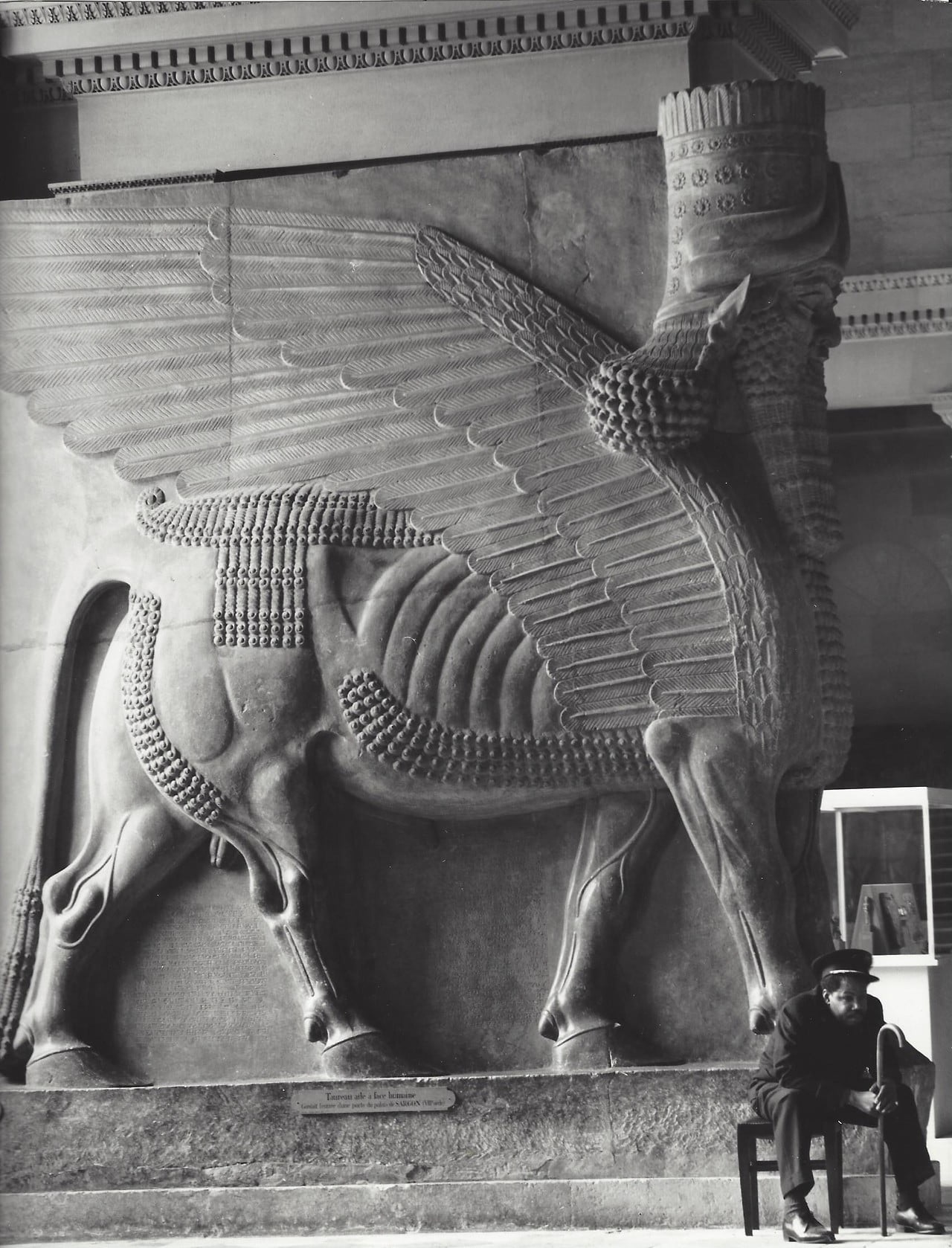
A similar word for the Hebrew term kruv is found across the languages of the Ancient Near East: kuribu in Akkadian, karabu or kirubu in Babylonian and Assyrian. These refer to very large statues placed at entrances to important venues which served as guardians. They had the body of a bull or lion, with wings, and a human head. At times, they were worshipped as guardian deities.

This parallels the Torah’s original description of Cherubs. The very first time Cherubs appear is in Genesis 3:24. Following Adam and Eve’s banishment from the Garden of Eden, God placed Cherubs to guard the entrance to Eden so that man could not return. Like the Mesopotamian kuribu, the Cherubs are guarding an entrance.

All of this is reminiscent of a famous passage in the Tanakh: Ezekiel’s Vision of the Chariot.This could be why the Cherubs were placed atop the Ark, again as guardians of the holy vessel. When the Tanakh describes how King Solomon built the Temple in Jerusalem (I Kings, chapter 6), it states that Solomon had two massive ten-cubit high Cherubs placed at the entrance to the Holy of Holies (the room in which the Ark of the Covenant was kept). The following chapter describes them as kruvim arayot, “Cherub-Lions” (7:36). Not only do we once again see the Cherubs as guarding an entrance, but we now have some evidence that the Cherubs had a lion-like appearance, just as the Mesopotamian kuribu (or lamassu) often had.

Kuribu were also known as lamassu. This is a photo by Kees Scherer, taken in the Louvre Museum in 1968, of a massive lamassu statue from King Sargon II’s palace, dated back to the 8th century BCE. It is from nearly the same time period as King Solomon’s giant Cherubs, which would have been about the same size.

Ezekiel’s Chariot

In the first chapter of the Book of Ezekiel, we are given a detailed description of the Merkavah, the Divine Chariot:

And I looked, and, behold, a stormy wind came out of the north, a great cloud, with a fire flashing up, a brightness was all around it; and from within the appearance of electrum, out of the midst of the fire. And from within it came the likeness of four living creatures. And this was their appearance: they had the likeness of a man. And every one had four faces, and every one of them had four wings. And their feet were straight feet; and the sole of their feet was like the sole of a calf’s foot… As for the likeness of their faces, they had the face of a man; and all four had the face of a lion on the right side; and all four had the face of an ox on the left side; all four had also the face of an eagle.”
(Ezekiel 1:4-10)

Ezekiel describes his angelic vision, with winged figures that have attributes of a lion, an ox, an eagle, and the appearance of a man. The figures are part of the Divine Chariot, again serving as sentries or guardians.

This description allows us to potentially synthesize the Torah’s description of Cherubs with the historical and Biblical evidence: human-like winged creatures with aspects of a lion and a bull or ox. Although Cherubs are not explicitly mentioned in Ezekiel’s account, the Merkavah shares the same root letters (k-r-v or r-k-v) as Cherubs, kruvim.

We can draw further proof from the Psalms 18:11, which states that God “rode upon a Cherub, and flew, and swooped down upon the wings of the wind,” as well as from II Samuel 22:11, which says God “rode upon a Cherub, and flew, and was seen upon the wings of the wind.” Clearly, the Cherubs are associated with the Divine Chariot upon which God rides, as described by Ezekiel.

So, are the Cherubs innocent child-like, winged angels—as commonly depicted in artwork—or are they powerful Heavenly guardians with the hybrid qualities of various majestic beasts?


The above is an excerpt from Garments of Light, Volume Two. Get the book here