Tag Archives: Ramban

Should You Wear a Red String on Your Wrist?

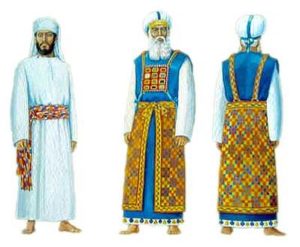
Vestments of the kohen and kohen gadol

This week’s parasha, Tetzave, continues to outline the items necessary for the Mishkan, or Tabernacle, starting with the Menorah and going into a detailed description of the priestly vestments. One of the materials necessary for the holy garments is tola’at shani, commonly translated as “crimson wool”. This was a deep red fabric apparently derived from some kind of insect or worm (which is what the Hebrew “tola’at” means). The Torah speaks of this material in multiple places and in multiple contexts. Today, wearing a “tola’at shani”-like red string on the wrist has become very popular among those calling themselves “Kabbalists” and even by secular Jews and non-Jews. What is the significance of the red fibre, and is there any real spiritual meaning to the red string bracelet?

The First Red String

The earliest mention of a red string is in Genesis 38:27-30, where Tamar gives birth to her twin sons Peretz and Zerach:

And it came to pass in the time of her labour that, behold, twins were in her womb. And in her labour, one hand emerged, and the midwife took a red string [shani] and tied it to his hand saying, “This one came out first.” And he drew back his hand, and behold, his brother came out, and she said: “With what strength have you breached [paratz] yourself?” so his name was called Peretz. And afterward came out his brother that had the red string upon his hand, and his name was called Zerach.

Here, the red string is simply used to designate the firstborn. It didn’t work out as planned, for the other twin ended up coming first. The strong Peretz would go on to be the forefather of King David, and therefore Mashiach, who is sometimes called Ben Partzi. Clearly, wearing the red string wasn’t much of an effective charm for Zerach.

Temple Rituals

In addition to being used in the garments of the priests and various Temple vessels, tola’at shani was employed in a number of sacrificial rituals. In Leviticus 14 we read how someone who had healed from tzara’at, loosely translated as “leprosy”, would bring an offering of two birds which were dipped in a mixture containing the red dye. From this we see that tola’at shani (or shni tola’at, as it appears here) is not necessarily the string itself, but simply the red dye extracted from the insect. Similarly, the red dye was used in the preparation of the parah adumah, “Red Cow”, mixture (Numbers 19) which was used to purify the nation from the impurity of death.

The Talmud (Yoma 67a) describes how a red string was tied to the scapegoat on Yom Kippur. Recall that on Yom Kippur two goats were selected, one being slaughtered and the other being sent off into the wilderness, “to Azazel”. This “scapegoat” had a red string attached to it, and if the string turned white the people would know that their sins had been forgiven, as Isaiah 1:18 states: “…though your sins be as scarlet, they shall be as white as snow; though they be red like crimson, they shall be as wool.” Here, then, the red string represents the sin of the people, bound to the scapegoat going to Azazel. If it turned white, it was a good sign, whereas if the string remained red it meant God was unhappy with the nation. Indeed, the Talmud (Yoma 39b) states that in the last forty years before the Second Temple was destroyed, the red string never once turned white.

Red in Kabbalah

In mystical texts, red is typically the colour of Gevurah or Din, severity and judgement. It was therefore generally discouraged to wear red. The Kabbalists often wore garments of all white, and this is still the custom during the High Holidays, a time of particularly great judgement. It was only centuries later that the Chassidic rebbe known as Minchat Eliezer (Rabbi Chaim Elazar Spira of Munkacz, 1868-1937) wrote how having a red cloth may serve to ward off judgement and severity. Another Chassidic rebbe, the Be’er Moshe (Rabbi Moshe Stern of Debreczin, 1890-1971) wrote that he remembered seeing people wear red strings as a child, but did not know why. Still, this does not appear to have been a very popular practice then, nor is it much of a custom among Chassidim now.
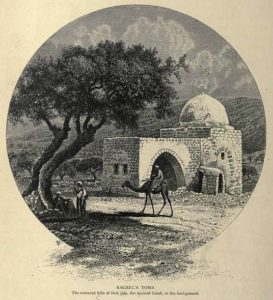
1880 Illustration of Rachel’s Tomb

Rather, the red string today has been popularized by The Kabbalah Centre and similar “neo-Kabbalah” movements that cater as much to non-Jews as to secular Jews. The Kabbalah Centre explains that the bracelets are made by taking a long red thread and winding it around Rachel’s Tomb seven times. The thread is then cut into wrist-size lengths, and if worn on the “left wrist, we can receive a vital connection to the protective energies surrounding the tomb of Rachel.” It is not clear where The Kabbalah Centre took this practice from. They claim that the red string wards off the evil eye. While they cite certain passages from the Zohar regarding the evil eye, there doesn’t seem to be any connection to a red string specifically.

The Zohar (II, 139a) does state in one place that the blue tekhelet represents God’s Throne, as is well-known, which means judgement, whereas the red shani is what emerges from the Throne and overpowers the judgement, thus bringing protection upon Israel. The Zohar relates shani to Michael, the guardian angel of Israel, and uses the metaphor of a worm eating through everything to explain the tola’at shani as eating up negative judgement. This is why the famous song Eshet Chayil (Proverbs 31) states that a “woman of valour” has her whole house dressed in shanim (v. 21). She guards her household in this way. (It should be noted that in this passage the Zohar states it is gold which represents Gevurah, and silver represents Chessed. White and red, meanwhile, appear to be aspects within the sefirah of Yesod.)

So, perhaps there is something to wearing a red string.

Bringing Back Shani

The Zohar does not speak of any red string at all, and instead explains the mystical power of the red dye called shani. It is the dye itself that has power, as we see from the Temple rituals noted above. It is well-known that the blue tekhelet dye comes from a certain mollusc or sea snail called chilazon. From where does shani come?
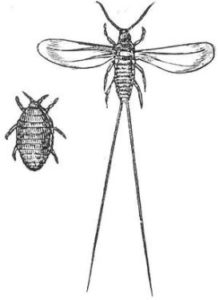
A female and male cochineal bug.

Professor Zohar Amar of Bar Ilan University researched the subject in depth and concluded that tola’at shani is similar to the cochineal insect, famous for producing the red dye carmine (E120) which is extensively used in the food industry. After a round-the-world search, it turned out that a cochineal-like insect is found in Israel as well, and grows on oak trees.

While the cochineal insect is native to South America (where most of the carmine is still produced), its Mediterranean cousin is the oak-dwelling kermes insect. Indeed, kermes was used across the Mediterranean world for millennia, being particularly prized in Greek, Roman, and medieval society. It is best known for its ability to dye wool extremely well. Jerusalem’s Temple Institute was convinced of the professor’s findings, and has begun harvesting the bugs and their red dye in order to produce authentic priestly vestments, as outlined in the Torah.

In light of this, a genuine red string “kabbalah” bracelet—with the protective powers mentioned in the Zohar—would undoubtedly have to be made of wool dyed with kermes red. And according to the Zohar, it probably shouldn’t be worn on the left wrist at all, but instead on the right leg, the body part which the Zohar (II, 148a) states that shani corresponds to.

Imitating Pagans

Judaism is very sensitive about not imitating the ways of the pagans, or darkei Emori. One example of this, as we wrote in the past, is kapparot, which the Ramban (among others) called an idolatrous practice. The Tosefta (Shabbat, ch. 7) has a list of practices that are considered darkei Emori, and one of them is “tying a red string on one’s finger”. So, already two millennia ago it seems there were Jews tying red strings on their body, and the Tosefta (which is essentially equivalent to the Mishnah) forbids it.
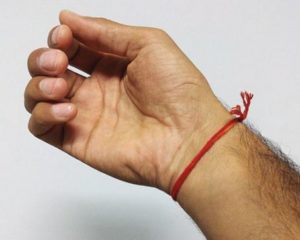
The Hindu kalava looks suspiciously similar to the “kabbalah” red string.

In fact, Hinduism has a custom to wear a red string called kalava around one’s wrist in order to ward off evil. This is precisely what The Kabbalah Centre claims their red string accomplishes. Based on this alone it would be best to avoid wearing such a red string. The Lubavitcher Rebbe was one of the recent authorities who stated that the red string should not be worn due to darkei Emori. Factoring in that the red string has no basis in the Zohar or any traditional Jewish mystical text is all the more reason to stay away from this practice.


The above is an excerpt from Garments of Light, Volume Two. Get the book here

The Most Important Torah Reading

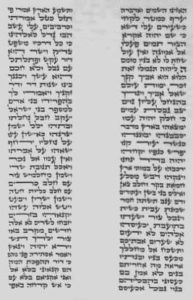
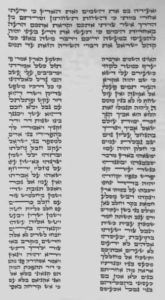
Two columns of parashat Ha’azinu in a Torah scroll

This Shabbat we will be reading Ha’azinu, a unique parasha written in two poetic columns. Ha’azinu is a song; the song that God instructed Moses to teach all of Israel: “And now, write for yourselves this song, and teach it to the Children of Israel. Place it into their mouths, in order that this song will be for Me as a witness for the children of Israel.” (Deut. 31:19) Of course, the entire Torah is a song, chanted with specific ta’amim, musical cantillations. In fact, the mitzvah for each Jew to write a Torah scroll of their own (one of the 613) is derived from the verse above, where God commands the Children of Israel to write this song for themselves. While the simple meaning is that God meant to write the song of Ha’azinu, our Sages interpreted it to refer to the entire Torah. (Since most people are unable to write an entire kosher Torah scroll by themselves, the mitzvah can be fulfilled by writing in a single letter, or by financially contributing to the production of a Torah scroll.)

Why is the song of Ha’azinu so special that God commanded Moses to ensure it will always remain in the mouths of Israel? A careful reading shows that Ha’azinu essentially incorporates all of the central themes of the Torah. We are first reminded that God is perfect, “and all His ways are just” (32:4). While it is common for people to become angry at God and wonder why He is seemingly making life so difficult for them, Ha’azinu reminds us that there is no injustice in God, and that all suffering is self-inflicted (32:5). The Talmud reminds us that hardships are issurim shel ahavah, “afflictions of love”, meant to inspire us to change, grow, repent, learn, and draw us closer to God. Isaac Newton said it well:

Trials are medicines which our gracious and wise Physician gives because we need them; and the proportions, the frequency, and weight of them, to what the case requires. Let us trust His skill and thank Him for the prescription.

History is the Greatest Proof

In the second aliyah, we are told to “remember the days of old and reflect upon the years of previous generations” (32:7). Is there any greater proof for God and the truth of the Torah than Jewish history? Despite all the hate, persecution, exile, and genocide, the Jewish people are still alive and well, prospering as much as ever.

Does it make sense that 0.2% of the world’s population wins over 20% of the world’s Nobel Prizes? (Out of 881 Nobels awarded thus far, 197 were awarded to Jews, who number just 14 million or so. Compare that to the 1.8 billion Muslims in the world—roughly 25% of the world’s population—who have a grand total of three Nobel Prizes in the sciences.) Does it make sense that a nation in exile for two millennia can return to its ancestral homeland, defeat five professional armies that invade it simultaneously (and outnumber it at least 10 to 1), and go on to establish a flourishing oasis in a barren desert in just a few short decades? Does it make sense that tiny Israel is a global military, scientific, democratic, and economic powerhouse? And yet, does it make any sense that the United Nations has passed more resolutions against Israel than all of the rest of the world combined?

There is no greater proof for God’s existence, for the truth of His Torah, and the distinctiveness of the Jewish people than history itself. It is said that King Louis XIV once asked the French polymath and Catholic theologian Blaise Pascal for proof of the supernatural, to which the latter simply replied: “the Jews”. Although Pascal—who was not a big fan of the Jews—probably meant it in a less than flattering way, he was totally correct.
The Consequences of Forgetting God

From the third aliyah onwards, Ha’azinu describes what the Jewish people have unfortunately experienced through the centuries: God gives tremendous blessings, which eventually leads to the Jews becoming “fat and rebellious”. They forget “the God who delivered” them (32:18). This is precisely when God hides His face (32:20), and just as the Jews provoked God with their foolishness and assimilation, God in turn “provokes [them] with a foolish nation”. God sends a wicked foreign nation to punish the Jews—whether Babylonians or Romans, Cossacks or Nazis—to remind the Jews who they are supposed to be: a righteous, Godly people; a light unto the nations. If the Jews will not be righteous and divine, God has no use for them.

Having said that, this does not exonerate those Cossacks and Nazis, for they, too, have been judged. They are a “foolish nation”, a “non-people”, who themselves merit destruction, and God “will avenge the blood of His servants” (32:43). The song ends with a promise: Israel will atone and fulfil its role, its enemies will be defeated, and God will restore His people to their land.

The Spiritual Power of Ha’azinu

The song of Ha’azinu beautifully summarizes the purpose and history of the Jewish people, and elegantly lays down the responsibilities, benefits, and consequences of being the nation tasked with God’s mission. Not surprisingly then, God wanted all of Israel to know Ha’azinu very well, and meditate upon this song at all times. This is why it was given in the format of a song, since songs are much easier to memorize and internalize then words alone. Music has the power to penetrate into the deepest cores of our souls.

In fact, the Zohar on this parasha writes that music is the central way to elevate spiritually, and can be used to attain Ruach HaKodesh, the prophetic Divine Spirit. Elsewhere, the Zohar goes so far as to say that Moses’ prophecy was unique in that all other prophets needed music to receive visions, while Moses alone could prophesy without the help of song!

Today, we have scientific evidence that music deeply affects the mind. It triggers the release of various neurotransmitters, and can rewire the brain. It has a profound impact on mood and wellbeing, and can be used to induce all sorts of mental and emotional states. Music is powerful.

And so, the Torah concludes with a song. After relaying Ha’azinu, the Torah says that “Moses finished speaking all of these words to Israel” (32:45). The lyrics were the last of the Torah’s instructions. Indeed, Ha’azinu is the last weekly Torah reading in the yearly cycle. (Although there is one more parasha, it is not read on its own Shabbat, but on the holiday of Simchat Torah, at which point we jump right ahead to Beresheet, the first parasha.)

So important is Ha’azinu that it is always read during the High Holiday period, usually on Shabbat Shuvah, the Sabbath of Repentance, or Return. So important is Ha’azinu that it is most often the first parasha read in the New Year. And so important is Ha’azinu that it was commonly believed the entire Torah is encoded within it. When our Sages derived the mitzvah of writing the Torah from the command of writing Ha’azinu, they literally meant that Ha’azinu encapsulates the whole Torah! The Ramban went so far as to teach that all of history, including the details of every individual, is somehow encrypted in Ha’azinu. This prompted one of the Ramban’s students, Rabbi Avner, to abandon Judaism and become an apostate. In a famous story, the Ramban later confronts Avner, and proves that Avner’s own name and fate is embedded in one of Ha’azinu’s verses.

In past generations, many people customarily memorized Ha’azinu. The Rambam (Hilkhot Tefillah 7:13) cites another custom to recite Ha’azinu every morning at the end of Shacharit, and the Talmud (Rosh Hashanah 31a) states that in those days it was read every Shabbat. This Shabbat, take the time to read Ha’azinu diligently, and see why it was always considered the most important Torah reading. Perhaps you will even find your own life encoded in its enigmatic verses.


The above essay is adapted from Garments of Light, Volume Three.
Get the book here! 

Should Jews Believe in Astrology?

This week’s parasha, the second last of the Torah, is Ha’azinu. This parasha is unique in that it consists almost entirely of one lengthy song – clearly visible when looking at a Torah scroll, where the text of Ha’azinu is split into two narrow columns. Moses sang this prophetic song to the nation right before his passing.

Two columns of parashat Ha'azinu

Two columns of parashat Ha’azinu

In the verses that introduce it (Deut. 31:19), we see God commanding Moses to write the song and “teach it to the Children of Israel. Place it in their mouths so that this song will be for Me a witness for the Children of Israel.” God wanted Moses to diligently teach this song to the entire nation. In fact, the actual wording of the verse has God commanding everyone – each member of the nation – to write the song for themselves. It is based on this verse that the Sages drew the mitzvah of writing a Torah scroll (or participating in writing one), even though the plain text of the verse states only to write this particular song, Ha’azinu.

Perhaps because of this, the Ramban taught that Ha’azinu contains the entire Torah within it. Moreover, he believed that every detail of every person’s life is somehow encoded within this song! In one famous story, when a student of the Ramban, a man named Avner, heard this teaching, he was so baffled by it that he left Judaism entirely, converted to another religion, and became a prominent anti-Semite. When Avner later confronted the Ramban, the Rabbi showed him how one verse in the song did indeed accurately point to this man’s life. Avner was so ashamed that he disappeared, never to be heard from again.

Heavenly Princes

And so, each and every one of the song’s 43 verses has a great deal to teach us. The eighth verse begins by telling us that God gave each nation their lot, and the ninth verse says that “Hashem’s portion is His people, the lot of His inheritance.” The Zohar comments on these words that while God established Heavenly “princes” to watch over every nation in the world, Israel is watched over by God Himself. The Ramban (in his Discourse on Rosh Hashanah) elaborates:

He gave each and every nation… some known star or constellation, as is known by means of the science of astrology… Higher above [the constellations] are the angels of the Supreme One, whom He appointed as “princes” over them… It is further written, “So shall you be My people, and I will be your God, and you will not be subject to other powers at all.” (Jeremiah 11:4)

When we often say that Hashem is our God (as we do in the daily Shema), or when the Tanakh writes that we are God’s people, this does not mean that gentiles cannot have a relationship with God, or that there are other gods out there for the non-Jewish world. Rather, it means that while God oversees absolutely everything in His universe, and has created all people, He has also appointed various Heavenly (or astrological) forces above each nation – except Israel. These forces are not independent in their own right, as they are subject to the angels above them, and these angels ultimately serve God. As such, the nations of the world have various Heavenly intermediaries between themselves and Hashem. Israel, however, has a direct connection to Him. In fact, this is the hidden meaning within the name “Israel” (ישראל), which can be read as yashar El. (ישר-אל), “straight to God”.

Ain Mazal L’Israel

Long before the Ramban, the Sages of the Talmud debated whether the constellations had an effect on people (Shabbat 156a). The consensus of the Rabbis was that constellations do impact people, but Jews are free from this influence. They learn this from the prophet Jeremiah, who prophesied: “Thus said Hashem: Learn not the way of the nations, and be not dismayed at the signs of heaven, for the nations are dismayed at them.” (10:2) God tells Israel not to draw meaning from heavenly signs as the other nations do. The Talmud goes on to tell us a story about Abraham, who cried out to God: “Master of the Universe! I have looked at the constellations and find that I am not fated to have children.” To this, God replied: “Stop your star-gazing! Israel has no constellations.”

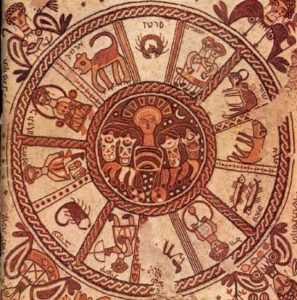
Hebrew Zodiac from a 6th Century Synagogue

Hebrew Zodiac from a 6th-Century Synagogue

Elsewhere, the Talmud tells us that Abraham was once a powerful astrologer, and great men from around the world came to consult with him about their fortunes (Bava Batra 16b). When Abraham looked into his own fate, he saw that he would not have children. God commanded him to desist from astrology, for the Jewish people have the power to transcend the stars. Of course, Abraham went on to have many children.

Later on, Moses would record in the Torah the prohibition for Jews to consult various fortune-tellers and astrologers. The Rambam codifies the law in this way:

It is forbidden to tell fortunes. [This applies] even though one does not perform a deed, but merely relates the falsehoods which the fools consider to be words of truth and wisdom. Anyone who performs a deed because of an astrological calculation or arranges his work or his journeys to fit a time that was suggested by the astrologers is [liable for] lashes, as [Leviticus 19:26] states: “Do not tell fortunes.”
(Sefer HaMadda, Hilchot Avodah Zarah, Chapter 11, Halacha 9)

Transcending Nature

We see from the above that various Heavenly forces, angels, and constellations do exist, and certainly do influence the world. Astrological signs can be potent forces. Ironically, earlier in his discourse, the Ramban points out how astrology is intricately tied into the Jewish calendar: it is no coincidence that Pesach is celebrated in the month of Nisan, the sign of which is Aries (the ram, or sheep), since the main mitzvah of Pesach was to sacrifice a lamb; and it is no coincidence that Rosh Hashanah – judgement day, when each person is put on trial – is in the month of Tishrei, the sign of which is Libra, the scales of justice. The Midrash (Yalkut Shimoni, Shemot 418) even tells us how each of the 12 Tribes of Israel corresponds to one of the 12 astrological signs of the zodiac!

And yet, all the sources are clear: Jews are not to dabble in astrology, for we have no need for intermediaries, and we have all the power to break free from the influence of the constellations. It is precisely when we believe in astrology that it becomes real, just as Abraham had no children as long as he believed in the heavenly signs that he saw. Every Jew must realize that we are Israel, yashar El, and that Hashem alone is our astrological sign. There is no need to believe in what the Rambam calls “emptiness and vanity”. The Rambam ends his laws on this subject by telling us to live up to the Torah’s call (Deut. 18:13) to be of “perfect faith with Hashem, your God.” When one has perfect faith in the Master of the Universe, anything is possible, and this is how God finished his rebuke to Abraham:

“Stop your star-gazing! Ain mazal l’Israel. What is your calculation? Is it because Jupiter stands in the West? Then I will turn it back and place it in the East!”


The article above is an excerpt from Garments of Light: 70 Illuminating Essays on the Weekly Torah Portion and Holidays. Click here to get the book!