Tag Archives: Rashi

The Right Way to Observe the “Three Weeks”

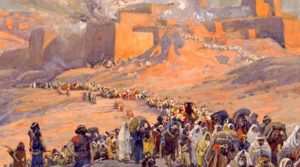
‘The Flight of the Prisoners’ by James Tissot, depicting the Jewish people’s exile after the destruction of the First Temple.

The “Three Weeks” refers to the period between the fast days of the seventeenth of Tamuz and the ninth of Av. The Talmud describes five tragedies that happened on each of these fast days, culminating with the destruction of both Holy Temples in Jerusalem on Tisha b’Av. Over the centuries, many customs have emerged with regards to this time bein hameitzarim, “between the straits”. Today, it has essentially become a three-week mourning period—even though the Talmud and other early texts say nothing about it. Furthermore, many have come to believe that this is an “unlucky” or “dangerous” time for the Jewish people, and thus abstain from various activities. What is the origin of these customs and how should they be followed?

Surprises in the Talmud

Throughout the Three Weeks period it is customary to abstain from shaving and haircuts, as well as listening to music. Generally, weddings are not held (with minor exceptions), and saying the blessing of shehecheyanu (on new clothes, fruits, or other) is discouraged. The mourning intensifies once the month of Av begins. Henceforth, the consumption of meat and wine is restricted, as is bathing for pleasure, doing laundry, or purchasing valuable new things. The source for most of these prohibitions is in the Talmud (Ta’anit 26b-30a), where we read:

With the beginning of [the month of] Av, rejoicing is curtailed. During the week in which the ninth of Av falls, it is forbidden to cut hair and to wash clothes, but on Thursday it is permissible in honour of the Sabbath. On the eve of the ninth of Av, one may not partake of a meal of two courses, nor eat meat, nor drink wine.

The Mishnaic statement above simply states that once the month of Av begins, one must lessen their joy. This would presumably include going to parties and weddings, and listening to music (which, in those days, could only be enjoyed live). Still, it is only speaking of the first days of Av, not of a three week period from the seventeenth of Tamuz. The Mishnah then states that in the actual week in which Tisha b’Av falls, one should abstain from haircuts and laundry (of course, this is permissible if preparing for Shabbat, the honour of which is greater than any mourning custom). The Talmud then debates this Mishnah:

…it is forbidden to cut the hair and to wash clothes from the beginning of the month until after the fast—this is the opinion of Rabbi Meir. Rabbi Yehudah says: It is forbidden the whole month. Rabban Shimon ben Gamaliel says: It is forbidden only on that particular week. … Rava said: The halachah is according to Rabban Shimon ben Gamaliel. And Rava further said: The halachah is according to Rabbi Meir. And both decisions are in favour of the more lenient practice, and both are needed [to be stated]. For had it only been stated that the halachah is according to Rabbi Meir, I might have said that the restriction is in force from the beginning of the month, therefore it is also clearly stated that the halachah is according to Rabban Shimon ben Gamaliel. And had it only been stated that the halachah is according to Rabban Shimon ben Gamaliel, I would have said that the restriction continues even on the days after [Tisha b’Av], therefore it is clearly stated that the halachah is according to Rabbi Meir.

There were three schools of thought in those days: Rabbi Meir held that we mourn from the start of Av until the fast; Rabban Shimon that we only mourn during the week of Tisha b’Av itself; and Rabbi Yehudah was the most stringent, holding that the entire month of Av is mournful. The halacha originally favoured Rabban Shimon, however this presented an ambiguity: If we are meant to mourn in the week of Tisha b’Av, does that mean we must continue to mourn for the remainder of the week after the fast is over? To clarify, Rava combines the view of Rabban Shimon and Rabbi Meir, and concludes that we mourn until the fast, and not after. For this reason, today’s custom is to intensify the mourning practices in the week of Tisha b’Av itself.

Finally, the Mishnah states that in the very last meal one eats before the fast begins, they should avoid meat and wine. The Talmud once more elaborates:

Rav Yehudah said: This restriction applies to any time after midday, but not to any time before midday. Rav Yehudah further said: It applies only to the concluding meal [before the fast] but not to any other meal… One who has a meal on the eve of Tisha b’Av with the intention to have another meal [later], he may eat meat and drink wine; but if not, he may not eat meat nor drink wine.

The Talmud makes it clear that one need only abstain from meat and wine in the very last meal before the fast begins. There is no Talmudic basis for avoiding meat and wine from Rosh Chodesh Av. In fact, the Talmud goes on to state that while Rabbi Meir said one should avoid meat and wine in that final meal, the rest of the Sages said one should only lessen his consumption of meat and wine:

How should one restrict? If he was in the habit of eating one pound of meat he should eat one half only; if it is his usual practice to drink one log of wine he should drink one half log only…

The Talmud later clarifies that salted meat and new wine is always permitted. It is only fresh meat and the finer, aged wine that shouldn’t be consumed! Despite this, many Jewish communities became more and more stringent over the centuries, and took upon themselves to avoid all meat and wine from the start of the month. Rav Ovadia Yosef held that since it is already an ancient custom, it should be continued. Interestingly, the Yemenite Jews had no such custom, and only abstained from meat and wine in that final meal before the fast, as the Talmud requires. Nonetheless, Rav Ovadia encouraged them to take on the more stringent custom, especially because now they were living in Israel where destruction of the Temple is felt more pressingly.

The Talmud also mentions the custom of bathing:

At the meal intended to be the concluding one before Tisha b’Av, it is forbidden to eat meat or to drink wine, or to bathe after the meal. At the meal which is not intended to be a concluding meal prior to Tisha b’Av, it is permissible to eat meat and to drink wine, but not to bathe. Rabbi Ishmael bar Yose said in the name of his father: So long as it is permissible to eat meat it is also permissible to bathe.

The Talmud at first suggests that bathing may be one of those things one shouldn’t do the week of Tisha b’Av. Rabbi Ishmael comes to conclude that as long as eating meat is allowed, so is bathing. Thus, from a Talmudic perspective alone, bathing is permitted right up until the final meal of Tisha b’Av.

Laying Down the Law

The Rambam, aka. Maimonides

In the 12th century, the Rambam (Rabbi Moshe ben Maimon, 1135-1204) produced his monumental Mishneh Torah, the first complete, comprehensive, and conclusive Jewish book of laws. While many more law books have been laid out since then, the Mishneh Torah is seen by many as the gold standard. Some hold that it is the greatest law code in Judaism (with the Rambam regularly compared to Moses himself), and there are those today who consider themselves “Rambamists” that strictly follow the dictates of the Mishneh Torah.

There are many reasons why the Mishneh Torah is so great. For one, the Rambam wrote it succinctly, clearly, with no grey areas, and covering every aspect of Judaism. (In fact, he himself writes in the introduction that one need only read Scripture and his Mishneh Torah to know essentially everything about Judaism!) Secondly, the Rambam did not include any customs of non-Jewish origin or of an irrational nature, of which there are unfortunately quite a lot today. He was precisely logical and practical in his halacha. On a related note, the Rambam completely avoided anything Kabbalistic, mystical, or magical. He utterly rejected the belief in evil spirits and demons that would later become more popular (partly due to Christian and Muslim influence). Thus, the Rambam’s law code may be described as a pure, unadulterated compendium of authentic Judaism. (For more on the Mishneh Torah’s supremacy, see here.)

With that in mind, this is what the Mishneh Torah (Hilkhot Ta’aniot, 5:6-8) says about the Three Weeks:

When the month of Av enters, we reduce our joy. During the week of Tisha b’Av, it is forbidden to cut one’s hair, to do laundry, or to wear a pressed garment—even one of linen—until after the fast.

It has already been accepted as a Jewish custom not to eat meat or enter a bathhouse during this week until after the fast… One should not eat meat or drink wine at the meal before the fast. One may, however, drink grape juice that has not been left [to ferment] for three days. One may eat salted meat that was slaughtered more than three days previously. One should not eat two cooked dishes.

When does the above apply? When one ate in the afternoon on the day preceding Tisha b’Av. If, however, one eats a meal before noon, although this is the last meal one eats before the fast, one may eat all that one desires.

When the day before Tisha b’Av falls on the Sabbath, one may eat and drink to the full extent of one’s needs, and one may serve even a meal resembling Solomon’s feasts at one’s table. Similarly, when Tisha b’Av falls on the Sabbath, one need not withhold anything at all.

We see from the Rambam that all of the prohibitions really only kick in the week of Tisha b’Av itself. He rules that one is only forbidden from partaking meat and wine in the afternoon of the day preceding Tisha b’Av, though there is an established custom to avoid meat the entire week. And if Tisha b’Av falls on Shabbat (as it does this year), then there is essentially no mourning at all. This last statement likely reflects the position of Rabbi Yehudah haNasi (the redactor of the Mishnah), who said that the fast of Tisha b’Av should be cancelled if it falls on Shabbat. (Others say he wanted to abolish the fast entirely!)

If that’s the case, how did we go from minimal mourning in the time of the Talmud—and even in the time of the Rambam just over 800 years ago—to today’s extensive three week period?

The Influence of Midrash and Kabbalah

On Tisha b’Av it is customary to read Megillat Eichah, the Book of Lamentations. This is the prophet Jeremiah’s gruesome account of Jerusalem’s destruction. Jeremiah writes: “Judah went into exile because of affliction and great servitude; she settled among the nations, [and] found no rest; all her pursuers overtook her bein hameitzarim [between the straits].” (Lamentations 1:3) Rashi cites two meanings for the term “between the straits” or “between the boundaries”. The simple meaning is that it refers to the borders of the Jewish people’s former farms and vineyards which have been destroyed. He then cites the Midrash by stating that “between the straits” also refers to the three week period between the seventeenth of Tamuz and Tisha b’Av.
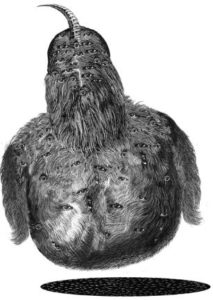
An artist’s rendition of the hairy and ocular “Ketev Meriri”

Going directly to the source, the Midrash (Eichah Rabbah 1:29) suggests that “her pursuers overtook her bein hameitzarim” means that there is an evil spirit that is particularly strong during the Three Weeks, and has the power to pursue and hurt the Jewish people. The Midrash calls this evil spirit Ketev Meriri (קֶטֶב מְרִירִי), which is mentioned just a single time in the Torah (Deuteronomy 32:24), in parashat Ha’azinu: “The wasting of hunger, and the devouring of the fiery bolt, and Ketev Meriri; and the teeth of beasts will I send upon them, with the venom of crawling things of the dust.” Although usually translated as “bitter destruction”, or a “plague”, or “bad vapour”, some hold that Ketev Meriri is some kind of evil entity or demon out to hurt the Jewish people.

The Midrash in question says it is a demon entirely covered with eyes and hair, and anyone who looks upon it immediately dies. While it is allowed to roam free during the Three Weeks, it is only active “between the end of the fourth hour and the start of the ninth hour of the day, and it goes neither in the sun nor in the shade, but right along the border between a sunny and shaded area.” So, this Ketev Meriri is only found for several hours in the day during the Three Weeks, and can only cause damage if a person is standing or walking, alone, right between a sunny and shaded area! This sounds like plain old superstition, which is precisely why the Rambam rejects it outright.
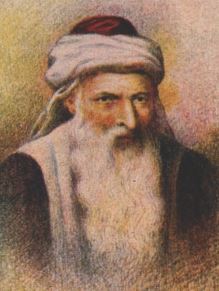
Maran Yosef Karo, aka. the “Mechaber”

Nonetheless, it is mentioned in the Shulchan Arukh (Orach Chaim, 551:18), which warns to beware of Ketev Meriri during the Three Weeks, between the fourth and ninth hour of the day. It is important to remember that the Shulchan Arukh was composed by Rabbi Yosef Karo (“Maran”, 1488-1575), one of the great Tzfat Kabbalists. Although generally speaking he, too, sought to keep his updated law code free of Kabbalah, one who reads the Shulchan Arukh will undoubtedly see how mystical concepts and practices permeate it. This is one key difference between the Rambam’s Mishneh Torah and Maran’s Shulchan Arukh. Of course, the latter went on to become the authoritative law code of Judaism.

In recent centuries, even more superstitious fear developed among certain Jews, worrying that something horrible will happen during the Three Weeks. And over time it became customary to avoid going swimming, partaking in any kind of “risky” activity, or even flying in an airplane. Under such conditions, it is only natural that the entire Three Week period became one of pretty intense mourning.

Yet, even the Shulchan Arukh does not speak of such intense mourning. It, too, begins by speaking of mourning from the start of Av. And it is only in the week in which Tisha b’Av itself falls that haircuts and laundry are prohibited (Orach Chaim, 551:3). The same is true for consuming meat and wine, although Maran mentions other customs to abstain from meat and wine from Rosh Chodesh, or even from the seventeenth of Tamuz. He concludes that one who eats meat when his community does not is a sinner and will be—to borrow a Talmudic term—“bitten by a snake”.

The Shulchan Arukh also lists two different customs for bathing: some abstain from Rosh Chodesh, and others only in the week of Tisha b’Av. And then we are told that some fast every single day during the Three Weeks! (551:16) We see how, unlike the Rambam’s Mishneh Torah, which is clear as to precisely how a Jew should act, the Shulchan Arukh lists numerous varying customs. This is another critical difference between the two law codes.

Summarizing the Law

To conclude, if one wants to observe the mourning period strictly as mandated by the Talmud, Mishneh Torah, and even the Shulchan Arukh, one need only abstain from music and festivities from the start of Av, and abstain from bathing, cutting hair, and laundering in the week of Tisha b’Av itself. With regards to meat and wine, although the letter of the law is only to abstain in the last meal before the fast, it is now nearly universal to abstain the entire week of Tisha b’Av, and the Shulchan Arukh holds that a person should not deviate from whatever is their local established custom.

On the note of bathing and cutting hair or shaving, it is important to remember how great the honour of Shabbat is: While mourning may be an important custom, looking presentable and dignified on Shabbat is actually an halachic requirement. The Talmud makes it clear that one must bathe and cut their hair for Shabbat—even on a Thursday immediately preceding a Tisha b’Av which falls on a Friday. (This is technically not possible in our fixed calendar, but was possible in those days). The Sephardic custom reflects this halachic necessity, while the Ashkenazi custom strangely does not. Rav David Bar-Hayim, despite being of Ashkenazi background himself, holds that the Ashkenazi custom of abstaining from haircuts for the entire Three Weeks—which he traces to about 600 years ago—is really contrary to halacha.

Finally, there is no need to fear of calamities during the Three Weeks, unless one conducts themselves according to Kabbalah, in which case they may need to beware of Ketev Meriri between the fourth and ninth hour of the day, especially if walking alone between sunny and shaded areas.


The above essay is adapted from Garments of Light, Volume Three.
Get the book here! 
Did Moses Have a Black Wife?

Towards the end of this week’s Torah portion, Beha’alotcha, we read that “Miriam and Aaron spoke against Moses because of the Cushite woman whom he had married, for he had married a Cushite woman.” (Numbers 12:1) This verse brings up many big questions, and the Sages grapple with its meaning. Who is this Cushite woman? When did Moses marry her? Why did Miriam and Aaron speak “against” Moses because of her? Why the superfluous phrasing of mentioning twice that he married the Cushite woman? What does “Cushite” even mean?

Traditionally, there are two main ways of looking at this passage: either Moses actually took on a second wife in addition to his wife Tzipporah, or the term “Cushite” simply refers to Tzipporah herself. The second interpretation is problematic, since we know Tzipporah was a Midianite, not a Cushite. The term “Cushite” generally refers to the people of Cush, or Ethiopia, and more broadly refers to all black people or Africans. Scripture does connect the Cushites with the Midianites in one verse (Habakkuk 3:7), which some use as proof that the Midianites were sometimes referred to as Cushites, or had particularly dark skin.

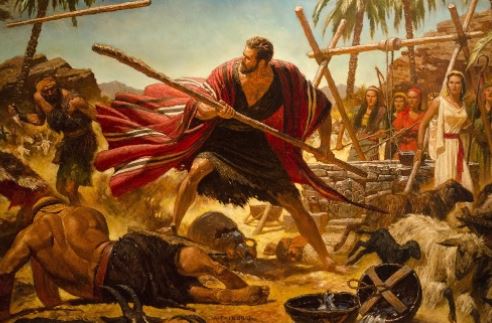
‘The Fight at Jethro’s Well’ – where Moses first meets Tzipporah – scene from ‘The Ten Commandments’ (1953) painted by Arnold Friberg.

Rashi (Rabbi Shlomo Itzchaki, 1040-1105) prefers the second interpretation. He says that Tzipporah was called a “Cushite” because she was very beautiful. He cites Midrash Tanchuma in stating that just as everyone can immediately identify a black person (Cushite), everyone immediately recognized the incomparable beauty of Tzipporah. The same Midrash offers another possibility: apparently if a person had a very beautiful child in those days, they would call them “Cushite” to ward off the evil eye. This suggests that a Cushite was not considered beautiful at all, yet Rashi provides a numerical proof that Cushite does indeed mean “beautiful”, since the gematria of Cushite (כושית) is 736, equal to “beautiful in appearance” (יפת מראה), the term frequently used in the Torah to describe beauty.

If the Cushite is Tzipporah, then why did Miriam and Aaron suddenly have a problem with her? Rashi cites one classic answer: because Moses had become so holy—recall how after coming down Sinai, his skin glowed with such a blinding light that he had to wear a mask over his face—he had essentially removed himself from this material world. This means he was no longer intimate with his wife Tzipporah. Miriam had learned of this, and thought Moses was in error for doing so.

Unlike certain other religions, Judaism does not preach celibacy, and does not require complete abstinence to remain holy and pure. Conversely, Judaism holds that sexual intimacy is an important aspect of spiritual growth. The famous Iggeret HaKodesh (the “Holy Letter”, often attributed to the Ramban, Rabbi Moshe ben Nachman, 1194-1270, but more likely written by Rabbi Joseph Gikatilla, 1248-1305) writes that it is specifically during sexual union (if done correctly and in holiness) that a man and woman can bring down and experience the Shekhinah, God’s divine presence.

As such, Miriam and Aaron came to their little brother and admonished him for separating from his wife. This is why the Torah goes on to state that “They said, ‘Has God spoken only to Moses? Hasn’t He spoken to us too?’” (Numbers 12:2) Miriam and Aaron argued that they, too, were prophets, and they clearly had no need to separate from their own spouses! Moses was so humble and modest that he did not respond at all: “…Moses was exceedingly humble, more so than any person on the face of the earth.” (Numbers 12:3)

God immediately interjected and summoned Miriam and Aaron to the Ohel Mo’ed, the “Tent of Meeting”, where He regularly conversed with Moses. God told them:

If there be prophets among you, I will make Myself known to him in a vision; I will speak to him in a dream. Not so My servant Moses; he is faithful throughout My house. With him I speak mouth to mouth; in [plain] sight and not in riddles, and he beholds the image of the Lord…

God makes it clear to Miriam and Aaron that although they are also prophets, they are nowhere near the level of Moses. In all of history, Moses alone was able to speak to God “face to face”, while in a conscious, awake state. All other prophets only communed with God through dreams or visions, while asleep or entranced.

By juxtaposing the fact that Moses was the humblest man of all time, and also the greatest prophet of all time, the Torah may be teaching us that the key to real spiritual greatness is humility. Moses had completely subdued his ego, and so he merited to be filled with Godliness. Fittingly, the Talmud (Sotah 5a) states that where there is an ego, there cannot be a Godly presence, because a person with a big ego essentially sees themselves as a god—and there cannot be two gods! “Every man in whom there is haughtiness of spirit, the Holy One, blessed be He, declares: ‘I and he cannot both dwell in the world.’”

Moses Had a Black Wife

The explanation above is certainly a wonderful one, yet it is hard to ignore the plain meaning of the text: that Moses actually married a Cushite woman. The repetitive phrasing of the verse seems like it really wants us to believe he had taken another wife. And many of the Sages agree. However, Moses hadn’t married her at this point in time, but many years earlier. The Midrash describes in great detail what Moses was up to between the time that he fled Egypt and arrived in Midian. After all, he had fled as a young man, and returned to Egypt in his 80th year. What did he do during all those intervening decades?

The Midrash (Yalkut Shimoni, Shemot 168) says that Moses initially fled to Cush. At the time, the Cushites had lost their capital in a war and were unsuccessful in recapturing it. Their king, named Koknus (קוקנוס, elsewhere called Kikanos or Kikianus), fought a nine-year war that he was unable to win, and then died. The Cushites sought a strong ruler to help them finally end the conflict. They chose Moses, presumably because he had fought alongside the Cushites and had a reputation as a great warrior. Moses did not disappoint, and devised a plan to win the war and recapture the Cushite capital. (His enemy was none other than Bilaam!) The grateful Cushites gave Moses the royal widow of Koknus for a wife, and placed him upon the throne.

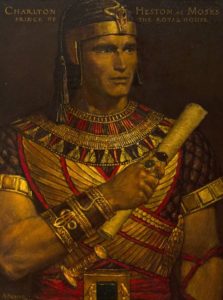
Charlton Heston as Egyptian General Moses, also by Arnold Friberg

This Midrash is very ancient, and was already attested to by the Jewish-Roman historian Josephus (37-100 CE). Josephus writes (Antiquities, II, 10:239 et seq.) a slightly different version of the story, with Moses leading an Egyptian army against the Cushites. The Cushite princess, named Tharbis, watches the battle and falls in love with the valiant Moses. She goes on to help him win the battle, and he fulfils his promise in return to marry her. In some versions, Moses eventually produces a special ring that causes one to forget certain events, and puts it upon Tharbis so that she can forget him. He then returns to Egypt.

So, Moses married a Cushite queen. Yet, he remembered “what Abraham had cautioned his servant Eliezer” about intermarriage, and abstained from touching her. (If you are wondering how Moses later married Tzipporah, who was not an Israelite, remember that the Midianites are also descendants of Abraham through his wife Keturah, see Genesis 25:2. Thus, Moses still married within the extended family of Abrahamites.) Although Moses married the Cushite queen, he never consummated the marriage. The Midrash says he reigned over a prosperous Cush for forty years until his Cushite wife couldn’t take the celibacy anymore and complained to the wise men of Cush. Moses abdicated his throne and finally left Ethiopia. He was 67 years old at the time.

All of this was kept secret until it came out publicly in this week’s parasha. This is a terrific version of the story, but it doesn’t answer why Miriam and Aaron complained to Moses. For this we must look to the mysticism of the Arizal.

Soulmates of Moses

The Arizal cites the above Midrash in a number of places (see Sefer Likutei Torah and Sha’ar HaPesukim on this week’s parasha, as well as Sha’ar HaMitzvot on parashat Shoftim). He explains that both Tzipporah and the Cushite were Moses’ soulmates. This is because Moses was a reincarnation of Abel, who had two wives according to one tradition. This was the reason for the dispute between Cain and Abel, resulting in the latter’s death. Cain was born with a twin sister, and Abel was born with two twin sisters (otherwise, with whom would they reproduce?) Cain reasoned that he should have two wives since he was the older brother, and the elder always deserves a double portion. Abel reasoned that he should have the second wife since, after all, she was his twin! Cain ultimately killed Abel over that second wife.

Therefore, the Arizal explains that Cain reincarnated in Jethro, and Abel in Moses. This is why Jethro gave his daughter Tzipporah to Moses, thus rectifying his past sin by “returning” the wife that he had stolen.* Moses’ other spiritual twin was the Cushite woman. The Arizal suggests that Miriam and Aaron were aware of this, and were frustrated that Moses did not consummate his marriage to the Cushite, for she was his true soulmate! Apparently, after the Exodus Moses summoned the Cushite woman and she happily joined the Israelites and converted to Judaism. The Arizal explains that this was a necessary tikkun, a spiritual rectification for her lofty soul. However, he could not consummate the marriage because her soul originated from a place of intense dinim gemurim, strict judgement and severity. It appears that when Miriam heard about his abstention from his wife, she complained to Moses, failing to grasp that a soul as pure as Moses’ had different requirements.

Whatever the case may be, the root of the matter is Moses’ separation from his wife (or wives). Having said all that, there is a third possibility. This comes from a simple reading of the Torah text, and the lesson that we learn from it is particularly relevant today.

Black or White

When we read the first two verses of Numbers 12 in isolation, we might be led to believe that Miriam and Aaron had a problem with Moses marrying a black woman. Was there a hint of racism in their complaint, or did they just genuinely wonder whether an Israelite was allowed to marry a black person? Either way, we see how perfectly the punishment fits the crime: “… Behold, Miriam was afflicted with tzara’aat, [as white] as snow.” (Numbers 12:10)

If the issue was about Moses separating from his wife, it isn’t clear why Miriam would be punished with tzara’at (loosely translated as “leprosy”). Rashi, for one, does not seem to offer a clear explanation why this in particular was her punishment. Of course, we know that God doesn’t really “punish”, and simply metes out justice, middah k’neged middah, “measure for measure”. It is therefore totally fitting that in complaining about Moses taking a black woman as a wife, Miriam’s own skin is turned white “like snow”. Perhaps God wanted to remind her that she is not so white herself.

We can learn from this that there really is no place for racism in Judaism. In fact, God explicitly compares the Israelites to the Cushites (Amos 9:7), and maintains that He is not the God of the Jews alone, but the God of all peoples: “‘Are you not as the children of the Cushites unto Me, O children of Israel?’ Said Hashem. ‘Have I not brought up Israel out of the land of Egypt, [just as I brought] the Philistines from Caphtor, and Aram from Kir?’” Among a list of nine holy people that merited to enter Heaven alive, without ever dying, the Sages include a Cushite man named Eved-Melekh (Derekh Eretz Zuta 1:43, see Jeremiah 39:16).

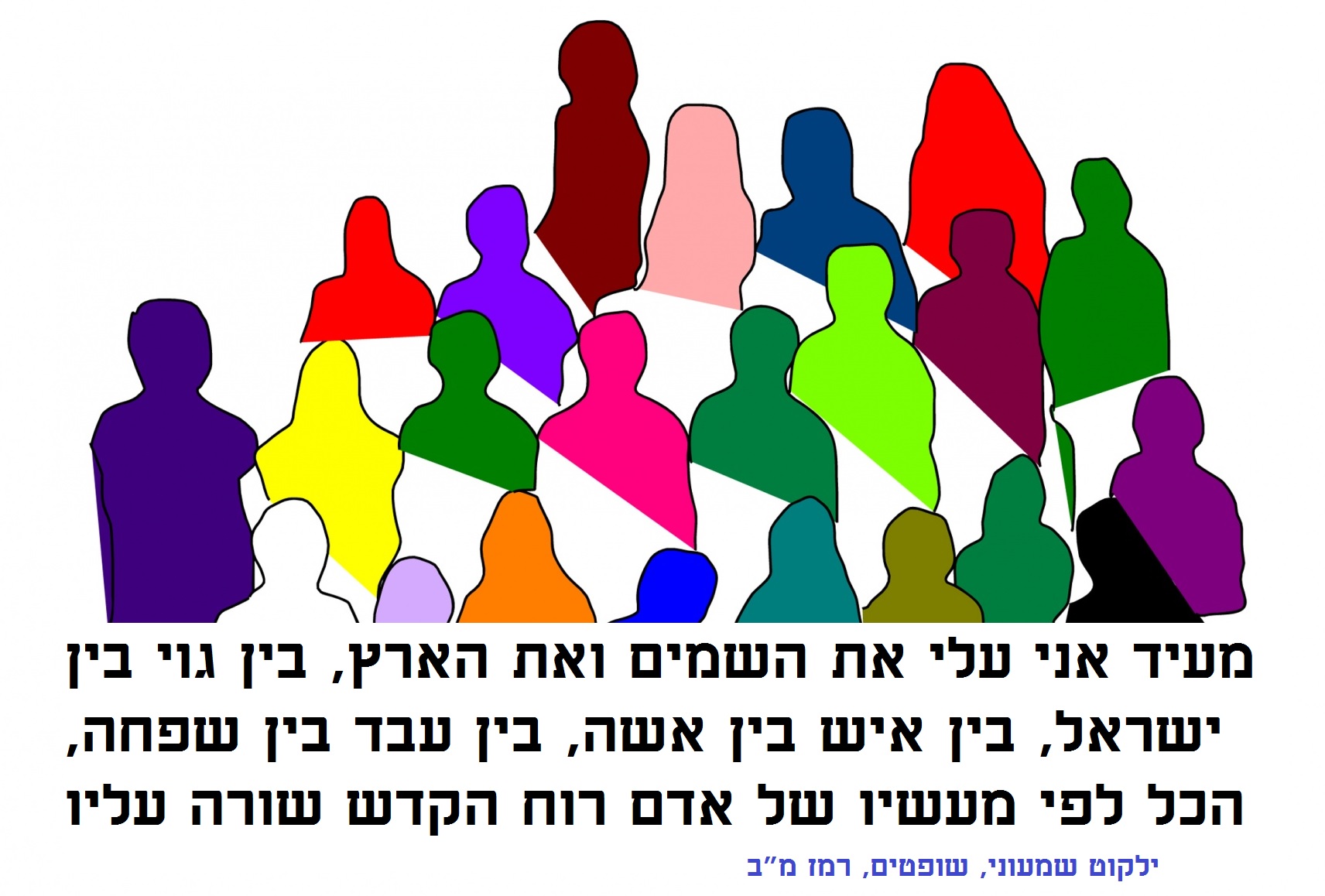
At the end of the day, there is no reason to hold prejudice against anyone, or discriminate against any individual at all, as the Midrash (Yalkut Shimoni, Shoftim 42) clearly states:

I bring Heaven and Earth to witness that the Divine Spirit may rest upon a non-Jew as well as a Jew, upon a woman as well as a man, upon a maidservant as well as a manservant. All depends on the deeds of the particular individual.

*The Arizal actually writes how Cain reincarnated in three people: Korach, Jethro, and the Egyptian taskmaster that Moses killed before fleeing Egypt. The rectification for the improper dispute between Cain and Abel was rectified in the dispute between Korach and Moses, with Moses’ victory. The rectification for the stolen wife was fulfilled by Jethro. And the rectification for Cain murdering Abel was that Moses, in return, killed the Egyptian taskmaster. Thus, all the rectifications were complete. We can see a hint in the name Cain (קין) to his three future incarnations: the ק for Korach (קרח), the י for Jethro (יתרו), and the ן for the Egyptian, whose name we don’t know but perhaps it started with a nun!


The above essay is adapted from Garments of Light, Volume Three.
Get the book here! 
The Year 5778: Apex of the Messianic Era

The stars of this week’s parasha, Vayeshev, are Joseph and Judah. We are told how the sons of Jacob were envious (and suspicious) of Joseph, and ended up throwing him in a pit while deliberating what to do with him. Shimon wished to kill him, Judah to sell him, and Reuben to save him. Meanwhile, Midianite merchants found the helpless Joseph and abducted him, later selling him to Ishmaelites who brought Joseph down to Egypt. There, Joseph enters into servitude in the home of a well-to-do Egyptian family.

The Torah diverges from this narrative to describe what happens to Judah. Judah marries and has three sons. The elder Er marries Tamar and dies because of his sinful ways, as does the second son Onan after fulfilling the law of levirate marriage and marrying his former sister-in-law. After Judah fearfully avoids another levirate marriage for Shelah, his last son, Tamar seduces Judah and becomes pregnant. She gives birth to twins, Peretz and Zerach.

Peretz would go on to be a forefather of King David, and thus a forefather of Mashiach. As is known, there are actually two messianic figures (or two aspects to Mashiach): Mashiach ben David, and Mashiach ben Yosef—one from the line of Judah and one from the line of Joseph. In fact, it is in this week’s parasha where the spiritual origins of the two messiahs begin.

Samson and the Messiahs

Mashiach ben Yosef is the first messiah. He is the warrior that battles evil in the “End of Days”. Unfortunately, he is destined to die in these battles. The Talmud (Sukkah 52a) states how the entire nation will mourn his tragic death. However, it will not be too long before Mashiach ben David arises. As the direct descendant of the royal line, he re-establishes the rightful throne and restores the holy Kingdom of Israel. The Third Temple is built thereafter, and according to some Mashiach ben David reigns for forty years, as did his progenitor King David (Sanhedrin 99a, Midrash Tehillim 15).

We have already discussed why Mashiach ben Yosef must die in the past (see ‘Secrets of the Akedah’ in Garments of Light). How he will die is not exactly clear. What will bring him to his death? It appears that Mashiach ben Yosef will be sold out by his own people. This is what happened to one of the earliest prototypes of Mashiach ben Yosef: the Biblical judge Shimshon (Samson).

As is well known, when Jacob blessed his children, he concluded the blessing to Dan with the words “I hope for Your salvation, Hashem” (Genesis 49:18) which Rashi says refers to Samson, a descendent of Dan. Samson was the potential messiah of his generation. He was a warrior fighting the oppressive Philistines. Yet, the people of Judah did not appreciate the “trouble” he was causing, and apprehended him (Judges 15:11-12):

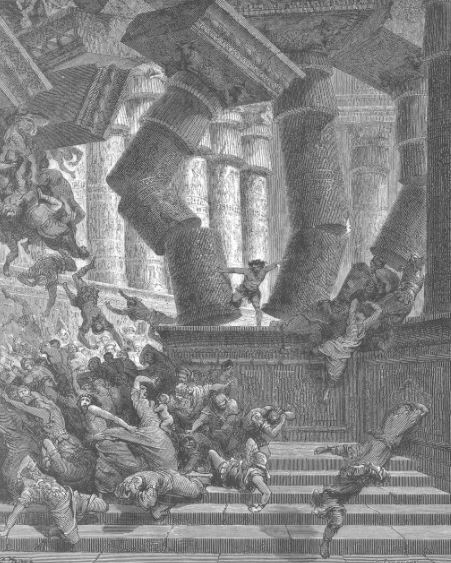
“Death of Samson”, by Gustav Doré

Then three thousand men of Judah went down to the cleft of the rock of Eitam, and said to Samson: “Do you not know that the Philistines are rulers over us? What then is this that you have done to us?” And he said to them: “As they did to me, so have I done to them.” And they said to him: “We have come to bind you, that we may deliver you into the hand of the Philistines.”

Samson turned himself in voluntarily, but with God’s help smote the Philistine oppressors and freed himself. He would be betrayed again by Delilah, but would manage to defeat the Philistines for good, though at the cost of his own life. Like Mashiach ben Yosef, Samson sacrifices himself.

The text above specifically states that three thousand men of Judah came for Samson. What is the significance of this numeric detail?

The Evil 3000

At the Exodus, the Torah states there was a “mixed multitude” (erev rav) of three thousand men among the Israelites. They, too, accepted the Torah at Mt. Sinai, only to instigate the Golden Calf incident forty days later. It is said that the same will happen at the End of Days, with an “erev rav” among the Jews who will instigate all sorts of problems for the nation from within (see, for example, Zohar I, 25 or Sha’ar HaGilgulim, ch. 39). Like Samson’s three thousand men of Judah, Mashiach ben Yosef is sold out by three thousand “Jewish” individuals.

And the fact that they are men of Judah is all the more significant. It was Judah in this week’s parasha who proposed selling Joseph. And to whom did he want to sell him?

And Judah said to his brothers: “What is the gain if we slay our brother and cover up his blood? Come, let us sell him to the Ishmaelites, but our hand shall not be upon him, for he is our brother, our flesh.” (Genesis 37:26-27)

Judah wanted to sell his brother to the Ishmaelites. In speaking of the battles of Mashiach ben Yosef and the End of Days, it is often the Ishmaelites (or the Ishmaelites banded together with Esau) that are implicated (see, for example, Pirkei d’Rabbi Eliezer, ch. 30). Today, of course, the modern “Philistines” are Ishmaelites, and among their biggest supporters are the descendants of Esau.

In The Era of Mashiach

This discussion is particularly timely in light of what’s currently happening in the Middle East. It seems the region is preparing for a massive war, one that would inevitably engulf the entire Ishmaelite sphere, if not the whole world. We’ve written before that we are undoubtedly in the “footsteps of the Messiah” and here is another intriguing point:

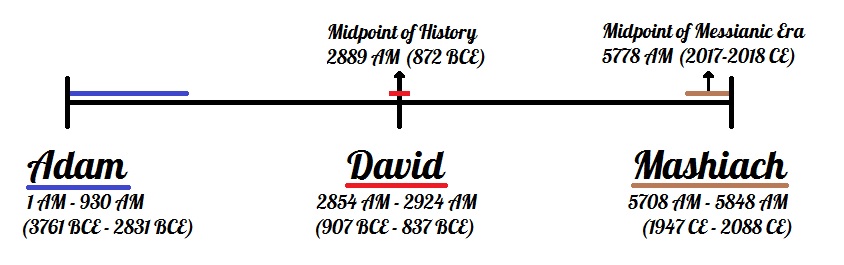
God originally intended for Adam to live 1000 years. Yet, we see in Genesis that Adam lived only 930 years. This is because, as is well known, Adam foresaw that David would be stillborn, and donated 70 years of his life to him. Indeed, David went on to live exactly 70 years. The Arizal saw in the name Adam (אדם) an acronym for three figures: Adam, David, Mashiach. These are the first, middle, and last major figures of human history. Based on this, Rabbi Yitzchak Ginsburgh teaches that David is supposed to be the literal midpoint of history. If that’s the case, then we only need to see when David lived to calculate the era of Mashiach.

The traditional lifetime for David is 2854-2924 AM (Anno Mundi, Hebrew calendar years, corresponding to about 907-837 BCE). To find the time period for the End of Days we must simply multiply David’s years by two. This gives 5708-5848, or 1947/1948-2087/2088 CE. That’s quite amazing, considering that Israel officially became a state in 5708 (the UN vote to create Israel took place in November 1947, and Israel declared independence in May 1948—both dates fall within the Jewish year 5708). And what would be the midpoint, or perhaps the apex, of the “End of Days” period? None other than 5778, the year which we are currently in.

Stay tuned.


The above essay is adapted from Garments of Light, Volume Three.
Get the book here!