Tag Archives: Redemption

Secrets of the Pesach Seder Plate

This Friday evening marks the start of Passover. At the Passover seder, it is customary to have a plate upon which all the symbolic Passover foods are placed. According to one arrangement, on the top right we place the zeroa bone; parallel to it on the left is an egg; then the maror (bitter herb) in the centre; the sweet charoset on the bottom right, opposite the karpas vegetable; and in the bottom centre the chazeret, horseradish or another serving of maror (which is used in the korech “sandwich”). In addition, we have three matzahs and the cup of wine, to be filled four times. What is the significance of these Pesach elements?

The zeroa represents the fact that God took us out of Egypt “with an outstretched arm” (b’zeroa netuya), as the Torah states. It also represents the korban pesach, the Pesach offering that would be brought and consumed in the days of the Temple. For this reason, it is best to have a zeroa from a lamb shank, since the Pesach offering was a lamb. The lamb itself was in commemoration of the fact that the Israelites smeared the blood of the lamb on their doorposts on the eve of their Exodus, to protect their homes from the tenth and final plague. It was a lamb in particular because the astrological sign for the month of Nisan is Aries, a ram or sheep. This is tied to Egyptian idolatry, where a number of Egyptian gods were depicted as ram-headed, or with the horns of a ram, including Khnum and Osiris. The slaughter of a lamb was thus symbolic of destroying the idols of Egypt, like the Ten Plagues themselves (see ‘The Ten Plagues: Destroying the Idols of Egypt’ in Garments of Light).

The egg symbolizes another offering brought on Passover: the chagigah, or holiday offering. This was the standard offering brought on all festivals in the days of the Temple. The reason that it is specifically an egg is because a whole egg is one of the foods traditionally consumed by mourners. (The round egg represents the cycle of life.) In this case, the egg is a symbol of mourning for the destruction of the Temple. Intriguingly, Rav Sherira Gaon (d. 1006) wrote how it is customary to eat meat, fish, and egg at the Pesach seder to represent the foods that will be eaten in the End of Days at the Feast of Mashiach. According to the Midrash, in that time the righteous will eat the fishy flesh of Leviathan, that great sea-dragon that Mashiach will slay; as well as the meat of the beast called Behemoth; and the egg of the mythical bird Ziz. So, eating an egg at the Pesach meal is symbolic of that future messianic feast.
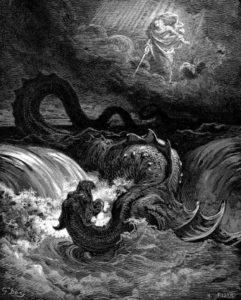
‘Destruction of Leviathan’ by Gustav Doré

The maror famously represents the bitter oppression of the Jews, just as the Torah states that the Egyptians “embittered” (v’imareru) the lives of the Jews with mortar and brick, and hard labour (Exodus 1:14). The need to eat maror actually comes explicitly from the Torah, which commands that Jews should eat the Pesach offering together with matzah and bitter herbs (Exodus 12:8). The Mishnah (Pesachim 2:6) lists five possible maror herbs, though their identity is not entirely clear. The only one that appears to be undisputed is lettuce, and hence it is lettuce that is used for maror in Sephardic communities. Another possibility is that maror is horseradish—not the mustard-like sauce but an actual horseradish root (since maror must be a raw vegetable, as the Shulchan Arukh states in Orach Chaim 473:5). There are other traditions for maror’s identity as well.

Interestingly, the Midrash states that the consumption of maror on Pesach is one of the few things King Solomon did not understand! In Proverbs 30:18, Solomon wrote that “Three things are wondrous to me and four I do not know.” Although the passage continues to state what it is that Solomon wondered about, the Midrash (Vayikra Rabbah 30:14) has an alternate explanation: The three things wondrous to Solomon were the Pesach offering, matzah, and maror; and the four he didn’t know were the mysteries behind the four species of Sukkot!

The Mystery of Karpas and Charoset

The maror is dipped into the sweet charoset. This paste is meant to resemble the clay mortar that the Israelites used, or the mud that was baked into clay bricks. The word charoset comes from cheres, “clay”. There are vastly different traditions as to the ingredients of charoset. One tradition is to use the fruits mentioned in Shir HaShirim, the Song of Songs, among them: apples (2:3), figs (2:13), nuts (6:11), dates (7:7), wine (1:2), and cinnamon (4:14). The romantic lyrics of the Song are interpreted as an allegorical “love story” between God and Israel, and the fruits are used throughout the text in metaphorical fashion to describe that passionate love. It is particularly appropriate to use the Song of Songs recipe since it is customary to read the Song of Songs on the holiday of Pesach. (There are five megillot, “scrolls”, in the Tanakh, and each is read on a particular holiday: Shir HaShirim on Passover, Ruth on Shavuot, Eichah on Tisha b’Av, Kohelet on Sukkot, and Esther on Purim.)

Some have pointed out that charoset may have a Greek origin, as it was common…


The above is an excerpt from Garments of Light, Volume Two. To continue reading, get the book here

Tisha B’Av: The Untold Story of Napoleon and the Jews

Tisha b’Av is the saddest day on the Jewish calendar. This holiday commemorates many historical tragedies, most significantly the destruction of both Holy Temples in Jerusalem. One of the most common stories heard on Tisha b’Av is about Napoleon walking by a Paris synagogue on this day, hearing the lamentations and loud weeping of the Jews. In the story, he asks what the Jews are crying about, and after being told about the destruction of the Temple nearly two millennia ago, apparently remarks something along the lines of: “A nation that cries and fasts for 2,000 years for their land and Temple will surely be rewarded with their Temple.”

Hearing this story immediately sets off some alarms. Firstly, Napoleon was no ignoramus, and was certainly well aware of the destruction of the Temple (after all, the Temple is featured in the “New Testament” and plays an important role in Christian history as well). More notably, Napoleon was a military man his entire life; his biography is the very definition of a tough guy. This man lived by the sword—it is highly unlikely that he would praise people for sitting and crying about something.

In fact, the myth of Napoleon and Tisha b’Av has been debunked multiple times. One of the earliest known sources of the legend is a Yiddish article from 1912, later included in the 1924 American Jewish Yearbook, and similarly appearing in a 1942 book called Napoleon in Jewish Folklore. Here, we are given a far more logical version of the story: After hearing the weeping of the Jews in a synagogue in Vilnius, Napoleon points to his sword and says, “This is how to redeem Palestine.”

Napoleon and the Jews

An 1806 depiction of Napoleon emancipating the Jews

Napoleon would actually play a tremendous role in Jewish history, and might even be credited with starting the process of “redeeming Palestine”. It was Napoleon that ushered in the “emancipation” of Jews in Europe. Wherever he conquered, he would free the Jews from the ghettos, and give them equal rights. In France, he went so far as to declare Judaism one of the state’s official religions in 1807. Napoleon also famously sought (and failed) to re-establish the Sanhedrin.

These actions brought upon him the ire of many of his contemporaries, especially Czar Alexander of Russia, who branded Napoleon the “Anti-Christ” for liberating the despised Jews. Moscow’s religious authority at the time proclaimed:

In order to destroy the foundations of the Churches of Christendom, the Emperor of the French has invited into his capital all the Judaic synagogues and he furthermore intends to found a new Hebrew Sanhedrin—the same council that the Christian Bible states condemned to death (by crucifixion) the revered figure, Jesus of Nazareth.

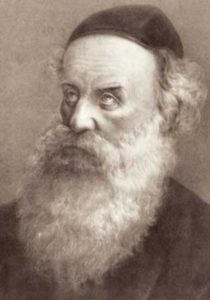
Rabbi Schneur Zalman of Liadi, the “Alter Rebbe” (1745-1812)

Of course, most Jews were ecstatic, and relished their newly acquired liberties. It became common for Jews to name their children “Napoleon”, or adopt the last name “Schöntheil”, the German translation of “Bonaparte”. Yet, not all Jews were happy about this development. The Alter Rebbe—founder of Chabad, who lived during the times of Napoleon—wrote the following in one of his letters:

If Bonaparte will be victorious, Jewish wealth will increase, and the prestige of the Jewish people will be raised; but their hearts will disintegrate and be distanced from their Father in Heaven. But if Alexander will be victorious, although Israel’s poverty will increase and their prestige will be lowered, their hearts will be joined, bound and unified with their Father in Heaven…

The Alter Rebbe thus fled from the approaching French forces, inspired his followers to do the same, and even supported the Russian military. He was right about Bonaparte. Napoleon had no interest whatsoever in seeing the Jews flourish as Jews, or practice their religion proudly. His intentions were clear: the complete assimilation of the Jews into European society. It was Napoleon that first permitted Jews to serve in the military, openly stating that “Once part of their youth will take its place in our armies, they will cease to have Jewish interests and sentiments; their interests and sentiments will be French.”

As it turned out, opening the doors for Jews to serve in the French military would lead to the proliferation of the Zionist movement, and the establishment of the State of Israel.

France and Israel

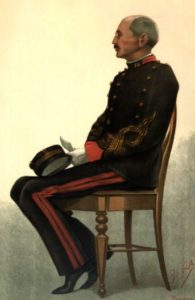
1899 Guth painting of Alfred Dreyfus for Vanity Fair

In 1894, Theodor Herzl was a young journalist working in Paris. He was covering the infamous “Dreyfus affair”, where a Jewish captain in the French military, Alfred Dreyfus, was wrongly accused of treason. During this time, Herzl witnessed the extreme anti-Semitism of the French firsthand. He realized that no matter how much the Jews assimilate, they would still never be accepted into European society, and reasoned that the Jews must have their own free state. Thus, it was a Jewish soldier in the French military—what Napoleon so dearly wanted—which catapulted the Zionist movement.

Interestingly, Napoleon himself seemed to have supported the notion of a Jewish state in Israel. In 1799, before he was emperor, and while besieging the city of Acre in Israel, Napoleon issued a proclamation inviting “all the Jews of Asia and Africa to gather under his flag in order to re-establish the ancient Jerusalem. He has already given arms to a great number, and their battalions threaten Aleppo.” Ultimately, the British defeated Napoleon’s forces, and the plan never materialized.

Nonetheless, Napoleon’s role in igniting the flames of Zionism cannot be overlooked. Zionism was primarily a secular movement, its most fervent supporters being assimilated European Jews who, like Herzl, were frustrated that they were still hated and unwanted in European society. This secularism was a direct result of Napoleon’s campaigns. Without his spearheading of the Jewish “emancipation”, it is doubtful that there would have ever been a Zionist movement to begin with.

And although there is much to criticize about Zionism, these mostly secular European Jews succeeded in re-establishing a free Jewish state in the Holy Land after two very long millennia. Yes, the Israeli government is unfortunately secular, and Mashiach has not yet come, and there is a great deal of work to do to restore a proper Jewish kingdom as God intended. However, the State of Israel allowed for the majority of Jews to return to their homeland, escape persecution, live openly as Jews, fulfil mitzvot only possible in the Holy Land, and travel freely to Jerusalem. Israel is undoubtedly paving the way for the Final Redemption, which is why many great rabbis of recent times have described it as reshit tzmichat geulatenu, the first steps of the redemption.

It is therefore fitting that the gematria of “France” (צרפת), where the whole process began, is 770, a number very much associated with redemption as it is equivalent to בית משיח, the “House of Mashiach”. Ironically, this number is most special for Chabad—the same Chabad that so resisted Napoleon and the French! (And at the same time, adopted the tune of Napoleon’s military band as their own niggun, still known as “Napoleon’s March” and traditionally sung on Yom Kippur!)

Most beautifully, it appears to have all been predicted long ago by the Biblical prophet Ovadia, who prophesied (v. 17-21):

And Mount Zion shall be a refuge, and it shall be holy; and the house of Jacob shall possess their heritage… And they shall possess the Negev, the mount of Esau, and the Lowland, with the [land of the] Philistines; and they shall possess the field of Ephraim, and the field of Samaria; and Benjamin with Gilead. And the great exile of the children of Israel, that are wandering as far as צרפת [France], and the exile of Jerusalem that is in Sepharad, shall possess the cities of the Negev. And saviours shall come upon Mount Zion to judge the mount of Esau; and the kingdom shall be God’s.


The article above is an excerpt from Garments of Light: 70 Illuminating Essays on the Weekly Torah Portion and Holidays. Click here to get the book! 

The Eighth Day of Pesach: Isaac, the Afikoman, and Mashiach ben Yosef

Of the three patriarchs, the holiday of Passover is most intimately tied to Isaac. According to tradition, Isaac was born on Passover. Commenting on Genesis 18:10, Rashi explains that the angels’ visit to Abraham and Sarah occurred on Passover, and the angels promised a son to be born – Isaac – exactly one year from that time. This important detail helps to solve a key chronological problem. Earlier, God had told Abraham that his offspring would be subjugated for 400 years. However, when one makes an accounting of the timeline, they will find that the Jews were only in Egypt for a total of 210 years! How could this be?

Commenting on that verse (Genesis 15:13), Rashi calculates how the Exodus occurred exactly 400 years from the birth of Isaac. Thus, God’s word was perfectly fulfilled, since Isaac was the very first of Abraham and Sarah’s offspring. Although Isaac was not subjugated in the sense that the Jews in Egypt were, nonetheless he was certainly troubled by the Canaanites and Philistines, as the Torah records, and was considered a “foreigner” in the Holy Land throughout his life, since God had not yet officially granted the land to the Jews, nor did Isaac settle it permanently.

Digging further, if Isaac was born on the first day of Passover, then his brit milah (circumcision) would have been on the eighth day of Passover. Though the eighth day is not celebrated in Israel, it is celebrated in the diaspora. According to Chassidic custom, as initiated by the Baal Shem Tov (the founder of Chassidism) the eighth day of Passover is associated with Mashiach. In fact, it is customary to hold a Seudat Mashiach, a “Mashiach Feast” on the final afternoon of the holiday, complete with matzahs and four cups of wine. Just as Passover celebrates the First Redemption (led by Moses), the last day of Passover is meant to represent the Final Redemption (led by Mashiach). And it is only commemorated in the diaspora since, after all, it is diaspora Jewry that needs the Final Redemption and the Ingathering of the Exiles more than anyone.

Finally, during the Pesach seder we have three matzahs to go along with the Pesach platter. It is taught that these three matzahs represent the three patriarchs: Abraham, Isaac, and Jacob. One of the fifteen steps in the seder is yachatz, where the middle of the three matzahs is broken in half. The larger half is covered and hidden as the afikoman, while the smaller half remains at the seder table. Thus, the matzah which we break is specifically the one associated with Isaac.

So then, what is the deeper connection between Mashiach and the Redemption, Passover and the Afikoman, and the forefather Isaac?

Who is Mashiach?

The Jewish mystics teach that there are actually two messiahs: Mashiach ben Yosef, and Mashiach ben David. This is derived from a number of texts and principles. One of these is the fact that the Tanakh has a clear pattern when it comes to major national events: first comes a descendant of the matriarch Rachel to usher it in, and then comes a descendant of the matriarch Leah to complete the mission. For example, Yosef (a son of Rachel) came to Egypt first to set the stage, and then came Yehuda (a son of Leah) to prepare the land for the actual arrival of the rest of the family (see Genesis 46:28). First, Joshua (of the tribe of Ephraim, and a descendant of Rachel) brought the Jews into the land of Israel following the Exodus, then Othniel (from the tribe of Yehuda) finished the job of conquering and settling the land. The first king of Israel was Saul (from the tribe of Benjamin, and a descendant of Rachel) and only then came King David (again of Yehuda). Thus, in every major event, we see clearly that first comes a descendant of Rachel to prepare the way and fight the battles, and only afterwards comes a descendant of Leah to finish the job.

In the same way, the Sages teach that first comes Mashiach ben Yosef (a descendant of Rachel), whose mission is to fight all the battles on behalf of Israel, and only after this comes Mashiach ben David (a descendant of Leah), who completes the messianic role. And who is Mashiach ben Yosef? Amazingly, the Sages say that this is none other than Isaac, reincarnated!

Of all the patriarchs and major Torah figures, Isaac is spoken of the least in Scripture. Hardly anything is said of him. It is explained that this is because Isaac has not completed his mission, and his story is not over. He has yet to fight many battles. The Sages permute his name – Itzchak (יצחק) – into the words Ketz Chai (קץ חי), literally that he “will live [again] at the End”. This is one reason why Itzchak (which means “will laugh”) is in the future tense. Isaac is Mashiach ben Yosef, who will come at the End to fight the final battles. Beautifully, the gematria of Itzchak (יצחק) is 208, equivalent to Ben Yosef (בן יוסף), also 208.

This brings us back to Passover and the afikoman. The middle matzah is broken in half. One half – the one associated with the patriarch Isaac – remains on the seder plate, together with the other matzahs that symbolize the other patriarchs. The other half – the larger one – is hidden away, only to be revealed at the very end. This is symbolic of Isaac’s final role as that of Mashiach, whose arrival is also concealed until the very ‘End of Days’. And on the eighth and final day of the Passover holiday – the day on which Isaac was circumcised and entered into the Covenant – we hold a ‘Mashiach Feast’ to celebrate the coming Final Redemption, may it arrive speedily and in our days.

Chag sameach!