Tag Archives: Reincarnation

Everything You Wanted to Know About Reincarnation in Judaism

This week’s Torah portion is Mishpatim, which is concerned with the first major set of laws that the Israelites received following the Ten Commandments. While the term mishpatim literally means “ordinances” or “judgements”, the Zohar (II, 94a) suggests a very different interpretation:

“And these are the judgements which you shall set before them…” These are the rules concerning reincarnation, the judgement of souls that are sentenced according to their acts.

The Zohar goes on to interpret the laws in the Torah with regards to the mechanisms of reincarnation. For example, whereas the Torah begins by describing a Hebrew servant who is indentured for six years of labour and must then be freed in the seventh year, the Zohar interprets that this is really speaking of souls which must reincarnate in order to repair the six middot before they could be freed. (The middot are the primary character traits: chessed, kindness; gevurah, restraint; tiferet, balance and truth; netzach, persistence and faith; hod, gratitude and humility; and yesod, sexual purity.)

While the Zohar speaks at length about reincarnation, it is the Arizal who systematically laid down the rules of reincarnation and explained the Zohar in depth. His primary disciple, Rabbi Chaim Vital, recorded these teachings in a famous treatise known as Sha’ar HaGilgulim, “Gate of Reincarnation”. The following is a brief condensation of the basic rules of reincarnation that are defined in this tremendous text, answering many of the common questions people have about spiritual transmigration.

Why Do People Reincarnate?

At the start of the eighth chapter, Rabbi Vital writes:

למה מתגלגלים. דע, כי הנשמות יתגלגלו לכמה סבות, הראשונה הוא, לפי שעבר על איזו עבירה מעבירות שבתורה, ובא לתקן. הב’ הוא, לתקן איזו מצוה שחסר ממנו. השלישית היא, שבא לצורך אחרים, להדריכם ולתקנם… לפעמים יתגלגל, ליקח את בת זוגו, כי לא זכה בראשונה לקחתה

Why do people reincarnate? Know that souls reincarnate for several reasons: The first is that one transgressed one of the prohibitions in the Torah, and returns to repair it. The second is to fulfil a mitzvah that one lacks. The third is in order to assist others, to guide them, and rectify them… Sometimes one reincarnates to marry their soulmate, which they did not merit to do in a previous life.

The Ari explains that people mainly reincarnate in order to atone for sins of past lives, or to fulfil mitzvahs that they didn’t do previously. Later, in Chapter 16, we read that people who return do not have to fulfil all the mitzvahs in one lifetime, but only have to accomplish those that their souls are still lacking. Some reincarnate not for their own rectification, but to assist others. We are told elsewhere that these are usually very righteous individuals who agree to return to this world in order to help others.

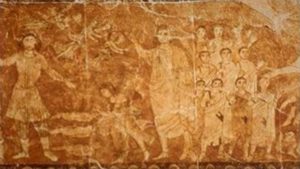
Fresco of the Resurrection of the Dead from the ancient Dura-Europos Synagogue

Some also reincarnate because they either did not marry, or married the wrong person. They must return to reunite with their true soulmate. The Arizal teaches that, unfortunately, some people are so deeply mired in kelipot, negative spiritual “husks”, that they are unable to find their soulmate in this world. These people will reunite with their other half only in Olam HaBa, the “next world” at the time of the Resurrection. With regards to finding soulmates, this is directed particularly at male souls, for it is primarily a man’s responsibility to find his soulmate.

On that note, the following chapter tells us that female souls actually reincarnate very rarely. To begin with, female souls are more refined than male ones, and are unlikely to require more rectifications. What does happen more commonly is that male souls are reincarnated into female bodies! This opens up a number of fascinating scenarios which Rabbi Chaim Vital describes.

What Do People Reincarnate Into?

In Chapter 22, we read that people can reincarnate not only into human bodies, but also animals, vegetation, and even inanimate matter. For example, a person who feeds others non-kosher food reincarnates as a tree; one who sheds blood reincarnates into water; those who transgress various sexual prohibitions reincarnate into bats, rabbits, and other animals; while proud people and those who talk too much reincarnate into bees. (We are told that this is what happened to the judge Deborah who, despite her greatness and wisdom, had a bit of pride and was required to reincarnate into a bee, hence her name devorah, which literally means “bee”!)

It is important to mention, though, that an entire human soul does not fully reincarnate into another organism. Rather, souls are complex entities made up of many different interacting sparks. It is only those sparks that require rectification that return to this world (Chapter 14). Interestingly, the Arizal teaches that when two people really dislike each other, and are constantly in conflict with one another, this is often because the two are sharing sparks from one soul!

How Many Times May One Reincarnate?

Sha’ar HaGilgulim records that a person can reincarnate thousands of times—but only on the condition that they improve at least a little bit in each incarnation. If they fail to improve, they can only reincarnate a maximum of three times. After three strikes, that particular spark is sent to Gehinnom (loosely translated as “hell”) where it will be purified. However, the souls of those who regularly learn Torah are never sent to Gehinnom, and always merit reincarnation. This is one of the incredible protective powers of regular Torah study.

In multiple places, the Arizal teaches about the reincarnations of Abel, the son of Adam. Abel (הבל) had a good side and a bad one. The good side was represented by the letter Hei (ה) of his name, and the bad by the Beit and Lamed (בל). In order to be rectified, the bad part reincarnated in Laban (לבן), the wicked father-in-law of Jacob. Laban didn’t do much better, so he was reincarnated in the gentile prophet Bilaam (בלעם). He, too, was an ungodly person, so the Beit-Lamed soul was reincarnated for the third time in Naval (נבל), the ungrateful man who rejected David. Naval was strike three, and that Beit-Lamed soul no longer returned in the same way in a human reincarnation. It did suffer a punishment at some point in the form of a stone, which is why we read in the Tanakh (I Samuel 25:37) that when Naval died, “he became a stone” secretly alluding to a reincarnation in stone!

We see from the above how a person’s name may offer tremendous hints as to their soul sparks, previous lives, tests, challenges, and character traits. When we read about the above individuals in the Tanakh, we see how similar they were. All three were very wealthy, famous, and participated in divination and sorcery. All were cunning, greedy, and deceitful individuals. The Arizal explains in detail what rectifications each was supposed to do, and how one life affected the next, weaving together these three seemingly unrelated Biblical narratives that span nearly a thousand years into one beautiful tapestry.

Which Body Will A Person Have at the End?

Perhaps the most famous question: if a soul has so many different bodies over so many different lifetimes, which body will that soul inhabit in the afterlife, or in the world of Resurrection? Rabbi Vital writes:

וכן הענין בכל נשמה ונשמה, וכאשר יהיה זמן התחיה, כל גוף וגוף יקח חלקו של נשמתו, כפי חלק הזמן שלו באיזו מדרגה היתה

And with each and every soul, when the time of the Resurrection comes, each and every body will take its corresponding soul, according to the part that it had at that particular time.

Thus, each part of the soul will have its own body, and all reincarnations will exist simultaneously as distinct individuals in Olam HaBa!

Breaking Free from Materialism

In Chapter 23, Rabbi Vital suggests that the most important thing to take from all of this is to live a meaningful, spiritual life. When a person is mired in materialism, and cares only for their physical aspects, they become so attached to their bodies that they cannot exist without one. And so, when that person’s body dies their soul is in complete disarray; frightened, pained, and unable to ascend onwards. Angels must come and quickly place the soul in a new body. As such, this person can never free themselves from endless reincarnations into this imperfect, difficult world.

However, those who in their lifetimes tap into their souls, and are comfortable with their spiritual side, are able to simply take off their dead bodies like an old garment, and move on. For such people, their wonderful portion in Olam HaBa is not too far away.


The above is an excerpt from Garments of Light: 70 Illuminating Essays on the Weekly Torah Portion and Holidays. Click here to get the book! 

Will There Be Sacrifices in the Third Temple?

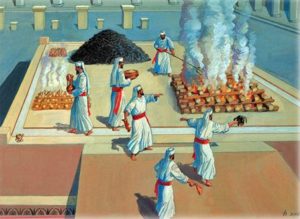
Offerings on the Altar (Courtesy: Temple Institute)

Offerings on the Altar (Courtesy: Temple Institute)

This week’s Torah reading is Acharei, focusing on the details of the priestly procedure performed on Yom Kippur in the Temple (or Tabernacle). God instructs Aaron to take two goats and one bull. One of the goats is to be sacrificed, while the other is to be sent to “Azazel” (the identity of which we have discussed in the past). Meanwhile, the bull is also to be sacrificed, and its blood sprinkled on the Holy Vessels within the innermost chamber of the Temple, the Holy of Holies. The third book of the Torah, Vayikra (Leviticus), often details such lengthy sacrificial procedures. To the modern reader, these passages tend to be quite difficult to read, with rituals that seem unnecessarily bloody and distasteful. Does God really want us to sacrifice animals? And when the Third Temple is rebuilt, will we once again be responsible for performing such rituals?

Back to the Garden of Eden

When God initially created the world, he placed man in a perfect environment where there was absolutely no death or bloodshed of any kind. Man was instructed only to consume fruits and plant matter. In fact, it wasn’t until the time of Noach that God reluctantly agreed to allow mankind to consume meat.

From a Kabbalistic perspective, this was done only for the purposes of tikkun, spiritual rectification (see Sha’ar HaMitzvot on parashat Ekev, and Sha’ar HaPesukim on Beresheet). The sinful souls of the flood generation were reincarnated into animals, and through their slaughter and consumption, those souls could be rectified and returned to the Heavenly domain. This is clearly hinted to in the phrasing of the Torah’s text: the animals that Noach took unto the Ark to be saved were initially described as zachar v’nekeva, “male and female” (Genesis 6:19). However, we are later told that some of the animals, particularly those to be slaughtered following the flood, were ish v’ishto, literally “man and woman”, or “husband and wife” (Genesis 7:2)!

We can deduce from this that sacrifices—and the consumption of meat in general—is a temporary phenomenon, for the purposes of tikkun, and not what God intended in His ideal conception of the world. Indeed, God often states in Scripture that He neither wants, nor requires, any sacrifices. He even states, perplexingly, that He never commanded them to begin with:

So said Hashem, Lord of Hosts, the God of Israel: “You add burnt offerings onto your sacrifices, and eat flesh, which I did not speak unto your forefathers, nor did I command them on the day that I took them out of Egypt, concerning burnt offerings and sacrifices. Rather, it is this that I commanded them: Listen to My voice, and I shall be for you a God, and you shall be for me a people, and you shall walk in all my ways that I shall command you, that it may be well for you.” (Jeremiah 7:21-23)

The Rambam explains that when taking the Israelites out of Egypt, God could not forbid them from offering sacrifices. This is because in that time period, offering sacrifices was the most common form of divine worship among the masses, and this is what the Israelites were familiar with. Thus, God allow the Israelites to bring sacrifices temporarily, as a means to slowly wean them off the practice:

The Israelites were commanded to devote themselves to His service… But the custom which was in those days general among all men, and the general mode of worship in which the Israelites were brought up, consisted in sacrificing animals in those temples which contained certain images, to bow down to those images, and to bum incense before them; religious and ascetic persons were in those days the persons that were devoted to the service in the temples erected to the stars, as has been explained by us. It was in accordance with the wisdom and plan of God, as displayed in the whole of Creation, that He did not command us to give up and to discontinue all these manners of service; for to obey such a commandment it would have been contrary to the nature of man, who generally cleaves to that which he is used to; it would in those days have made the same impression as a prophet would make at present if he called us to the service of God and told us in His name, that we should not pray to Him, not fast, not seek His help in time of trouble; that we should serve Him in thought, and not by any action. For this reason God allowed these kinds of service to continue; He transferred to His service that which had formerly served as a worship of created beings, and of things imaginary and unreal, and commanded us to serve Him in the same manner; namely, to build unto Him a temple; “And they shall make unto me a sanctuary” (Exodus 25:8); to have the altar erected to His name; “An altar of earth you shall make me” (Exodus 20:21); to offer the sacrifices to Him; “If any man of you bring an offering unto the Lord” (Leviticus 1:2), to bow down to Him and to bum incense before Him… By this Divine plan it was affected that the traces of idolatry were blotted out, and the truly great principle of our faith, the Existence and Unity of God, was firmly established. This result was thus obtained without deterring or confusing the minds of the people by the abolition of the service to which they were accustomed and which alone was familiar to them…

The Rambam goes on to elaborate on this point in more detail, and to thoroughly prove his argument, which is quite a fascinating read (Guide for the Perplexed, Part III, Ch. 32). He is clear on the fact that sacrifices were not God’s original intention, as we see in the Garden of Eden and through the words of the Prophet Jeremiah, but only a temporary necessity.

Sacrifices in the Third Temple?

Having said that, the Rambam does, somewhat paradoxically, write in his Mishneh Torah that sacrifices will resume in the Third Temple. It appears that the Rambam publicly went with the mainstream Orthodox approach but, in private, held that sacrifices will not be performed ever again. The Rambam writes that prayer is a far greater mode of worship than sacrifice, an idea that goes back to the prophet Hoshea, who declared “…we shall offer the cows with our lips.” (Hoshea 14:3)

More recently, Rabbi Avraham Itzchak Kook, the first Ashkenazi Chief Rabbi of Israel, similarly appeared to vacillate on the issue. In one place, he suggests that only grain offerings will be reinstated, and not animal offerings. (This is based on Malachi 3:4, which only mentions a restoration of grain offerings.) The Midrash suggests that only one type of offering will return, the voluntary Todah, or “thanksgiving” offering (see Vayikra Rabbah 9:7). Others propose that sacrifices will return for a short period of time only before being permanently abolished.

Ultimately, if God intended a perfect world with no death—as was His original plan for the Garden of Eden—and the future Redemption is essentially a global return to a state of Eden, then we certainly shouldn’t expect any more (animal) sacrifices in the future. It should be mentioned that the Sages teach that Adam did bring an animal sacrifice to God (Avodah Zarah 8a). However, this was not inside the Garden of Eden, but after he had already been banished, and due to his fear that the previously-decreed death sentence was upon him. Within Eden itself there could not be any death whatsoever. And so, if the world is set to return to an idyllic Eden-like state, there will certainly be no place for sacrifices.


The above is adapted from Garments of Light, Volume Two. Get the book here

Bilaam: The Last Prophet

This week’s Torah portion, Balak, is named after the Moabite king who sought to curse the Jewish people in the Wilderness. Seeing how the Hebrew nation had grown so large and powerful, and had earned God’s favour, Balak feared the Jews. He knew that taking them on physically would fail, so he decided on a spiritual solution to his problem. He summoned Bilaam (or Balaam), the greatest prophet among the gentiles, to curse the Jewish people in return for vast riches. Bilaam, however, refused the generous offer, knowing that there was no way he could curse the Jews if God did not wish it. Bilaam admitted that as a genuine prophet, he could only pronounce what Hashem would put in his mouth, and nothing more. Nonetheless, Balak continued to entice Bilaam until the prophet acquiesced, and agreed to give it a shot. Every single one of his attempts failed, and each time that Bilaam would open his mouth to curse the Jews, a blessing would emerge instead. Frustrated, Balak and Bilaam give up.

The story does not end there, though. Having failed to curse the Jews, Balak and Bilaam come up with another plan. Knowing that God’s favour only rests upon the Jews when they act righteously and in a holy manner, the two realized that they could tempt the Jews towards sin. Once the people are mired in sin, God’s divine protection would be lost, and the nation would in effect be cursed. This time, their plan worked like a charm.

'Balaam and the Angel' by John Linnell

‘Balaam and the Angel’ by John Linnell

Balak and Bilaam sent a great number of gentile women to bring the Jewish men into sexual immorality and licentiousness. From there, they enticed them further into idolatry. Everything spins out of control, and Moses seems powerless to stop the endless cycle of sin. This reaches a climax when Zimri, the prince of the tribe of Shimon, publicly engages in sexual acts with a Midianite woman.

It is Pinchas, the grandson of Aaron, who finally steps in to end the tragedy. He slays Zimri, shocking the nation and waking the people. Pinchas is given an everlasting blessing for bringing an end to the immorality. According to some opinions, he later slays Bilaam as well. The Talmud (Sanhedrin 106a) states that it was precisely when Bilaam went to redeem his reward that he was killed.

Interestingly, all of the ancient texts agree that Bilaam was a true prophet, and was even equal in prophecy to Moses! How did Bilaam attain the merit for prophecy, and how did he fail so miserably?

The Origins of Bilaam

The Midrash relates how the gentiles brought a complaint against God. They argued that had God given them a leader like Moses, they too would have surely become holy and righteous nations. So, God did indeed send them a prophet like Moses. This was Bilaam.

In fact, the Arizal states that Moses and Bilaam stem from the same spiritual root: they were both reincarnations of Abel, the son of Adam (Sha’ar HaGilgulim, ch. 29). The spiritual spark corresponding to the letter Hei in Abel’s name (הבל) was given to Moses (משה), while the sparks corresponding to the letters Bet and Lamed in Abel’s name (הבל) were given to Bilaam (בלעם). So, it isn’t surprising that the two are often described as being of equal greatness in prophecy.

Unfortunately, the gentiles’ request for a prophet did not bring the result they had expected. Instead of using their prophet as a leader for goodness, they adopted him to further their own evil ends.  And this began long before Balak summoned him.

The Talmud (ibid.) recounts how Bilaam was once one of the three main advisors and soothsayers to the Pharaoh in Egypt. The other two were Iyov (Job) and Yitro (Jethro). When Pharaoh’s astrologers saw that the Redeemer of the Hebrews would soon be born, it was Bilaam who advised that all the male firstborn be drowned. Job was against the idea, but remained silent. For this, he was so severely punished (as described in the Book of Job). Jethro was the only one who spoke up and tried to avert the decree. For his opposition to the Pharaoh, he was forced to flee the kingdom. In poetic fashion, the very redeemer he was trying to save at birth ended up being his own son-in-law! Bilaam, meanwhile, ended up working with Balak to try and finish the job he started over a century earlier. Once again, he failed.

A Balance in the Universe

The Midrash (Tanchuma on Balak, Passage 1) elaborates that for every great leader, king, or prophet that God had sent the Jews, he equally sent one to the non-Jews. King Solomon’s counterpart was Nebuchadnezzar. While the former used his talents to build the First Temple, a House for God and a place of holiness and unity, the latter used those same talents to destroy that very same holy place. King David’s counterpart was Haman. Both were blessed with wealth and success. The former used these resources to bring the people together and unify all the tribes, bringing peace to the region; the latter used his resources to incite a genocide. Moses’ counterpart was Bilaam. The former used his prophecy to bring God’s message of holiness, peace and goodness; the latter used his prophecy for idolatry, destruction, and immorality. The passage in the Midrash concludes that God subsequently took away all forms of prophecy from non-Jews. Bilaam was the last true prophet among the gentiles.