Tag Archives: Sefer HaBahir

Do Men Have More Mitzvot than Women?

This week’s parasha, Tazria, begins by describing the rituals that a mother must perform upon giving birth to a new child. If the child is male, the mother is considered “impure” for seven days following her delivery, and then spends an additional 33 days in purification. For a female child, the durations are doubled, with the mother “impure” for 14 days, and purifying for another 66 days. Why is the duration of purification for a female doubly longer than a male?
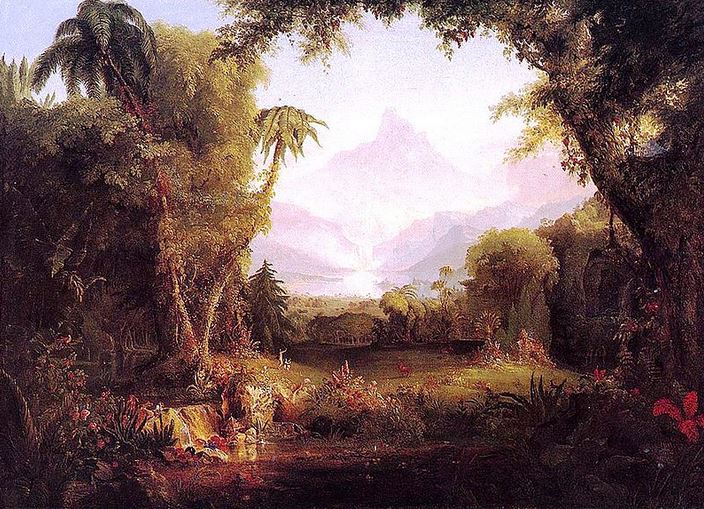
‘Garden of Eden’, by Thomas Cole

The apocryphal Book of Jubilees (3:8) suggests an interesting idea: Adam was made on the Sixth Day of Creation but, apparently, Eve wasn’t made until a whole week after. This is why a mother of a male child is impure for a week, but a mother of a female child for two weeks! Jubilees also holds that Adam was only brought into Eden forty days after being created, while Eve was brought in after eighty days. This is why a mother of a male child needs a total of forty days to purify, and a mother of a female child needs eighty days. Of course, Rabbinic tradition rejects the Book of Jubilees, and it is accepted that Adam and Eve were both created on the Sixth Day, and were in Eden from the beginning.

Commenting on this week’s parasha, the Zohar (III, 43b) states that it takes a soul 33 days to settle in the body. This is primarily referring to the new soul that enters a newborn baby, as it takes time for the ethereal soul to get used to its descent into a physical world. The Zohar doesn’t add too much more on this, but we might assume that, based on the words of the Torah, it takes a male soul 33 days to settle, and a female soul 66 days to settle. At the same time, the Zohar may be referring to the soul of the mother, too, as she is the one that spends 33 or 66 days in purification. As we’ve explained in the past, the severing of the mother’s direct connection to her child distresses her soul for 33 or 66 days following childbirth.

Whatever the case, the implication is that a female soul is somehow greater than a male soul. It has more spiritual power, taking longer to settle. The notion that female souls are greater is found throughout Jewish texts, especially mystical ones. Sefer HaBahir, one of the most ancient Kabbalistic texts, states that the female soul is the most beautiful of all, and an aspect of the Shekhinah, the Divine Presence (chs. 173-175). It explicitly makes clear that life on Earth would be impossible without the life-giving mother, who in this regard is much closer to God.

On that note, it has been said that God created the world sequentially from simple to complex, starting with the basic elements: light, air, water, earth; progressing to plants, then simple animals, then mammals, then man, and finally woman. The woman is the last of God’s creation, and therefore the most intricate and the most refined. It may be because of this that the Arizal taught that while male souls typically reincarnate to rectify themselves, female souls rarely if ever reincarnate at all (Sha’ar HaGilgulim, ch. 9).

It is important to mention here that we are speaking of female souls, not necessary to all women. The Arizal (as well as the Zohar cited above) speak of the possibility of female souls in male bodies, or male souls in female bodies. And it should also be mentioned that this does not necessarily affect the body’s sexuality. A “female” soul in a male body can still very much be a heterosexual male, and vice versa. (For more on this, see Rav Yitzchak Ginsburgh’s lecture here on the female soul of the forefather Isaac, as well as the prophets Samuel, Jonah, and Habakkuk.)

There are a number of consequences to the greater souls of females. For one, it gives them binah yeterah, an “extra understanding” sometimes referred to as “women’s intuition” (Niddah 45b). This is one reason why the women of the Exodus generation, for example, did not participate in the sin of the Golden Calf, nor the sin of the Spies. In fact, the Kli Yakar (Rabbi Shlomo Ephraim Luntschitz, 1550-1619, on Numbers 13:2) states that, had Moses sent female spies, there would have been no problem at all!

On the other hand, a more elevated soul and an extra depth of understanding means a greater sensitivity to the world, which makes women generally less prone to violence and drug abuse, but significantly more prone to depression and anxiety. The greater female soul has the amazing potential to bring life, yet simultaneously (to balance the equation) the potential for severe destruction, “more bitter than death”, to borrow from King Solomon in Kohelet 7:26. This is symbolically reflected in the menstrual cycle, where a lack of conception of life necessarily results in the shedding of blood, a “minor death” that is then rectified in the living waters of the mikveh.

Finally, a greater soul means that women require slightly less mitzvot than men. After all, the “mitzvot were given only in order that human beings might be purified by them… their purpose is to refine…” (Beresheet Rabbah 44:1) A more refined female soul does not need the same mitzvot that a male soul does. Unfortunately, this has sometimes been a point of contention in modern times. Yet, upon closer examination, we see that the differences in mitzvot between men and women are actually minimal and, contrary to the general belief, there is a perfect balance between those mitzvot done exclusively by men and those done exclusively by women.

“Time-Bound” Mitzvot?

The general rule is that, at least in principle, women are exempt from any mitzvah that can only be done at a particular time. This includes mitzvot like prayer, tefillin, and tzitzit. However, in practical terms we see that this “rule” isn’t really a thing, and there are many time-bound mitzvot that women are obligated in. For example,


The above is an excerpt from Garments of Light, Volume Two. To continue reading, get the book here

Who is Samael?

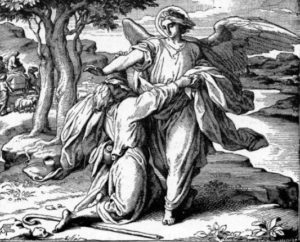
In this week’s parasha, Vayishlach, we read of Jacob’s famed battle with the angel. According to many sources, Jacob battled Esau’s guardian angel. While the identity of the angel is concealed in the plain text of the Torah, Jewish tradition associates this angel with Samael. That name is one of the most famous—or infamous—of all angelic entities, not just in Judaism, but also in Christianity, Gnosticism, and other Near Eastern traditions. Who is Samael?

‘Jacob Wrestling with an Angel’ by Charles Foster

The Primordial Serpent

One of the most ancient Jewish mystical works is Sefer HaBahir. At the very end of the text (ch. 200), we are told that Samael was the angel that came down to the Garden of Eden in the form of a serpent. We read here that one of his punishments was to become the guardian angel of the wicked Esau. The Bahir explains that Samael was jealous of man, and disagreed with the fact that God gave man dominion over the earth. He came down with the mission of corrupting mankind.

The Midrash (Pirkei d’Rabbi Eliezer, ch. 14) seems to agree, describing how God “cast down Samael and his troop from their holy place in Heaven.” In the previous chapter of the same Midrash, we read how Samael is unique in that, while other angels have six wings, Samael has twelve, and “commands a whole army of demons”. The Arizal (Rabbi Isaac Luria, 1534-1572) adds that Samael is in charge of all the “male” demons, called Mazikim, while his “wife” Lilith is in charge of all the “female” demons, called Shedim (Sha’ar HaPesukim on Tehilim). He further associates Lilith with the sword of the “Angel of Death”.

A little-known apocryphal text called the Ascension [or Testament] of Moses (dating back at least to the early 1st century CE) states that Samael is the one “who takes the soul away from man”, directly identifying him with the Angel of Death. This ties neatly into his name, since Samael (סמאל) literally means “poison of God”. Indeed, the Talmud (Avodah Zarah 20b) states that the Angel of Death takes a person away by standing over them with his sword, before a drop of poison falls from the tip of the sword into the victim’s mouth. Elsewhere, the Talmud (Bava Batra 16a) tells us that the Angel of Death is the same entity as Satan, and as the source of the yetzer hara (the Evil Inclination).

In his Kabbalah (pg. 385), Gershom Scholem brings a number of sources that state Satan and Samael are one and the same, together with another figure called Beliar, or Belial. There are those who say that while Satan simply means “prosecutor”, and is only a title, Samael is actually his proper name. The Zohar (on parashat Shoftim) appears to agree, stating that the two main persecuting forces in Heaven are Samael and the Serpent. Some sources depict Samael as actually riding upon the Serpent!

Belial, meanwhile, is a term that appears many times in the Tanakh. It is first found in Deuteronomy 13:14, in a warning that certain bnei Belial will come out to tempt Israel into idolatry. While the simple meaning (and the way it is generally translated) is “base” or “wicked men”, the Kabbalistic take is that it refers to impure spirits that come to lure Israel to sin. Note that the Torah says these bnei Belial will emerge from among our own people.

Not surprisingly, the Zohar (Raya Mehemna on Ki Tetze) says that there are a very small group of “Jewish” imposters who actually worship Samael. These are the ones that give all Jews a bad name, and aim to reverse all the good that Jews do in the world. We have written much of this small group of imposters before, as they are more commonly referred to as the Erev Rav. The Zohar states that Samael and Lilith were once good angels before their “fall”, and began to be worshipped as deities in their own right in the pre-Flood generation. The people in those days worshipped them in order to manipulate them to do their bidding. The Erev Rav aims to do the same today. Thankfully, God will destroy them all in the End of Days, and this is the deeper meaning of Zechariah 13:2:

“And it shall come to pass in that day,” says the Lord of Hosts, “that I will cut off the names of the idols out of the land, and they shall no more be remembered; and also I will cause the prophets and the unclean spirit to pass out of the land.”

Which prophets is God referring to? Those leaders of the Erev Rav that attempt to convince the masses that they are “prophets”, only to lead the people astray.

With this in mind, Jacob’s battle with Samael takes on a whole new meaning. It reminds us that the job of each Jew is to fight Samael and all his evil minions—the bnei Belial, the Erev Rav—tooth and nail, unceasingly, all through the dark night, as Jacob did. We must always stand on the side of light and truth, holiness and Godliness. This makes us Israel, as Jacob was renamed, the ones who fight alongside God. The Jewish people are meant to be God’s holy warriors in this world.

Battling 365 Days of the Year

Commenting on this week’s parasha, the Zohar states that there are 365 angels ruling over each of the 365 days of the solar year. These further correspond to the 365 gidim (“sinews”, or more accurately, major nerves) of the human body, as Jewish tradition maintains. In Jacob’s battle, Samael struck him in the thigh, on his gid hanashe, the sciatic nerve. For this reason, the Torah tells us, the Jewish people do not eat the sciatic nerve “until this day” (Genesis 32:33). Removing this sinew is a key part of koshering meat. In most places, since removing it is so difficult, they simply do not include the back half of the cow or sheep in the kosher meat process.

The Zohar says that since there are 365 days corresponding to 365 sinews, the gid hanashe corresponds to a specific day of the year, too, of course. Which day is that? Tisha b’Av, the most tragic day in Jewish history. The Zohar concludes that Samael is the angel that rules over this day, which is why it is so “unlucky” and sad. At the same time, it suggests that Jacob fought Samael on that same day, so even when Samael is at his strongest, each Jew has the power to defeat him.

Interestingly, the Talmud has a different approach. There we read that Satan rules 364 days of the year! (Nedarim 32b) This is why the gematria of HaSatan (השטן, the way it appears in the Tanakh) is 364. According to the Talmud, the one day a year that Satan “rests” is Yom Kippur. Thus, Yom Kippur is a particularly favourable day to repent and to have God accept our prayers. The Midrash (Pirkei d’Rabbi Eliezer, ch. 46) takes it one step further and states that not only does Satan rest on Yom Kippur, but he actually crosses the floor in the Heavenly Court and joins the defense!

How do we reconcile the seeming contradiction between the Talmud and the Zohar? Perhaps Samael, before his “fall”, was originally appointed to rule over Tisha b’Av. After his rebellion, he sought to dominate as much of the year as possible, and remains at large 364 days of the calendar, being particularly strong on Tisha b’Av. Only on Yom Kippur does God make sure that Satan has no dominion at all.

This should remind us that, at the end of the day, God is infinite and omnipotent, and there is none that can stand before Him. Satan or Samael can be winked out of existence instantaneously if God so willed it. Alas, the impure spirits still have a role to play in history. They will soon meet their end:

Kabbalistic texts state that Satan will lead one last battle in the End of Days, against Mashiach. He will come as the dreaded Armilus. In Sefer Zerubavel, Armilus is identified with Satan himself in bodily form, while in Nistarot d’Rabbi Shimon bar Yochai, he is the son of Satan. He will seek to kill Mashiach, and he may succeed in killing Mashiach ben Yosef, before being in turn extinguished by Mashiach ben David. This is why the Arizal instituted a custom to insert a short prayer for Mashiach ben Yosef, that he should survive, in the blessing for Jerusalem in the Amidah. We have written elsewhere, though, why Mashiach ben Yosef must die to accomplish an important tikkun (see ‘Secrets of the Akedah’ in Garments of Light).

Until then, how do we keep Samael away? The Arizal (Sha’ar HaMitzvot on Shemot) taught not to pronounce his name out loud, for this attracts him. In Jewish tradition, we instead say the letters ס״ם, “samekh-mem”. The Ramak (Rabbi Moshe Cordovero, 1522-1570) stated that eating too much red meat during the week gives power to Samael. It is generally best to leave red meat consumption for Shabbat and holidays if possible. It goes without saying that one should eat kosher meat to avoid the gid hanashe. Meanwhile, the Talmud (Shabbat 30b) famously recounts how David kept the Angel of Death at bay by constantly being immersed in Torah study. We should be focused on study of holy texts, prayer, repentance, doing mitzvot and good deeds. Finally, we must do everything we can to defeat our own inner evil inclinations, struggling as long as it takes, unrelenting, as Jacob did in his battle. In the same passage where the Talmud speaks of the death of Mashiach ben Yosef (Sukkah 52a), it tells us:

In the time to come, the Holy One, blessed be He, will bring the Evil Inclination and slay it in the presence of the righteous and the wicked. To the righteous it will have the appearance of a towering hill, and to the wicked it will have the appearance of a hair thread. Both the former and the latter will weep: the righteous will weep saying, “How were we able to overcome such a towering hill?!” The wicked also will weep saying, “How is it that we were unable to conquer this hair thread?!” And the Holy One, blessed be He, will also marvel together with them, as it is said, “Thus says the Lord of Hosts, ‘If it be marvellous in the eyes of the remnant of this people in those days, it shall also be marvellous in My eyes…’” [Zechariah 8:6]

The Guardian Angels of Israel

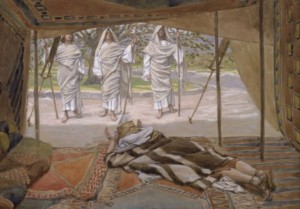
‘Abraham and the Three Angels’ by James Tissot

This week’s parasha, Vayera, begins with Abraham being visited by a trio of angels. Jewish tradition holds that these angels were Michael, Gabriel, and Raphael. The Ba’al HaTurim (Rabbi Yakov ben Asher, c. 1269-1343)—famous for his numerological commentary—points out that the words “And behold three…” (והנה שלשה), referring to the three angels, has the same gematria (701) as “these are Michael, Gabriel, and Raphael” (אלו מיכאל גבריאל ורפאל).

Rashi (Rabbi Shlomo ben Itzchak, 1040-1105) comments that each angel came for a specific mission: Michael to bless Abraham and Sarah with news of their impending child; Gabriel to destroy Sodom (which happens right after in the Torah); and Raphael to heal Abraham from his circumcision (which happened just before). The root of Gabriel is gevurah, “strength” or “restraint”, which is why Gabriel often appears in difficult situations, or acts of destruction. The root of Raphael is refuah, “healing”, so he appears whenever a recovery is required. Michael is the guardian angel of Israel, as we are told explicitly in Daniel 12:1.

These three angels regularly appear together. They were originally depicted as the highest of the angels in the Heavens. Later mystical literature would place others above them (namely Metatron). Still, the trio of Michael, Gabriel, and Raphael remain the most well-known. What else do we know about them?

Michael: Priest and Saviour

In one mystical passage, the Talmud (Chagigah 12b) outlines the Seven Heavens. The first is called Vilon (“curtain”) and simply refers to the atmosphere stretching over the Earth like a curtain. This is the place of clouds and weather, serving no particular spiritual purpose. Then comes the Rakia, the vast realm beyond Earth’s atmosphere that includes the Sun, moon, and all the stars and planets, ie. outer space. The third Heaven is called Shechakim, which we learn from other sources is the interface between this physical universe and the spiritual realms beyond. The Sages sometimes metaphorically describe it as being composed of millstones, or slabs of pure marble. The Talmud says this is the source of the manna that the Israelites ate in the Wilderness.

The fifth, sixth, and seventh Heavens are called Ma’on, Machon, and Aravot, but it is the fourth Heaven that is of particular interest for the present discussion. Here one will find the illustrious Yerushalaim shel Ma’alah, the Heavenly Jerusalem, a spiritual version of the Jerusalem below. Mirroring the one on Earth, there is a Temple up there, too, and it is Michael who serves as its High Priest.

Michael also serves as “Prince of Israel” and our Heavenly Guardian. In this role, he stands opposite Samael, the Heavenly “Accuser” who seeks to harm Israel. Hence, Michael stands at the gates of Heaven, admitting the righteous and guiding their souls. Similarly, he was Israel’s guide during their forty years in the Wilderness, being identified with the “angel that will go before you” (Exodus 23:20, 32:34), as God has promised (see Midrash haNe’elam, Beresheet 2).

Naturally, Michael is a great saviour for the Jews. It was he who saved Abraham from the fiery furnace (Beresheet Rabbah 44:16), and protected Sarah when she was abducted by Avimelech (Pirkei d’Rabbi Eliezer 26). In one intriguing Midrash (Yalkut Shimoni, Beresheet 134), we learn that Michael saved the baby that was born from Dinah’s rape by Shechem. Michael took the baby to Egypt, into the care of a wealthy childless couple. That wealthy man was Potiphar, and the adopted baby was Osnat, future wife of Joseph!

Gabriel and the Founding of Rome

When it comes to Joseph, it was Gabriel that helped him throughout his journey. According to the Talmud (Sotah 36b), Gabriel taught Joseph overnight (or perhaps “uploaded” into his brain) knowledge of the seventy languages, which allowed him to become viceroy of Egypt. Gabriel also taught Joseph all of the esoteric mystical wisdom of the Torah (while Raphael taught the same wisdom to Isaac; see Ravad on Sefer Yetzirah).

The Talmud credits Gabriel with setting the foundations of Ancient Rome (Shabbat 56b). This happened on the very same day that King Solomon married an Egyptian princess. Although Solomon’s intensions were certainly good, his many marriages spiralled out of control, and ultimately led to his downfall. In poetic fashion, King Solomon first builds Jerusalem’s Temple, and simultaneously sows the seeds of its destruction, for Rome would go on to destroy Jerusalem’s Temple for good, ushering in an endless exile which we are still in.

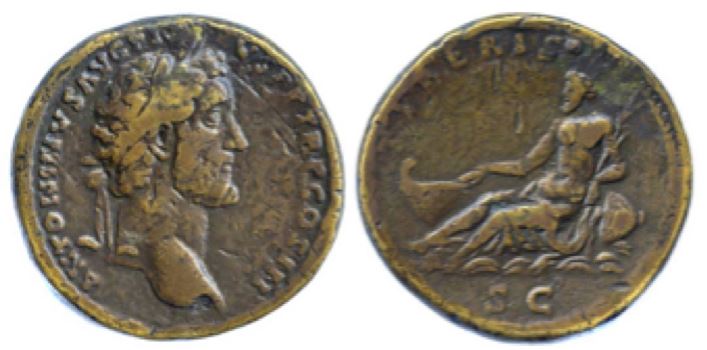
Interestingly, archaeologists have found coins bearing images depicting this version of Rome’s founding. The coins show a divine being of some sort planting reeds in the Tiber River to set the foundations of the “eternal city”, just as the Talmud describes. These coins were minted in the time of Emperor Antoninus Pius, which is most fitting because the Talmud tells us that a Roman emperor named Antoninus was good friends with Rabbi Yehudah haNasi, and the two engaged in many philosophical discussions.

Coins minted by Emperor Antoninus depicting the founding of Rome.


The above essay is an excerpt from Garments of Light, Volume Three.
To continue reading, get the book here!