Tag Archives: Shabbat

The Most Important Torah Reading

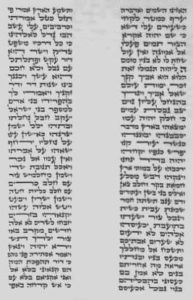
Two columns of parashat Ha’azinu in a Torah scroll

This Shabbat we will be reading Ha’azinu, a unique parasha written in two poetic columns. Ha’azinu is a song; the song that God instructed Moses to teach all of Israel: “And now, write for yourselves this song, and teach it to the Children of Israel. Place it into their mouths, in order that this song will be for Me as a witness for the children of Israel.” (Deut. 31:19) Of course, the entire Torah is a song, chanted with specific ta’amim, musical cantillations. In fact, the mitzvah for each Jew to write a Torah scroll of their own (one of the 613) is derived from the verse above, where God commands the Children of Israel to write this song for themselves. While the simple meaning is that God meant to write the song of Ha’azinu, our Sages interpreted it to refer to the entire Torah. (Since most people are unable to write an entire kosher Torah scroll by themselves, the mitzvah can be fulfilled by writing in a single letter, or by financially contributing to the production of a Torah scroll.)

Why is the song of Ha’azinu so special that God commanded Moses to ensure it will always remain in the mouths of Israel? A careful reading shows that Ha’azinu essentially incorporates all of the central themes of the Torah. We are first reminded that God is perfect, “and all His ways are just” (32:4). While it is common for people to become angry at God and wonder why He is seemingly making life so difficult for them, Ha’azinu reminds us that there is no injustice in God, and that all suffering is self-inflicted (32:5). The Talmud reminds us that hardships are issurim shel ahavah, “afflictions of love”, meant to inspire us to change, grow, repent, learn, and draw us closer to God. Isaac Newton said it well:

Trials are medicines which our gracious and wise Physician gives because we need them; and the proportions, the frequency, and weight of them, to what the case requires. Let us trust His skill and thank Him for the prescription.

History is the Greatest Proof

In the second aliyah, we are told to “remember the days of old and reflect upon the years of previous generations” (32:7). Is there any greater proof for God and the truth of the Torah than Jewish history? Despite all the hate, persecution, exile, and genocide, the Jewish people are still alive and well, prospering as much as ever.

Does it make sense that 0.2% of the world’s population wins over 20% of the world’s Nobel Prizes? (Out of 881 Nobels awarded thus far, 197 were awarded to Jews, who number just 14 million or so. Compare that to the 1.8 billion Muslims in the world—roughly 25% of the world’s population—who have a grand total of three Nobel Prizes in the sciences.) Does it make sense that a nation in exile for two millennia can return to its ancestral homeland, defeat five professional armies that invade it simultaneously (and outnumber it at least 10 to 1), and go on to establish a flourishing oasis in a barren desert in just a few short decades? Does it make sense that tiny Israel is a global military, scientific, democratic, and economic powerhouse? And yet, does it make any sense that the United Nations has passed more resolutions against Israel than all of the rest of the world combined?

There is no greater proof for God’s existence, for the truth of His Torah, and the distinctiveness of the Jewish people than history itself. It is said that King Louis XIV once asked the French polymath and Catholic theologian Blaise Pascal for proof of the supernatural, to which the latter simply replied: “the Jews”. Although Pascal—who was not a big fan of the Jews—probably meant it in a less than flattering way, he was totally correct.

The Consequences of Forgetting God

From the third aliyah onwards, Ha’azinu describes what the Jewish people have unfortunately experienced through the centuries: God gives tremendous blessings, which eventually leads to the Jews becoming “fat and rebellious”. They forget “the God who delivered” them (32:18). This is precisely when God hides His face (32:20), and just as the Jews provoked God with their foolishness and assimilation, God in turn “provokes [them] with a foolish nation”. God sends a wicked foreign nation to punish the Jews—whether Babylonians or Romans, Cossacks or Nazis—to remind the Jews who they are supposed to be: a righteous, Godly people; a light unto the nations. If the Jews will not be righteous and divine, God has no use for them.

Having said that, this does not exonerate those Cossacks and Nazis, for they, too, have been judged. They are a “foolish nation”, a “non-people”, who themselves merit destruction, and God “will avenge the blood of His servants” (32:43). The song ends with a promise: Israel will atone and fulfil its role, its enemies will be defeated, and God will restore His people to their land.

The Spiritual Power of Ha’azinu

The song of Ha’azinu beautifully summarizes the purpose and history of the Jewish people, and elegantly lays down the responsibilities, benefits, and consequences of being the nation tasked with God’s mission. Not surprisingly then, God wanted all of Israel to know Ha’azinu very well, and meditate upon this song at all times. This is why it was given in the format of a song, since songs are much easier to memorize and internalize then words alone. Music has the power to penetrate into the deepest cores of our souls.

In fact, the Zohar on this parasha writes that music is the central way to elevate spiritually, and can be used to attain Ruach HaKodesh, the prophetic Divine Spirit. Elsewhere, the Zohar goes so far as to say that Moses’ prophecy was unique in that all other prophets needed music to receive visions, while Moses alone could prophesy without the help of song!

Today, we have scientific evidence that music deeply affects the mind. It triggers the release of various neurotransmitters, and can rewire the brain. It has a profound impact on mood and wellbeing, and can be used to induce all sorts of mental and emotional states. Music is powerful.

And so, the Torah concludes with a song. After relaying Ha’azinu, the Torah says that “Moses finished speaking all of these words to Israel” (32:45). The lyrics were the last of the Torah’s instructions. Indeed, Ha’azinu is the last weekly Torah reading in the yearly cycle. (Although there is one more parasha, it is not read on its own Shabbat, but on the holiday of Simchat Torah, at which point we jump right ahead to Beresheet, the first parasha.)

So important is Ha’azinu that it is always read during the High Holiday period, usually on Shabbat Shuvah, the Sabbath of Repentance, or Return. So important is Ha’azinu that it is most often the first parasha read in the New Year. And so important is Ha’azinu that it was commonly believed the entire Torah is encoded within it. When our Sages derived the mitzvah of writing the Torah from the command of writing Ha’azinu, they literally meant that Ha’azinu encapsulates the whole Torah! The Ramban went so far as to teach that all of history, including the details of every individual, is somehow encrypted in Ha’azinu. This prompted one of the Ramban’s students, Rabbi Avner, to abandon Judaism and become an apostate. In a famous story, the Ramban later confronts Avner, and proves that Avner’s own name and fate is embedded in one of Ha’azinu’s verses.

In past generations, many people customarily memorized Ha’azinu. The Rambam (Hilkhot Tefillah 7:13) cites another custom to recite Ha’azinu every morning at the end of Shacharit, and the Talmud (Rosh Hashanah 31a) states that in those days it was read every Shabbat. This Shabbat, take the time to read Ha’azinu diligently, and see why it was always considered the most important Torah reading. Perhaps you will even find your own life encoded in its enigmatic verses.


The above essay is adapted from Garments of Light, Volume Three.
Get the book here! 
Secrets of Rosh Hashanah

This first of this week’s two Torah portions, Nitzavim, is always read right before Rosh Hashanah, and appropriately begins: “You are all standing today before Hashem, your God…” The verse has traditionally been seen as an allusion to Rosh Hashanah, when each person stands before God and is judged. The Torah says today, implying one day, yet everyone celebrates Rosh Hashanah over two days. This is true even in Israel, where yom tovs are typically observed for only one day.
The reason for this is because in ancient times there was no set calendar, so a new month was declared based on the testimony of two witnesses. Once the new month was declared in Jerusalem, messengers were sent out to inform the rest of the communities in the Holy Land, and beyond. Communities that were far from Israel would not receive the message until two or three weeks later, so they would often have to observe the holidays based on their own (doubtful) opinion of when the holiday should be. They therefore kept each yom tov for two days.

Rosh Hashanah, however, is the only holiday that takes place on the very first day of the month, so as soon as the new month of Tishrei was declared, it was immediately Rosh Hashanah, and messengers could not be sent out! Thus, even communities across Israel would observe the holiday for two days, based on their own observations.

Although today we have a set calendar, and there is no longer a declaration of a new month based on witnesses, two days are still observed since established traditions become permanent laws. Of course, this is only the simplest of explanations, for there are certainly deeper reasons in observing two days, especially when it comes to Rosh Hashanah.

Judgement in Eden

Rosh Hashanah commemorates the day that God fashioned Adam and Eve. On that same day, the first couple consumed the Forbidden Fruit, were judged, and banished from the Garden of Eden. Originally, they had been made immortal. Now, they had brought death into the world, and God decreed that their earthly life would have an end. Adam and Eve were, not surprisingly, the first people to be inscribed in the Book of Death. Each year since, on the anniversary of man’s creation and judgement, every single human being (Jewish or not) is judged in the Heavenly Court, and inscribed in the Book of Life, or the Book of Death.

This is the idea behind the symbolic consumption of apples in honey. In Jewish tradition, the Garden of Eden is likened to an apple orchard, with the scent of the air in Eden being like that of apples. (Having said that, it is not a Jewish tradition that the Forbidden Fruit itself was an apple!) The apple reminds us of the Garden—of Adam and Eve and their judgement—and we dip it in honey so that our judgement should be sweet.

But what happens when Rosh Hashanah falls on Shabbat? It is well-known that there is no judgement on Shabbat. The Heavenly Court rests, and even the souls in Gehinnom are said to have a day off. This is illustrated by a famous exchange in the Talmud (Sanhedrin 65b) between Rabbi Akiva and the Roman governor of Judea at the time, Turnus Rufus:

Turnus Rufus asked Rabbi Akiva: “How does [Shabbat] differ from any other day?”
He replied: “How does one official differ from another?”
“Because my lord [the Roman Emperor], wishes it so.”
Rabbi Akiva said: “the Sabbath, too, is distinguished because the Lord wishes it so.”
He asked: “How do you know that this day is the Sabbath?”
[Rabbi Akiva] answered: “The River Sambation proves it; the ba’al ov proves it; your father’s grave proves it, as no smoke ascends from it on Shabbat.”

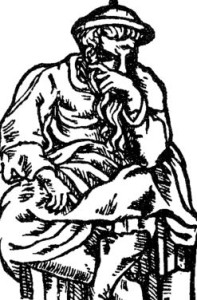
An illustration of Rabbi Akiva from the Mantua Haggadah of 1568

Rufus asks Rabbi Akiva how the Jews are certain that the Sabbath that they keep is actually the correct seventh day since Creation. Rabbi Akiva brings three proofs:

The first is a legendary river called the Sambation (or Sabbation), which was known in those days, and which raged the entire week, but flowed calmly only on Shabbat. The second proof is that people who summon the dead from the afterlife (practicing a form of witchcraft called ov) are unable to channel the dead on Shabbat. (I know of a person who was once involved in such dark arts and became a religious Jew after realizing that he was never able to summon spirits on the Sabbath or on Jewish holidays!) Lastly, Rabbi Akiva notes how Turnus Rufus’ own father’s grave would emit smoke every day of the week, except on Shabbat. This is because the soul of Rufus’ wicked father was in Gehinnom, but all souls in that purgatory get a reprieve on Shabbat. (Historical sources suggest that Rufus’ father was Terentius Rufus, one of the generals involved in the destruction of the Second Temple.)

Based on this, we can understand why Rosh Hashanah must be observed over two days. When the holiday falls on Shabbat, no judgement can take place, so the judgement is pushed off to the next day. This is also related to the fact that when Rosh Hashanah falls on Shabbat, the shofar is not blown. This is not at all because blowing a shofar is forbidden on Shabbat, which is, in fact, permitted.

The simple explanation given for this is that we’re worried the person blowing the shofar might carry it to the synagogue (in a place without an eruv), and carrying is forbidden on Shabbat. The deeper reason is this: Blowing the shofar is supposed to “confound Satan”. Satan is not the trident-carrying, horned demon of the underworld (as popularly believed in Christianity). Rather, Satan literally means the “one who opposes” or the “prosecutor”. It is Satan’s job to serve as the prosecution in the Heavenly Court. The shofar’s blow confuses Satan, and prevents him from working too much against us. On Shabbat, the Heavenly Court rests, and Satan is having a day off, so there is no need to confound him!

The First Shabbat

One might argue that Rosh Hashanah should only be two days long when it falls on Shabbat; in other years, one day would suffice. Other than the fact that this would be confusing—as the holiday would span different lengths in different years—there are other explanations for the two days, including that each day involves different types of judgement (for example, one day for sins bein adam l’Makom, between man and God; and one day for bein adam l’havero, between man and his fellow). Nonetheless, our Sages still describe Rosh Hashanah as really being one day—one unique, extra-long, 48-hour day which our Sages called yoma arichta, literally the “long day”. Perhaps this is another reason for the custom of not sleeping on the “first night” of Rosh Hashanah. (The other reason: how could anyone possibly sleep through their own trial?)

Finally, the story of Rabbi Akiva and Turnus Rufus gives us one more reason to commemorate Rosh Hashanah over two days. Rufus questioned Rabbi Akiva on how he can be so sure that the Sabbath which he keeps is indeed the correct seventh day going back to Creation. If Rosh Hashanah is the day Adam and Eve were created, then it corresponds to the sixth day of Creation. That means the very next day was the seventh day of Creation, and that the second day of Rosh Hashanah always commemorates the very first Sabbath. When we celebrate on the second day of Rosh Hashanah, we mark Adam and Eve’s first Shabbat, and recognize that each seventh day has been observed ever since, and will continue to be observed for another, 5778th upcoming year.

Shana Tova u’Metuka!

Tisha B’Av: Why Are We Still Mourning?

This week’s Torah portion is Devarim, which begins the fifth and final book of the Torah. This book (Deuteronomy), is written from the perspective of Moses, and summarizes much of what the Torah discussed earlier. At the same time, it also introduces many new mitzvot, and reveals deeper insights into the Torah’s previous narratives. For example, while the book of Numbers told us that Moses was forbidden to enter the Holy Land because he disobeyed God in striking the rock, here we are told that Moses was forbidden to enter the Land because of the incident of the Spies! (1:22-38) How do we reconcile these differences? The answer can actually be found in next week’s parasha, Va’etchanan.

Va’etchanan (literally “and I beseeched”) describes how Moses begged God to allow him to enter the Holy Land. The Talmud (Berachot 32b) states that Moses prayed so much that God actually relented and forgave him for striking the rock. However, it would have been wrong for Moses to enter the Holy Land at that time, considering that the rest of the men were condemned to perish in the Wilderness because of the sin of the spies. After all, Moses was their leader. Could a shepherd abandon his flock? Would a captain abandon his sinking ship? So, Moses didn’t enter the land not because of the rock, but because of the spies.

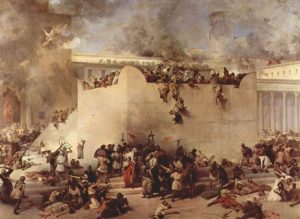
'Destruction of the Temple of Jerusalem' by Francesco Hayez (1867)

‘Destruction of the Temple of Jerusalem’ by Francesco Hayez (1867)

This is all the more pertinent now with Tisha B’Av right around the corner. Tisha B’Av commemorates the destruction of both Holy Temples in Jerusalem, along with a handful of other tragedies said to have happened on, or around, that date – the ninth of the month of Av. According to tradition, the origins of Tisha B’Av lie in the incident of the spies. It was on that day that the spies returned from the land of Israel, and reported negatively about the people’s chances of conquering the land. The faithless nation feared and cried needlessly on that day so, it is said, God subsequently gave the nation many good reasons to truly fear and cry on that day throughout history.

The Problem with the 9th of Av

There are many problems with this classic narrative. First of all, why would God punish generations far in the future for the sins of that one generation long ago? Deuteronomy 24:16 itself states clearly that “Parents shall not be put to death because of their children, nor children because of their parents. Each person shall be put to death for their own crime.” While the Torah does also mention a number of times that God “carries over the iniquity of the fathers onto the children to the third and fourth generations”, the phrase concludes by saying this is only true to those that “hate Him”. In any case, it is only to the third and fourth generations, not millennia into the future! Even so, the Talmud (Makkot 24a) says the prophet Ezekiel came and repealed this divine decree anyway:

Said Rabbi Yose bar Chanina, “Moses pronounced four decrees upon Israel, which four prophets came and cancelled.”
…Moses said, “carries over the iniquity of the fathers onto the children…” (Exodus 34:7) Ezekiel came and cancelled it: “The one who sins will die.” (Ezekiel 18:14)

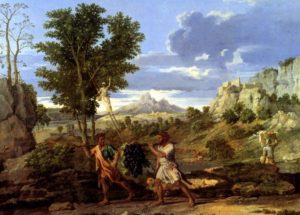
'The Spies With The Grapes Of The Promised Land' by Nicolas Poussin (1664)

‘The Spies With The Grapes Of The Promised Land’ by Nicolas Poussin (1664)

Second of all, did the spies really return on the 9th of Av? The Talmud (Ta’anit 29a) calculates that the spies went forth on the 29th of Sivan and returned forty days later on the 9th of Av. However, the Torah tells us that the spies went to Israel at the start of the grape harvest (Numbers 13:20) and the same tractate of Talmud (Ta’anit 30b) states that the grape harvest season lasted from the 15th of Av until Yom Kippur! How could the spies have returned on the 9th of Av when the grape harvest only began on the 15th? (A simple Google search reveals that the ideal time for grape harvest is September-October, which is right between the 15th of Av and Yom Kippur.)

On the same note, when exactly were the Temples destroyed? The Tanakh tells us that “in the fifth month, on the seventh day of the month, which was the nineteenth year of King Nebuchadnezzar, king of Babylon, came Nebuzaradan, the captain of the guard, a servant of the king of Babylon, to Jerusalem. And he burned the house of Hashem, and the king’s house…” (II Kings 25:8-9) This verse suggests the First Temple was destroyed on the 7th of Av.

Another verse in the Tanakh tells us that “in the fifth month, in the tenth day of the month, which was the nineteenth year of King Nebuchadnezzar, king of Babylon, came Nebuzaradan, the captain of the guard, who stood before the king of Babylon, to Jerusalem; and he burned the house of Hashem, and the king’s house…” (Jeremiah 52:12-13) The verse is nearly identical, except that this one says Nebuzaradan came on the 10th and destroyed the Temple.

We have the 7th of Av and the 10th of Av, but no 9th! The Talmud (Ta’anit 29a) notes this contradiction and tries to reconcile it this way: “On the seventh the heathens entered the Temple and ate therein and desecrated it throughout the seventh and eighth, and towards dusk of the ninth they set fire to it and it continued to burn the whole of that day [the tenth].” Rabbi Yochanan goes on to say that if it were up to him, the mourning day would be the 10th of Av, not the 9th, since this is when the Temple was mostly destroyed.

And what about the Second Temple? Josephus lived through its destruction, and later wrote about it in detail. He says that it was destroyed on the 10th of Av, and writes that the Jews mourn its destruction on the same day that they mourn the destruction of the First Temple. However, he seems to admit that he is uncertain about the exact dates that the Temples fell.

What does the Talmud say? It, too, is uncertain, but concludes that since “good things tend to happen on good days, and bad things on bad days,” it is assumed that the Second Temple was destroyed on the same day as the First Temple!

Postponing, Abolishing, or Redefining?

This year, Tisha B’Av falls on Shabbat, so the fast is postponed, appropriately, to the 10th. While Rabbi Yochanan felt that the 10th is the correct day to fast anyway, Rabbi Yehudah HaNasi – the great redactor of the Mishnah – wanted to have the fast of Tisha B’Av abolished completely! Some say this was only when Tisha B’Av falls on Shabbat and needs to be postponed, while others say he wanted it gone entirely (Megillah 5b).

This idea has been echoed in modern times. The primary reason for mourning on Tisha B’Av is because of Jerusalem’s destruction and the Jewish people’s exile. Today, the Jewish people have returned to the Holy Land and have rebuilt Jerusalem. While there’s no Temple just yet, we are free to travel to, and settle in, the Holy City whenever we wish. Why are we still mourning?

Perhaps Rabbi Yehudah felt the same way. In his day, Jews had also returned to Jerusalem and enjoyed relatively good terms with the Romans. Rabbi Yehudah himself was friends with the Caesar known in the Talmud as ‘Antoninus’ (possibly the Emperor Marcus Aurelius, or maybe a local Roman governor).

Meanwhile, far worse tragedies have befallen the Jewish people since then: crusades, inquisitions, pogroms, the Holocaust, and the list goes on. Why focus on the temples and Jerusalem when there are more recent, greater tragedies? Indeed, former Israeli Prime Minister Menachem Begin intended to combine all the days of commemoration, and move Holocaust Remembrance Day and Israel’s Memorial Day to Tisha B’Av.

Perhaps this is what Tisha B’Av should be: one day to remember all of the suffering that has troubled the Jewish people, and all the suffering that continues to plague the world. A day to remind us that Mashiach has not come yet, the Temple is not yet rebuilt, and the world is not yet whole. A day to ask ourselves: what exactly are we doing to hasten the arrival of that magnificent, forthcoming time? What are we doing that will finally put an end to all the mourning? Tisha B’Av should be a day not about drowning in the sad tears of the past, but about actively working towards the happy tears of the future.

And this is precisely what Rabbi Akiva told his colleagues when they saw the ruins of the Temple. While Rabban Gamliel, Rabbi Elazar ben Azariah, and Rabbi Yehoshua ben Chananiah immediately fell into a bout of weeping, Rabbi Akiva was laughing. Surprised, they asked him to explain himself. He told them that while they were dwelling on the destruction of the first and second temples, he was dwelling on the vision of the coming Third Temple. The rabbis responded – and with this the tractate ends – “Akiva, you have consoled us! Akiva, you have consoled us!”