
Category Archives: Jewish Law & Life Cycle

The Blood Libels

In this week’s parasha, the Torah devotes an entire chapter (Leviticus 17) to the prohibition of consuming blood. God first forbids idolatrous and improper sacrifices before declaring that “if anyone of the house of Israel or of the strangers who reside among them partakes of any blood, I will set My face against the person who partakes of the blood; I will cut that person off from among kin.” (17:10) The Torah goes on to say that any land animal or bird that is slaughtered for food must have its blood entirely drained and buried under earth, before emphasizing again that “the soul of all flesh—its blood contains its soul. Therefore, I say to the Children of Israel: you shall not partake of the blood of any flesh, for the soul of all flesh is in its blood. Anyone who partakes of it shall be cut off.” (17:14)

Because of this, Jews throughout history have been exceedingly careful not to consume any blood whatsoever, even a tiny speck in a chicken egg. It is therefore tragically ironic that one of the most grotesque antisemitic accusations leveled against Jews for centuries is the “blood libel”—that Jews consume the blood of gentiles or use gentile blood to prepare matzot, or engage in some form of ritual murder. Where did this disgusting accusation come from, how did it evolve over the centuries, and how did it shape Jewish history? Continue reading →
Constellations and the Jewish Calendar

Yesterday marked the start of the new month of Nisan, first of the Jewish calendar. According to our ancient mystical texts, like Sefer Yetzirah, each of the twelve months of the Jewish year corresponds to one of the twelve Zodiac constellations (mazalot). The month of Nisan corresponds to Aries, or tal’e in Hebrew. Aries is depicted as a sheep or ram and, of course, the highlight of Nisan is the holiday of Pesach, referring to the korban pesach, the “paschal lamb”—a sheep!

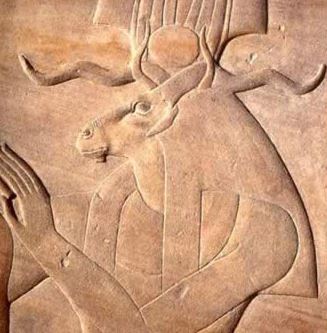
The Ram-headed idol Ra

Our Sages pointed out that God specifically commanded this species to be sacrificed because it was what the Egyptians worshipped at the time. This is likely referring to the ram-headed deity Ra. Amazingly, Ra is actually mentioned in the Torah when Pharaoh tells Moses that Ra neged pneichem (Exodus 10:10), typically translated as “evil [ra] will be before you”. Rashi comments here that Ra is an Egyptian idol and Pharaoh was warning the Israelites that they would perish under the wrath of his god Ra. Of course, the entire Exodus narrative was about showing God’s mastery over all aspects of Creation, and His destruction of Egypt’s false idols, Ra chief among them.

In astrology, Aries is a “fire” sign, which is quite appropriate for the Exodus connection. The fire alludes to the fire of the sacrificial altar for the korban pesach, as well as the pillar of fire that led the Israelites out of Egypt and through the Wilderness. Furthermore, at the Pesach seder, the Haggadah reminds us to say “blood, and fire, and columns of smoke”, dam v’esh v’timrot ashan, in memory of the Ten Plagues and the Exodus. (Actually, this phrase originally comes from Joel 3:3, straight from the prophet’s vision of the End of Days!) Continue reading →

Secrets of the Jewish Calendar

Today we welcome the new month of Kislev. It is well-known that the months of the Hebrew year parallel the Tribes of Israel and the zodiacal constellations. According to Sefer Yetzirah, each month also embodies one of twelve fundamental aspects of humanity and life: sight, sound, smell, speech, taste, touch, action, motion, temper, joy, thought, and sleep (ראיה, שמיעה, ריחה, שיחה, לעיטה, תשמיש, מעשה, הלוך, רוגז, שחוק, הרהור, שינה). Each of these further corresponds to twelve main parts and organs of the human body, and actually emerges at their core from the twelve “elemental” letters of the Hebrew alphabet, as well as the twelve permutations of God’s Ineffable Name. Recall that Sefer Yetzirah divides up the alphabet into three categories: “mother” letters, “doubled” letters, and “elemental” or “simple” letters (for more on these, see here). Continue reading →