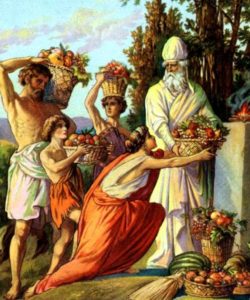
This week we begin reading the third book of the Torah, Vayikra. In English, the book is called “Leviticus” because it is primarily concerned with the work of the Levites in the Temple. Among the Tribe of Levi were the kohanim, the “high priests”, direct descendants of Aaron. The kohanim were the ones who actually oversaw all the offerings in the Temple, facilitated atonement, and blessed the nation. The rest of the Levites, who were not kohanim, had other work to do. As is well-known, one of their main roles was to provide musical accompaniment in the Temple. Yet, the Torah never actually says this directly! How do we know? Continue reading
Category Archives: Personal Development
The Economics of Jewish History
In addition to the weekly parasha and Rosh Chodesh reading, this week we also read an extra portion called Parashat Shekalim. In the weeks leading up to Purim and Pesach, there are a number of additional readings to commemorate the key events surrounding those holidays. One of these readings is Shekalim, literally “shekels”, where we recount how the Israelites had each donated a half-shekel in order to conduct a census. The Torah forbids counting souls for several reasons, including the simple fact that people shouldn’t be treated like numbers. So, each adult Israelite male gave a half-shekel (a “substitute for the soul” as the Torah says), the result being the collection of some 300,000 shekels of silver.
In the Purim story, we read how Haman promised to pay the king 10,000 kikar of silver to finance the extermination of the Jewish people. One kikar is equivalent to 3000 shekels, meaning Haman amassed 30 million shekels for his final solution. This is an astronomical amount of money, especially back in those days. Where did Haman get it? Rav Ovadia Yosef explained: The Persian and Babylonian businessmen at the time were losing income because the Jewish exiles had come and set up their own superior businesses. The Persians and Babylonians couldn’t compete with the Jews. So, Haman told the businessmen that he can get rid of the Jews for them, and all he needed was a little financial support. They all gladly pitched in for his campaign. This is why the Megillah has Haman saying “I will pay ten thousand kikar of silver al yadei osei hamelakhah [by the hand of those who do business].” (Esther 3:9)
Without those funds, there would be no Purim story! This is one small example of how the shekel—money—drives historical events. We find that, beneath the surface, most of history is a result of economics and business. While so much of Judaism is built upon commemorating the distant past, we seldom think about the financial aspects of those ancient events. Of course, the root reasons for those events are entirely spiritual, yet the way they are brought to actualization is financial. This is hinted to by the Torah’s language itself, where the numerical value of shekel (שקל) is 430, equal to nefesh (נפש), “soul”. It is further alluded to by the Talmud where money is referred to as zuz, literally “move”. Money is the prime “mover” of history. What follows, therefore, is a look at some of the key events of Jewish history—from an economical perspective. Continue reading
Palm-Reading in Judaism
At the start of this week’s parasha, Yitro, Moses’ eponymous father-in-law (aka. Jethro) joins the Israelite camp in the Sinai. The Zohar (II, 69b) explains, as per tradition, that Jethro wished to convert to Judaism, along with his entire family. The Zohar then uses this as a segue into a much broader discussion:
Rabbi Itzchak and Rabbi Yose were sitting one day in Tiberias and delving into Torah study. Rabbi Shimon passed by and asked: “What are you studying?” They replied: “We are on that verse from which our master taught us…” [Rabbi Shimon] asked: “And which is it?” They said: “That which is written: ‘This is the book of the generations of man [ze sefer toldot adam], when God created man, He made him in the likeness of God…’” (Genesis 5:1)
This verse in the Torah is used to introduce the genealogy of Adam and Eve. The Zohar explains that God showed Adam all future generations of humans that would descend from him, including all the future great leaders and sages (Jethro being one of them). Now, Adam was only given a vision of these people, meaning he only saw their outward appearance. Yet, from their outward appearance alone he could deduce a great deal about their souls. This is the deeper meaning behind sefer toldot adam, ie. wisdom that can reveal a person’s inner qualities, referring “to the secrets of the physical features of human beings… their hair, forehead, eyes, face, lips, lines on the hands, and ears. Through these seven traits a person can be known.” (Zohar II, 70b) The Zohar here is clearly referring to the ancient practices of physiognomy and chiromancy: understanding a person—and perhaps even telling their future—through their facial features and palm-lines. Continue reading