
Category Archives: Personal Development

Is Playing Sports a Mitzvah?

In this week’s parasha, Va’etchanan, we read the famous words: v’nishmartem me’od l’nafshotechem, “Guard your souls very much…” (Deuteronomy 4:15). The plain meaning of the passage within which these words are found is to be careful not to descend into idolatry, nor to make any sculptures or images of any figures that might be idolatrous. However, since ancient times the phrase to “guard your souls very much” has also been used to mean that it is our obligation to stay healthy and in good physical shape. If the body is not healthy and dies, then the soul will depart it. Having a healthy soul therefore requires maintaining a healthy body, and a pure soul requires a pure bodily vessel.

Interestingly, it was the great Hillel who first pointed out the connection between the prohibition of idolatry and the mitzvah of taking care of one’s body. The Midrash (Vayikra Rabbah 34:3) recounts how Hillel once took leave of his students and they asked him where he was going, to which he replied: “To do a mitzvah!” They asked which mitzvah, and he replied that he was going to the bathhouse. The puzzled students questioned him: is taking a bath a mitzvah? Hillel replied affirmatively, and explained: if all the statues and icons erected in public places needed to be constantly washed, and they are nothing but man-made objects depicting flesh-and-blood kings and nonsensical idols, how much more so must we keep our bodies clean since we were made in the image of God? And this is the deeper meaning behind King Solomon’s words gomel nafsho ish chassed (Proverbs 11:17), that a kindly or pious man makes sure to take care of his soul.

Our Sages had much to say about maintaining good health. For instance, in Gittin 70a, we are taught that there are 8 things that are healthy in small quantities, but harmful in excess. These eight are: travel, sexual intercourse, wealth, labour, wine, sleep, baths, and bloodletting. When it comes to the latter, in those days bloodletting was a popular therapy and it was thought that draining out some “old” blood will stimulate the production of new, healthier blood. There may be something to this, with recent research showing that bloodletting may indeed have been beneficial, and was possibly even effective against bacterial infections. Today, bloodletting is no longer done, but there may be a way to reap the same benefits (and do a double-mitzvah) by going to donate blood. Continue reading
The Powerful Link Between Tisha b’Av and Tu b’Av

What is the true meaning of the ancient and little-known Biblical holiday of Tu b’Av? Where did Tu b’Av come from and what does it have to do with Creation? Finally, how does Tu b’Av rectify the problem of Tisha b’Av, the saddest day of the Jewish year?

Also discussed is the Jewish view of soulmates, the three types of love, the purpose of the Book of Judges (Shoftim), and a deeper look at the lives of Kings David and Solomon.

Practical Jewish Meditation

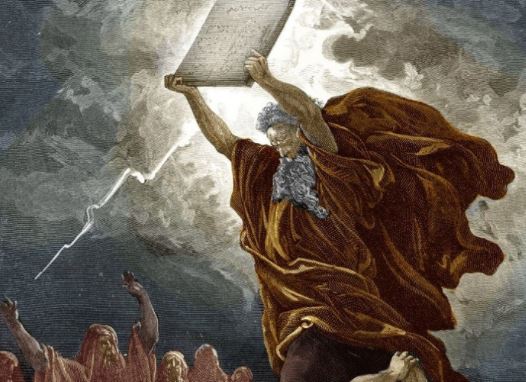
An illustrated section from Gustav Doré’s “Moses Breaking the Tablets of the Law”

In this week’s parasha, Ki Tisa, we read how Moses goes up Mount Sinai on three separate occasions. His first ascent concludes with receiving the Two Tablets, only to come down and see the horror of the Golden Calf. Following this, the Torah tells us that “Moses returned to God”, back up the mountain, to address the Calf fiasco and its aftermath (Exodus 32:31). Moses then came back down to pitch a “Tent of Meeting” (33:7) where he could more regularly communicate with God without having to ascend the Mountain, and for when the Israelites would leave Sinai to head to Israel. Moses asked to see God’s Presence directly, and God replied that no mortal can see God and live, though He would show Moses His “back”. To do this, God asked Moses to come up Sinai one last time (34:2), where a new set of tablets would be created to replace the shattered ones.

When Moses descended from Sinai for the last time to present the new Tablets, the Torah tells us that “He was there with God for forty days and forty nights; he ate no bread and drank no water…” (34:28) Moses had gone up Sinai three times, each for forty days, making 120 days total. Indeed, if one counts the days of the Jewish calendar between Shavuot and Yom Kippur, one would find 120 days, since Shavuot is the date of the initial Sinai Revelation while Yom Kippur is when God forgave the Israelites for the Golden Calf and Moses returned with the new Tablets. At the end of Moses’ three sessions of intense meditation with God, his face glowed and the people could no longer look at him directly (34:29-30). Moses would henceforth wear a mask.

The Torah motif of going up a mountain to spend time in prayer and divine meditation spread all over the world, and we find very similar descriptions in other faiths that emerged after Judaism. Buddha, for instance, spent 40 days (or 49 days) up on a mountain meditating under a bodhi tree to attain enlightenment, and also abstained from food and water during that time. Jesus is said to have spent forty days in the wilderness without food and water, and Mohammad purportedly received his first revelation while meditating and fasting for days on Mount Hira at the age of 40. Despite the fact that Moses was undoubtedly the first, meditation today is associated more with Eastern faiths, and strangely not with Judaism.

The truth is that meditation has always been central to Judaism since ancient times. In fact, it is highly likely that it was Jewish exiles who introduced meditative practices around the world after their expulsion from Israel in the 6th century BCE at the hands of the Babylonians. It is intriguing to point out that many world religions began in the century following Israel’s exile, including Buddhism and Confucianism, as well as the Pythagorean and Orphic religions in Greece. Even ancient Zoroastrianism and Hinduism were heavily influenced by spreading Torah ideas in the middle of the first millennium BCE.

Today, science has uncovered the vast benefits of regular meditation—everything from reducing stress and improving sleep, to boosting the immune system and accelerating healing, even positively impacting the expression of our genes! So, what does the Torah tradition have to teach us about meditation, and what are some specific Jewish meditative techniques we can put into practice daily to enhance our lives? Continue reading