Tag Archives: Bilaam

Did Moses Have a Black Wife?

Towards the end of this week’s Torah portion, Beha’alotcha, we read that “Miriam and Aaron spoke against Moses because of the Cushite woman whom he had married, for he had married a Cushite woman.” (Numbers 12:1) This verse brings up many big questions, and the Sages grapple with its meaning. Who is this Cushite woman? When did Moses marry her? Why did Miriam and Aaron speak “against” Moses because of her? Why the superfluous phrasing of mentioning twice that he married the Cushite woman? What does “Cushite” even mean?

Traditionally, there are two main ways of looking at this passage: either Moses actually took on a second wife in addition to his wife Tzipporah, or the term “Cushite” simply refers to Tzipporah herself. The second interpretation is problematic, since we know Tzipporah was a Midianite, not a Cushite. The term “Cushite” generally refers to the people of Cush, or Ethiopia, and more broadly refers to all black people or Africans. Scripture does connect the Cushites with the Midianites in one verse (Habakkuk 3:7), which some use as proof that the Midianites were sometimes referred to as Cushites, or had particularly dark skin.
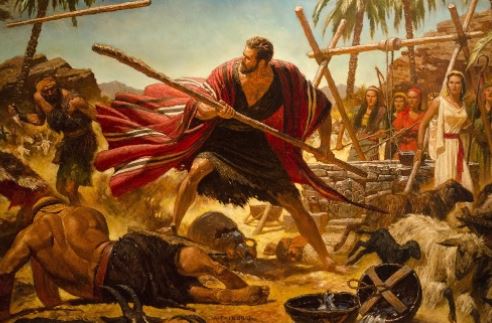
‘The Fight at Jethro’s Well’ – where Moses first meets Tzipporah – scene from ‘The Ten Commandments’ (1953) painted by Arnold Friberg.

Rashi (Rabbi Shlomo Itzchaki, 1040-1105) prefers the second interpretation. He says that Tzipporah was called a “Cushite” because she was very beautiful. He cites Midrash Tanchuma in stating that just as everyone can immediately identify a black person (Cushite), everyone immediately recognized the incomparable beauty of Tzipporah. The same Midrash offers another possibility: apparently if a person had a very beautiful child in those days, they would call them “Cushite” to ward off the evil eye. This suggests that a Cushite was not considered beautiful at all, yet Rashi provides a numerical proof that Cushite does indeed mean “beautiful”, since the gematria of Cushite (כושית) is 736, equal to “beautiful in appearance” (יפת מראה), the term frequently used in the Torah to describe beauty.

If the Cushite is Tzipporah, then why did Miriam and Aaron suddenly have a problem with her? Rashi cites one classic answer: because Moses had become so holy—recall how after coming down Sinai, his skin glowed with such a blinding light that he had to wear a mask over his face—he had essentially removed himself from this material world. This means he was no longer intimate with his wife Tzipporah. Miriam had learned of this, and thought Moses was in error for doing so.

Unlike certain other religions, Judaism does not preach celibacy, and does not require complete abstinence to remain holy and pure. Conversely, Judaism holds that sexual intimacy is an important aspect of spiritual growth. The famous Iggeret HaKodesh (the “Holy Letter”, often attributed to the Ramban, Rabbi Moshe ben Nachman, 1194-1270, but more likely written by Rabbi Joseph Gikatilla, 1248-1305) writes that it is specifically during sexual union (if done correctly and in holiness) that a man and woman can bring down and experience the Shekhinah, God’s divine presence.

As such, Miriam and Aaron came to their little brother and admonished him for separating from his wife. This is why the Torah goes on to state that “They said, ‘Has God spoken only to Moses? Hasn’t He spoken to us too?’” (Numbers 12:2) Miriam and Aaron argued that they, too, were prophets, and they clearly had no need to separate from their own spouses! Moses was so humble and modest that he did not respond at all: “…Moses was exceedingly humble, more so than any person on the face of the earth.” (Numbers 12:3)

God immediately interjected and summoned Miriam and Aaron to the Ohel Mo’ed, the “Tent of Meeting”, where He regularly conversed with Moses. God told them:

If there be prophets among you, I will make Myself known to him in a vision; I will speak to him in a dream. Not so My servant Moses; he is faithful throughout My house. With him I speak mouth to mouth; in [plain] sight and not in riddles, and he beholds the image of the Lord…

God makes it clear to Miriam and Aaron that although they are also prophets, they are nowhere near the level of Moses. In all of history, Moses alone was able to speak to God “face to face”, while in a conscious, awake state. All other prophets only communed with God through dreams or visions, while asleep or entranced.

By juxtaposing the fact that Moses was the humblest man of all time, and also the greatest prophet of all time, the Torah may be teaching us that the key to real spiritual greatness is humility. Moses had completely subdued his ego, and so he merited to be filled with Godliness. Fittingly, the Talmud (Sotah 5a) states that where there is an ego, there cannot be a Godly presence, because a person with a big ego essentially sees themselves as a god—and there cannot be two gods! “Every man in whom there is haughtiness of spirit, the Holy One, blessed be He, declares: ‘I and he cannot both dwell in the world.’”

Moses Had a Black Wife

The explanation above is certainly a wonderful one, yet it is hard to ignore the plain meaning of the text: that Moses actually married a Cushite woman. The repetitive phrasing of the verse seems like it really wants us to believe he had taken another wife. And many of the Sages agree. However, Moses hadn’t married her at this point in time, but many years earlier. The Midrash describes in great detail what Moses was up to between the time that he fled Egypt and arrived in Midian. After all, he had fled as a young man, and returned to Egypt in his 80th year. What did he do during all those intervening decades?

The Midrash (Yalkut Shimoni, Shemot 168) says that Moses initially fled to Cush. At the time, the Cushites had lost their capital in a war and were unsuccessful in recapturing it. Their king, named Koknus (קוקנוס, elsewhere called Kikanos or Kikianus), fought a nine-year war that he was unable to win, and then died. The Cushites sought a strong ruler to help them finally end the conflict. They chose Moses, presumably because he had fought alongside the Cushites and had a reputation as a great warrior. Moses did not disappoint, and devised a plan to win the war and recapture the Cushite capital. (His enemy was none other than Bilaam!) The grateful Cushites gave Moses the royal widow of Koknus for a wife, and placed him upon the throne.
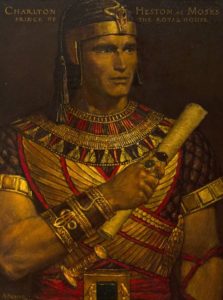
Charlton Heston as Egyptian General Moses, also by Arnold Friberg

This Midrash is very ancient, and was already attested to by the Jewish-Roman historian Josephus (37-100 CE). Josephus writes (Antiquities, II, 10:239 et seq.) a slightly different version of the story, with Moses leading an Egyptian army against the Cushites. The Cushite princess, named Tharbis, watches the battle and falls in love with the valiant Moses. She goes on to help him win the battle, and he fulfils his promise in return to marry her. In some versions, Moses eventually produces a special ring that causes one to forget certain events, and puts it upon Tharbis so that she can forget him. He then returns to Egypt.

So, Moses married a Cushite queen. Yet, he remembered “what Abraham had cautioned his servant Eliezer” about intermarriage, and abstained from touching her. (If you are wondering how Moses later married Tzipporah, who was not an Israelite, remember that the Midianites are also descendants of Abraham through his wife Keturah, see Genesis 25:2. Thus, Moses still married within the extended family of Abrahamites.) Although Moses married the Cushite queen, he never consummated the marriage. The Midrash says he reigned over a prosperous Cush for forty years until his Cushite wife couldn’t take the celibacy anymore and complained to the wise men of Cush. Moses abdicated his throne and finally left Ethiopia. He was 67 years old at the time.

All of this was kept secret until it came out publicly in this week’s parasha. This is a terrific version of the story, but it doesn’t answer why Miriam and Aaron complained to Moses. For this we must look to the mysticism of the Arizal.

Soulmates of Moses

The Arizal cites the above Midrash in a number of places (see Sefer Likutei Torah and Sha’ar HaPesukim on this week’s parasha, as well as Sha’ar HaMitzvot on parashat Shoftim). He explains that both Tzipporah and the Cushite were Moses’ soulmates. This is because Moses was a reincarnation of Abel, who had two wives according to one tradition. This was the reason for the dispute between Cain and Abel, resulting in the latter’s death. Cain was born with a twin sister, and Abel was born with two twin sisters (otherwise, with whom would they reproduce?) Cain reasoned that he should have two wives since he was the older brother, and the elder always deserves a double portion. Abel reasoned that he should have the second wife since, after all, she was his twin! Cain ultimately killed Abel over that second wife.

Therefore, the Arizal explains that Cain reincarnated in Jethro, and Abel in Moses. This is why Jethro gave his daughter Tzipporah to Moses, thus rectifying his past sin by “returning” the wife that he had stolen.* Moses’ other spiritual twin was the Cushite woman. The Arizal suggests that Miriam and Aaron were aware of this, and were frustrated that Moses did not consummate his marriage to the Cushite, for she was his true soulmate! Apparently, after the Exodus Moses summoned the Cushite woman and she happily joined the Israelites and converted to Judaism. The Arizal explains that this was a necessary tikkun, a spiritual rectification for her lofty soul. However, he could not consummate the marriage because her soul originated from a place of intense dinim gemurim, strict judgement and severity. It appears that when Miriam heard about his abstention from his wife, she complained to Moses, failing to grasp that a soul as pure as Moses’ had different requirements.

Whatever the case may be, the root of the matter is Moses’ separation from his wife (or wives). Having said all that, there is a third possibility. This comes from a simple reading of the Torah text, and the lesson that we learn from it is particularly relevant today.

Black or White

When we read the first two verses of Numbers 12 in isolation, we might be led to believe that Miriam and Aaron had a problem with Moses marrying a black woman. Was there a hint of racism in their complaint, or did they just genuinely wonder whether an Israelite was allowed to marry a black person? Either way, we see how perfectly the punishment fits the crime: “… Behold, Miriam was afflicted with tzara’aat, [as white] as snow.” (Numbers 12:10)

If the issue was about Moses separating from his wife, it isn’t clear why Miriam would be punished with tzara’at (loosely translated as “leprosy”). Rashi, for one, does not seem to offer a clear explanation why this in particular was her punishment. Of course, we know that God doesn’t really “punish”, and simply metes out justice, middah k’neged middah, “measure for measure”. It is therefore totally fitting that in complaining about Moses taking a black woman as a wife, Miriam’s own skin is turned white “like snow”. Perhaps God wanted to remind her that she is not so white herself.

We can learn from this that there really is no place for racism in Judaism. In fact, God explicitly compares the Israelites to the Cushites (Amos 9:7), and maintains that He is not the God of the Jews alone, but the God of all peoples: “‘Are you not as the children of the Cushites unto Me, O children of Israel?’ Said Hashem. ‘Have I not brought up Israel out of the land of Egypt, [just as I brought] the Philistines from Caphtor, and Aram from Kir?’” Among a list of nine holy people that merited to enter Heaven alive, without ever dying, the Sages include a Cushite man named Eved-Melekh (Derekh Eretz Zuta 1:43, see Jeremiah 39:16).

At the end of the day, there is no reason to hold prejudice against anyone, or discriminate against any individual at all, as the Midrash (Yalkut Shimoni, Shoftim 42) clearly states:

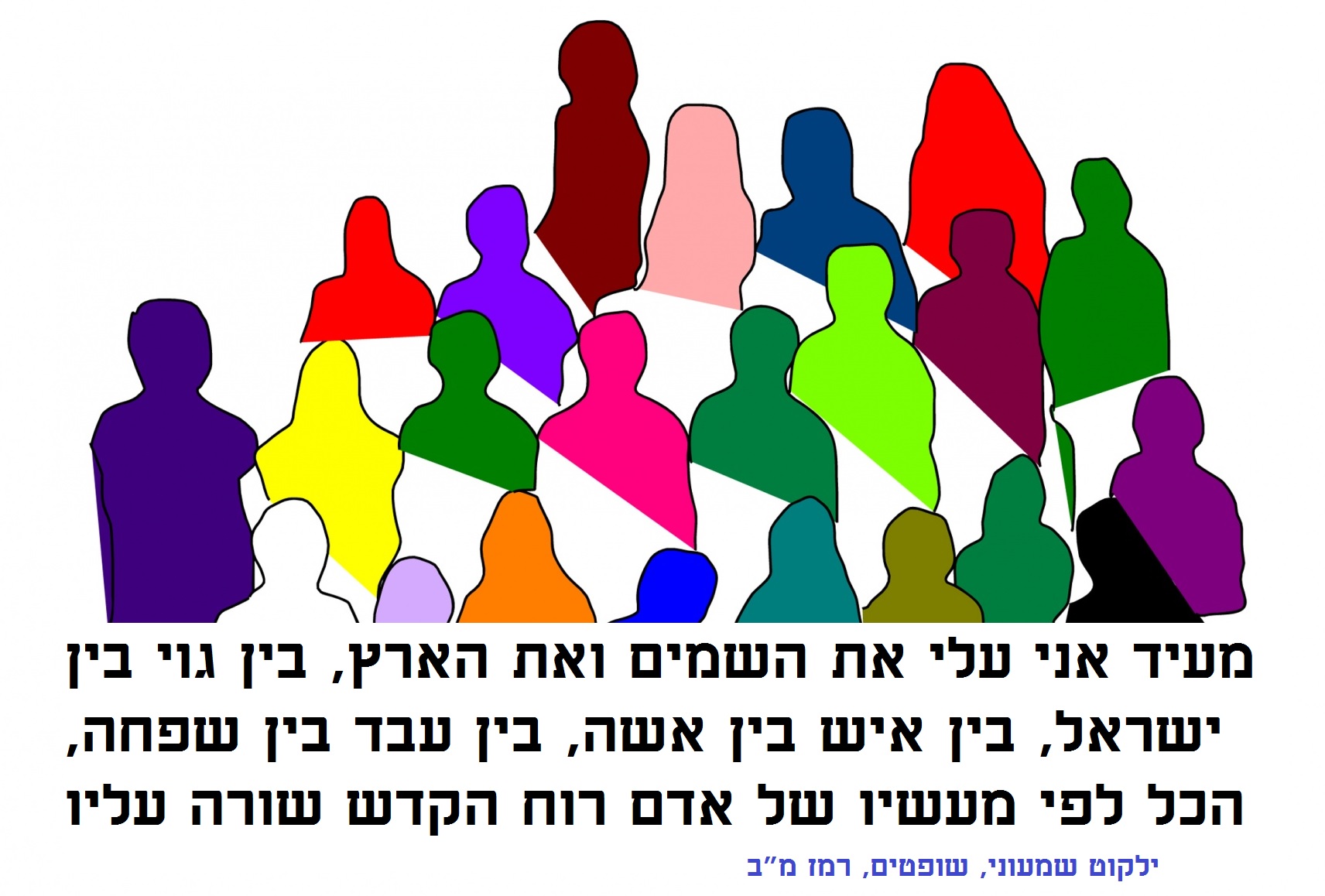
I bring Heaven and Earth to witness that the Divine Spirit may rest upon a non-Jew as well as a Jew, upon a woman as well as a man, upon a maidservant as well as a manservant. All depends on the deeds of the particular individual.
*The Arizal actually writes how Cain reincarnated in three people: Korach, Jethro, and the Egyptian taskmaster that Moses killed before fleeing Egypt. The rectification for the improper dispute between Cain and Abel was rectified in the dispute between Korach and Moses, with Moses’ victory. The rectification for the stolen wife was fulfilled by Jethro. And the rectification for Cain murdering Abel was that Moses, in return, killed the Egyptian taskmaster. Thus, all the rectifications were complete. We can see a hint in the name Cain (קין) to his three future incarnations: the ק for Korach (קרח), the י for Jethro (יתרו), and the ן for the Egyptian, whose name we don’t know but perhaps it started with a nun!


The above essay is adapted from Garments of Light, Volume Three.
Get the book here! 
The Kabbalah of Moses’ Divine Staff

In this week’s parasha, Va’era, we read about the first seven plagues to strike Egypt. These were brought about through the Staff of Moses, as were the later Splitting of the Sea, the victory over Amalek (Exodus 17) and the water brought forth from a rock. What was so special about this particular staff, and what was the source of its power?
Pirkei Avot (5:6) famously states that the Staff was one of ten special things to be created in the twilight between the Sixth Day and the first Shabbat. The Midrash (Pirkei d’Rabbi Eliezer, ch. 40) elaborates:

Rabbi Levi said: That staff which was created in the twilight was delivered to the first man out of the Garden of Eden. Adam delivered it to Enoch, and Enoch delivered it to Noah, and Noah to Shem. Shem passed it on to Abraham, Abraham to Isaac, and Isaac to Jacob, and Jacob brought it down to Egypt and passed it on to his son Joseph, and when Joseph died and they pillaged his household goods, it was placed in the palace of Pharaoh.

And Jethro was one of the magicians of Egypt, and he saw the staff and the letters which were upon it, and he desired it in his heart, and he took it and brought it, and planted it in the midst of the garden of his house. No one was able to approach it any more.

When Moses came to his house, he went into Jethro’s garden, and saw the staff and read the letters which were upon it, and he put forth his hand and took it. Jethro watched Moses, and said: “This one in the future will redeem Israel from Egypt.” Therefore, he gave him Tzipporah his daughter to be his wife…

God gave the staff to Adam, who gave it to Enoch (Hanokh)—who later transformed into the angel Metatron—and Enoch passed it on further until it got to Joseph in Egypt. The Pharaoh confiscated it after Joseph’s death. The passage then alludes to another Midrashic teaching that Jethro (Yitro), Moses’ future father-in-law, was once an advisor to Pharaoh, along with Job and Bila’am (see Sanhedrin 106a). The wicked Bila’am was the one who advised Pharaoh to drown the Israelite male-born in the Nile. While Job remained silent (for which he was so severely punished later), Jethro protested the cruel decree, and was forced to resign and flee because of it. As he fled, he grabbed the divine staff with him. Arriving in Midian, his new home, Jethro stuck the staff in the earth, at which point it seemingly gave forth deep roots and was immovable.

A related Midrash states that all the suitors that sought the hand of his wise and beautiful Tzipporah were asked to take the staff out of the earth, and should they succeed, could marry Jethro’s daughter. None were worthy. (Not surprisingly, some believe that this Midrash may have been the source for the Arthurian legend of the sword Excalibur.) Ultimately, Moses arrived and effortlessly pulled the staff out of the ground.

The passage above states that Moses was mesmerized by the letters engraved upon the staff, as was Jethro before him. What were these letters?

The 72 Names

Targum Yonatan (on Exodus 4:20) explains:

And Moses took the rod which he had brought away from the chamber of his father-in-law, made from the sapphire Throne of Glory; its weight forty se’ah; and upon it was engraved and set forth the Great and Glorious Name by which the signs should be wrought before Hashem by his hand…

God’s Ineffable Name was engraved upon the sapphire staff, which was itself carved out of God’s Heavenly Throne. The staff weighed a whopping 40 se’ah, equivalent to the minimum volume of a kosher mikveh, which is roughly 575 litres (or 575 kilograms) of water. (This might explain why none could dislodge the staff, except he who had God’s favour.)

A parallel Midrash (Shemot Rabbah, 8:3) also confirms that the staff was of pure sapphire, weighing forty se’ah, but says it was engraved with the letters that stand for the Ten Plagues, as we recite at the Passover seder: datzach, adash, b’achav (דצ״ך עד״ש באח״ב).

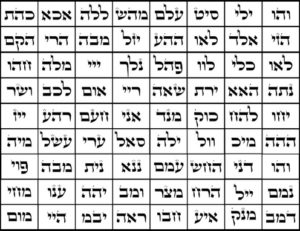
A final possibility is that the “Great and Glorious Name by which the signs should be wrought” refers to the mystical 216-letter Name of God (or 72-word Name of God). This Name is actually 72 linked names, each composed of three letters. The names are derived from the three verses Exodus 14:19-21:

And the angel of God, who went before the camp of Israel, removed and went behind them; and the pillar of cloud removed from before them, and stood behind them; and it came between the camp of Egypt and the camp of Israel; and there was the cloud and the darkness here, yet it gave light by night there; and the one came not near the other all the night. And Moses stretched out his hand over the sea; and Hashem caused the sea to go back by a strong east wind all the night, and made the sea into dry land, and the waters were divided.

The 72 Three-Letter Names of God

Each of these verses has exactly 72 letters. Hidden within them is this esoteric Name of God, the most powerful, through which came about the miracle of the Splitting of the Sea as the verses themselves describe. The Name (or 72 Names) is derived by combining the first letter of the first verse, then the last letter of the second verse, and then the first letter of the third verse. The same is done for the next letter, and so on, for all 72 Names.

Since the Splitting of the Sea and the plagues were brought about through these Names, the Midrash above may be referring not to the Ineffable Name, but to these 72 Names as being engraved upon the Staff. In fact, it may be both.

Staff from Atzilut

The 72 Names are alluded to by another mystical 72-Name of God. The Arizal taught that God’s Ineffable Name can be expanded in four ways. This refers to a practice called milui,* where the letters of each word are themselves spelled out to express the inner value and meaning of the word. God’s Ineffable Name can be expanded in these ways, with the corresponding values:

יוד הא ואו הא = 45

יוד הה וו הה = 52

יוד הי ואו הי = 63

יוד הי ויו הי = 72

The Name with the 72 value is the highest, not just numerically, but according to the sefirot, partzufim, and universes laid out in Kabbalah. The 52-Name corresponds to Malkhut and the world of Asiyah; the 45-Name to Zeir Anpin (the six “masculine” sefirot) and the world of Yetzirah; and the 63-Name to Binah and the world of Beriah. The 72-Name—which is, of course, tied to the above 72 Names of God—corresponds to the highest universe, Atzilut, the level of God’s Throne, where there is nothing but His Emanation and Pure Light. Here we come full circle, for the Midrash states that the Staff of Moses was itself carved out of God’s Throne. This otherworldly staff came down to this world from the highest Heavenly realm!

Where is the Staff Today?

What happened to Moses’ staff after his passing? Another Midrash (Yalkut Shimoni, Psalms 869) answers:

…the staff with which Jacob crossed the Jordan is identical with that which Judah gave to his daughter-in-law, Tamar. It is likewise the holy staff with which Moses worked, and with which Aaron performed wonders before Pharaoh, and with which, finally, David slew the giant Goliath. David left it to his descendants, and the Davidic kings used it as a sceptre until the destruction of the Temple, when it miraculously disappeared. When the Messiah comes it will be given to him for a sceptre as a sign of his authority over the heathens.

This incredible passage contains a great deal of novel insight. Firstly, Jacob used this divine staff to split the Jordan and allow his large family to safely cross back to Israel, just as the Israelites would later cross the Jordan in miraculous fashion under the leadership of Joshua. It seems Joshua himself, as Moses’ rightful successor, held on to the staff, and passed it down through the Judges and Prophets until it came to the hand of David. Unlike the traditional account of David slaying Goliath with the giant’s own sword (after the slingshot), the Midrash here says he slew Goliath with the staff!

The staff remained in the Davidic dynasty until the kingdom’s end with the destruction of the First Temple. At this point a lot of things mysteriously disappeared, most famously the Ark of the Covenant. It is believed that the Ark was hidden in a special chamber built for it by Solomon, who envisioned the day that the Temple would be destroyed. It is likely that the staff is there, too, alongside the Ark.

Mashiach will restore both of these, and will once again wield the sceptre of the Davidic dynasty. As the staff is forged from God’s own Heavenly Throne, it is fitting that Mashiach—God’s appointed representative, who sits on His corresponding earthly throne—should hold a piece of it. And this symbol, the Midrash concludes, will be what makes even the heathens accept Mashiach’s—and God’s—authority. Jacob prophesied this on his deathbed (Genesis 49:10), in his blessing to Judah:

The sceptre shall not depart from Judah, nor the ruler’s staff from between his feet, until the coming of Shiloh; and unto him shall the obedience of all the peoples be.

Shiloh is one of the titles for Mashiach (see Sanhedrin 98b), and his wielding of the staff will bring about the obedience of all the world’s people to God’s law. We can now also solve a classic problem with the above verse:

The verse states that the sceptre will not depart from Judah until the coming of Mashiach, as if it will depart from Judah when Mashiach comes. This makes no sense, since Mashiach is a descendent of Judah! It should have simply said that the sceptre shall never depart from Judah, from whom the messiah will come. Rather, Jacob is hinting that the Staff will one day be hidden in the land of Judah, deep below “between his feet”, and won’t budge from there for millennia until Mashiach comes and finally restores it.

May we merit to see it soon.

*Interestingly, using the same milui method, one can expand the word staff (מטה) like this: מאם טאת הה, which is 501, equivalent to דצ״ך עד״ש באח״ב, the acronym for the Ten Plagues which the Staff brought about!


The above is an excerpt from Garments of Light, Volume Two. Get the book here

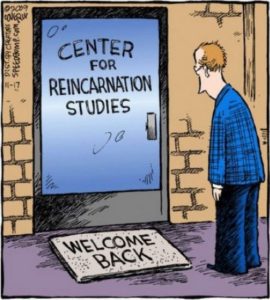
Everything You Wanted to Know About Reincarnation in Judaism

This week’s Torah portion is Mishpatim, which is concerned with the first major set of laws that the Israelites received following the Ten Commandments. While the term mishpatim literally means “ordinances” or “judgements”, the Zohar (II, 94a) suggests a very different interpretation:

“And these are the judgements which you shall set before them…” These are the rules concerning reincarnation, the judgement of souls that are sentenced according to their acts.

The Zohar goes on to interpret the laws in the Torah with regards to the mechanisms of reincarnation. For example, whereas the Torah begins by describing a Hebrew servant who is indentured for six years of labour and must then be freed in the seventh year, the Zohar interprets that this is really speaking of souls which must reincarnate in order to repair the six middot before they could be freed. (The middot are the primary character traits: chessed, kindness; gevurah, restraint; tiferet, balance and truth; netzach, persistence and faith; hod, gratitude and humility; and yesod, sexual purity.)
While the Zohar speaks at length about reincarnation, it is the Arizal who systematically laid down the rules of reincarnation and explained the Zohar in depth. His primary disciple, Rabbi Chaim Vital, recorded these teachings in a famous treatise known as Sha’ar HaGilgulim, “Gate of Reincarnation”. The following is a brief condensation of the basic rules of reincarnation that are defined in this tremendous text, answering many of the common questions people have about spiritual transmigration.

Why Do People Reincarnate?

At the start of the eighth chapter, Rabbi Vital writes:

למה מתגלגלים. דע, כי הנשמות יתגלגלו לכמה סבות, הראשונה הוא, לפי שעבר על איזו עבירה מעבירות שבתורה, ובא לתקן. הב’ הוא, לתקן איזו מצוה שחסר ממנו. השלישית היא, שבא לצורך אחרים, להדריכם ולתקנם… לפעמים יתגלגל, ליקח את בת זוגו, כי לא זכה בראשונה לקחתה

Why do people reincarnate? Know that souls reincarnate for several reasons: The first is that one transgressed one of the prohibitions in the Torah, and returns to repair it. The second is to fulfil a mitzvah that one lacks. The third is in order to assist others, to guide them, and rectify them… Sometimes one reincarnates to marry their soulmate, which they did not merit to do in a previous life.

The Ari explains that people mainly reincarnate in order to atone for sins of past lives, or to fulfil mitzvahs that they didn’t do previously. Later, in Chapter 16, we read that people who return do not have to fulfil all the mitzvahs in one lifetime, but only have to accomplish those that their souls are still lacking. Some reincarnate not for their own rectification, but to assist others. We are told elsewhere that these are usually very righteous individuals who agree to return to this world in order to help others.

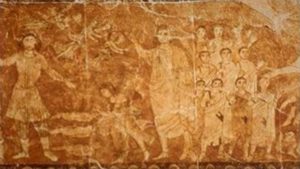
Fresco of the Resurrection of the Dead from the ancient Dura-Europos Synagogue

Some also reincarnate because they either did not marry, or married the wrong person. They must return to reunite with their true soulmate. The Arizal teaches that, unfortunately, some people are so deeply mired in kelipot, negative spiritual “husks”, that they are unable to find their soulmate in this world. These people will reunite with their other half only in Olam HaBa, the “next world” at the time of the Resurrection. With regards to finding soulmates, this is directed particularly at male souls, for it is primarily a man’s responsibility to find his soulmate.

On that note, the following chapter tells us that female souls actually reincarnate very rarely. To begin with, female souls are more refined than male ones, and are unlikely to require more rectifications. What does happen more commonly is that male souls are reincarnated into female bodies! This opens up a number of fascinating scenarios which Rabbi Chaim Vital describes.

What Do People Reincarnate Into?

In Chapter 22, we read that people can reincarnate not only into human bodies, but also animals, vegetation, and even inanimate matter. For example, a person who feeds others non-kosher food reincarnates as a tree; one who sheds blood reincarnates into water; those who transgress various sexual prohibitions reincarnate into bats, rabbits, and other animals; while proud people and those who talk too much reincarnate into bees. (We are told that this is what happened to the judge Deborah who, despite her greatness and wisdom, had a bit of pride and was required to reincarnate into a bee, hence her name devorah, which literally means “bee”!)

It is important to mention, though, that an entire human soul does not fully reincarnate into another organism. Rather, souls are complex entities made up of many different interacting sparks. It is only those sparks that require rectification that return to this world (Chapter 14). Interestingly, the Arizal teaches that when two people really dislike each other, and are constantly in conflict with one another, this is often because the two are sharing sparks from one soul!

How Many Times May One Reincarnate?

Sha’ar HaGilgulim records that a person can reincarnate thousands of times—but only on the condition that they improve at least a little bit in each incarnation. If they fail to improve, they can only reincarnate a maximum of three times. After three strikes, that particular spark is sent to Gehinnom (loosely translated as “hell”) where it will be purified. However, the souls of those who regularly learn Torah are never sent to Gehinnom, and always merit reincarnation. This is one of the incredible protective powers of regular Torah study.

In multiple places, the Arizal teaches about the reincarnations of Abel, the son of Adam. Abel (הבל) had a good side and a bad one. The good side was represented by the letter Hei (ה) of his name, and the bad by the Beit and Lamed (בל). In order to be rectified, the bad part reincarnated in Laban (לבן), the wicked father-in-law of Jacob. Laban didn’t do much better, so he was reincarnated in the gentile prophet Bilaam (בלעם). He, too, was an ungodly person, so the Beit-Lamed soul was reincarnated for the third time in Naval (נבל), the ungrateful man who rejected David. Naval was strike three, and that Beit-Lamed soul no longer returned in the same way in a human reincarnation. It did suffer a punishment at some point in the form of a stone, which is why we read in the Tanakh (I Samuel 25:37) that when Naval died, “he became a stone” secretly alluding to a reincarnation in stone!

We see from the above how a person’s name may offer tremendous hints as to their soul sparks, previous lives, tests, challenges, and character traits. When we read about the above individuals in the Tanakh, we see how similar they were. All three were very wealthy, famous, and participated in divination and sorcery. All were cunning, greedy, and deceitful individuals. The Arizal explains in detail what rectifications each was supposed to do, and how one life affected the next, weaving together these three seemingly unrelated Biblical narratives that span nearly a thousand years into one beautiful tapestry.

Which Body Will A Person Have at the End?

Perhaps the most famous question: if a soul has so many different bodies over so many different lifetimes, which body will that soul inhabit in the afterlife, or in the world of Resurrection? Rabbi Vital writes:

וכן הענין בכל נשמה ונשמה, וכאשר יהיה זמן התחיה, כל גוף וגוף יקח חלקו של נשמתו, כפי חלק הזמן שלו באיזו מדרגה היתה

And with each and every soul, when the time of the Resurrection comes, each and every body will take its corresponding soul, according to the part that it had at that particular time.

Thus, each part of the soul will have its own body, and all reincarnations will exist simultaneously as distinct individuals in Olam HaBa!

Breaking Free from Materialism

In Chapter 23, Rabbi Vital suggests that the most important thing to take from all of this is to live a meaningful, spiritual life. When a person is mired in materialism, and cares only for their physical aspects, they become so attached to their bodies that they cannot exist without one. And so, when that person’s body dies their soul is in complete disarray; frightened, pained, and unable to ascend onwards. Angels must come and quickly place the soul in a new body. As such, this person can never free themselves from endless reincarnations into this imperfect, difficult world.

However, those who in their lifetimes tap into their souls, and are comfortable with their spiritual side, are able to simply take off their dead bodies like an old garment, and move on. For such people, their wonderful portion in Olam HaBa is not too far away.


The above is an excerpt from Garments of Light: 70 Illuminating Essays on the Weekly Torah Portion and Holidays. Click here to get the book!